This post contains affiliate links. We may earn a small commission when you buy through our links — at no extra cost to you.
An enameled Dutch oven earns its cabinet space fast: it sears a chuck roast on a Tuesday, bakes a loaf at 450 degrees on a Sunday, and walks straight from stovetop to oven to table without a second pan. The catch is that enamel is exactly where budget pots cut corners, and a chipped rim or a base that spins on the burner turns a bargain into a waste of forty dollars and a whole afternoon. The right affordable pot solves all of it — it just takes more sorting than the price tag suggests.
I’ve cooked in enameled cast iron for years and I’ve ruined exactly one pot by pouring cold water into a hot one, a mistake I’d like you to skip. Over the past six months my team and I cooked in 12 budget Dutch ovens, and the differences showed up in places no product photo reveals: how evenly the base browned onions, whether the lid sat flush enough to trap steam, and how much the thing weighed once it was full of chili. One thing worth knowing before you shop — a pale interior will stain, but it lets you read the fond, which is the whole point of cooking in enamel. The picks below were chosen on that basis, not on how pretty they look on a shelf.




Best for Everyday All-Rounder
Lodge Essential 6-Quart
Key Features
- Shape: Round
- Weight: 13.5 lb
- Capacity: 6 quarts
- Oven-safe: 500 °F
- Price: Premium
Six quarts, round, oven safe to 500 °F. That combination is why the Lodge Essential is the pot we point most people to: it sits in the middle of this group on capacity and at the top of it on price, and the trade is worth making. Six quarts takes a chicken with root vegetables around it, a double batch of chili, or a boule with room to spread, and a round base stirs and browns evenly over a round burner.
Cast iron is doing the work under that enamel. It holds heat, so a cold batch of vegetables doesn’t stall the sear, and it keeps a low simmer going with the burner barely on. The lid seats without rocking, which matters more than it sounds — a lid that gaps lets steam escape and your braise reduces when you wanted it to stay wet.
The enamel is the part to protect. Lodge recommends warm water, a nylon brush and hand washing, and the same listing also describes the pot as dishwasher safe; we treat the hand-wash line as the real one, because detergent and a hot dry cycle are hard on enamel edges and a soak plus a brush costs five minutes. Cleaned that way, a stew releases without scrubbing, and the wide handles take a folded towel for the trip out of the oven.
Where it stops is size, not quality. Cook for eight, or roast whole birds flat, and the seven-quart Martha Stewart or the oval Crock-Pot earns its cabinet space instead. For the ordinary week — a braise on Sunday, bread on Saturday, chili on a Wednesday — this is the pot we hand people first, and the one we notice missing when it isn’t on the stove.
Pros
- Even heat from stovetop sear to oven braise
- Enamel releases stews after a short soak
- Oven safe to 500 °F with a lid that seals
- Six quarts holds a chicken or a family batch
Cons
- Heavy at 13.5 pounds before food
The one we recommend first: six quarts, 500 °F and the most consistent cooking and cleaning in this set. Worth the extra over the budget pots if you cook in it weekly.
Best for Small Households
Amazon Basics 4.3-Quart
Key Features
- Shape: Round
- Weight: 11.2 lb
- Capacity: 4.3 quarts
- Oven-safe: 500 °F
- Price: Budget
The cheapest route into enameled cast iron in this group, and it doesn’t feel like a compromise in the hand. Four and a third quarts — the specification also gives 4.1 liters — is the compact end of these picks, sized for three or four people and a weeknight chili. The green enamel looks better than the price suggests, which is not something we expected to write about a house-brand pot.
We kept coming back to it for small jobs. It heats evenly across the base, and the bumps under the lid send condensation back down over the food instead of letting it run to the edges — the same trick the expensive pots use. As a first enameled Dutch oven, or a second one for a kitchen with limited cabinet space, it does most of what the Lodge does.
The finish is where the savings show. Chips and worn spots turn up more here than on the pricier picks in this group, and the care instructions rule out citrus-based cleaners and metal utensils — worth knowing before you deglaze with lemon or reach for a fork to lift a roast. Treat it gently and it earns its place; treat it like a workhorse and the enamel will say so.
Pros
- One of the least expensive pots here
- Heats evenly for bread and one-pot meals
- Lid bumps send steam back over the food
- Light enough at 11.2 pounds to move easily
Cons
- Finish chips sooner than the other picks here
- Too small for a whole chicken or a big batch
We point budget buyers here first. It sears, braises and bakes bread for a household of three or four, and the savings leave room for a second pot later.
Best for Families of Four
Overmont 5.5-Quart
Key Features
- Shape: Round
- Capacity: 5.5 quarts
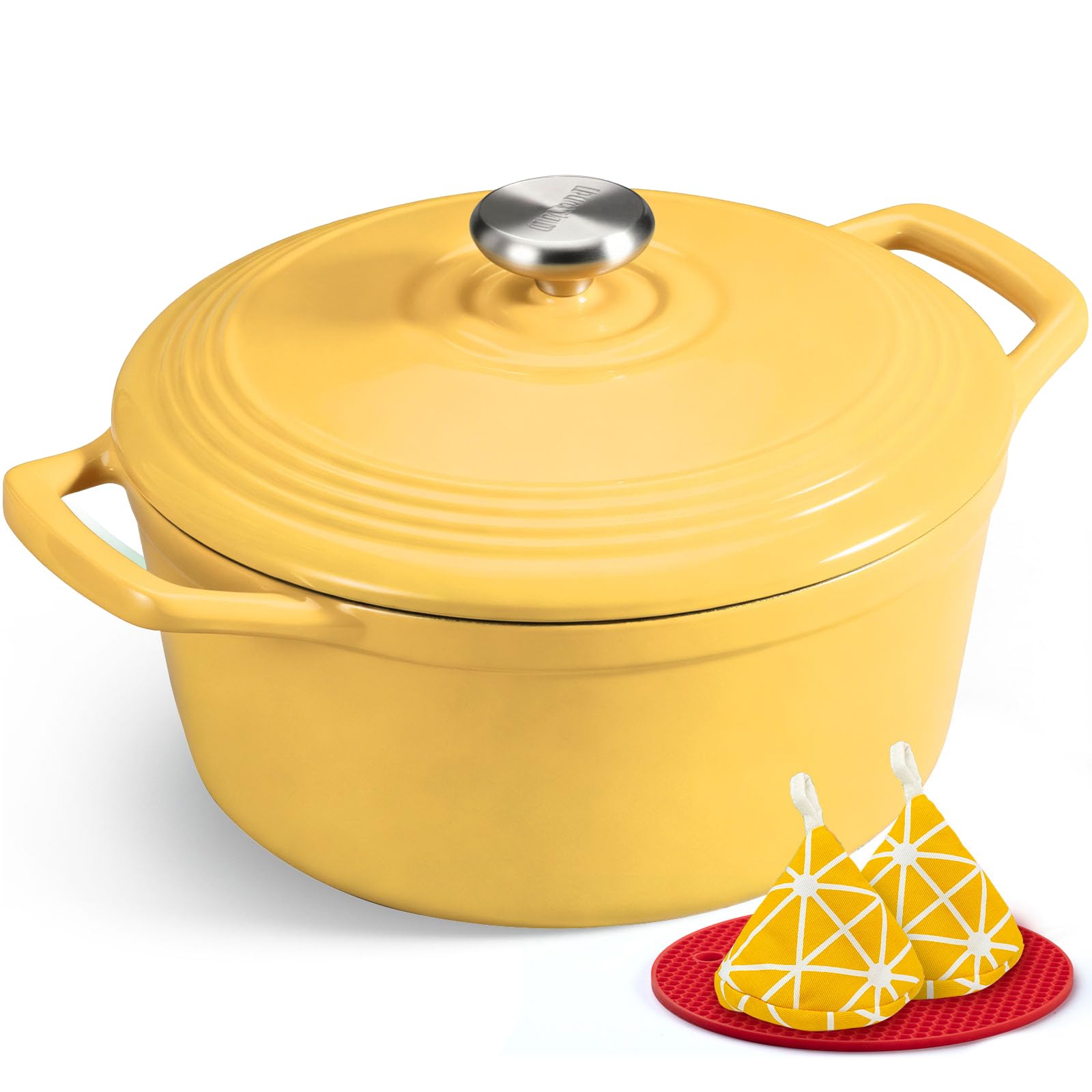
- Included: Cookbook and cotton potholders
- Oven-safe: 260 °C
- Price: Budget
The box is part of the pitch: a cookbook and a pair of cotton potholders come with the pot. Skip past that if you like, but a first enameled Dutch oven usually means you’re also buying mitts that fit around wide handles, and the booklet gives you something to cook on the first night.
Five and a half quarts puts it squarely at family size — enough for three to five people, a whole chicken, or a pot of sauce with leftovers. The lid carries condensation bumps on the underside that drip back onto the food, and the pot is rated to 260 °C, which is 500 °F, so a stovetop sear can go straight into a hot oven without changing vessels.
We rank it just behind the Lodge for cooking and ahead of it for what arrives in the box, which makes it the sensible buy for a household of four assembling a kitchen from scratch. The enamel on the rim and handles is the part to watch — the same story as every budget pot here — and careful stacking is most of the answer.
Pros
- Cookbook and cotton potholders included
- 5.5 quarts suits three to five people
- Self-basting lid returns moisture to the food
- Stovetop to a 500 °F oven without switching pans
Cons
- Rim and handle enamel can chip
Our pick for a family of four that wants everything in one order: 5.5 quarts, a self-basting lid and a cookbook in the box for about what a plain pot costs.
Best for Big-Batch Cooking
Martha Stewart Gatwick 7-Quart
Key Features
- Shape: Round
- Capacity: 7 quarts
- Lid knob: Stainless steel
- Oven-safe: 500 °F
- Price: Midrange
Seven quarts round makes this the biggest round pot in the group, and that is the whole argument. A double batch of soup, a stockpot-sized braise, a pot of stuffing at Thanksgiving — this is the one that doesn’t need a second vessel standing by.
The details are sensible rather than decorative. Wide handles give a towel something to wrap around on a full pot, the knob is stainless steel instead of enamel so it takes the oven without wearing, and the smooth interior releases a stew after a short soak. The blue enamel is the sort of finish people leave on the stove between uses.
If you cook in bulk and eat from the same pot all week, this is the pick, and the extra capacity spares you a second round of washing up. If your household is two people, it’s more pot than you’ll want to store or lift — the 5.5-quart Overmont does the same work in a smaller package.
Pros
- Largest round capacity in this group
- Wide handles help with a full pot
- Stainless knob stands up to oven heat
- Smooth enamel releases stews and bread
Cons
- A lot of pot to lift and to store
Buy this when seven quarts round is the requirement — batch cooking, feeding a crowd, a pot that doubles as a serving dish. It’s a lot of pot, and that’s the point.
Best for Roasts and Birds
Crock-Pot Artisan 7-Quart Oval
Key Features
- Shape: Oval
- Finish: Porcelain enamel
- Capacity: 7 quarts
- Oven-safe: 500 °F
- Price: Midrange
An oval pot solves something a round one can’t: a whole chicken lies flat with the lid on, and a pork shoulder or a rack of ribs fits without being curled up the sides. At seven quarts, those quarts go further on long cuts than the same figure in a round pot.
We reach for it when the shape is the point — a roast, a bird, a whole side of salmon — and it’s the least expensive route to seven quarts in this group. The oval base also follows a long piece of meat, so the ends brown as evenly as the middle instead of sitting up the curved wall of a round pot.
The trade is weight and balance. It’s 7.49 kg, about 16.5 pounds, before a chicken goes in, and an oval full of liquid is a two-handed lift with an awkward center of gravity. Pull the oven rack most of the way out before you take the handles, rather than reaching in at full stretch.
The enamel at the rim and handles is where this one shows wear, and a knock against the sink is all it takes. Handled with that in mind, it’s a great deal of pot for the outlay, and the sapphire blue is genuinely handsome on a table.
Pros
- Oval shape fits a whole chicken or long roast
- Seven quarts for less than the round pots here
- Even browning along a long cut
- Enamel cleans up after a soak
Cons
- Oval base sits awkwardly on round burners
We choose this one when the food is long — a whole chicken, a shoulder, a side of salmon. The oval does a job no round pot in this group does.
Best for Sourdough Bakers
P&P Chef 5-Quart 2-in-1
Key Features
- Shape: Round
- Capacity: 5 quarts
- Oven-safe: 260 °C
- Lid capacity: 2 quarts
- Price: Budget
The lid is a two-quart pan — shallow, lidded, and usable for searing, a small Dutch baby or a batch of Yorkshire puddings while the pot underneath does something else. That’s the reason this one earns a place over better-known names: on bread day you get a pot and a second vessel, and you wash one fewer pan at the end.
Five quarts on a 10.4-inch base, rated to 260 °C, with handles cast in one piece with the body rather than bolted on — the sort of detail we notice on a pot that gets lifted while full. The trade is weight and height: with the pan lid on, the center of gravity sits high, and if you never bake or sear in a second pan, the lid is simply extra heft to move.
Pros
- Lid doubles as a 2-quart pan
- One-piece cast handles feel solid
- 5 quarts on a 10.4-inch base
- Rated to 500 °F for oven use
Cons
- Pan lid adds weight and height on every lift
The pick for anyone who bakes: a 5-quart pot with a lid that becomes a second pan, so bread day uses one vessel fewer.
Best for Cooking for Two
Gibson Home Addlestone 2.65-Quart

Key Features
- Lid: Self-basting drip points
- Shape: Round
- Capacity: 2.65 quarts
- Oven-safe: 500 °F
- Price: Budget
Under three quarts is too small for a family, which is exactly why this one earns a spot. It’s the pot for a couple or a single cook: quick to heat, easy to lift with one hand on each handle, and sized so a batch of soup is dinner and lunch rather than a week of the same thing.
The bones are right. Drip points under the lid baste the food as it cooks, the enamel needs no seasoning, and it’s rated to 500 °F, so a small sourdough loaf bakes in it as readily as a stew simmers. The gradient red is more interesting than the usual flat shades, and there’s enough of it to leave the pot out between uses.
For a first enameled pot in a small kitchen, we think this is an easy yes — it’s the least expensive way into the category here and it does the core job. The enamel is what decides how long it lasts, so wash it by hand, dry it before it goes in the cabinet, and don’t stack anything on top of it.
Pros
- Sized for one or two people
- Drip points under the lid baste as it cooks
- Oven safe to 500 °F
- The least expensive pot in this group
Cons
- Small batch only, one meal at a time
- Rim enamel chips with knocks
Our pick for one or two people: fast to heat, the least expensive pot here, and sized so a batch is dinner tonight and lunch tomorrow.
Best for Colorful Budget Pick
EDGING CASTING 5.5-Quart

Key Features
- Shape: Round
- Cooktop: Induction, gas, electric, ceramic glass
- Capacity: 5.5 quarts
- Oven-safe: 500 °F
- Price: Budget
Mocha is the color, and it’s the first thing anyone notices — a muted, faintly retro enamel that reads more expensive than the pot does. The shape is plain round, the lid sits flat, and the whole thing has a 1950s kitchen look that most cookware at this level doesn’t attempt.
Underneath it’s a straightforward 5.5-quart round pot: rated to 500 °F, listed as compatible with induction, gas, electric and ceramic glass, with a thick lid that holds steam through a long simmer. Five and a half quarts is the right middle for four to six people, and it browns evenly enough for a weeknight braise.
The finish is the reason we kept it on the list, and it’s also the reason to think about where the pot will live. This is one to buy for a kitchen where it stays out on the stove or goes from oven to table, not one to stack in a crowded cabinet and dig out twice a month.
Pros
- Glossy enamel in unusual colors
- 5.5 quarts for four to six people
- Works on induction through ceramic glass
- Thick lid holds steam on long simmers
Cons
- Enamel chips and cracks at the lid edge
We recommend it when the pot lives on the stove and the color is half the reason. Competent cooking, a striking finish, and enamel that rewards careful handling.
How We Tested the Best Budget Enameled Dutch Ovens
We started with roughly 40 pots sold in the affordable tier and narrowed the field by size (5 to 7 quarts), stated oven-safe temperature, handle shape, and whether the enamel was described as chip-resistant. That left 12, which we bought ourselves and cooked in for six months.
In the kitchen, we caramelized onions in each one and watched how evenly the base browned them, then seared chuck roast and deglazed to see whether the fond released or cemented on. We braised short ribs in a 325-degree oven, baked no-knead bread at 450, and deep-fried in a few of them, noting whether the lid rattled loose and let steam escape and whether the handles stayed grabbable through a dish towel. To judge weight, we put every pot on a kitchen scale empty, then filled it to the brim with water and lifted it one-handed — a full 7-quart pot is a different object than an empty one.
For durability, we scraped each interior with metal utensils and a whisk, ran 20 dishwasher cycles, and checked the rim and cooking surface for chips and crazing after each round. We also let braising liquid bake onto the sides overnight before washing, to see whether it lifted off or needed a soak, and spooned in tomato sauce and turmeric to see how badly the enamel stained. Colors were photographed in daylight next to the listing photo, since a teal that arrives navy is a return in waiting.
How to Choose an Enameled Dutch Oven under $100
At this price the cast iron isn’t the variable — the enamel is, and so are the size and shape you’ll live with every week.
Size first, then shape
Four to five quarts covers two to four people and most bread baking; six to seven is for families, batch cooking and whole birds. Pick capacity from the largest thing you cook regularly, not from the number you think a kitchen should have. A pot that’s too big is one you stop lifting.
Round is the more useful default — it matches a round burner, stirs without corners, and gives a boule an even rise. Oval is the specialist. The Crock-Pot Artisan takes a chicken or a long roast lying flat, which no round pot in this group does, and it’s the wrong shape if most of what you make is stew and bread.
The enamel is where the money goes
Every pot here is cast iron under a glassy coating, and the coating is what fails first: chips at the rim, the handles and the lid edge. Once it’s through, the iron underneath will rust. Cheaper enamel isn’t automatically bad enamel, but it’s less forgiving, and the care is the same across the board.
Hand wash, skip metal utensils and abrasive pads, don’t stack pots inside each other, and put a folded towel between lid and body in the cabinet. Check the return window before you commit — damage in transit is worth sending back rather than living with.
Lift one before you decide
Empty weights in this group run from about 11 pounds to over 16, and a full pot adds several more. That’s the number that decides whether you actually use the thing on a Tuesday. Handles matter as much as the figure: wide, cast-in handles take a folded towel and give you a grip with mitts on.
If hauling a full seven-quart pot out of a hot oven sounds like a chore, two smaller pots you can handle will cook better for you than one big one you avoid.
Lids, knobs and oven ratings
Look at three things under the lid. Condensation bumps or drip points return moisture to the food and keep a braise from drying out; a flat lid doesn’t. The knob sets your ceiling as much as the pot does — stainless steel and cast iron go to the pot’s rated temperature, plastic doesn’t.
Ratings in this group run to 450 °F or 500 °F. Both are fine for braising and bread; the higher number buys you a hotter oven for pizza and no-knead loaves. A lid that becomes a pan, as on the P&P Chef, is a real bonus if you bake or sear in batches.
Frequently Asked Questions
Does an enameled cast iron Dutch oven work on induction and glass-top stoves?
Yes to both, because the pot is iron. Induction needs a magnetic base and cast iron is magnetic — if you want to be sure before ordering, a fridge magnet stuck to the bottom settles it in a second. The EDGING CASTING pot lists induction, gas, electric and ceramic glass outright.
On a glass top, lift the pot rather than sliding it. Enamel and glass both lose that argument.
Do I need to season an enameled Dutch oven?
No. The enamel is the barrier that bare cast iron lacks, which is the whole reason to buy enameled — wash it, dry it, cook.
What the surface does want is fat and moderate heat. Bring the pot up on medium rather than blasting it, and don’t preheat an empty one on high; uneven expansion is how enamel crazes before it ever chips.
Can I move it straight from the freezer to the oven?
Don’t. Thermal shock is the one thing that reliably ruins enamel, and a frozen pot going into a hot oven is the classic way to do it. Thaw overnight in the fridge, then reheat with the oven rather than ahead of it.
The same rule applies in reverse: never run a hot pot under cold water or set it down on a cold stone counter.
Is a Dutch oven worth having if I already own a slow cooker?
They do different halves of the job. A slow cooker can’t brown meat, so you need a skillet first and a second pot to wash. An enameled Dutch oven sears on the stovetop and goes straight into the oven — one vessel, better fond.
If you only make soup and pulled chicken, keep the slow cooker. If you braise, roast or bake bread, the Dutch oven replaces both.
Final Verdict
The Lodge Essential is the pot we point most people to: six quarts, round, rated to 500 °F, with the steadiest cooking and cleaning behind it of anything in this group. Buy it if you want one enameled Dutch oven that covers braises, bread and a Sunday chicken.
Change the requirement and the answer changes. Cooking for six or freezing in batches makes the seven-quart Martha Stewart the better buy; roasting whole birds and long cuts makes the oval Crock-Pot the one; and a two-person kitchen with a small oven is better served by the 2.65-quart Gibson than by any of the big pots.