This post contains affiliate links. We may earn a small commission when you buy through our links — at no extra cost to you.
A fried egg should slide out of the pan with a nudge, not a chisel. That’s the promise of a good egg pan, and it’s also the first thing to fail: nonstick coatings wear out, thin pans scorch the edges before the whites set, and a handle that’s too short tips the whole breakfast. The right pan fixes all of that. It heats evenly, gives you enough room for two eggs and a spatula, and wipes clean without soaking.
Over the past six months, my team and I have cooked through 12 frying pans — ceramic, classic nonstick, and a couple of carbon steel — making fried eggs, omelets, and scrambles on repeat. The biggest surprise was how much heat distribution mattered: a thin base browned the edges before the center was set, no matter how low I turned the burner. The picks below are the ones that made eggs feel effortless, and they held up without scratching, sticking, or rusting at the rivets.



Best for Everyday Eggs
Tramontina Professional 8-Inch
Key Features
- Coating: Reinforced nonstick
- Diameter: 8 inches
- Stovetop: Gas, electric, ceramic glass (not induction)
- Oven safe: 400 °F
- Price: Midrange
Restaurant supply houses sell this pan by the dozen, and the construction explains why: heavy-gauge aluminum, a reinforced nonstick layer, and a riveted handle with a silicone sleeve that doesn’t flex when you tilt the pan to gather an omelet. Egg duty is where that shows up. The 8-inch surface heats evenly enough that a two-egg omelet sets at roughly the same rate from the middle to the rim, which is the difference between folding a sheet and chasing a rubbery edge around the pan.
Of everything here, this is the pan we reach for when the order is eggs and nothing else. The release is the confident, slippery kind rather than the delicate sheen a new ceramic pan starts with, and it takes a silicone spatula and a rinse without complaint. We also appreciate the 400 °F oven rating: slide the sleeve off and a frittata or a pan of shakshuka can finish in the oven instead of on the burner.
Two things to know before you commit. The base is not magnetic, so this pan is out on an induction cooktop. And on glass or ceramic ranges it can leave marks if you slide it across the surface — lift it instead of shoving it and the cooktop stays clean. The silicone sleeve also puts a little weight behind the rivets, so the empty pan wants a steady hand when you set it down on a burner.
What it does better than anything else here is repeat. Commercial kitchens replace pans when the coating gives out, not when the handle loosens, and this one is built for that cycle: NSF certified, with a lifetime warranty behind it. If eggs are a daily habit and you want a pan designed for that repetition rather than a delicate one, start here.
Pros
- Even heat across the whole 8-inch surface
- Confident release that takes daily cooking
- Oven safe to 400 °F with the sleeve off
- NSF certified with a lifetime warranty
Cons
- Not compatible with induction cooktops
- Can scuff glass and ceramic cooktops
For daily eggs we take the Tramontina: clean release, even heat across its 8-inch surface, and construction built for repetition. Not the pan if you cook on induction.
Best for Budget and Induction
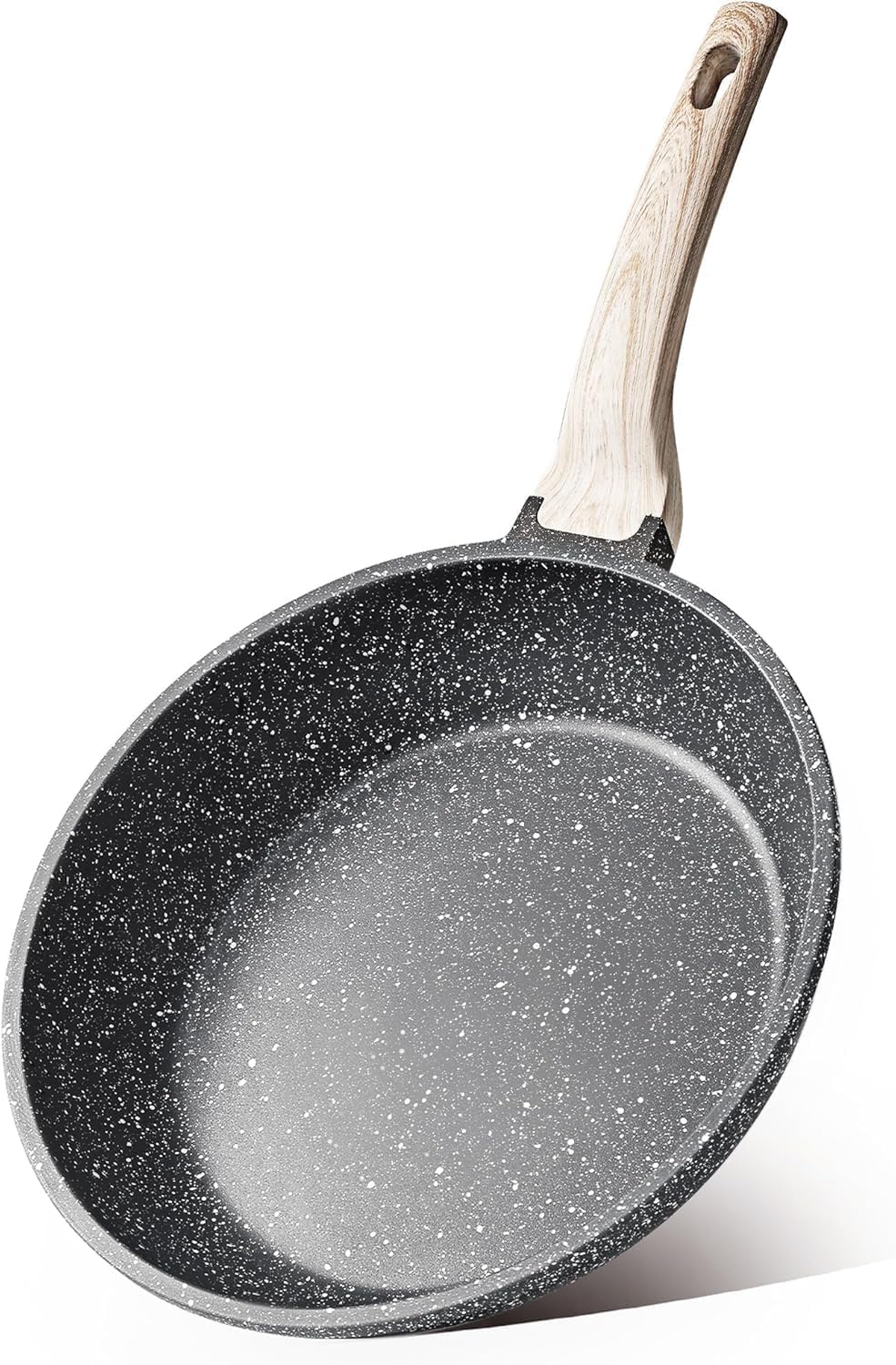
CAROTE Classic Granite 8-Inch
Key Features
- Coating: Nonstick granite
- Diameter: 8 inches
- Stovetop: Gas, induction and all cooktops
- Max temperature: 482 °F
- Price: Budget
This is the least expensive pan in the group, and it’s the one we point to when someone wants an egg pan without a decision attached. The granite-flecked coating lets a fried egg slide with a nudge of the wrist — the eggs-slide-right-out promise holds up in this pan — and the 8-inch surface is the right size for two eggs or a folded omelet. On value, nothing else here comes close.
It’s also the most flexible pan here on stovetop duty. The magnetic base works on induction, gas, coil and ceramic, which the Tramontina can’t claim, and the pan is light enough — about a pound and a quarter — to lift and tilt one-handed while you fold. The Bakelite handle stays cool through a scramble, and a paper towel handles most of the cleanup.
The trade-off is coating life, and heat is what shortens it. This pan’s care instructions say to avoid dry heating, and it’s at its best at medium, where an egg releases as cleanly in month twelve as in week one. Use it for eggs, pancakes and gentle sautés rather than high-heat searing and the release stays. The care sheet also says no dishwasher, which is worth knowing even though a rinse usually does the job.
Pros
- Eggs release with barely any oil
- Works on induction, gas and electric
- Light enough to lift and fold one-handed
Cons
- Coating wear is the recurring weak point
We send budget buyers to the CAROTE: eggs slide off, it works on induction, and it costs the least of any pan here. Keep the heat at medium and it earns its keep.
Best for Two-Pan Cooking
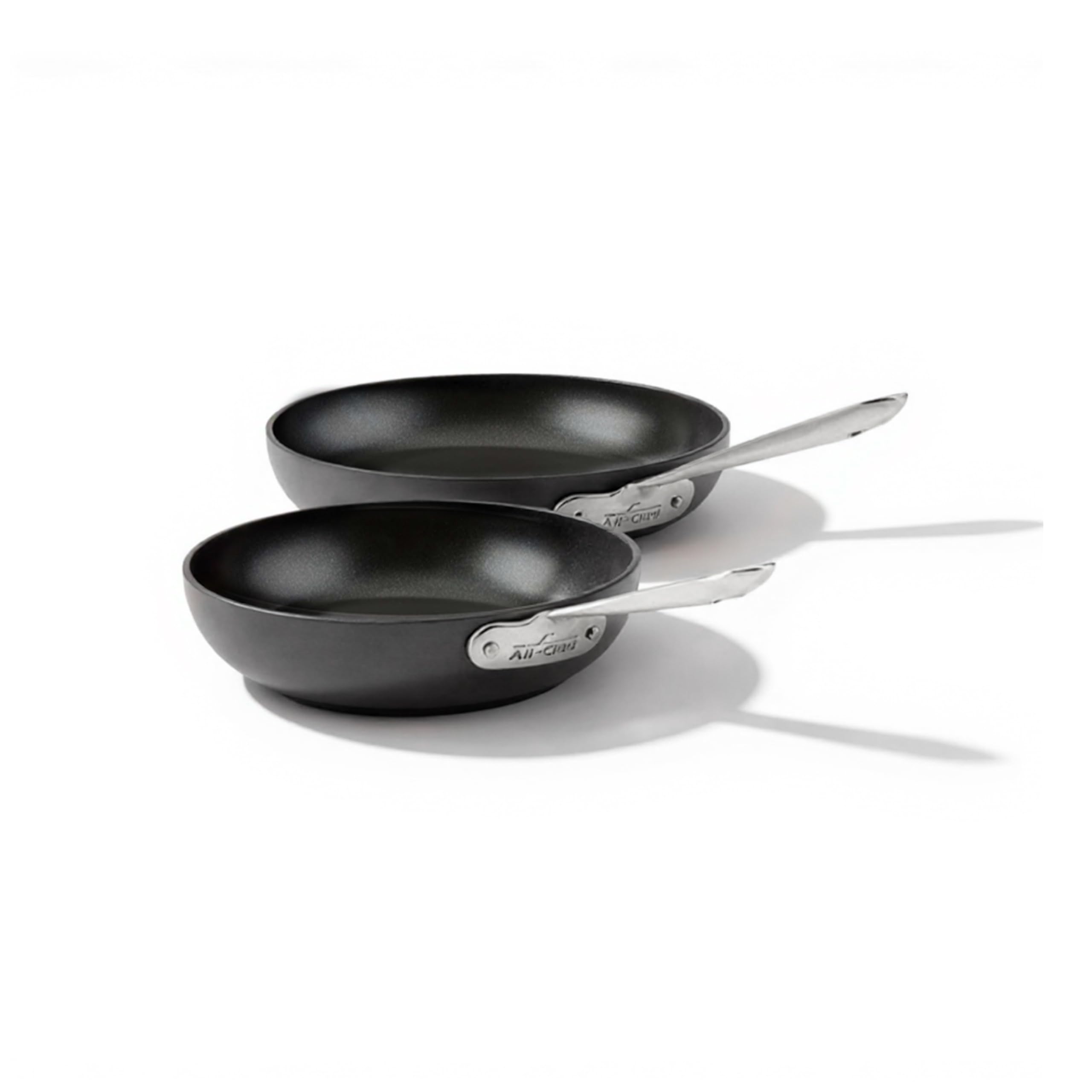
All-Clad HA1 8 & 10-Inch Set
Key Features
- Stovetop: All, including induction
- Oven safe: 500 °F
- Pan sizes: 8 and 10 inches
- Set includes: 2 fry pans
- Price: Premium
The 10-inch pan is the reason to buy this set rather than one of the single 8-inch pans here. A three-egg omelet, a frittata for two, or eggs and toast in the same pan all want more surface, and the 10-inch gives it without the pan turning into a two-handed job. The 8-inch is the everyday egg pan; the 10-inch is what you use when someone else is eating too.
Hard-anodized aluminum over a stainless base is serious construction. Both pans heat evenly across the base, resist warping, and work on induction as well as gas and electric. The nonstick is the smooth, hard sort that releases eggs cleanly and wipes out with a paper towel, and the pans are rated to 500 °F, matching the best oven rating in this group.
Where we hesitate is the handles. The pair weighs about five pounds, the 8-inch is noticeably heavier in the hand than the Tramontina, and the stainless handles are shaped for a full grip rather than the pinch most egg work uses. We noticed it most when flipping: the pan does the work, not the wrist, which is either reassuring or tiring depending on how many eggs you’re cooking. For a pan that goes from stove to table, neither matters much.
Dishwasher safe on paper, hand washed in practice — that’s how any nonstick survives. If you cook on induction, want a 10-inch pan in the same box, and don’t mind lifting something substantial, this is the set. It’s the most expensive way to buy an egg pan here, and the only one that also covers dinner.
Pros
- An 8- and 10-inch pan in one box
- Induction-ready and oven safe to 500 °F
- Even heat from a warp-resistant base
Cons
- Heavy pair at about five pounds
- Handles shaped for a full grip, not a pinch
Our pick for a two-pan kitchen: induction-ready, oven safe to 500 °F, and the 10-inch is the more useful half. Heavy, and the handles suit a full grip.
Best for Outfitting a Kitchen
Utopia Kitchen 3-Piece Set
Key Features
- Handle: Bakelite
- Coating: Nonstick
- Pan sizes: 8, 9.5 and 11 inches
- Set includes: 3 frying pans
- Price: Midrange
Three pans arrive, and one of them is going to become the egg pan. The 8-inch takes a single fried egg or a two-egg scramble, the 9.5-inch handles an omelet for two, and the 11-inch is for a frittata or a batch of pancakes. In our kitchen the 8-inch is the one on the burner at breakfast; the other two earn their cupboard space at dinner.
The nonstick is genuinely nonstick. Eggs lift cleanly, butter spreads across the base instead of beading at the edge, and cleanup is a rinse and a wipe. The three sizes cover the gaps most kitchens have — a small pan for one, a mid pan for two, a big one for the family — and the riveted Bakelite handles stay cool on the stovetop.
The coating is the part that gives out. Some of these sets cook for years; others start peeling at the rim, and the rim plus the spot under the rivets is where it shows first. Wash by hand with a soft sponge, keep the heat at medium, and don’t stack the pans without something between them.
Induction is the loose end. The set is described as having an induction base in some places and as electric-only in others, so if you have an induction hob, put a magnet on the base before the return window closes — or choose a pan whose induction support is unambiguous, like the CAROTE. For everyone else this is the most practical way to buy cookware here: three pans, three sizes, one modest outlay.
Pros
- Three useful sizes for a modest outlay
- Nonstick release on eggs and pancakes
- Cool, riveted Bakelite handles
Cons
- Coating can peel at the rim
- Induction support is uncertain
The set we hand a first-kitchen cook: the 8-inch releases eggs cleanly and the two larger pans cover dinner. Check induction support before you rely on it.
Best for Bigger Omelets
SENSARTE Swiss Granite 9.5-Inch
Key Features
- Coating: Swiss ILAG nonstick
- Diameter: 9.5 inches
- Stovetop: Induction, gas, electric
- Max temperature: 302 °F
- Price: Budget
Nine and a half inches across is the number that matters here. It’s wide enough for a three-egg omelet or two fried eggs with room to spare, and flat enough across the base that eggs set evenly rather than pooling at one edge. If your current 8-inch pan forces you to fold an omelet in thirds because it won’t fit otherwise, this is the size to move to.
The Swiss ILAG coating is a granite-style nonstick, and it does what that coating should: eggs slide with a little butter, nothing welds itself to the rim, and cleanup is a paper towel. The cast-aluminum body feels more substantial than the price suggests, and the woodgrain Bakelite handle stays cool through a full breakfast.
Two limits. The pan is rated to 302 °F, which makes it stovetop only — a frittata finished under the broiler needs a different pan. And the handle is the part to watch: the joint is where these can work loose over months of use, so check it’s tight when the pan arrives and give the screw a turn if it starts to wobble.
Neither limit touches straight egg duty. For omelets, scrambles and fried eggs on a stovetop, the extra inch does more for your breakfast than any feature on this page, and the pan is light enough at a pound and a half to handle while you fold.
Pros
- 9.5-inch surface for bigger omelets
- Granite nonstick that releases eggs cleanly
- Cool woodgrain handle through a full cook
Cons
- Oven use capped at 302 °F
- Handle joint can work loose
For omelets for two and any egg that needs room, our pick is the 9.5-inch SENSARTE: the wide, flat base sets eggs evenly and the coating releases cleanly. Keep it off the broiler.
Best for Pfas-Free Cooking
OXO Enhanced 8-Inch
Key Features
- Coating: Diamond-reinforced ceramic
- Diameter: 8 inches
- Oven safe: 430 °F
- Dishwasher safe: Yes
- Price: Premium
The coating here is ceramic with diamond particles mixed in and no PFAS, which is the reason most people end up looking at ceramic in the first place. It’s also dishwasher safe, which is unusual for ceramic nonstick and genuinely useful on a weekday morning when the pan is the last thing you want to deal with.
The pan itself is hard-anodized aluminum with a stainless handle, and it heats quickly and evenly on gas or electric. Fried eggs release with a knob of butter and slide to the edge of the pan, and the shallow, sloped sides make plating an omelet easy rather than a scrape-and-fold.
The stainless handle is heavier than the pan needs. On the 8-inch it makes the pan sit nose-down when empty, and it’s the one place where the balance feels off compared with the lighter pans here — you notice it most when the pan is empty and you set it down on the burner.
So this is a pan for the cook who cares what’s in the coating. Oven safe to 430 °F, dishwasher safe and free of PFAS, it’s the easiest ceramic pan here to live with, and the release is good while it lasts. The surface is the part we’re least confident about over years of use, which is why it sits behind the Tramontina.
Pros
- PFAS-free ceramic coating
- Dishwasher safe, which ceramic rarely is
- Oven safe to 430 °F
Cons
- Handle-heavy at 8 inches
- Ceramic surface is the long-term question
We keep the OXO for cooks avoiding PFAS: ceramic release, dishwasher-safe cleanup, 430 °F oven safety. The heavy handle and coating life are the trade.
Best for Oven Frittatas
Cuisinart Chef’s Classic 8-Inch

Key Features
- Handle: Stainless steel
- Coating: Ceramic nonstick
- Diameter: 8 inches
- Oven safe: 500 °F
- Price: Midrange
A riveted stainless handle and a hard-anodized body give this pan the most conventional look here, and the handle is the part we appreciate most: it stays cool on the stovetop, takes a full grip, and doesn’t flex under a loaded pan.
The ceramic coating releases eggs cleanly, and the shallow, sloped sides make sliding an omelet onto a plate easy rather than a fold-and-hope operation. It heats quickly for an 8-inch pan, and at a pound and a third it sits comfortably in the hand.
What lifts it above the other also-rans is the oven rating: 500 °F matches the best in this group, which makes this the one to reach for when breakfast turns into a baked frittata or eggs poached in tomato sauce finished in the oven. Hand washing is advised and the ceramic rewards it. The coating is the question mark, as it is on every ceramic pan here, and that’s what keeps this one out of the top tier.
Pros
- Oven safe to 500 °F
- Cool riveted stainless handle
- Sloped sides slide an omelet out
Cons
- Hand washing advised to protect the coating
We point oven cooks to the Cuisinart: 500 °F safety, a cool stainless handle and ceramic release make it the frittata pan of this group. It’s a hand-wash pan.
Best for One-Egg Cooking
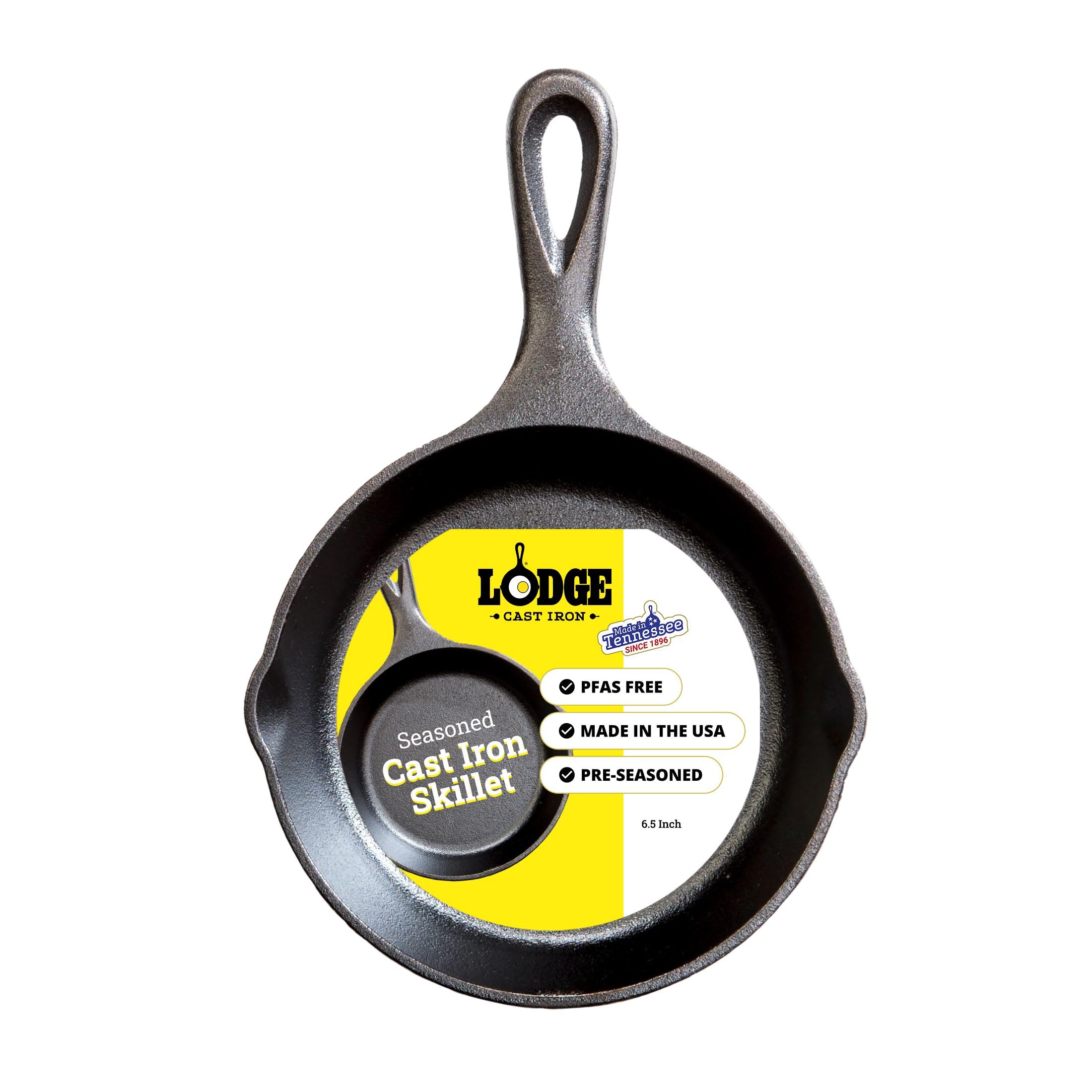
Lodge 6.5-Inch Cast Iron
Key Features
- Weight: 1.9 lb
- Diameter: 6.5 inches
- Material: Cast iron
- Max temperature: 500 °F
- Price: Budget
There’s no coating on this pan, which is either the whole point or a dealbreaker. Cast iron seasons into a black, slick surface with use, and a well-seasoned 6.5-inch skillet releases a fried egg as cleanly as any nonstick pan here — but it takes a few months of cooking and a minute of care after every use to get there.
The size is what makes it an egg pan. Six and a half inches holds one fried egg or a small two-egg scramble, and the low sides let a spatula slide under a yolk without a chase. It’s rated to 500 °F and works on gas, electric, induction, in the oven, on a grill or over a campfire, so it’s the one pan here that can follow you outside.
The care is real. Hand wash only, dry it fully on the stove, and wipe a little oil over the surface before it goes away; a pan put back damp is how rust starts. The handle is cast iron too, so it gets as hot as the pan does — keep a towel or a sleeve on it when you move the pan.
This one is for the cook who wants a single egg, no coating, and a pan with a lifetime warranty that can be re-seasoned rather than replaced when the surface goes bad. If breakfast needs to take ninety seconds and end with a rinse, one of the nonstick pans above is the better answer. That’s not a knock on the Lodge — it’s a different job.
Pros
- No coating to flake or replace
- Oven, grill, induction and campfire safe to 500 °F
- One-egg size with a lifetime warranty
Cons
- Hand wash, dry and oil after every use
- Iron handle gets as hot as the pan
We keep the Lodge for the coating-free one-egg job: it seasons slick, takes any heat source, and can be re-seasoned instead of replaced. It isn’t the fast option.
How We Chose and Tested the Best Egg Pans
We started by pulling together best-selling egg pans from major retailers and specialty cookware brands, then filtered the list by surface material (ceramic, PTFE nonstick, and carbon steel), base thickness, diameter, and price. We ruled out anything with a loose handle or a coating the manufacturer warned against metal utensils — this is a pan you’ll use every morning, often half-asleep, and it needs to tolerate a fork now and then. The final 12 pans ranged from budget-friendly skillets to mid-range coated pans, all in the 8-to-10-inch range.
For six months, we cooked at least three breakfasts a week in each pan: fried eggs over-easy, two-egg omelets, and soft scrambles. We noted whether the egg released with a gentle shake or needed a spatula to pry it loose, and whether the whites set evenly across the pan or left a ring of overcooked edges. To check heat distribution, we watched where a pat of butter melted first and cooked three eggs at once to see if any browned faster than the others. Size mattered too: we tested whether two large eggs fit without touching the sides, and whether a standard silicone spatula could slide underneath a fried egg without breaking the yolk.
After each session, we hand-washed every pan with a soft sponge and a drop of dish soap, noting whether residue lifted in one pass or needed a soak. Once a week, we scrambled eggs with a fork instead of a spatula to see how the coating held up to scratches, and we left each pan to air-dry on the rack to check for rust spots around the rivets and rim. We also tracked how the nonstick surface performed after repeated use — whether eggs started to stick in the center, and whether the pan warped or the handle loosened.
How to Choose a Frying Pan for Eggs
For eggs, the pan matters as much as the technique: a skillet that releases cleanly and heats evenly across an 8-inch surface saves you fat, scrubbing and a ruined breakfast.
Size: 8 inches is the default
The pan most people want for eggs is 8 inches across. It holds two eggs or a folded two-egg omelet without spreading them thin, and it stays light enough to tilt one-handed while you fold. Move up to 9.5 or 10 inches when a three-egg omelet or eggs for two is routine — the SENSARTE’s 9.5-inch base is the roomier single pan here, and the All-Clad set gives you both sizes in one box.
Going past 10 inches for a single serving works against you. The egg spreads thin, the edges set before the middle, and the pan gains weight you don’t need for breakfast. A 6.5-inch cast iron is the other direction: genuinely useful for one fried egg, cramped for anything more.
Coating: nonstick, ceramic or bare iron
Conventional nonstick is the practical default for eggs. It gives the slickest, most forgiving release, which is why our top pick uses it, and it tolerates the low-fat cooking eggs reward. Ceramic is the PFAS-free route — the OXO and the Cuisinart here — and it releases well while it lasts, though ceramic generally gives up its slip sooner than a good nonstick coating.
Bare cast iron is the lifetime answer at the cost of seasoning and a minute of care after each use. Pick the coating that matches how you cook rather than the longest feature list; every pan here has a coating limitation somewhere, and the trick is choosing the one you can live with.
Stovetop and oven compatibility
Check the base first if you cook on induction: the pan needs a magnetic base, and not every pan here has one. The Tramontina is gas, electric and ceramic-glass only, while the CAROTE, All-Clad and SENSARTE work on induction. On a glass cooktop, lift pans rather than sliding them — an aluminum base can leave marks that don’t come off.
Oven ratings run from 302 °F on the SENSARTE to 500 °F on the All-Clad and Cuisinart, and that range matters the moment you want a frittata or eggs baked in tomato sauce. If your eggs regularly finish in the oven, buy the rating, not the nonstick.
Weight and handle balance
An 8-inch egg pan should be light enough to lift and tilt with one hand, and most of these sit between about a pound and two. Where the weight sits matters as much as the total: a heavy stainless handle on a small pan makes it sit nose-down on the burner, and a cast-iron handle gets as hot as the pan it’s attached to.
Shopping online, read what the handle is made of before you buy. Bakelite stays cool and light, silicone sleeves come off for oven use, and stainless steel looks best but carries heat and heft. If you flip or fold at the stove rather than plating in the pan, favor the lighter handle.
Making a nonstick pan last
Most nonstick failures come down to heat and washing. Keep the burner at medium — every pan here still releases eggs at that temperature — never dry-heat an empty pan, and reach for silicone or wood instead of metal. Hand wash anything the maker doesn’t explicitly call dishwasher safe, and put a cloth between pans when you stack them.
When eggs start sticking in the center while the edges still release, the coating is done and the pan is finished. That’s the signal to replace it, not a reason to scrub harder.
Frequently Asked Questions
Do I need a separate pan just for eggs?
Not strictly, but it earns its space. An 8-inch nonstick pan uses less fat, heats faster and lets an egg slide out without a spatula, and it keeps the coating on your larger all-purpose skillet away from metal utensils and high heat.
If your everyday pan is 12 inches, a fried egg spreads thin and sets at the rim before the middle is done. A small dedicated pan fixes both problems for the cost of one takeout breakfast.
What is the difference between an omelet pan and a frying pan?
Mostly the name. An omelet pan is usually a shallow 8-inch skillet with sloped sides, which is what an 8-inch frying pan already is. Measure across the inside of the rim: 8 inches handles a two- or three-egg omelet, and 9.5 to 10 inches is the size for cooking for two.
Molded egg pans and tamagoyaki pans are built for specific shapes and aren’t needed for ordinary fried or scrambled eggs.
How do I keep eggs from sticking to a cast iron skillet?
Preheat the dry pan over medium heat for a few minutes, add butter or oil and let it shimmer, then add the eggs and leave them alone until the white sets before you move them. Cast iron releases best when the pan is hot and the seasoning is intact; a cold pan and a cold egg weld together.
Wash by hand, dry it fully on the stove, and wipe a thin film of oil over the surface before it goes away. A pan put back damp is how rust gets started.
Final Verdict
For most people cooking eggs, the Tramontina Professional 8-inch is the pan to buy: even heat, a release that stands up to daily eggs, commercial-grade construction and a lifetime warranty, for less than the premium picks here.
If you cook on induction, that changes — the CAROTE does the same job on any cooktop for less money. And if eggs for four are a regular order, the All-Clad set’s 10-inch pan is the one that earns its place in the cupboard.