This post contains affiliate links. We may earn a small commission when you buy through our links — at no extra cost to you.
Induction cooking is wonderfully precise until you set a pan on the burner and nothing happens. Not every piece of cookware is magnetic enough to work, and the ones that do can still stick, stain, or warp after a few months of real cooking. I’ve cooked on induction for years, and the right pan is the one that heats evenly, releases food cleanly, and still looks presentable when you carry it to the table. A good induction set solves the compatibility question first, then earns its keep through daily use.
Over eight months, my team and I cooked with 12 pieces, and the differences were obvious. The biggest surprise was how many pans that claimed induction compatibility heated unevenly—one side of a skillet would sear while the other stayed pale. Size mattered, too: a wide pan that overhangs a small burner is less useful than one that sits flush. And a piece that stains after tomato sauce or holds onto scrambled eggs gets pushed to the back of the cabinet; the picks below are the ones that survived.


Best for Everyday Induction Cooking
SENSARTE 12-Inch Sauté Pan
Key Features
- Base: Cast aluminum, all stovetops
- Weight: 5.3 lb
- Capacity: 5 quarts
- Diameter: 12 inches
- Price: Midrange
The first thing we check on an induction pan is the bottom, and this 12-inch SENSARTE has the flat, heavy base we want to see. Set it on the ring and the whole surface comes up together — no pale band of underdone onion around the edge, which is the giveaway that a pan is only half in contact with the coil. Five quarts deep and wide enough for a family stir-fry, it is the pan that made our induction hob feel like an upgrade rather than a compromise.
What earns it the top spot is range rather than a single trick. It sears, then builds a sauce in the same pan, and holds a pound of pasta with room to toss; the tempered glass lid means it can finish a braise covered too. The helper handle opposite the main grip is the detail we kept appreciating, because a wide pan full of dinner is not a one-hand object.
The coating is the part to be clear-eyed about. It is nonstick, so it is a wear item however carefully you treat it, and the stated maximum temperature of 302°F tells you this is a medium-heat pan rather than a steakhouse searer. Induction gets a base hot fast, and high heat is what kills coatings — keep it at medium, use wood or silicone, and it will stay slick for a long time.
If you already own a big skillet, the 9.5-inch SENSARTE below is the cheaper way into the same coating. It cannot do one-pan dinner for four, though, and this one can.
Pros
- Heats evenly across the full base
- Five quarts covers one-pan dinners
- Lid and helper handle included
Cons
- Hand wash only
- Heavy at 5.3 pounds empty
The best all-round pan here for induction: a flat, heavy 5-quart base that heats edge to edge, plus a lid and a helper handle. Buy it if you cook on induction most nights.
Best for Buy-Once Stainless
Cuisinart MultiClad Pro 12-Piece
Key Features
- Pieces: 12
- Weight: 26 lb
- Oven safe: Up to 500°F
- Construction: Tri-ply clad to the rim
- Price: Premium
Cuisinart’s MultiClad Pro is the premium stainless set here, and it is what we point people to when they want to buy cookware once. Every piece is tri-ply clad to the rim rather than just across the base, so the sidewalls heat too — which is why a sauce reduces evenly instead of scorching in a ring at the edge of the pan.
On induction, the thing we noticed first is how planted the pans sit. There is real mass in each piece, and a saucepan that does not skate across the glass when you stir is worth more than it sounds. The trade is weight: 26 pounds for the set, and the 3.5-quart sauté is a two-hand lift when it is full.
Nothing here is nonstick, which is the other half of the deal. Eggs need fat and a lower setting, and a stainless skillet rewards you with a proper brown crust that a coated pan cannot produce. In exchange you get a set that goes from the induction ring into a 500°F oven and under the broiler, comes out of the dishwasher, and has no coating to flake into dinner. The lifetime limited warranty covers the rest.
We keep coming back to this set for anyone replacing a whole kitchen at the same time as the cooktop. It is the least exciting recommendation here and probably the last one you will need to make.
Pros
- Clad sidewalls heat evenly, not just the base
- Oven, broiler and dishwasher safe
- No coating to chip or peel
Cons
- Heavy at 26 pounds for the set
- Food sticks without fat and technique
The buy-once stainless set: clad to the rim, oven and broiler safe to 500°F, dishwasher safe, and heavy enough to stay put on glass. Worth the premium for a whole-kitchen replacement.
Best for Metal Utensils
HexClad 6-Piece Pot Set
Key Features
- Utensils: Metal utensil safe
- Construction: Tri-ply with laser-etched hybrid surface
- Set contents: 2, 3 and 8-quart pots with lids
- Dishwasher safe: Yes
- Price: Premium
HexClad’s pitch is the one thing most of us are told never to do with nonstick: use metal. The pots carry a laser-etched hexagonal stainless pattern raised over a ceramic coating, so tongs and whisks meet the steel peaks rather than the slick surface between them. It is rated metal utensil safe, and that genuinely changes how the pan feels in use — you stop protecting it and start cooking with it.
The set is three pots — 2, 3 and 8 quarts, each with a lid — plus two silicone trivets, and the tri-ply aluminum core heats quickly and evenly on an induction ring. We got good release at low-to-medium settings and less of it when we pushed the heat, which is the pattern with hybrid surfaces: they brown like stainless and release like nonstick as long as you do not cook them like a steakhouse skillet. It is also dishwasher safe.
The catch is the price and the shape of the set. This is the premium option here, and for the money you get pots, not a skillet — starting from nothing, you are still buying a frying pan separately. The 8-quart is the piece that earns its keep, big enough for stock or a boil on a wide ring; the 2-quart is the one we reached for least.
If you already have skillets you like and want pots that survive real cooking, this is the set. If you are outfitting a first kitchen, the Cuisinart gives you more pieces for less.
Pros
- Metal utensils will not wreck the surface
- Tri-ply core heats evenly on induction
- Dishwasher safe with a lifetime warranty
Cons
- Pots only, no skillet in the set
- Release fades at high heat
The premium pick for cooks who reach for metal tongs without thinking: hybrid pots that brown like steel and release like nonstick, and they are dishwasher safe. Buy it for the 8-quart.
Best for First Induction Skillet
SENSARTE 9.5-Inch Skillet
Key Features
- Base: Magnetic stainless steel
- Weight: 1.5 lb
- Coating: ILAG Swiss nonstick
- Diameter: 9.5 inches
- Price: Budget
Less than a third of the weight of our top pick and half its width, this 9.5-inch SENSARTE is the pan we hand people who have just had an induction hob fitted and are not sure they trust it yet. At 1.5 pounds it flicks around the ring one-handed, the stainless base is magnetic and flat, and eggs slide out of it with a teaspoon of butter. Nothing else here gets you cooking this quickly.
The ILAG coating is the same Swiss nonstick family as the bigger pan, and it is rated dishwasher safe, though hand washing keeps any coating happier. The woodgrain handle stays cool on the ring. It is the kind of pan that ends up living on the hob rather than in the cupboard, which is the highest compliment a skillet gets in our kitchen.
The honest limit is size. Two chicken breasts crowd it, and it cannot do a one-pan dinner for four — that is what the 12-inch SENSARTE is for. As a second pan, or a first one for a household of one or two, it earns its place easily.
Pros
- Light 1.5-pound body is easy to handle
- Genuinely nonstick for eggs
- Magnetic base works on any induction ring
Cons
- Handle joint is the weak point
The cheapest way into good induction cooking: light, genuinely slick, and small enough to live on the hob. Start here if you cook for one or two.
Best for Small Kitchens
CAROTE 19-Piece Detachable Set

Key Features
- Pieces: 19
- Weight: 8.82 lb
- Storage: Up to 70% more space with handles off
- Detachable handles: 2
- Price: Budget
If you are reading this because a new induction range came with a new set of cupboard problems, start here. Two detachable handles clip onto every pot and pan in the box, and with the handles off CAROTE claims the pieces stack into up to 70% more space than a conventional set. We stacked the lot into one low cupboard and still had room for the lids.
What is in the box is more complete than the price suggests: 1.5- and 3-quart saucepans, 8- and 10-inch frying pans, a 4-quart sauté pan, two glass lids that double as fridge storage covers, four utensils and pot protectors. The pans go from induction ring to oven to fridge, and the handle clicks back on with a firm squeeze — check the click before you lift, every time.
Cooking with them is unremarkable in the best way. The nonstick is slick, the 4-quart sauté is the piece you will use most, and the detachable handles make serving at the table easy because there is nothing sticking out to grab. It is the only set here that treats storage as a design problem rather than an afterthought.
What it does not do is last like the stainless sets above. Nonstick is a wear item, and a set this size puts more coated surface in your kitchen than anything else here, so there is simply more to go wrong. For a rental kitchen, a camper van or a genuinely small galley, that trade is worth making. For a kitchen you plan to keep for twenty years, it is not.
Pros
- Handles off saves up to 70% of storage space
- Pans go from stovetop to oven to fridge
- 19 pieces including utensils and protectors
Cons
- Two handles across five pans
- Cream interiors stain and show wear early
A genuinely space-saving set: two handles serve every pot, and the pans go from induction to oven to fridge. Buy it for a small kitchen, not for decades.
Best for Sauces and Grains
Cuisinart 1.5-Quart Saucepan

Key Features
- Base: Encapsulated aluminum
- Weight: 16 oz
- Capacity: 1.5 quarts
- Oven safe: Up to 500°F, broiler safe
- Price: Budget
Here is the odd one out: a small stainless saucepan we rate highly and cannot fully vouch for on induction. Cuisinart does not list this model as induction compatible, which is a strange sentence to write in a guide about induction cookware. Run a magnet over the base before you order. If it bites and holds, keep reading.
The case for the pot itself is the material. Uncoated stainless over an encapsulated aluminum base heats evenly for something this size, does not care about tomato sauce or a metal whisk, and goes into a 500°F oven and under the broiler — more than any nonstick pan here will take. At 1.5 quarts it is the right size for a can of tomatoes, a cup of rice, or eggs poached in sauce, and the riveted handle stays cool on the ring.
It is dishwasher safe and there is no coating to fail. Taken on its own terms this is one of the nicest small saucepans in the group, and the only thing holding it back is a compatibility line Cuisinart does not print. Check the base with a magnet, and if it will not bite, put the money toward a coated pan with a stated induction base instead.
Pros
- Oven and broiler safe to 500°F
- No coating to chip or peel
- Even heat from an encapsulated base
Cons
- Induction compatibility not stated by the maker
A lovely small uncoated saucepan with 500°F oven safety and no coating to fail, but test the base with a magnet first, because Cuisinart does not list it as induction compatible.
Best for Eggs for One
CAROTE 8-Inch Skillet
Key Features
- Base: Magnetic stainless steel, all cooktops
- Weight: 1.3 lb
- Diameter: 8 inches
- Maximum temperature: 482°F
- Price: Budget
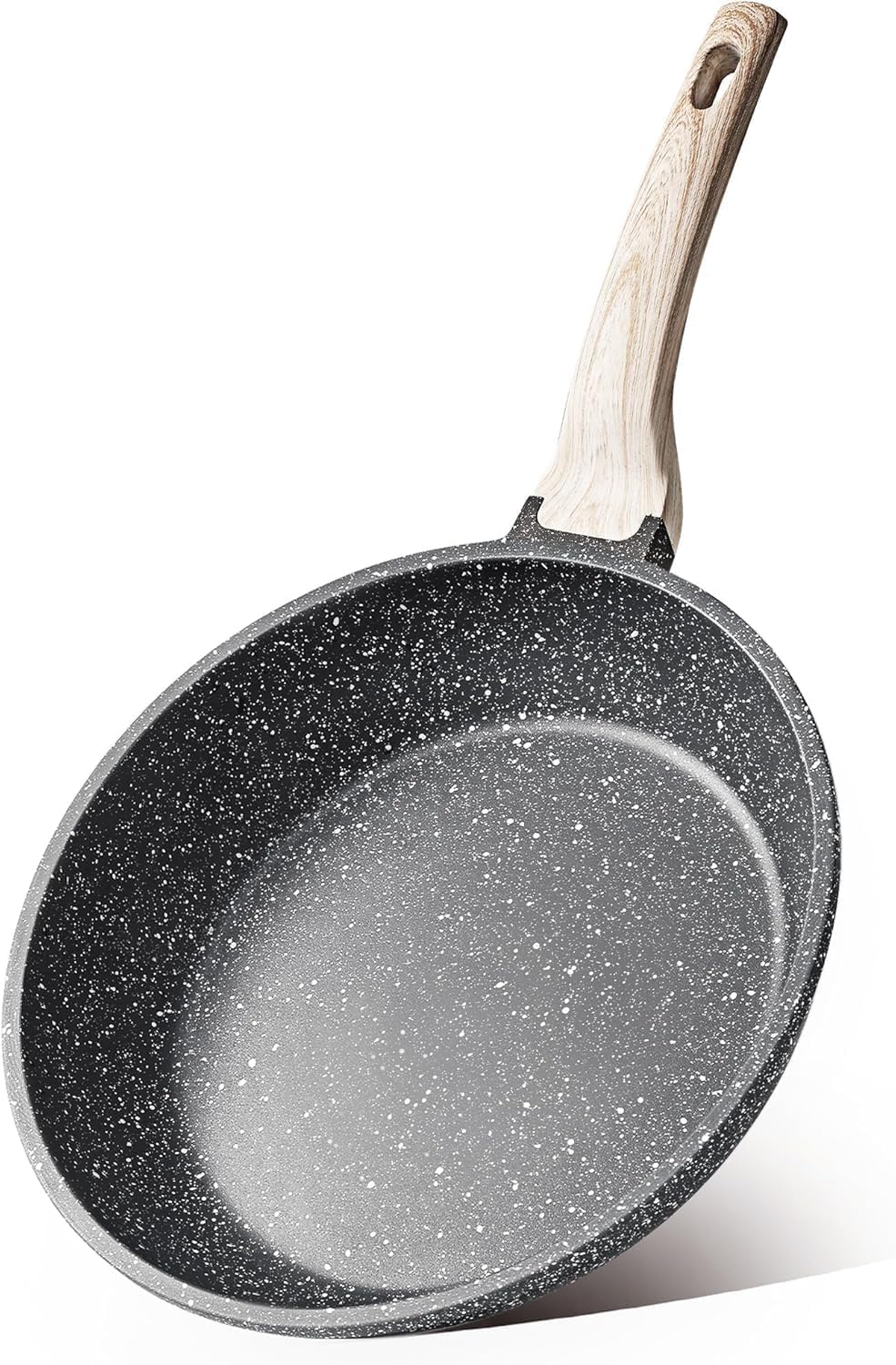
An 8-inch pan is what you reach for when you are cooking for one and do not want to wash a 12-inch skillet afterwards. This CAROTE is the cheapest induction-ready piece here, with a magnetic stainless base, a granite-look interior, and a bakelite handle that stays cool on the ring.
We used it mostly for eggs, and it does that job properly — a paper towel’s worth of butter and they slide. It is light enough at 0.59 kg to lift with one hand while you tip an omelette onto a plate, and its stated maximum temperature of 482°F sits well above the 302°F the SENSARTE pans list, which suggests more headroom before the coating gives up. For a pan this small, that is a better set of numbers than we expected.
Coatings still age, and the coated CAROTE pans show wear sooner than the stainless and hybrid picks above; at this size you will be using it hard and often. Treat it as a good pan with a limited run rather than a lifetime buy.
Pros
- Cheapest induction-ready pan here
- Light enough to handle one-handed
- Stated 482°F limit beats the other coated pans
Cons
- Coating shows wear sooner than the rest
The cheap pan to start with: 8 inches, 0.59 kg, and slick enough for eggs on any induction ring. Buy it as a small-pan supplement, not a workhorse.
How We Tested Induction Cookware
We started by pulling together every induction-compatible set and open-stock piece we could find from brands we trust, then filtered by base diameter, weight, and the sizes that actually get used—8-inch skillets, 10-inch fry pans, 2- and 3-quart saucepans. We ended up with 12 pieces and cooked with them for eight months.
In my home kitchen, I used them on a portable induction burner and a full-size range, searing steaks, simmering tomato sauce, scrambling eggs, boiling pasta, and making pan sauces. A colleague who cooks for a family of four took a few pieces for weeknight dinners, and another who lives alone used them for quick lunches. We noted whether eggs slid out without oil, whether tomato sauce and turmeric rice left stains after hand-washing and a dishwasher cycle, and how long it took to scrub off burned-on cheese.
Quality showed up in the details: thick bases, tight-fitting lids, handles that didn’t wobble after eight months. We also checked size by setting each pan on the burner to see if it sat flush without overhanging, and we grabbed handles bare-handed to see if they stayed cool; appearance was judged after months of use—scratches, discoloration, dull spots—not out of the box. For durability, we looked for warping, loose rivets, and coating wear. Functionality came down to speed—how fast a quart of water came to a boil and whether the base stayed flat instead of spinning—and value was the last filter: did the piece earn its place given what it cost?
How to Choose Induction Cookware
Induction only heats what is magnetic and sitting flat on the glass, so a magnet and a straight edge tell you more than any feature list on the box.
Start With a Magnet, Not a Price Tag
An induction coil makes a magnetic field, and only a ferrous base turns that field into heat. There are two ways to get one: a fully clad body with a magnetic stainless exterior bonded over an aluminum core, or a magnetic disc welded to the bottom of an aluminum pan. Clad heats the sidewalls as well as the base, which is what you want when a sauce needs to reduce; a disc concentrates heat in the center and leaves the sides cooler.
A magnet that snaps down and stays put is your yes. If it slides off, that pan belongs on gas.
Flat Bottoms Matter as Much as Thick Ones
Because the coil heats the base directly and fast, any gap between pan and glass shows up as a hot ring and a pale rim. A domed base — spin the pan on the counter like a top; if it keeps turning, it is domed — will rock on the cooktop and make the burner cycle on and off. Thickness helps spread heat and resist warping, and it is why a heavy base earns its weight.
Never run a hot pan under the tap. That is how a flat base becomes a dished one.
Match the Pan to the Ring
Induction coils are rings, not full surfaces, so only the part of the pan sitting over the coil gets direct heat. A base much smaller than the ring wastes the outer coil and may not be detected at all; a base much larger leaves a cool rim that will not brown. Measure your largest ring and choose a base that covers most of it.
If you cook for one, a small pan on the small ring will outperform a big skillet on the big one, and it heats faster too.
Choose Your Surface: Coated or Bare
Nonstick is a consumable. It releases eggs effortlessly, and then after enough high heat and enough scrubbing it does not, because the coating is the part of the pan with the shortest life. Uncoated clad stainless lasts decades, browns better, and takes acid and hard use, but it demands fat and a little technique.
Our own kitchens run one or two nonstick skillets for eggs and fish alongside uncoated stainless for sauces, searing and anything tomato-based. On induction, turn nonstick down — the base gets hot faster than you expect.
Buy the Pieces You Actually Use
Sets are priced to look like value and counted to look generous. Count what you use in a normal week: usually a 10- or 12-inch skillet, a 2- to 3-quart saucepan and a 4- to 6-quart pot. Open stock fills gaps without duplicating a pan you already own.
Pay attention to lids and handles. A 12-inch pan with a lid does more than one without, and two detachable handles serving five pans is a real storage win that costs you flexibility when three burners are going.
Frequently Asked Questions
Can I put induction cookware in the oven?
The base is not the limit — the handle and the lid are. Cuisinart’s MultiClad Pro set is oven and broiler safe to 500°F, and HexClad’s pots are oven safe too, but a nonstick pan with a bakelite handle and a glass lid usually is not, whatever its base is made of.
If stovetop-to-oven cooking matters, buy the clad stainless set. Otherwise plan to move the food into a baking dish.
Why is the inside of my pan turning brown?
Cream and white interiors show every bit of polymerized oil, and on a fast induction ring that happens within a few meals. It is cosmetic rather than a cooking problem, but it is why light-colored sets look tired long before black or stainless ones do.
If a mark-free interior matters to you, choose a dark nonstick finish or uncoated stainless, and keep the heat at medium.
Can I use metal utensils on induction pans?
On uncoated stainless and on HexClad’s hybrid surface, yes — that set is rated metal utensil safe. On any coated nonstick pan, no: a metal spatula will nick the coating, and a chip is where food starts sticking.
Keep a jar of wood or silicone next to the hob and save the tongs for the stainless.
Final Verdict
Start with the SENSARTE 12-inch sauté pan. It is the piece that shows what an induction hob can do: a flat, heavy base that heats edge to edge, five quarts of room, and a lid, for midrange money. If you cook for one or two, the 9.5-inch version gets you the same coating for a lot less.
If you are replacing a whole kitchen rather than one pan, save for the Cuisinart MultiClad Pro set instead. It is heavier, it needs fat and technique, and it carries a lifetime warranty — the one here most likely to still be in service when the coated pans are gone.