This post contains affiliate links. We may earn a small commission when you buy through our links — at no extra cost to you.
A pizza stone does one job: it pulls heat out of your oven and dumps it straight into the base of the dough, fast and all at once. Home ovens top out around 500 to 550 degrees, so the stone is the only thing closing the gap between your kitchen and a blistering-hot deck oven. Choose badly and you get a pale, bendy middle and a bottom that never chars; choose well and a Tuesday night pie comes out with leopard spots and a crackly base.
I’ve made pizza at home for years, and over the past eight months my team and I have baked on 14 different stones. The lesson that surprised me most is that thickness is a trade-off, not a spec to maximize. A thick stone holds heat through pie after pie but becomes a two-handed lift, and anything wider than your peel leaves you fumbling the launch. The picks below are the ones that earned their cabinet space.



Best for Everyday Oven Use
Rocksheat 15 x 12 Pizza Stone
Key Features
- Size: 15 x 12 inches
- Material: Cordierite
- Thickness: 0.63 inch
- Max temperature: 1400 °F
- Price: Budget
The feature that sold us on the Rocksheat is easy to overlook in a listing: four built-in handles molded into the stone. A hot pizza stone is awkward to move with a peel alone, and those handles give you a secure place to grip it when you slide it onto a rack or lift it out. That practical advantage, plus the 15-by-12-inch footprint, makes this the stone we recommend first for a standard home oven.
At 0.63 inch thick and 7.1 pounds, it has enough mass to hold heat through a bake; we found the crust browned evenly without the pale center that thinner stones can leave. The cordierite construction is rated to 1400°F, so it has headroom for grill use as well as oven use. It is heavy, though, and the weight is the trade-off for that steady heat.
You launch the pie with a peel or parchment, then use the handles to move the stone itself. The handles do not replace a peel for loading pizza; they make moving the stone safer. Cleanup is the usual cordierite routine: let it cool, scrape, and rinse without soap. Dark marks are part of ownership, not a sign the stone has failed.
If you already own a peel, this is the most sensible place to start. The Ritual Life set makes more sense when you want a larger round stone and a full set of tools, but the Rocksheat gets the core job right with less clutter and a shape that fits a standard oven rack.
Pros
- Built-in handles make hot transfers safer
- Thick 0.63-inch cordierite holds heat evenly
- Standard 15 x 12 size fits home ovens
Cons
- No peel included
For a standard home oven, the Rocksheat’s built-in handles and thick cordierite make it the easiest stone here to move and the one we recommend first.
Best for Large Family Pizzas
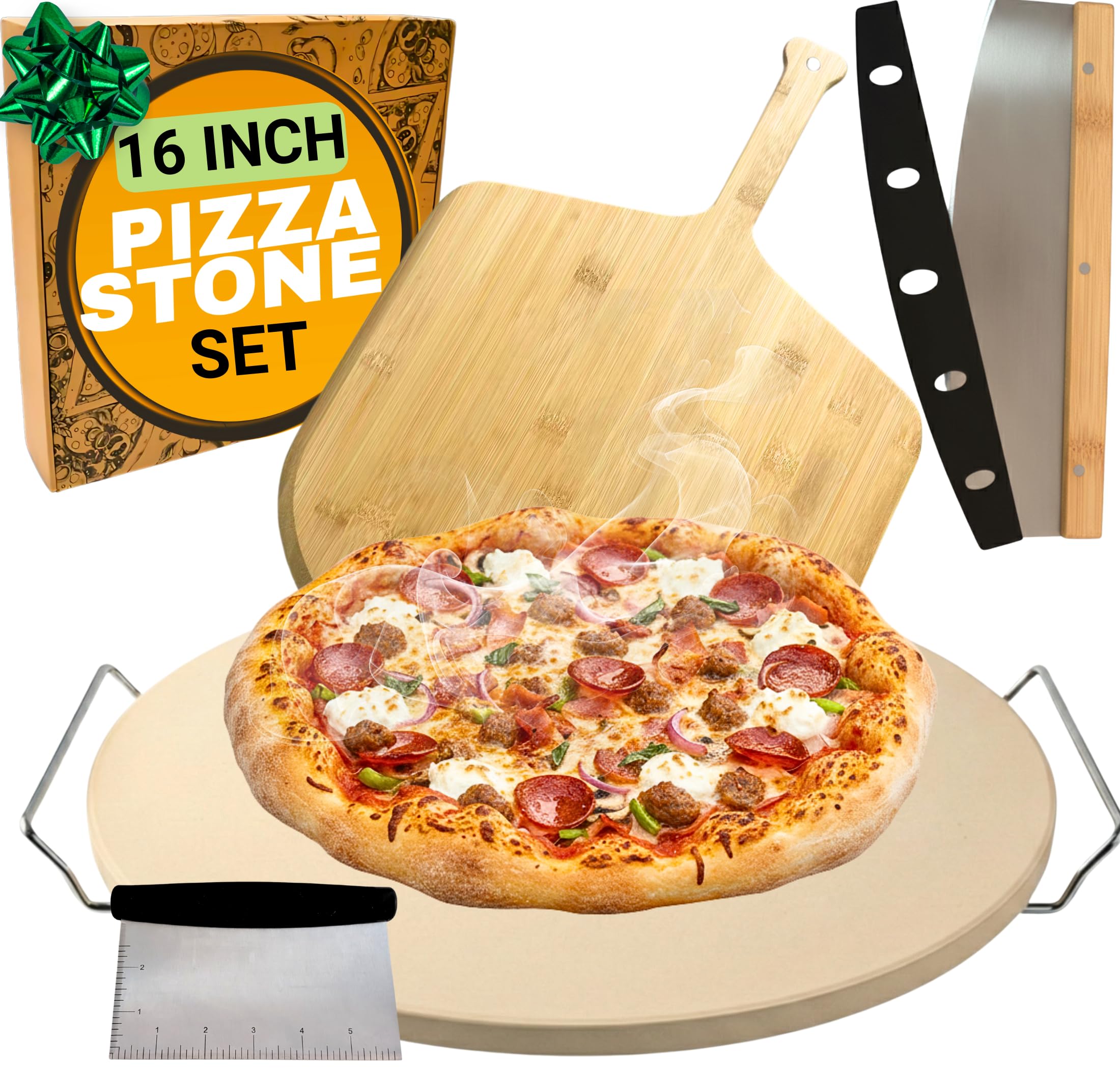
Ritual Life 16-Inch Pizza Stone Set
Key Features
- Set: Five-piece set
- Diameter: 16 inches
- Thickness: 0.6 inch
- Max temperature: 1500 °F
- Price: Premium
A 16-inch round stone is the closest thing here to a family-pizza surface, and the Ritual Life set leans into that role with detachable stainless handles and a 14-inch bamboo peel. The stone itself is 0.6 inch thick and rated to 1500°F, with enough thermal mass for a hot oven or a grill.
We rate it as the best large-round choice for people who want the complete kit. The handles are the detail that matters: a 16-inch cordierite disc is heavy, and lifting it bare-handed is not something we want to do. The included peel is sized to work with the stone rather than fighting it. That coordination is rare in bundled sets.
The set is aimed at people with room for a 16-inch disc and a place to store the extra tools. If you mainly bake 12-inch pies, the Unicook square is easier to live with; if you want one stone for big pizzas and bread, this is the set we reach for.
Pros
- Detachable handles make a heavy stone manageable
- 16-inch round fits family-size pizzas
- Complete set includes peel, cutter, and dough tool
Cons
- Peel only handles up to 14-inch pizzas
A 16-inch round with detachable handles and a matching peel is what the Ritual Life delivers, and we think that combination makes family pizza night easier.
Best for No-Frills Value
Culinary Couture 15 x 12 Pizza Stone
Key Features
- Size: 15 x 12 inches
- Material: Cordierite
- Thickness: 0.5 inch
- Max temperature: 1000 °F
- Price: Budget
If you already own a peel and a cutter, the Culinary Couture stone is the one that keeps the cost down without feeling like a compromise. It is a plain 15-by-12-inch cordierite rectangle, 0.5 inch thick, with a 1000°F limit and no handles or bundled tools.
The thickness is the reason to consider it. At half an inch, it has more mass than the thin 0.4-inch stones here, and the even browning that comes with that mass is what we noticed first. The surface is porous in the way a pizza stone should be, so it pulls moisture from the dough and gives you a crisper base. It is not a nonstick surface; flour, cornmeal, or parchment still do the work.
What you give up is convenience. There are no handles, so you need a peel or a good pair of mitts to move it, and the 1000°F ceiling is lower than the grill-ready stones here. For oven pizza at a modest price, though, it is the straightforward buy we point value-minded cooks toward. The Old Stone is the step up when you need a wider baking surface.
Pros
- Half-inch thickness supports even browning
- Simple rectangle leaves budget for a peel
- Cordierite surface absorbs moisture
Cons
- No handles or peel included
- 1000°F limit is lower than grill-ready stones
We point value-minded cooks who already own a peel here: the Culinary Couture is thick enough for even browning and keeps the stone simple.
Best for Big Batches
Old Stone 14 x 16 Pizza Stone
Key Features
- Size: 14 x 16 inches
- Material: Stoneware
- Thickness: 0.43 inch
- Max temperature: 1450 °F
- Price: Midrange
The Old Stone is the largest rectangular stone in this group, a 14-by-16-inch slab that takes up serious oven real estate. That size is the reason to buy it: it can hold a large pie or several smaller loaves at once, and the stoneware body is rated to 1450°F.
At 0.43 inch thick, it is not the chunkiest stone here, but the width makes it a better fit for bread bakers and anyone cooking for a crowd. We found the heat spread steady across the surface, with a crust that came out crisp rather than pale. The lack of handles is the catch; a stone this wide is awkward to lift, especially when hot.
We recommend it when batch size matters more than easy handling. It is a poor fit for a small oven or a cook who wants to move the stone often; the Rocksheat’s handles make more sense there. But for a big Sunday bake, the extra width earns its place.
Pros
- Wide 14 x 16 surface fits large pies or bread
- Even heat and crisp crust
- 1450°F rating works in ovens and grills
Cons
- No handles for hot transfers
- Large footprint needs a big oven
The Old Stone earns our recommendation when batch size matters more than easy handling, because its wide surface fits a large pie or several loaves at once.
Best for Grill-Ready Bundle
Hans Grill Rectangular Pizza Stone
Key Features
- Size: 14.96 x 11.8 inches
- Includes: Stone and peel
- Thickness: 0.59 inch
- Max temperature: 1112 °F
- Price: Midrange
Hans Grill bundles a wooden peel with a 15-by-12-inch cordierite stone, which sounds like the obvious starter kit until you try to move a full-size pie with it. The peel is on the small side for the stone, so it is better for turning and serving than for launching a 12-inch pizza. We still think the stone is a strong grill candidate, but the bundle is not the complete solution it appears to be.
The stone is 0.59 inch thick and rated to 1112°F, with enough heft to hold heat on a grill. We like the rectangular shape for fitting around a grill’s hot zones, and the included peel is useful for rotating the pie even if it is not the main launch tool. The surface is porous and will grab wet dough; flour or cornmeal on the peel is not optional.
This is the pick for someone who wants one box with a stone and a wooden peel for occasional grill pizza. If you bake large pies regularly, buy a wider peel or choose a set with a properly sized one; the Ritual Life set is the more complete package. The stone itself is capable, but the accessorizing is where the value gets uneven.
Pros
- Rectangular cordierite stone is grill-friendly
- Comes with a wooden peel
- Generous 15 x 12 baking surface
Cons
- Included peel is small for the stone
- Dough can stick without enough flour
The Hans Grill makes sense to us as a grill-ready bundle when you want a stone and a wooden peel together, provided you add a wider peel for big pies.
Best for Small Pizza Ovens
Unicook 12 x 12 Pizza Stone

Key Features
- Size: 12 x 12 inches
- Includes: Stone and scraper
- Thickness: 0.6 inch
- Max temperature: 1450 °F
- Price: Budget
A 12-inch square stone is a specialist: it fits the small pizza ovens and countertop ovens that a 15-inch rectangle will not. The Unicook is built for that niche, with a 12-by-12-inch cordierite surface, a 0.6-inch thickness, and a 1450°F rating.
The square shape makes more sense than a round in a compact oven because it uses the corners instead of leaving them empty. We found the heat even across the surface, and the included scraper is a genuinely useful addition for cleanup. It is also one of the few stones here explicitly matched to 12-inch pizza ovens, which takes some of the guesswork out of buying.
The caveats are real. It is small for family-size pizzas, and a strong odor can appear during the first high-heat uses; give it a long initial burn-off with the kitchen ventilated before you cook on it. The stone is hand-wash only, and dark stains are normal.
We recommend it for a 12-inch countertop pizza oven or a small apartment oven, not as the main stone for a full-size family oven. If that is your setup, the compact square is the difference between using the stone often and not using it at all.
Pros
- 12 x 12 square fits compact pizza ovens
- Even heat and strong baking performance
- Includes a dough scraper
Cons
- Can emit a strong odor on early high-heat use
- Too small for family-size pizzas
For a 12-inch countertop pizza oven or a small apartment oven, we recommend the Unicook because its compact square fits where a full-size stone does not.
Best for Budget Large Round
Zemibi 16-Inch Round Pizza Stone

Key Features
- Diameter: 16 inches
- Material: Stoneware
- Max temperature: 1450 °F
- Price: Budget
No peel, no handles, just a 16-inch baking surface: the Zemibi is the pared-back round at the low end of this group. The stone is rated to 1450°F and listed as stoneware, so it is a different material from the cordierite stones that dominate the rest of the list.
We see it as the budget route to a large round. The 16-inch diameter gives you room for a family pizza, and the stoneware surface is a change from the cordierite stones here. The lack of handles is the practical catch, and there is no peel to help you load the pie.
For a first stone or a spare for the grill, it is a reasonable low-cost experiment. It is not the top pick for a busy kitchen because the handling is basic and the material is less proven for high-heat grill use. The Rocksheat remains the safer default.
Pros
- 16-inch round gives room for family pizzas
- 1450°F rating suits oven and grill use
- Low-cost route to a large round
Cons
- No handles or peel included
Our budget pick for a large round pizza is the Zemibi, with the caveat that you give up handles and a peel to get there.
Best for Balanced Rectangle
Lunvarion 15 x 12 Pizza Stone

Key Features
- Size: 15 x 12 inches
- Weight: 5.8 lb
- Thickness: 0.47 inch
- Max temperature: 1472 °F
- Price: Midrange
A 0.47-inch thickness is the compromise the Lunvarion is selling: thicker than the thinnest stones here, thinner than the heavy slabs, and light enough at 5.8 pounds to move without a struggle. The 15-by-12-inch size is the standard rectangle, and the cordierite body is rated to 1472°F.
On paper, that is a sensible middle ground for oven and grill use. The rectangular shape fits a normal rack, the thickness gives it more heat stability than a 0.4-inch stone, and the price is midrange rather than premium. There is no peel, no handles, and no scraper in the box.
The lack of extras keeps the cost down and the storage simple. You can use parchment or a peel you already own, and the 5.8-pound weight is manageable for a single pair of hands.
We recommend it as an also-consider for a cook who wants a standard rectangular stone with a bit more heat tolerance than the cheapest option and does not need a bundle. If you want handles or a longer record, the Rocksheat is the safer choice; if you want a complete set, the Ritual Life is the better fit.
Pros
- 0.47-inch thickness balances heat and weight
- 15 x 12 rectangle fits standard ovens
- 1472°F rating gives grill headroom
Cons
- No handles or peel included
Cooks who already own a peel and want more heat tolerance than the cheapest stone should consider the Lunvarion; we think its middle-ground rectangle is the right compromise.
How We Tested the Best Pizza Stones
We started with more than 30 stones and cut the list down by material, published maximum temperature, thickness, and footprint, checking each against a standard half-sheet pan, a common 14-inch peel, and the depth of a typical home oven rack. Price mattered too, but only as a ratio against size and weight. That left 14 stones, which we baked on for eight months.
Testing happened on real pizza nights, usually Friday and sometimes Sunday, with the oven run at full blast for a solid hour before the first launch. We took surface readings at the center, mid-radius, and edge with an infrared thermometer, then slid the same dough onto each stone with the same peel and watched what happened: how the rim puffed, how evenly the bottom browned from middle to perimeter, and whether the base was set by four minutes or still raw at six. Every stone also baked three pies back to back so we could see how quickly it recovered.
Along the way we weighed each stone dry and again after a session, scraped off burnt semolina and welded-on cheese with a bench scraper, and noted which surfaces stained or held onto smells. Durability meant repeated heat cycles and cooling on the counter, watching for hairline cracks and chipped edges. Because stickiness can ruin a bake, we used identical dough and flour on every stone and recorded whether the pie released cleanly or had to be pried loose. Peel fit got its own check: whether a standard peel could slide under a pie with the stone sitting in the oven, and how much landing room was left on the rack.
How to Choose a Pizza Stone
Start with fit and heat tolerance, then decide how much handling help you want, because a stone that is awkward to move stops getting used.
Fit and shape come first
A pizza stone has to live in your oven, so measure the rack and the door clearance before you fall for a surface. A 15-by-12-inch rectangle is the safest default for a standard home oven; it leaves room for air to move and fits a standard peel. A 16-inch round gives you a bigger continuous surface for family pies, but it can crowd a small oven or block the door. A 12-inch square is the specialist choice for countertop pizza ovens and small apartments.
Shape also changes what you can bake. Rectangles are better for bread loaves and multiple small items; rounds suit a single large pizza. Do not buy a stone larger than the rack can hold level, and check that your peel can reach the full surface.
Thickness, heat, and thermal shock
Thicker stones hold more heat and recover faster when you open the oven, but they are heavier and take longer to preheat. A 0.5- to 0.6-inch cordierite stone is the sweet spot for most home ovens; 0.4 inch is lighter and quicker, while a 0.63-inch slab like the Rocksheat is built for steadier heat. Heat tolerance matters most if you plan to use the grill: check the maximum temperature and stay within it.
Thermal shock is the quiet killer. Never put a cold stone into a hot oven or onto a hot grill, and never submerge a hot stone in water. Preheat the stone with the appliance, and let it cool completely before cleaning.
Handles, peel size, and safe transfers
The most useful upgrade is not a bigger surface; it is a way to move the stone without burning yourself. Built-in handles on the Rocksheat are worth having because a hot stone is awkward to grip with mitts alone. Detachable handles on the Ritual Life serve the same purpose on a bigger round. If the stone has no handles, plan on leaving it in the oven and using a peel to load and retrieve pizza.
Check the peel against the stone, not just the price. A 14-inch peel is fine for a 14-inch pizza, but it is not a full-size match for a 16-inch stone; a peel that is too small makes a launched pie fold or slide off. Bundled peels are often the weak link in a set.
Release, cleaning, and what to spend on
Sticking is usually a launch problem, not a stone defect: dust the peel with flour or cornmeal, keep the dough moving, and use parchment if you are still learning. Once the pizza is on the stone, avoid opening the oven more than you need. Dark stains are normal; scrape off food, rinse with warm water, and skip soap.
Spend on the features you will actually use. Handles and a correctly sized peel earn their keep; a cutter and dough tool are nice extras but not reasons to choose a set. If you already own tools, a plain stone like the Culinary Couture is the better value. If you want one box for a big family pizza, the Ritual Life set makes more sense.
Frequently Asked Questions
Does a pizza stone need to be seasoned?
No. Cordierite and stoneware stones should not be oiled or seasoned like cast iron; oil can turn sticky and smoke at high heat. They darken naturally as you bake, and those stains do not hurt performance. Scrape off food, rinse with warm water, and let the stone dry fully before storing.
Can I cut pizza directly on the stone?
No. A knife or wheel can scratch the surface and leave marks that are harder to clean, and the stone is hot and awkward to cut on. Slide the pizza onto a board or peel with a spatula, then cut it there. If you serve on the stone, let it cool first.
Can I use a pizza stone for bread?
Yes. Rectangular stones are especially useful for batards, baguettes, and several rolls at once; a round stone suits one large boule. Preheat the stone fully and dust it with flour or cornmeal. For wet doughs, parchment makes the transfer easier, and dark stains are normal.
Final Verdict
The Rocksheat 15 x 12 is our default because it solves the two things that make a stone annoying: uneven heat and an awkward hot transfer. The thick cordierite holds temperature, the built-in handles give you a safe grip, and the standard rectangle fits a normal oven rack.
If you want a larger round stone with a complete set of tools, choose the Ritual Life; if you bake wide batches of bread or several small pizzas, the Old Stone’s extra surface is the better fit.