This post contains affiliate links. We may earn a small commission when you buy through our links — at no extra cost to you.
A compact microwave is a trade with your countertop: less footprint, and in exchange a smaller turntable, a shallower cavity, and the odd cold center in last night’s leftovers. That’s a fair deal as long as the machine heats evenly, closes with a solid thunk, doesn’t sound like a leaf blower, and comes in a finish that doesn’t advertise every fingerprint. What a good one buys you is a counter that stays usable: room to chop, to set down a hot pan, to not rearrange everything just to make oatmeal. The catch is that compact is measured on the outside, and dinner is measured on the inside.
I’ve measured more microwave footprints than I’d like to admit, and the number that matters is rarely on the spec sheet. It’s the turntable diameter, which decides whether a dinner plate spins freely or scrapes the walls. Over seven months, my team and I cooked, defrosted, and reheated our way through a dozen compact models, and the spread in evenness and noise was wider than the spread in price. The picks below are the ones that earned their square footage.



Best for Small Kitchens
Toshiba 0.9 Cu. Ft. 900W
Key Features
- Wattage: 900 watts
- Capacity: 0.9 cubic feet
- Turntable: 10.6 inches
- Exterior dimensions: 13.3"D x 18.7"W x 10.7"H
- Price: Midrange
The spec that settles this one for us is the combination of 900 watts and a 0.9-cubic-foot cavity. Several 0.7-cubic-foot models here are only about an inch and a half narrower, so the Toshiba asks for a little more counter width and gives back more room for a dinner plate, a mug, and a container that actually fits.
We recommend it as the default for a small kitchen because it has the power to do more than reheat. The 10.6-inch turntable gives you some margin around a standard plate, and the 11 power levels are useful when you want to soften butter or finish something gently rather than blast it. The six presets cover the usual popcorn, pizza, potato, and beverage jobs without making you scroll through a menu.
The two-step child lock is the feature we have to remember every time; it is a safety feature, not a flaw, but it makes the door a deliberate open rather than a quick pull. Noise is the other variable we noticed: this is not the quietest microwave in the group, and some units develop a click or rattle that is worth returning while the window is open.
Pros
- 900 watts for faster reheating and cooking
- 0.9-cubic-foot cavity with a 10.6-inch turntable
- 11 power levels and six presets
Cons
- Durability is the long-term question
For most small kitchens, we choose the Toshiba: 900 watts and a 0.9-cubic-foot cavity handle real meals, not just reheats, without crowding the counter.
Best for Tight Counters
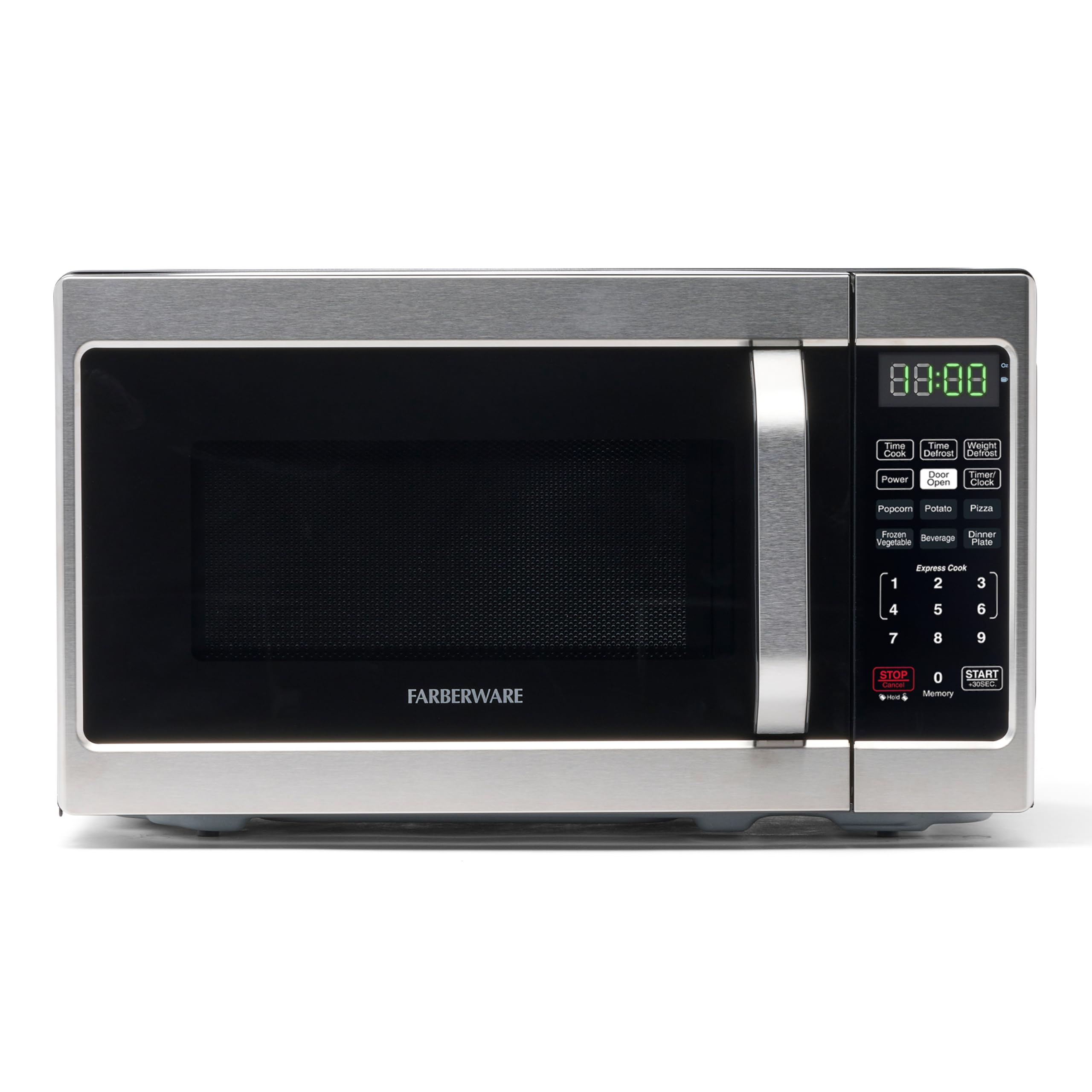
Farberware 0.7 Cu. Ft. 700W
Key Features
- Wattage: 700 watts
- Capacity: 0.7 cubic feet
- Turntable: 10.6 inches
- Exterior dimensions: 12.99"D x 17.3"W x 10.14"H
- Price: Midrange
The handle is the first thing we noticed, and it is the reason to choose this Farberware over the push-button models. A real pull handle is easier to grab when your hands are full, and it gives you leverage without pushing the whole microwave backward on the counter.
At 0.7 cubic feet, this is a true small-kitchen microwave. The 10.6-inch turntable is the same size as the Toshiba’s, so a dinner plate fits with a little room to spare, though the lower ceiling makes tall mugs and stacked containers a tighter proposition. The stainless finish is a nice bonus if the microwave sits out in the open.
What you give up is power. The 700-watt output is fine for leftovers and coffee, but it takes longer than the 900-watt Toshiba for frozen food or anything cooked from raw. We think the six presets and 10 power levels are enough for everyday use, and the controls are easy to read without a manual.
Pros
- Pull handle is easy to grip
- 10.6-inch turntable fits dinner plates
- Stainless finish looks good on an open counter
Cons
- End beeps are loud
This is the compact microwave we point to when a real handle and a clean stainless look matter more than raw power; it is easy to live with.
Best for Everyday Reheating
Black+Decker 0.7 Cu. Ft. 700W
Key Features
- Wattage: 700 watts
- Capacity: 0.7 cubic feet
- Turntable: 10 inches
- Exterior dimensions: 13"D x 17.3"W x 10.2"H
- Price: Midrange
The keypad is the comfort here: popcorn, potato, pizza, frozen vegetable, beverage, and dinner plate are one press away, and the 30-second express key is the sort of shortcut you use without thinking. This is the microwave we hand to a guest or a teenager without explaining a sequence.
The 0.7-cubic-foot cavity is compact, but the 10-inch turntable is the limiting part. A standard dinner plate fits; a wide casserole dish does not. At 700 watts, it reheats leftovers and coffee without drama, but frozen food and cooking from raw take longer than they do in the 900-watt Toshiba. That is the trade for a smaller, less expensive box.
The push-button door is where our enthusiasm cools. It needs a firm press, and the latch can feel sticky over time; if anyone in the house has weak grip or arthritis, the Farberware’s handle is the more considerate choice. We also treat this one as an appliance to buy from a retailer with an easy return, because the door release is the part most likely to test your patience.
Pros
- Familiar one-touch presets and express cooking
- Compact 0.7-cubic-foot footprint
- Large LED display is easy to read
Cons
- Durability is the long-term question
- Running noise can be loud
We keep the Black+Decker in the shortlist for its familiar one-touch keypad and compact footprint, provided you can live with a firmer door press.
Best for Dorms and Offices
Comfee 0.7 Cu. Ft. 700W
Key Features
- Wattage: 700 watts
- Capacity: 0.7 cubic feet
- Power levels: 11
- Exterior dimensions: 12.7"D x 17.3"W x 10.2"H
- Price: Budget
For a dorm room, office, or a counter that has to hold a coffee maker too, the Comfee makes the strongest case for going small. The 0.7-cubic-foot body is narrow enough to tuck into a corner, and the white finish is less likely to dominate a rental kitchen than a stainless box.
We recommend it as the budget pick because it covers the basics and adds a couple of genuinely useful extras. Eco mode cuts standby power, and the mute function is a real convenience in a shared space. The one-touch cooking buttons and 11 power levels are more than you need for leftovers.
Heating speed is the compromise. This is a 700-watt microwave, and the compact cavity means a full plate takes longer than it does in the Toshiba; frozen food needs extra time and a stir halfway. That is acceptable for a backup appliance or a dorm, where the microwave is mostly for snacks and reheating. Frozen food needs extra time and a stir halfway; that is the cost of the smaller power draw.
Pros
- Space-saving 0.7-cubic-foot body
- Eco mode and mute function
- Simple one-touch cooking controls
Cons
- Keypad needs a firm press
The Comfee is our budget pick for dorms and offices: it saves space and adds eco and mute modes, as long as you are not in a hurry.
Best for Quiet Households
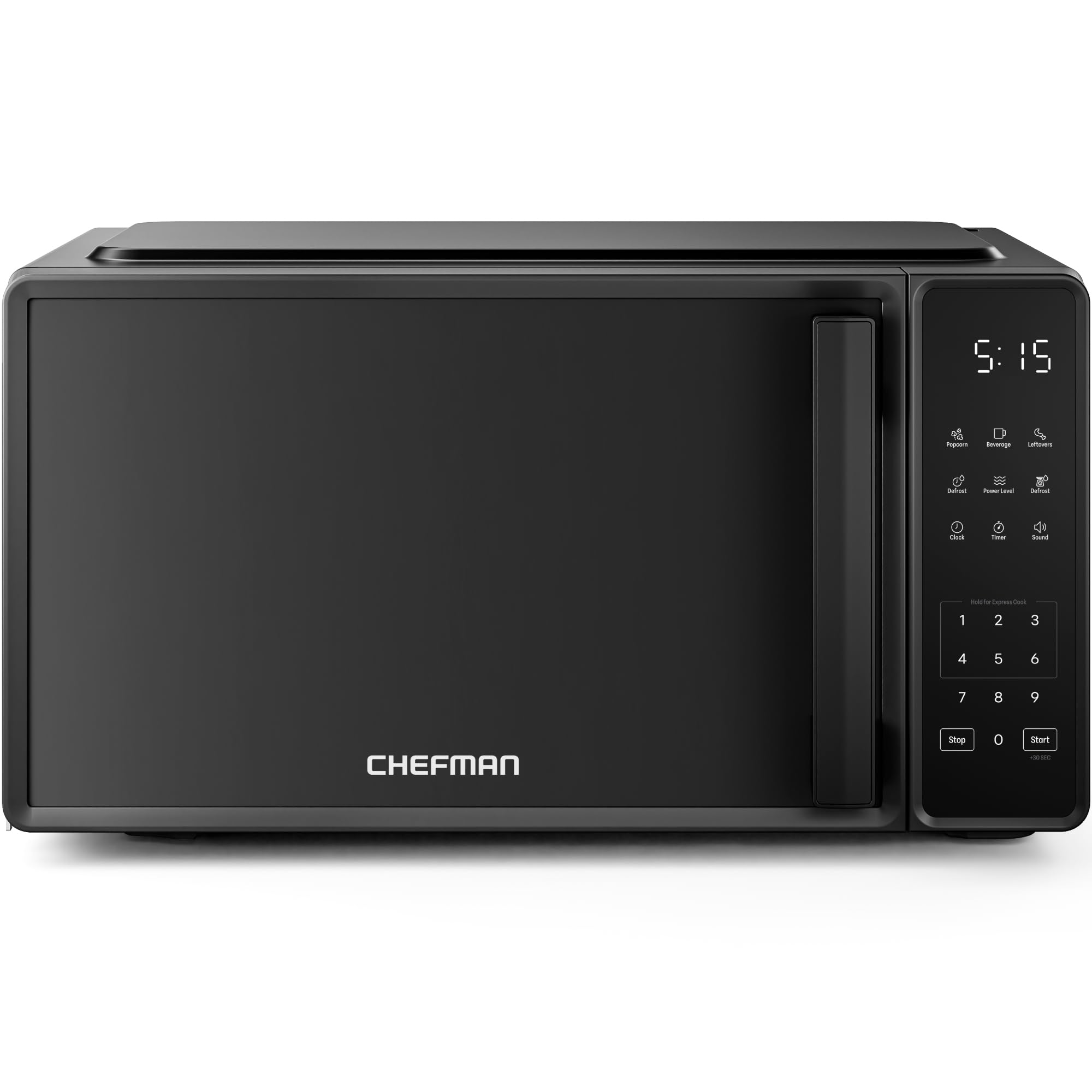
Chefman 0.7 Cu. Ft. 700W
Key Features
- Wattage: 700 watts
- Capacity: 0.7 cubic feet
- Power levels: 10
- Exterior dimensions: 12.93"D x 17.52"W x 9.53"H
- Price: Budget
The mute button is the small feature that makes the Chefman easy to live with in a shared apartment or a kitchen near a sleeping child. Press it and the beeps stop, which is more useful than it sounds when the microwave is on the same counter as a kettle and a coffee maker.
We like the child safety lock on the handle, though it changes how you open the door: you pull upward on the top edge rather than pulling the whole door toward you. That is a deliberate two-step motion, and it can feel fussy when you are carrying a plate. If you do not need a lock, the extra motion is the price of the feature.
The 0.7-cubic-foot cavity and 700 watts are the basics. It handles leftovers, popcorn, and a mug of coffee, but a full dinner plate is tight and a family-size container is out of the question. The six presets cover popcorn, pizza, beverages, veggies, potatoes, and leftovers, which is more than enough for the way most people use a small microwave.
Pros
- Mute button silences beeps
- Child safety lock on the handle
- Compact 0.7-cubic-foot body
Cons
- Noise can vary by unit
We like the Chefman for quiet households that want a muted, child-locked compact microwave; it suits singles and light reheating.
Best for Retro Kitchens
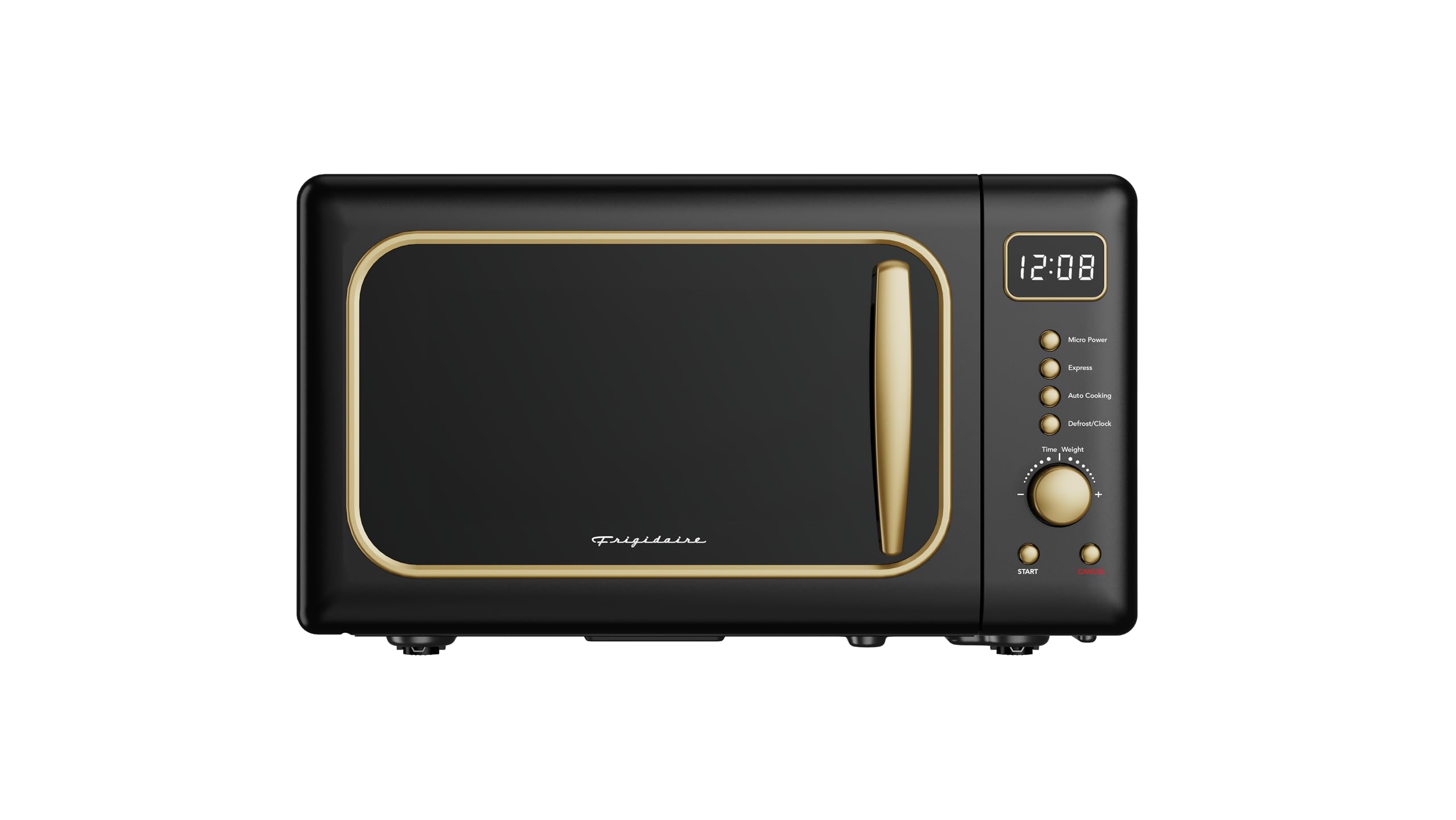
Frigidaire Retro 0.7 Cu. Ft. 700W
Key Features
- Wattage: 700 watts
- Capacity: 0.7 cubic feet
- Power levels: 5
- Exterior dimensions: 13.27"D x 18.9"W x 11.52"H
- Price: Budget
The black-and-gold retro finish is the reason this Frigidaire exists in the lineup, and it is a genuinely handsome small appliance. The rounded corners and chrome trim make it look more like a counter accessory than a box, which is worth something in a kitchen where everything is on display.
Under the finish it is a conventional 0.7-cubic-foot, 700-watt microwave with eight auto-cook menus and a bright LED display. The five power levels are fewer than the 10 or 11 on most picks here, which matters if you use lower settings for melting butter or softening cream cheese. For reheating a plate or a mug, the power is adequate.
The door release is the compromise we mind most: you press cancel before the door opens, so it is not a one-hand grab. We understand the safety logic, but it adds a press every time you check your food. It is the kind of detail that decides whether you love the appliance or just tolerate it.
Pros
- Retro black-and-gold finish
- Eight auto-cook menus
- Compact 0.7-cubic-foot body
Cons
- Durability is the long-term question
The Frigidaire Retro earns its place on looks first: a handsome compact for a style-led kitchen, with basic power and a cancel-to-open door.
Best for Style-First Kitchens
Nostalgia Retro 0.7 Cu. Ft. 700W

Key Features
- Presets: 12
- Wattage: 700 watts
- Capacity: 0.7 cubic feet
- Exterior dimensions: 12.5"D x 17.5"W x 10"H
- Price: Midrange
The ivory retro styling is the whole pitch, and it is the one microwave here that can change the look of a counter rather than just occupy it. The chrome handle and dial give it a mid-century feel that suits a rental kitchen, a studio apartment, or a breakfast nook.
The look is backed by 12 pre-programmed settings and a compact 0.7-cubic-foot body. The rotating carousel helps even heating, and the digital clock is easy to read.
The controls are the part to try before you commit: the dial-and-button layout is not as direct as a keypad, and the door has to be unlocked before it opens. That is a safety step, but it adds a motion every time you check your food.
The heating is the part to watch. The 700 watts are fine for coffee and leftovers, but frozen food can come out uneven, and the compact cavity leaves little room for a full plate plus a side. We think the retro finish is the reason to buy this one; the cooking performance is ordinary, and the controls ask for patience.
Pros
- Retro ivory finish stands out
- 12 pre-programmed settings
- Compact 0.7-cubic-foot body
Cons
- Durability is the long-term question
We point to the Nostalgia when the microwave has to look good in a retro kitchen; the styling is the draw, and the cooking is merely adequate.
How We Tested Compact Microwaves
We built a shortlist of roughly 40 compact models from spec sheets, retailer listings, and our own archives, then cut anything too deep to sit under a standard upper cabinet, anything under 700 watts, and anything with a turntable smaller than about 9.6 inches. That left 12, running from two-dial basics to inverter units with flatbeds, and we lived with them for seven months across three real kitchens: my own galley setup, a colleague’s narrow counter with 15 inches between the fridge and the sink, and a family kitchen where the microwave does most of the actual cooking.
Before plugging anything in, we taped each unit: exterior width, depth including the door handle, height, and the clearance needed behind and above for vents. We also checked how far the door swung and whether it blocked the drawer beside it, then measured the turntable and set a 10.5-inch dinner plate on it. In daily use we boiled two cups of water and timed it, reheated leftovers and took readings at the center and edge to see how evenly heat spread, defrosted a pound of ground beef looking for cooked gray edges, and made popcorn, counting the unpopped kernels. A decibel app a foot from the door gave every model a noise baseline.
Durability and appearance got the unglamorous work: a few dozen door opens and closes to check for hinge play, a fingerprint wipe on every finish, and a look for scratches after a month of normal use. Our notes flagged any unit that ran hot on top, stalled its turntable, or smelled of hot plastic, and we weighed all of it against price. The models that made the list weren’t the cheapest or the most powerful, but they heated a bowl evenly, stayed reasonably quiet, and left enough counter to cook on.
How to Choose a Compact Microwave for a Small Kitchen
In a small kitchen, the winning microwave is the one that fits the counter and your plates, not the one with the smallest box.
Start with the footprint, not the cubic feet
Compact is a class, not a promise. The models here run about 17.3 to 18.9 inches wide and 12.5 to 13.3 inches deep, and a 0.9-cubic-foot Toshiba is only about an inch and a half wider than several 0.7-cubic-foot picks. Measure the landing, the height under the cabinet, and the door swing before you fall for a capacity figure.
Leave room for the ventilation grille and for the door to open fully. A microwave that fits with a half-inch to spare but cannot open past the handle is not a fit. We prefer a model with a real handle when the counter is tight, because it gives you something to pull without pushing the whole box backward.
Match the cavity to your plates
A 0.7-cubic-foot microwave can hold a dinner plate, but the turntable is the real limit. A 10- to 10.6-inch tray is common in this class, so check the interior width if you use wide plates or squared containers. A 0.9-cubic-foot cavity gives you more room to slide a plate past the door frame and still leave space for a mug.
If you routinely reheat plated dinners, the Toshiba’s larger cavity and 10.6-inch turntable are the more forgiving combination. If you mostly warm a bowl of soup or a mug, a 0.7-cubic-foot model is enough and saves counter space.
Decide whether 700W is enough
Wattage is the clearest dividing line here: 700W versus 900W. A 700W model reheats leftovers, but it adds time and can struggle with frozen food or cooking from raw. The 900W Toshiba is the one we choose when the microwave is a real cooking tool rather than a coffee warmer.
Power levels matter less than wattage, but 10 or 11 levels give more control for melting and softening than five. If you mostly reheat, choose the smaller, lower-power model and give dense food extra time.
Try the door and controls before you commit
Door release is the daily interaction that separates a pleasant microwave from an annoying one. A pull handle is easiest with full hands; a push-button release saves front clearance but can need a firm press. Child locks add a deliberate sequence, and some models require cancel before the door opens.
The Farberware’s handle is the easiest here for weak grip. The Toshiba and Comfee use child-lock routines that need a beat to learn, and the Frigidaire Retro makes you press cancel before opening. Open and close the door a few times before buying, or test the release immediately if you order online.
Plan for noise, beeps, and the long haul
Noise and beep volume vary; mute is worth having in an open kitchen, and the Chefman and Comfee both offer a way to quiet the appliance. Durability is the cloud over this class, with door latches and control panels the parts to watch. A one-year warranty is standard here, so keep the receipt and test every function in the return window.
Frequently Asked Questions
Do compact microwaves use less electricity?
A 700-watt model draws less power while it runs than a 900-watt one, but it may need to run longer. For coffee and leftovers the difference is modest; for frozen dinners or cooking from raw, the higher-wattage model can finish sooner. Match wattage to how you actually use the microwave, not just the number on the box.
Can I put a compact microwave on top of a mini fridge?
Only if the fridge is stable, the microwave’s feet sit fully on top, and there is clearance for vents and the door. A 0.7-cubic-foot model is easier to fit on a dorm fridge, but measure the combined height before you lift it. Never let the microwave overhang the fridge or block its vents.
How should I clean the interior?
Lift out the glass turntable and its ring, then wipe the cavity with a damp cloth and mild dish soap. Avoid abrasive pads on painted or coated interiors, and do not put the turntable in the dishwasher unless the manual says it is safe. A cracked tray should be replaced before the next use.
Final Verdict
For most small kitchens, the Toshiba is the one to buy: 900 watts and a 0.9-cubic-foot cavity handle real meals, not just reheats, and the footprint is still compact enough for a tight counter.
The Farberware is the better choice when a real handle matters more than power, the Comfee is the dorm or office pick, and the Frigidaire Retro or Nostalgia earns the counter when the look is part of the decision.