This post contains affiliate links. We may earn a small commission when you buy through our links — at no extra cost to you.
Move-in day has a way of humbling people: you’ve hauled a mini-fridge up three flights, the furniture is bolted down, and the only free outlet is behind the desk. The hall microwave is a walk away and a shared experience nobody wants. Having one in your room fixes that — hot food at midnight, coffee reheated between classes, popcorn without shoes. The catch is that dorm rooms punish anything bulky, loud, or power-hungry, and a microwave can be all three at once.
We spent five months with 12 microwaves in real dorm rooms and a couple of very small apartments. One thing I learned the hard way: the wattage on the box is not the same as even heating — a 900-watt unit with a turntable that actually turns will beat a 1,000-watt one with cold spots every time. Fit matters just as much, since a model an inch too deep won’t sit on the desk you were issued. The picks below earned their counter space.



Best for Most Dorm Rooms
COMFEE’ EM720CPL-PMB
Key Features
- Power: 700 W
- Capacity: 0.7 cu ft
- Turntable: 10 in
- Dimensions: 13"D x 17.3"W x 10.2"H
- Price: Midrange
The setup this oven was built for is the one most dorm rooms actually offer: the flat top of a mini fridge, a sliver of desk, and a roommate asleep eight feet away. At 0.7 cubic feet and 17.3 inches wide the COMFEE’ takes up about as much room as a toaster oven and still swallows a full dinner plate on its 10-inch turntable, and that balance is why it’s our pick for most students.
Two features did more for that verdict than anything on the spec sheet. The first is the mute key: hold the sound button for three seconds and every beep stops, which turns a midnight reheat from a shared-room event into nothing at all. The second is ECO mode, which cuts standby draw by about half — a rounding error in a kitchen, and worth having in a room where the oven is plugged in around the clock on an outlet shared with a fridge and a laptop.
The 700-watt cooking is the part to go into with your eyes open. It heats a plate of leftovers fine; it doesn’t do it on the schedule a 1,000-watt kitchen oven trained you to expect, and the flat touch panel wants a firm, deliberate press rather than a tap. We ended up using the 1-to-6-minute express keys as the whole interface, which is how a dorm microwave gets used anyway.
Longevity is the question we can’t answer for you. This class is built to a price, the warranty is a year, and that’s true of every pick here — so buy where returns are painless and keep the box through the first month. Everything this oven is actually asked to do, it does without waking anyone.
Pros
- Fits a dinner plate on a 10-inch turntable
- Mute key silences every beep
- ECO mode halves standby draw
- Sized to sit on a mini fridge top
Cons
- Touch keys need a firm, deliberate press
- Two-step child lock is fiddly to undo
We recommend it as the default dorm microwave: it swallows a dinner plate, fits a fridge top, and goes silent on command.
Best for Faster Cooking
Toshiba ML-EM09PA(SS)
Key Features
- Power: 900 W
- Weight: 24.9 lb
- Capacity: 0.9 cu ft
- Dimensions: 13.3"D x 18.7"W x 10.7"H
- Price: Premium
Two hundred watts doesn’t sound like much until you’re the one standing in front of the oven at midnight. The Toshiba’s 900-watt output is the only one in this group above 700, and the gap shows up on exactly the food a 700-watt oven is worst at: a dense bowl of leftovers, a burrito, anything you’d rather not reheat twice.
We think it’s the one to stretch for if the microwave will do real cooking rather than reheating. It’s also the roomiest oven here — 0.9 cubic feet behind a 10.6-inch turntable, enough for a full dinner plate with space around it — and the stainless front is the best-looking thing in this group after the retro Frigidaire.
The costs are physical. At 24.9 pounds it’s the heaviest oven here, which is worth knowing on the third floor of a building with no elevator, and its 18.7-inch width needs a wider shelf than the 0.7-cubic-foot picks. Its 1,400-watt input is also the biggest draw in the group, so if the room shares one circuit with a mini fridge and an electric kettle, that’s a conversation to have before move-in.
The detail we keep coming back to is the turntable. Ten and a half inches of glass is the difference between a plate that sits flat and one that scrapes the door as it turns, and only the GE here gives you more. Add defrost by weight and a mute function and this is the most capable oven in the group — you’re paying for capability, not for the badge.
Pros
- 900 W heats faster than the 700 W picks
- Roomiest interior here at 0.9 cu ft
- Mute function silences the beeps
- Stainless front looks the part
Cons
- Heaviest oven here at 24.9 pounds
- 1,400 W input is the biggest draw here
Our pick if you cook rather than reheat — 900 watts and the roomiest interior in this group.
Best for Shared Kitchens
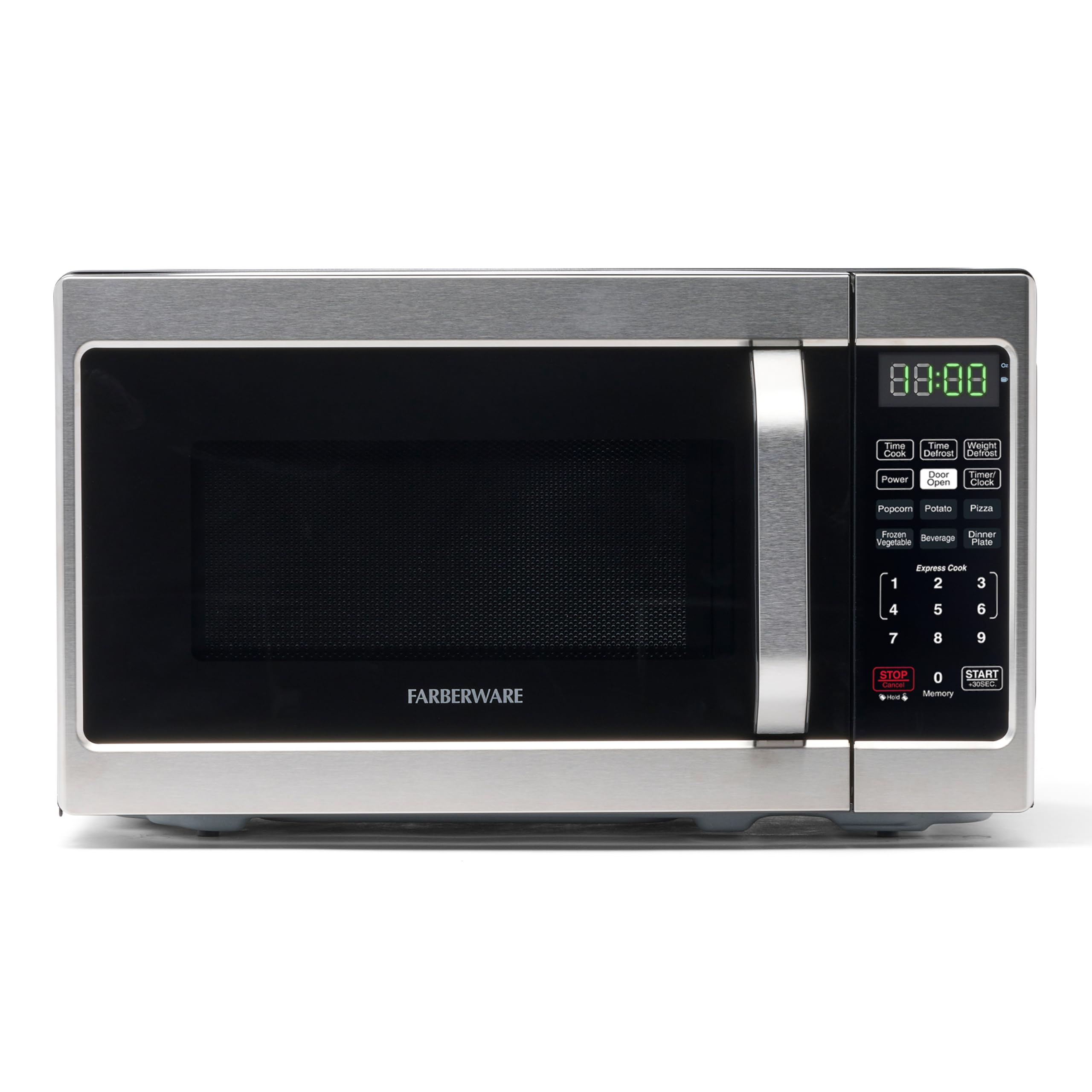
Farberware 0.7 Cu. Ft.
Key Features
- Power: 700 W
- Capacity: 0.7 cu ft
- Turntable: 10.6 in
- Dimensions: 12.99"D x 17.3"W x 10.14"H
- Price: Midrange
Stainless in a dorm room is a small gamble — the finish shows every fingerprint — but the Farberware is the one here that looks like it belongs in a kitchen rather than a hotel room. The better reason we rank it this high is inside: a 10.6-inch turntable that only the Toshiba matches and the GE beats, so a full dinner plate sits flat instead of scraping.
Ten power levels and multi-stage cooking are more control than most students will ever use; the six one-touch keys for popcorn, potato, pizza, vegetables, beverage and a dinner plate are the part that earns its keep. The interior light and the clear LED display matter more than they sound — you can see whether the plate is turning without opening the door and dumping the heat.
Where it gives ground is noise. The end-of-cycle chime is a loud one, and a loud chime carries in a single room; if you’re reheating after your roommate has gone to bed, that’s the moment the mute keys on the COMFEE’ and the Toshiba look like the better buy. Otherwise there is very little between you and a hot plate.
Pros
- 10.6-inch turntable fits a full dinner plate
- Stainless front looks like a real appliance
- Six one-touch keys cover the usual foods
Cons
- End-of-cycle chime is loud
Buy it for the stainless front and the big plate circle; this is the one we picture in a shared kitchen.
Best for Tight Budgets
Chefman RJ55-7-V2
Key Features
- Power: 700 W
- Weight: 23.8 lb
- Capacity: 0.7 cu ft
- Dimensions: 12.93"D x 17.52"W x 9.53"H
- Price: Budget
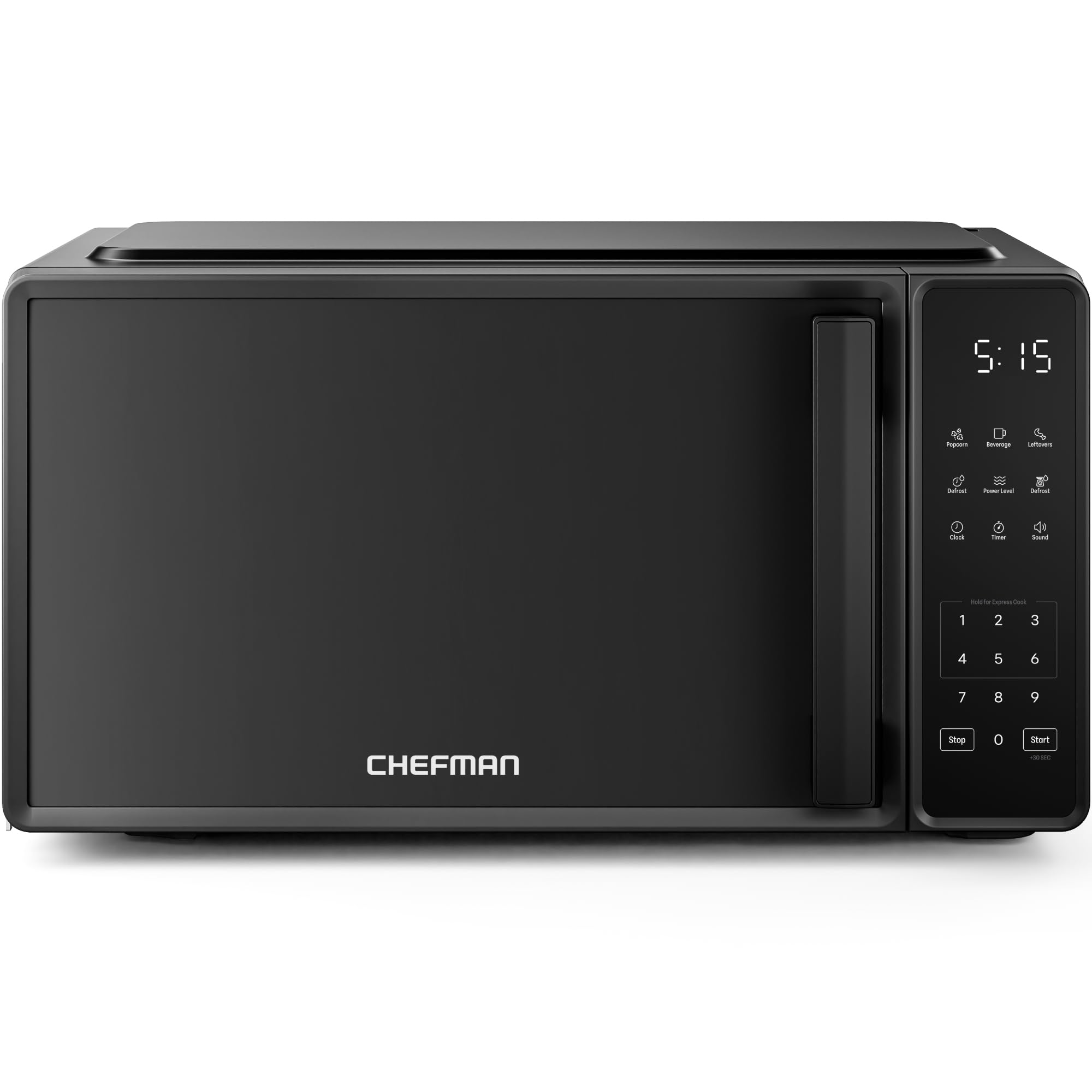
The Chefman is the least expensive oven here, and it’s also the shortest — 9.53 inches tall, which happens to be the number that matters if the microwave has to slide under a shelf or into a cubby built into a desk. That combination is why it’s the budget pick rather than just the cheap one.
We’re pleasantly surprised by how little the saving costs you in features: 10 power levels, six presets covering popcorn, pizza, beverages, vegetables, potatoes and leftovers, express keys that start cooking on a number press, and a mute button that kills the beeps. What the money doesn’t buy is speed. Seven hundred watts is the floor of this group, so the express keys are a starting point rather than a finish line.
The child safety lock is the one design decision we question. It lives on the door handle — you pull up on the top edge of the handle to get in — so the safety latch is part of the same motion as opening the door, and it’s the least intuitive entry in this group. It’s a real safeguard and we’re glad it’s there; we just notice it every time our hands are full.
Pros
- Shortest cabinet here at 9.53 inches
- Mute button kills the beeps
- Six presets plus express-cook keys
Cons
- Tight interior for a wide dinner plate
- Heaviest body here at 23.8 pounds
The budget pick we hand people first: 9.53 inches tall, six presets, and a mute key.
Best for Style-First Rooms
Frigidaire Retro 0.7 Cu. Ft.
Key Features
- Power: 700 W
- Weight: 14.5 lb
- Capacity: 0.7 cu ft
- Dimensions: 13.27"D x 18.9"W x 11.52"H
- Price: Budget
Most dorm microwaves are a black box you learn to ignore. This one isn’t: the white cabinet with rose-gold trim is the only oven here anybody will comment on, and in a room where the microwave sits in view of the bed, that’s worth more than it would be in a kitchen.
It’s also the lightest oven in the group at 14.5 pounds, which is the spec that matters on move-in day and again in May — it’s the one you can carry up three flights without a second pair of hands. Light and good-looking is the whole argument, and it’s a stronger one in a dorm than it sounds.
Underneath the paint it’s a 700-watt, 0.7-cubic-foot oven with five power levels and eight auto menus — the fewest power levels here, which matters less than it sounds when most dorm cooking is full power or defrost. The door is the quirk: it stays latched until you press stop. That’s a safety interlock rather than a fault, and it becomes routine within a day, but it is an extra press every single time.
The width is the number to take seriously. At 18.9 inches this is the widest cabinet here, and it’s also the tallest at 11.52 inches, so a shelf that swallows the COMFEE’ will not necessarily swallow this one. Measure the gap before you fall for it.
Pros
- Rose-gold retro cabinet stands out
- Lightest oven here at 14.5 pounds
- Ceramic enamel interior wipes clean
Cons
- Widest cabinet here at 18.9 inches
- Only five power levels
We like it when the microwave is furniture as much as appliance — the best-looking, lightest oven here.
Best for Shelves and Cubbies
GE GCST07N1WSS
Key Features
- Power: 700 W
- Capacity: 0.7 cu ft
- Turntable: 10.75 in
- Dimensions: 12.75"D x 17.31"W x 10.19"H
- Price: Premium
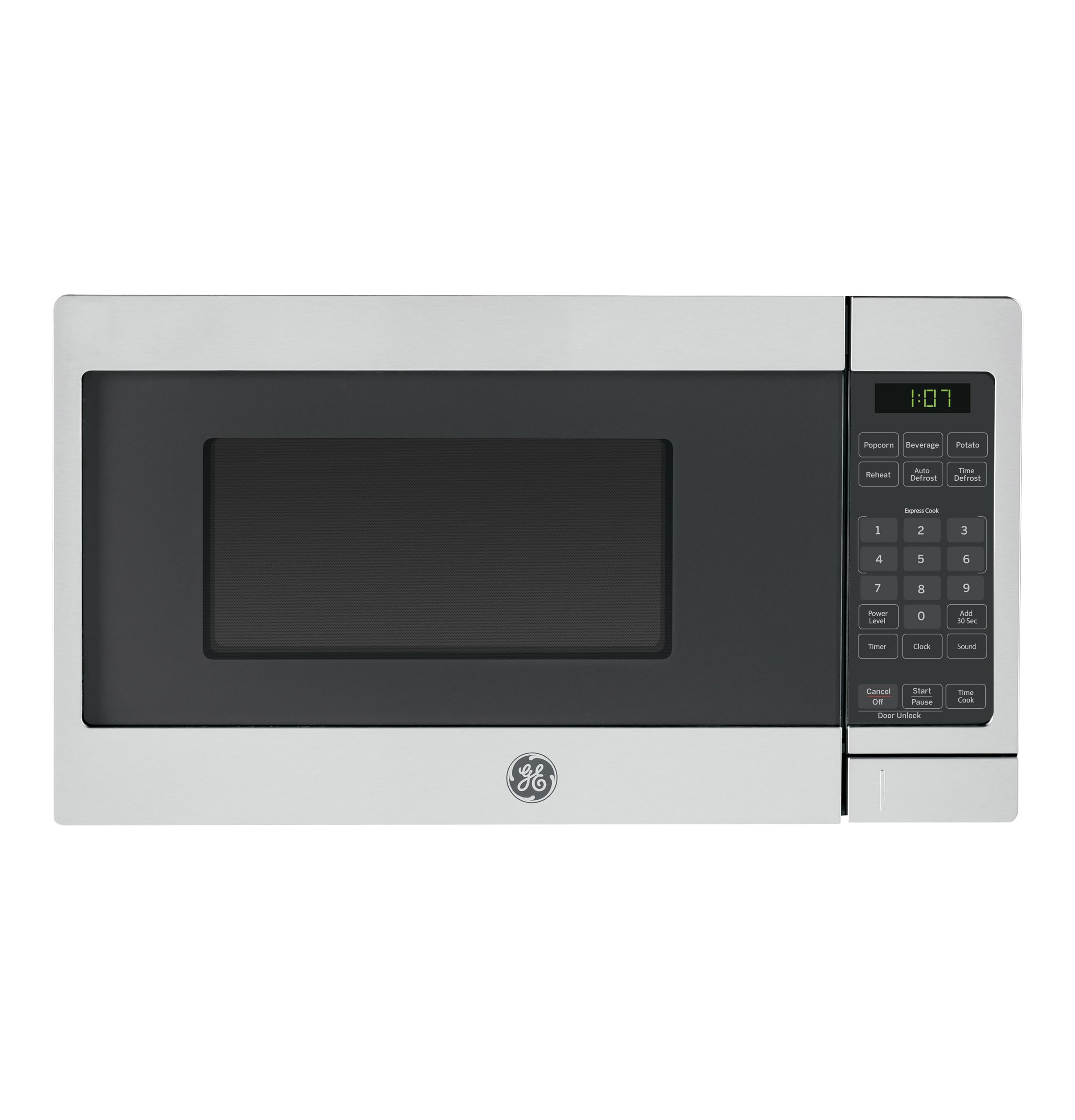
At the top of this group’s price range sits a 700-watt, 0.7-cubic-foot microwave, which sounds like a poor deal until you notice the one thing GE does that nobody else here bothers with: it tells you how much air the cabinet needs. Three inches on each side and above, one inch at the rear, nothing blocking the base. If the oven is going into a cubby built into a dorm desk, that’s the difference between a vent that works and an oven that overheats.
The hardware is respectable. The 10.75-inch turntable is the widest circle here, 10 power levels and four convenience settings cover the usual foods, and manual and auto defrost are both there for frozen dinners. It runs quietly, too, and in a room with a bunk bed that’s worth more than a preset you’ll never press.
We think the premium is hard to justify for most students. The GE is 700 watts at money the Toshiba undercuts with 900 watts and more interior room, and the one thing it clearly wins is the plate circle. What the extra buys is a stated one-year replacement warranty, worth something in a building where nobody can repair anything. For most students, though, the money goes further down this list.
Pros
- Widest turntable here at 10.75 inches
- Publishes its own clearance requirements
- Easy one-touch express cooking
Cons
- Door release sits tight against the door edge
- Keypad needs firm, accurate presses
We keep it on the list for fixed shelves: no other pick states the clearance it needs.
How We Tested Dorm Microwaves
We started by narrowing the field to compact models small enough for a residence-hall desk, then crossed the listed dimensions against the depth of a standard dorm desktop and the clearance under a lofted bed. Anything with a confusing control panel, no turntable, or a reputation for dying mid-semester got cut early, as did units that cost more than a student’s grocery budget for a month.
Each of the 12 finalists lived on a three-foot desk next to a mini-fridge. We taped the footprint and checked how far the door swung open, then loaded a 10.5-inch plate to see whether it spun without scraping the walls. We timed a mug of water to a boil, popped a bag of popcorn, and reheated leftovers, noting which models left a cold center and which turned edges to lava. Noise got measured with a decibel app at arm’s length while each unit ran, because a roommate sleeping six feet away notices everything.
We also carried every microwave up a flight of stairs, wiped splatters out of rounded versus square corners, and slammed doors shut far more often than a normal person would. Over five months each unit ran several times a day, which is how we caught keypads that stopped responding and handles that loosened. The ones that survived still heat evenly and still fit where they’re supposed to.
How to Choose a Microwave for a Dorm Room
The right dorm microwave is the one that fits the shelf you actually have, takes the plate you actually eat off, and goes quiet when your roommate is asleep; the wattage on the box comes a distant fourth.
Measure the shelf, not the room
Cubic feet describes capacity, not footprint, and that trips up more buyers than anything else here. Every 0.7-cubic-foot oven in this group is roughly 17 inches wide and 13 inches deep — bigger than most people picture when they order something called compact. Measure the top of the mini fridge, the gap beside the desk and the height under the shelf above, then compare those numbers against the cabinet dimensions.
Height is the one people forget. The Chefman is 9.53 inches tall; the retro Frigidaire is 11.52. That two-inch spread is the difference between an oven that slides into a cubby and one that lives on the floor for a year.
The turntable decides whether your plate fits
Capacity tells you volume; the turntable tells you whether the plate you eat off will spin. The ovens here run from about 9.5 to 10.75 inches of glass, and a standard 10-inch dinner plate needs the larger end of that range to turn without catching the walls. Measure your widest plate across the rim before you buy, and treat anything under 10.5 inches as a gamble if you eat out of pasta bowls.
A tight fit doesn’t break the oven. It just means you stop using it for dinner and start using it for popcorn.
700 watts is enough; 900 watts is quicker
Nearly everything in this class is 700 watts, which reheats a plate, pops popcorn and boils a mug perfectly well — just not on the schedule a bigger kitchen oven taught you. Add a minute or two rather than deciding the unit is faulty.
The one 900-watt pick here is genuinely faster and holds more, and it draws 1,400 watts doing it. That’s worth a thought if the room shares a single circuit with a mini fridge and an electric kettle.
Beeps, fans and the roommate problem
This is the criterion nobody compares and everyone notices. Three picks here have a documented mute key, and it’s the feature we protect above presets and power levels — a microwave two feet from someone’s pillow is a different appliance from one in a kitchen.
Fan and turntable noise vary too, and a rattle you can hear through a wall only turns up after the return window. Run a full cycle in the first week, while you can still send it back.
Buy for the warranty, not the badge
Every oven in this group carries a one-year warranty, and the failure worth planning for is the one that stops a unit heating inside the first twelve months; door latches and keypads are the other two places these give out. None of that argues for spending more.
It argues for buying somewhere with a painless return window, registering the warranty the day the box arrives and keeping the carton until the first semester ends. Treat the first month as the audition.
Frequently Asked Questions
Can I have a microwave in a dorm room?
That’s a housing question before it’s a shopping question. Residence halls often set their own appliance rules, including a wattage cap, and some rent out microfridge units instead of allowing a personal oven. Ask residence life for the limit and whether the room has a dedicated outlet. If the cap lands around 700 watts, every pick here except the Toshiba fits comfortably.
How do I turn off the beeping?
Look for a sound, audio or mute key on the panel. On the COMFEE’ you hold it for three seconds, the Chefman puts a dedicated Audio button on the keypad, and the Toshiba lists a mute function as well. Set it the day the oven arrives, before the first midnight bag of popcorn, and check a panel photo before ordering if a quiet room matters.
Can I put a microwave on top of a mini fridge?
Usually, if the fridge top is flat and rated for the weight — check the fridge manual first, and keep the microwave’s vents clear. Nothing goes on top of the microwave itself, and the cabinet needs the rear gap the manufacturer specifies. Around 20 pounds sits comfortably up there; the Toshiba’s 24.9 pounds is a lot of weight on a fridge lid.
How do I clean it without a kitchen sink?
Steam does the work: a bowl of water with a splash of vinegar, five minutes on high, then wipe with a sponge — softened food lifts off without scrubbing. Do it weekly rather than at the end of the semester, and skip anything abrasive on a painted or enameled interior. Oven cleaner never goes inside a microwave.
Final Verdict
The COMFEE’ EM720CPL-PMB is the one we point most students to. It fits a mini fridge top, takes a full dinner plate on its 10-inch turntable, and — the part that decides it in a single room — it can be told to stop beeping.
If the microwave is going to do real cooking rather than reheating, the Toshiba’s 900 watts and 0.9 cubic feet justify both their weight and their money. Start with the shelf you have, then the plate you eat off, then the noise.