This post contains affiliate links. We may earn a small commission when you buy through our links — at no extra cost to you.
A large-batch cold brew maker has one job it cannot fail at: keeping a full batch where you put it. Sixty-four ounces of concentrate soaking into a fridge shelf at two in the morning is the kind of cleanup that ends a product’s career in your kitchen. The good ones earn their counter space differently — you load them once, wait a day, and pour iced coffee all week for less than two café runs, from a spigot that doesn’t drip and a filter that doesn’t let silt through.
I’ve made cold brew at home for years, and I’ve learned that the gap between a clean, sweet batch and a bitter one usually comes down to the filter and how painful the thing is to take apart afterward. My team and I brewed through 12 large-batch makers over eight months, and the ones worth your money got the basics right: a seal that holds, a basket you can rinse in under a minute, and a footprint that leaves room for actual food.

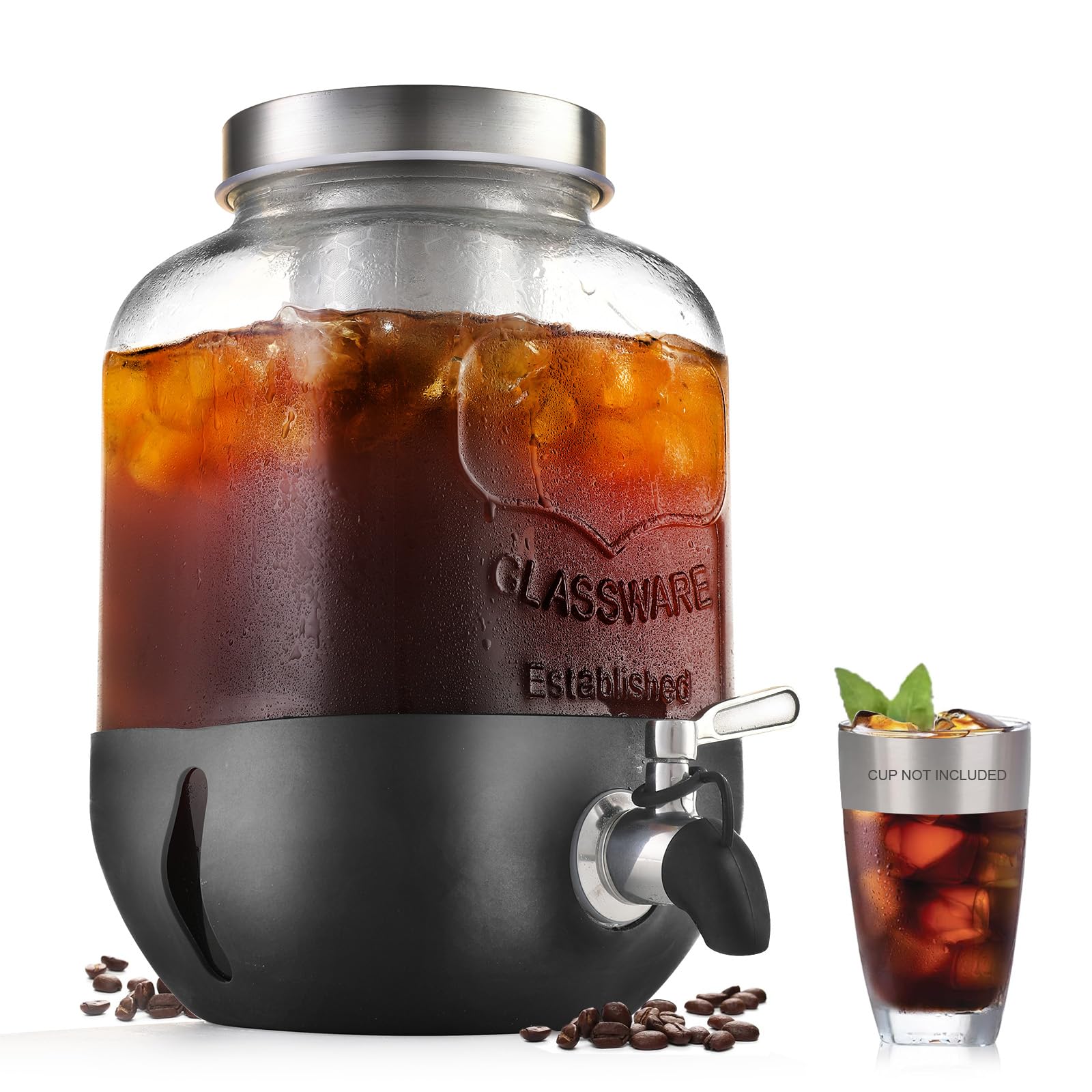


Best for Everyday Large Batches
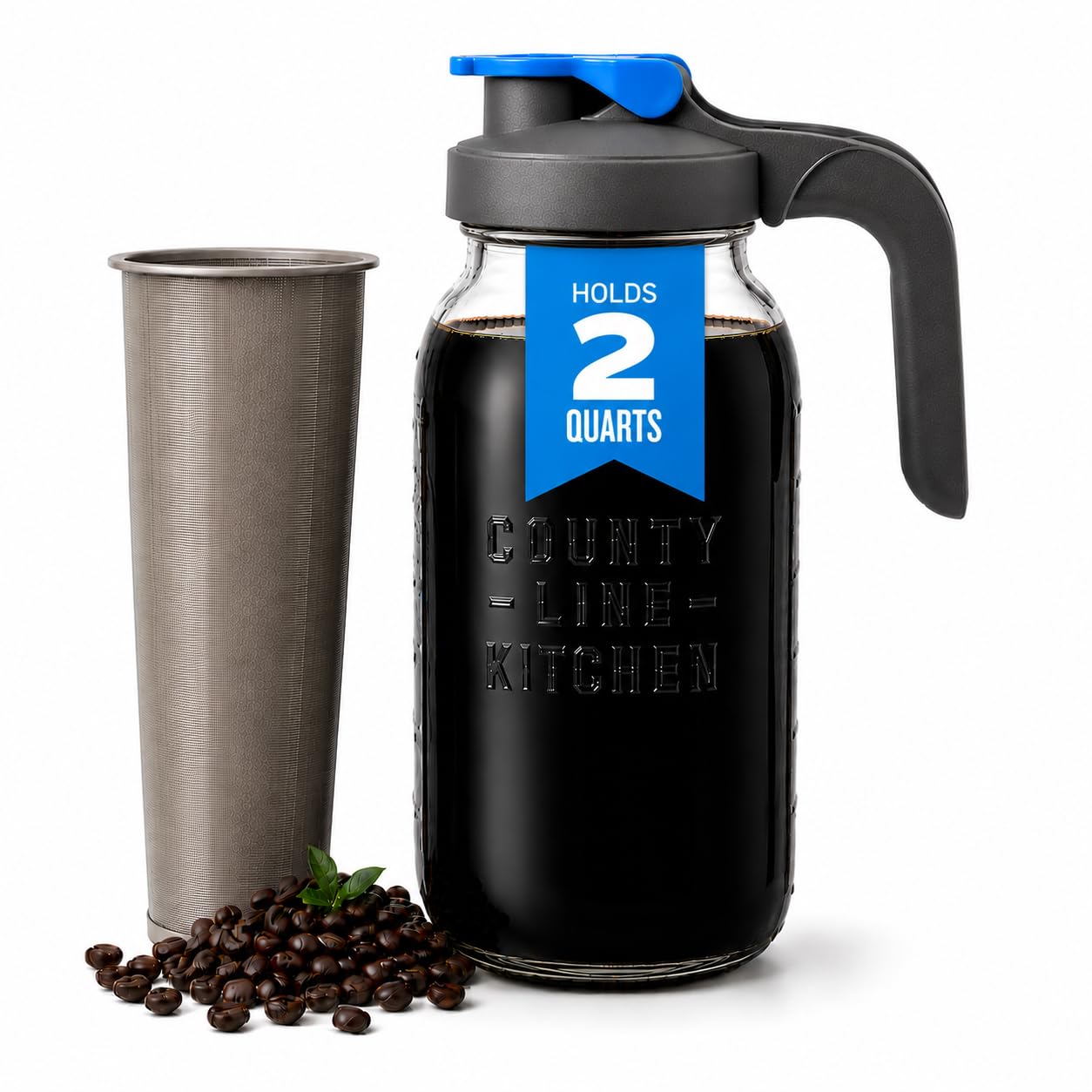
County Line Kitchen 64 oz
Key Features
- Filter: Stainless steel mesh
- Height: 10.25 in
- Capacity: 64 oz (2 quarts)
- Material: Glass
- Price: Midrange
Getting the spent grounds out of the jar is the job nobody warns you about with a mason-jar brewer, and the County Line Kitchen handles it better than anything else here. The stainless mesh basket lifts out with the coffee still inside it, so you carry one dripping cylinder to the bin instead of scooping sludge out of a jar. That is most of why it is our top pick for large batches: two quarts of brew per steep, and neither the filling nor the cleaning turns into a chore.
The jar is a wide-mouth 64-ouncer, about six and a quarter inches deep, four and a quarter wide and ten and a quarter tall, so it takes a shelf without claiming the whole row. The flip-cap lid seals hard enough that we do not think twice about a shake partway through the steep, and it pours from the cap without unscrewing anything. It is glass, so nothing sits between you and the coffee, and the handle makes a full jar manageable.
The trade is durability. Glass is glass, and a full jar set down too hard is how these end — handle it the way you would handle any mason jar and it will outlast the plastic pitchers here; treat it like a cooler and it will not. Against the gallon dispensers it is the simpler object with nothing to maintain, and against the cheaper jars it is the one whose lid and filter feel sorted rather than assembled.
Pros
- Filter basket lifts out full of grounds
- Wide mouth is easy to scrub
- Leak-proof flip cap pours without unscrewing
- Two-quart batch with no plastic in the path
Cons
- Glass can crack if it’s knocked over
Our pick for most people: two quarts at a time, a basket that carries the grounds out for you, and a lid that seals. Buy it unless you need plastic or a tap.
Best for Busy Fridges
Takeya Deluxe 2 Quart
Key Features
- Height: 9.5 in
- Weight: 12 oz
- Capacity: 2 quarts
- Material: Tritan plastic
- Price: Midrange
Plastic has a bad reputation in coffee gear, and the Takeya is the case for getting over it. The body is Tritan, which resists stains and odors and will not shatter when it goes over on a tile floor — the ending that eventually finds most glass pitchers in this group.
We reach for this one when the pitcher has to survive a crowded fridge and a dishwasher at the end of the week. The whole thing is dishwasher safe, which is more than the glass jars here promise, and at twelve ounces empty it is light enough that a full one is a one-hand carry from counter to shelf. It is also shaped for a fridge door, seven and a half inches wide by nine and a half tall, which is where ours lives.
Compared with our top pick it is the same two quarts in a body you do not have to be gentle with, and that is the whole trade: no glass heft, no glass anxiety, an extra inch of shelf width instead. If two quarts does not cover your week, skip straight to a gallon dispenser — nothing here makes a bigger pitcher that is not one.
Pros
- Shatter-proof Tritan body
- Whole pitcher is dishwasher safe
- Twelve ounces empty, easy to carry full
- Airtight lid keeps brew fresh for days
Cons
- Fine sediment can reach the last glass
- Wider body than the glass jars
The one to buy if glass in your fridge makes you nervous: shatter-proof, dishwasher-safe, and light enough to carry full, with the same two-quart batch.
Best for Entertaining a Crowd
dailybrew 1 Gallon
Key Features
- Capacity: 1 gallon
- Material: Glass and stainless steel
- Brew time: 4 to 6 hours
- Dispensing: Stainless steel spigot
- Price: Premium
A gallon is twice the batch of every jar on this page, and that is the entire argument for the dailybrew. One steep covers a week of glasses, or a table of people who all want iced coffee at the same time. If you are brewing for a household rather than a habit, nothing else here scales like it.
It is a dispenser as much as a brewer. The stainless tap means you fill a glass where the pitcher sits rather than lifting a full gallon of glass and coffee off the shelf, and the filter has a measuring line built into it, which quietly fixes the most annoying part of cold brew: guessing how much coffee you have put in. Brew time is put at four to six hours rather than overnight, so a batch started in the morning is ready by dinner.
The lid seal is the part to respect — fill to the line, keep it upright, and do not carry it by the tap. Do that and it behaves. The filter lifts out in one piece so the grounds step stays short, and heavy glass backed by a lifetime guarantee against accidental cracks makes this the least fussy gallon here.
Pros
- Gallon batch, twice the jars here
- Tap pours without lifting the pitcher
- Measuring line built into the filter
- Lifetime guarantee against accidental cracks
Cons
- Needs shelf headroom above the tap
For a household or a party, this is the one: a full gallon, a tap that saves you lifting it, and a filter that measures as you fill.
Best for Budget Two-Quart Brews
Glyntrof 64 oz
Key Features
- Filter: Mesh basket
- Capacity: 64 fl oz
- Includes: Lid, filter, brush
- Material: Glass
- Price: Budget
The Glyntrof does what our top pick does — two quarts, glass, a mesh basket, a lid you can pour from without taking it off — and it costs less doing it. That is the whole pitch, and for a lot of kitchens it is enough.
The differences are small but real. The basket is tall and narrow, so a full load of grounds does not all end up under water straight away; a stir at the start of the steep is the difference between a strong batch and a thin one. Otherwise the routine is familiar: screw the lid down over the filter, steep overnight, lift the basket out, pour from the spout. A brush comes in the box for the mesh.
What has surprised us is how little you give up at this price. The glass is thick, the seal holds, and the flip spout stays put when you tip the jar. It is the one we point people toward when they want to try a two-quart habit without spending much, and it is cheap enough to buy twice — one steeping in the fridge while the other gets emptied.
Pros
- Two quarts for less than the top pick
- Flip spout lid stays put when pouring
- Includes a brush for the mesh basket
- Thick glass with a tight seal
Cons
- Lid is the flimsiest part of the kit
The value pick: the same two-quart glass job as our top pick for noticeably less, with a decent seal and a brush in the box.
Best for Back-To-Back Batches
JunVpic 2-Pack 64 oz
Key Features
- Filter: Mesh filter
- Capacity: 64 fl oz per jar
- Material: Soda-lime glass
- Pack size: 2 jars
- Price: Midrange
Cold brew has a scheduling problem: the batch you are drinking is the batch that is still steeping. The JunVpic bundle answers it by selling two 64-ounce jars for about what one of the nicer singles costs, so one sits in the fridge and one sits on the counter.
Two jars turn out to be more useful than any single upgrade on this list. You can run a light roast and a dark one, keep a jar of iced tea going for the non-coffee drinkers, or simply stagger the brews so a morning never starts with an empty pitcher. Both jars take the same flip-cap lid, the same mesh filter and the same wide mouth, so there is nothing new to learn with the second one.
The jar is tall and narrow — about four and a quarter inches across and ten tall — so it tucks into a fridge door shelf or the gap beside the milk. The mesh is fine enough that most of the grit stays in the basket, and the wide mouth makes the rinse quick. It is a plain design done properly, twice.
Pros
- Two jars, so one is always ready
- Costs about what a single premium jar does
- Narrow body fits a fridge door
- Fine mesh keeps most grit out
Cons
- Lid can seep if it isn’t seated squarely
- Glass jars can crack when knocked
Two jars for about the price of one nice single, so a batch is always ready while the next one steeps. Buy it if you drink cold brew daily.
Best for Tight Fridge Shelves
Jrssae 64 oz

Key Features
- Filter: 160-micron stainless steel
- Capacity: 64 fl oz
- Includes: Mixing spoon, filter
- Warranty: 360 days
- Price: Budget
The Jrssae ships with a mixing spoon, which sounds like filler until you have tried to stir a jar of grounds with a butter knife. It is a small thing, but it says someone thought about the whole process rather than just the vessel.
The filter is a conical 160-micron stainless basket, as fine as any mesh here, and it sits deep in the jar so the water has to travel through the whole bed of coffee on its way to the spout. The parts come apart for the dishwasher, the glass is a standard wide-mouth jar that is easy to see through and easy to scrub, and at under four inches across it is the narrowest 64-ouncer in this group — it goes where a wider pitcher will not.
It is a small operation, and that is the appeal: fewer parts, no tap, nothing to break except the glass. The 360-day warranty is the longest of the jar makers here, though the glass is the part that actually fails. It is not the first one we reach for, but it is a tidy, inexpensive way into a two-quart habit, and the spoon genuinely gets used.
Pros
- 160-micron conical filter catches fine grit
- Mixing spoon included and actually useful
- Narrow body fits tight fridge gaps
- Longest jar warranty here at 360 days
Cons
- Glass can arrive cracked — check before first use
A narrow, tidy two-quart jar with a fine conical filter and a spoon in the box — a good budget start for one person.
Best for Budget First Setup
QHH 64 oz

Key Features
- Filter: 160-micron stainless steel
- Height: 8.4 in
- Capacity: 64 fl oz
- Max temperature: 140°F (60°C)
- Price: Budget
A limit worth repeating before anything else: do not pour boiling water into the QHH. The jar is rated to a maximum of 140°F, so no kettle shortcuts and no going straight from a cold fridge to hot tap water. Warm soapy water and a good rinse is how you clean it.
The rest of the package is a 64-ounce mason jar with a 160-micron stainless filter, a pour-spout lid and a cleaning brush. The flip top seals well but takes some force to open, and wet hands make it worse; it also does not snap shut with the solid click the lid’s looks suggest.
Brewing is the usual routine and the results are clean: the mesh holds the grounds, the spout pours without lifting the lid, and the jar wipes out easily. It is a decent, inexpensive way to get two quarts going, and the brush earns its place the first time you rinse the filter.
Where it fits is a first cold brew setup, a second jar for tea or decaf, or a gift for someone who will brew and chill and nothing more. Where it does not is any kitchen that treats a pitcher as a general-purpose hot-drink vessel, because that temperature ceiling is not a suggestion.
Pros
- 160-micron filter keeps the pour clean
- Brush included for the mesh
- Pour spout saves removing the lid
- Budget-friendly two-quart setup
Cons
- Flip top is stiff to open
- Lid doesn’t click shut firmly
A budget two-quart jar with a fine filter and a brush; just keep hot water out of it. Good for a first setup or a second jar.
Best for Party Dispensing
Zulay 1 Gallon

Key Features
- Capacity: 1 gallon (128 oz)
- Material: Glass and stainless steel
- Warranty: Lifetime
- Dispensing: Steel spigot
- Price: Premium
The spigot is the point of the Zulay. It turns a gallon of cold brew into a dispenser you serve from the shelf, which is genuinely nice at a brunch or over a long weekend, and it means nobody has to lift a full gallon of glass and coffee to pour a glass.
It is thick glass with a stainless filter and lid, and the filter lifts out in one piece for washing. The tap has a cover that keeps the spout clean between glasses, and the body is wide enough to get a hand and a bottle brush inside. The paperwork is thin — there is no measuring guide on the filter and the instructions will not teach you the tea side — so plan on finding your own ratio.
The tap is also the part that asks for care: open it all the way rather than halfway, and give the pitcher a shelf where a stray drip will not ruin anything. That is the honest cost of serving from a tap in a fridge.
Our take: it is the right shape for entertaining and the wrong one for a shelf you cannot afford to mop. If you want a gallon without a tap, the dailybrew is the better-behaved choice; if pouring without lifting is the whole reason you are buying, this one does it and does it well.
Pros
- Serves straight from the fridge shelf
- Gallon batch built for entertaining
- Filter lifts out in one piece
- Covered tap keeps the spout clean
Cons
- Glass can crack around the spigot
The entertaining pick: a gallon you serve from the shelf, as long as the tap gets a spill-tolerant spot and a careful hand.
How We Tested Large-Batch Cold Brew Makers
We started by gathering every maker we could find that claims 2 quarts or more, then cut anything without a replacement filter or basket sold separately — a cheap maker with no parts is a one-season purchase. From there we narrowed by capacity, footprint, and price, and landed on 12 units, which we brewed with on and off for eight months.
Each maker got at least three batches, split between my kitchen and a colleague’s, using the same medium-coarse grind and the same concentrate ratio so the coffee itself wasn’t the variable. We steeped at 16 hours and again at 20 to see which ones turned bitter first, then tasted each concentrate black and over ice with milk: thin and watery, or heavy enough to hold up. We also watched how much sediment slipped through the filter, since a mesh basket that lets silt past ruins the last glass of the batch.
Leaks got their own test. We filled every maker to the line, tipped it toward the spigot, and set it on a fridge shelf over a white paper towel for two days to catch anything that wept. Disassembly was timed — lid off, basket out, rinse, back together — and we noted whether the parts were dishwasher safe and whether the mesh held onto coffee oils after a plain rinse. Each footprint got measured against a shelf that also has to hold a gallon of milk, and we tracked cost per quart plus replacement filter pricing to see which ones genuinely save money over the café habit.
How to Choose a Large-Batch Cold Brew Coffee Maker
Three things decide a large-batch cold brew maker: how much you drink in a week, what the pitcher has to survive in your fridge, and whether you want to lift it or pour from a tap.
Match the batch to your week
Sixty-four ounces — two quarts — is the sensible floor for a large batch, and most of the brewers here sit exactly there. The dispensers double it. The honest question is how fast your household goes through a batch: if two quarts lasts four or five days, a jar is plenty and you will spend less on it.
If it lasts two days, you will be brewing constantly, and the gallon is the thing that stops cold brew from becoming a chore. Count the glasses you actually drink in a week before you count anything else.
Glass or shatter-proof plastic
Glass is the default for good reasons: it does not hold odors, you can see how dark the brew has gone, and nothing sits between the coffee and the jar. The cost is weight and fragility — a full two-quart jar is a two-handed object, and a drop onto tile usually ends it.
Tritan, the plastic the Takeya uses, is the pragmatic answer for a crowded fridge or a dishwasher, and it will not shatter. Our advice: glass if the pitcher lives on a quiet shelf, plastic if it shares space with lunchboxes and children.
Measure the shelf, not just the jar
The two-quart brewers here run roughly eight to ten and a half inches tall and four to seven and a half inches wide, which is the difference between fitting under a shelf and not fitting at all. Measure the gap, then add two inches of headroom so you can lift the jar out without scraping the shelf above.
If you are buying a dispenser, the tap needs clearance above it and a clear run in front for a glass. A gallon on a crowded shelf is a gallon you cannot pour from.
Filters: mesh, basket shape, and the grounds
Fineness gets quoted in microns, and 160 is the finest mesh in this group: finer mesh means less grit in the glass but a slower drain. Basket shape matters just as much — a tall narrow basket holds more coffee in less water, while a wide one wets more evenly.
Whichever you choose, rinse the basket the moment it comes out of the jar, because dried grounds set like cement in a mesh, and keep a small brush for the corners.
Lids, taps, and the mess you will tolerate
A sealed flip cap lets you shake the jar mid-steep and pour without unscrewing anything. A screw lid is simpler and slower. A tap is the most convenient and the most likely to drip, and a jar with a spigot has two seals to check rather than one.
Test any seal over the sink before the pitcher earns a shelf. If a stray drip would ruin something in your fridge, buy the jar without the tap.
Frequently Asked Questions
How much ground coffee should I use for a 64-ounce batch?
Start with about 8 ounces of coarse grounds for a 64-ounce jar — roughly one part coffee to eight parts water by weight — and adjust after the first steep. Coarse, like raw sugar, keeps a mesh basket from clogging.
If the result tastes weak rather than bitter, add grounds before you add hours.
How long does cold brew last in the fridge?
A week or two, and the lid matters less than what you do after the steep. Pull the filter out once the coffee reaches the strength you like, because grounds left sitting in the jar keep extracting and turn the batch bitter.
Covered and cold it holds its flavor; on the counter it will not.
Can I use these pitchers for iced tea or lemonade?
Yes — the same basket that holds coffee grounds holds tea leaves and fruit. Glass is the better choice for anything flavored, since it does not hang onto aromas the way plastic can.
Rinse the mesh with a brush rather than the dish sponge, or the next batch of coffee will taste of last night’s lemon.
Do I need paper filters as well?
No. Every brewer here includes a reusable stainless or mesh basket, and that is the point of the design. Paper will give you a cleaner cup if fine grit bothers you, but you lose some of the oils that make cold brew taste like cold brew, and you sign up to buy filters forever.
Final Verdict
The County Line Kitchen is our recommendation: two quarts at a time, a basket that carries the spent grounds out with it, and a lid that seals, for less than the plastic pitcher and either dispenser. Move to the Takeya if glass in a busy fridge makes you nervous, to the dailybrew if a gallon has to serve a crowd, and to the Glyntrof if you want the same two quarts for the least money.
The rest of the list is a variation on those four decisions.