This post contains affiliate links. We may earn a small commission when you buy through our links — at no extra cost to you.
Cold brew is supposed to be the low-effort coffee: grounds into water, walk away, strain, drink. The strain is where it falls apart — a filter that lets a snowstorm of silt through, a lid that dribbles concentrate across a fridge shelf, a carafe that takes ten minutes and a bottle brush to clean. I’ve made concentrate on my own counter for years, and the gap between a good cold brew maker and a bad one is almost never the beans. It’s the filter, the seal, and whether you dread the cleanup the next morning.
Over the past six months, my team and I have steeped with 12 makers, from mason-jar inserts to immersion towers, and the winners share one trait: you can run them half-asleep and clean them in under two minutes. Here’s something a first-time buyer rarely hears — grind size matters more in cold brew than in any hot method, and a filter that handles coarse grounds fine will still clog on a fine one. The picks below span the batch sizes, footprints, and budgets people actually shop for.


Best for Most Households
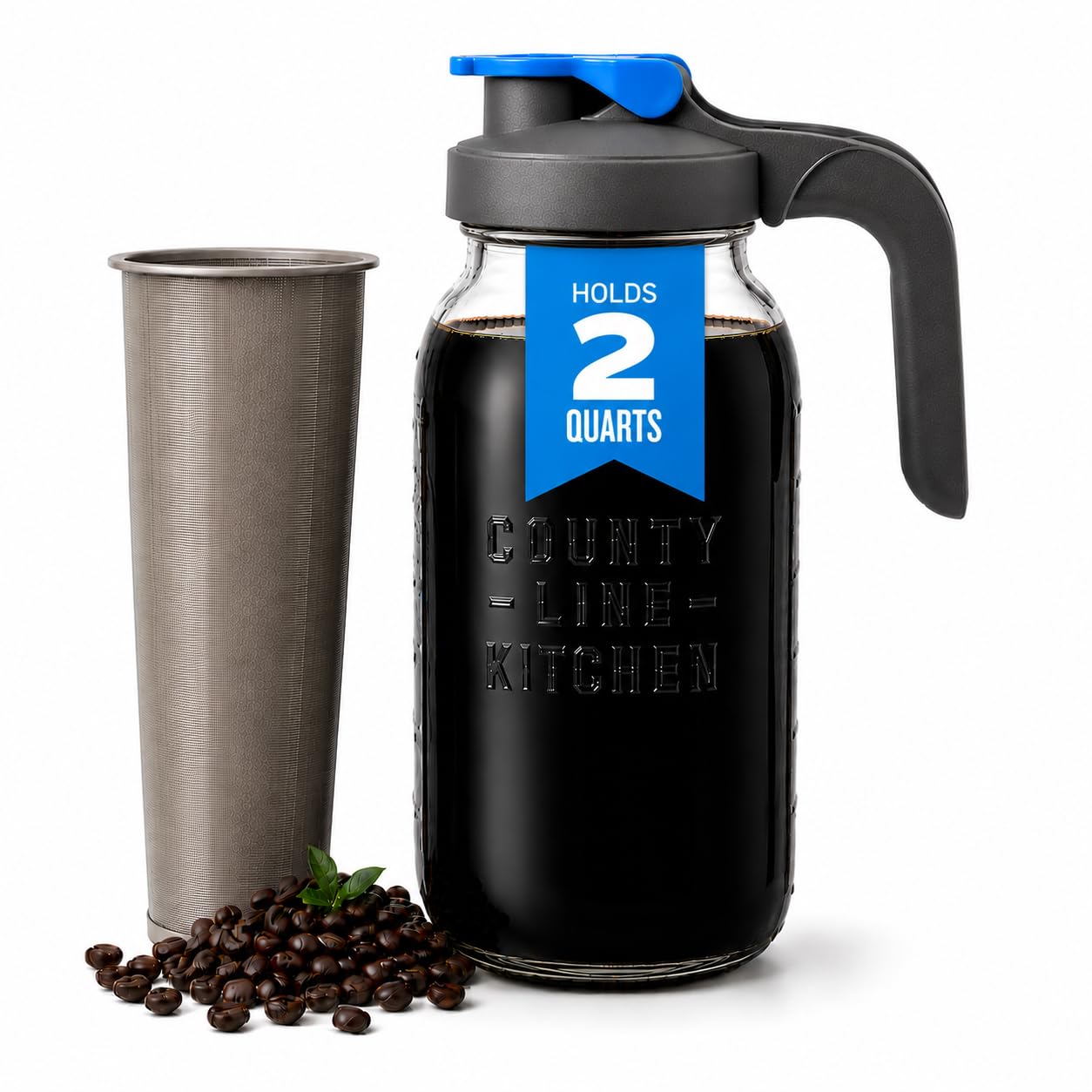
County Line Kitchen 64 oz Cold Brew Maker
Key Features
- Lid: Leak-proof flip cap
- Filter: Stainless steel mesh basket
- Capacity: 64 oz (2 quart)
- Material: Soda-lime glass
- Price: Midrange
A full two-quart jar of cold brew is heavier than it looks, and the flip cap on this lid is why we hand it to people first: thumb the cap open and pour, no unscrewing a band while the jar tips. The seal holds, too, so the jar can lie on its side on a crowded shelf without leaving a ring of coffee underneath it.
Inside, the stainless basket holds the grounds and lifts out by the rim, so spent coffee comes out as one plug instead of a slurry you chase around the sink. The wide-mouth mason jar is the other half of that: a sponge fits through the opening and there is no narrow shoulder to scrub blind. We appreciate that the parts are few — jar, basket, lid — because there is nothing to disassemble at seven in the morning.
Sixty-four ounces is about a week of concentrate for one person and a few days for two, and because the body is clear glass you can see how much is left without lifting it. The handle makes the trip from counter to shelf easy, though a full jar still wants a hand underneath. Fill to the line rather than to the rim once the basket is in, or the water pushes grounds over the top.
The catch is the material. Soda-lime glass does not forgive a knock against a tile floor or a hard sink edge, and that is the one thing keeping this from being an unqualified pick. If breakage is the risk you cannot take, the Takeya does the same job in Tritan. For everyone else, this is the cold brew maker to buy, and it costs well under the Takeya.
Pros
- Flip cap pours one-handed, no unscrewing
- Basket lifts out with grounds intact
- Wide-mouth jar is easy to scrub
- 64 ounces covers a week for one
Cons
- A little fine silt settles in the last glass
The best all-round cold brew maker here: 64 ounces, a filter that lifts out clean, and a flip cap you can pour from one-handed.
Best for Households Avoiding Glass
Takeya Deluxe Cold Brew Maker
Key Features
- Filter: Fine-mesh cylinder
- Capacity: 2 quarts
- Material: Tritan (shatter-proof)
- Dishwasher: Dishwasher safe
- Price: Premium
Tritan instead of glass is the entire argument for this pitcher. It is shatter-proof, it resists stains and odors, and when it goes over on the counter — and a two-quart pitcher does go over — nothing breaks and the lid keeps the coffee where it belongs.
We think that makes it the pick for a busy kitchen: kids, tile floors, a pitcher that gets carried to the table. The lid seals properly, so a batch keeps its flavor for days instead of picking up whatever else is in the fridge, and every part comes apart for washing.
The filter is a fine-mesh cylinder that stands in the middle of the pitcher with the grounds packed inside it. Pull it out before pouring, or the coffee runs back through the spent grounds on its way to your glass — a step that is easy to forget the first morning and automatic by the third.
Two quarts is the ceiling, and the grounds cylinder wants a brush rather than a rinse. In a house where more than one person drinks cold brew, you will be brewing twice a week rather than once, which is the real cost of choosing plastic over a bigger glass jar.
Pros
- Shatter-proof Tritan shrugs off knocks
- Airtight lid keeps a batch fresh
- Every part separates for washing
- Fits most fridge doors at two quarts
Cons
- 12.2 inches tall, too tall for some dishwasher racks
A shatter-proof pitcher that survives a busy kitchen; buy it if glass on the counter makes you nervous.
Best for One-Person Batches
Hario Mizudashi Cold Brew Maker
Key Features
- Filter: Fine-mesh basket
- Height: 11.6 in
- Capacity: 1000 ml (5 cups)
- Material: Heatproof glass
- Price: Budget
Just under 12 inches tall and barely 4 inches wide, this is the brewer to measure your fridge shelf for. There is no handle, the glass is thin-walled, and the whole thing is built to go from the fridge to the table as it is — the narrow spout pours a slow, controlled stream instead of sloshing.
The mesh basket holds 1000 ml, about five cups, which is a personal batch rather than a family one. Coarse grounds go in the basket, water to the line, overnight in the fridge, and the basket lifts out in the morning. The mesh is fine enough for a clean cup, and the basket feels delicate when it is wet, so rinse it under a slow tap rather than knocking it against the side of the sink.
This is the one we reach for when the batch is for one person and the carafe is going straight to the table, and it is the best-looking brewer in this roundup by a distance. The spout is what sells it: you can pour a glass at the table without a funnel or a very steady hand.
Pros
- Brews and serves from the same carafe
- Narrow spout pours without drips
- Fine mesh basket rinses clean
- Handsome enough for the table
Cons
- Tall, handle-less glass is easy to knock over
For one person brewing five cups at a time, this is the prettiest way to brew and serve from the same carafe.
Best for Tight Budgets
Glyntrof 64 oz Cold Brew Pitcher
Key Features
- Filter: Stainless steel mesh
- Capacity: 64 oz
- Included: Filter and cleaning brushes
- Material: Glass
- Price: Budget
This is the least expensive 64-ounce jar here, and it does not behave like a compromise: thick glass, a basket woven tightly enough that grounds stay put, and a lid that seals for fridge storage. That combination is why it stayed in the roundup instead of being treated as the cheap also-ran.
Two small things earn it a place beyond the price. It ships with cleaning brushes, and the brewing basket is the fussy part to wash, so having the right brush in the box saves you improvising with a bottle brush. And the pour spout means the jar goes from steeping to the fridge to the table without a decanting step.
The thing to know is pace. Sixty-four ounces is about a week for one person drinking a glass a day and closer to three days for two, so if you are brewing for a household, two of these costs more than the VA1KENE pair and takes up twice the shelf.
Pros
- Cheapest 64-ounce jar in this roundup
- Ships with brushes for the filter
- Spout lid seals for fridge storage
- Basket keeps grounds out of the glass
Cons
- Lid feels light on a full jar
The budget pick: the same 64-ounce glass-jar job as our top pick, with brushes in the box and a lighter lid.
Best for Fine Filtration
JunVpic 64 oz Cold Brew Pitcher

Key Features
- Lid: Leak-proof flip spout
- Filter: 100-micron stainless mesh
- Capacity: 64 oz
- Material: Soda-lime glass, 4.15 mm
- Price: Budget
Two details separate this jar from the others in the roundup: a 100-micron stainless weave, as fine as anything here, and a flip lid that stays open on its hinge while you pour instead of dropping into the stream. The thick 4.15 mm glass is the third thing you notice in the hand.
We rate it a step below the top picks, and the reason is the seal. The gasket and spout decide whether a 64-ounce jar can be shaken, tipped, or carried in a bag, and the seal is the part to test before you trust it: fill the jar with water, invert it over the sink, and check the ring is seated.
Do that and the rest is solid. The wide mouth cleans easily, 64 ounces is enough for a week of concentrate, and the flip cap staying up means one hand can hold the glass while the other steadies the jar. It is the pick for someone who wants a plain, well-made jar and does not mind checking the lid once.
Pros
- 100-micron mesh leaves little grit
- Flip lid stays up while pouring
- Thick 4.15 mm glass feels solid
Cons
A well-finished 64-ounce jar with fine 100-micron filtration; check the gasket before you trust it with a full batch.
Best for Brewing Ahead
VA1KENE 2-Pack Cold Brew Maker

Key Features
- Filter: 100-micron stainless mesh
- Capacity: 64 oz each
- Material: Glass
- Pitchers included: 2
- Price: Midrange
The second jar is the feature. One holds a finished batch in the fridge while the other steeps on the counter, so you are never caught on a morning when the cold brew ran out the night before.
You get two 64-ounce glass jars, two 100-micron stainless filters, two sealing lids with handles, and two cleaning brushes — the same kit twice, which is what makes it work as a system rather than a spare. The handle is contoured and easy to hold with a full jar, and the lids seal well enough to give the pitcher a shake before it goes back in the fridge. The second filter turned out to matter as much as the second jar: one rinses while the other dries.
For a household that empties a batch every few days, this is the most practical setup in the roundup, and it costs about what the top pick does for a single jar. The trade is upkeep — two filters to rinse, two jars to wash, and a brew schedule to stay ahead of.
Pros
- Two jars keep a batch always ready
- Two filters and brushes included
- Handled lids seal for shaking
Cons
- Fine grit slips through the filter
Two jars for roughly the price of one good one, so there is always a batch ready while another steeps.
How We Tested: Six Months, Twelve Pitchers, a Lot of Grounds
We started with a shortlist of about 40 makers pulled from retailer listings, brand catalogs, and the ones readers keep asking about, then narrowed it by what actually decides whether you’ll use one: brewing capacity, filter type, footprint on a counter and a fridge shelf, whether the parts are dishwasher safe, and price. Twelve made the cut, all in a range a normal person would spend. Every unit got the same coffee, ground coarse on the same grinder, at the same ratio, so any difference in the glass came down to the maker.
Brewing happened on a real kitchen counter, not a bench. Each pitcher went into the fridge at night and came out the next morning; we tasted at 12, 16, and 24 hours to catch where the concentrate turned bitter or went thin, then diluted it over ice and looked for grit at the bottom of the glass. We also filled each one to capacity, flipped it upside down over the sink for a full minute, and carried it to the fridge by the handle to catch leaks, weeping seams, and lids that don’t seat.
Cleanup was timed the morning after every batch — how long the grounds took to knock out of the mesh, whether they caked into the corners, whether the pieces came out of the dishwasher clouded or cracked. Durability notes piled up as the weeks went: hinges that loosened, silicone seals that stretched, lids that stopped sealing by month four. Value came last, and we compared the ounces of concentrate each maker yields against its price rather than judging on sticker price alone.
How to Choose a Cold Brew Coffee Maker
Every brewer here is the same three parts — a jar, a filter, and a lid — so the decision comes down to how big a batch you want, how clean you need the cup, and how much glass you are willing to own.
Start with the batch, not the brew method
The capacity on the box is the volume of the vessel, not the number of ounces you pour. A 64-ounce jar with a basket and a bed of grounds gives you noticeably less than 64 ounces, and concentrate stretches further again once it meets ice or milk. We size by the glass rather than the jar: Hario’s 1000 ml carafe is a personal batch, while the 64-ounce jars are about a week for one person and a few days for two. Count what you actually drink before you size up.
Finer mesh does not rescue a fine grind
Mesh is measured in microns, and the finest filters in this roundup are woven to 100. A tight weave keeps more grit out of the glass, but it also slows the steep and clogs if the grounds are too fine. The sediment people blame on the filter is usually a grind problem. Grind coarse, roughly the texture of raw sugar, and leave the basket loose rather than packed. A clean cup comes from the grind and the weave working together, not from the smallest number on the box.
The lid is what you live with
Pouring a full two-quart jar is the moment that decides whether you like a brewer. A wide-mouth mason jar with a plain screw band dribbles down the side; a flip cap or a molded spout lets you pour one-handed and set the jar back without wiping the counter. If the jar will travel — to work, to a picnic, onto a crowded shelf on its side — the gasket matters more than capacity. The flip cap on our top pick and the airtight lid on the Takeya are the two best seals in this set.
Glass or shatter-proof plastic
Glass shows you the brew, does not hold onto flavors, and feels better in the hand. It also breaks. Tritan is the opposite trade: it survives being knocked off a counter and can go in the dishwasher, at the cost of the look and the heft of glass. Decide by household rather than preference. If the pitcher lives on a crowded counter or gets carried around, the Takeya’s plastic body is the safer buy. If it stays on one fridge shelf, glass is the pleasanter object.
Measure the shelf and the dishwasher
Most of these brewers stand 10 to 12 inches tall, which is more than plenty of fridge shelves allow once something sits on the shelf above. Measure the gap before you order, and remember a full jar is heavy enough that a door bin may not be the answer. Dishwasher safe is conditional too: a 12-inch pitcher that clears your machine’s top rack is rare, and a narrow filter cylinder wants a brush either way.
Frequently Asked Questions
How long does cold brew last in the fridge?
A sealed jar of concentrate is good for about a week, and it holds up better than a batch you have already diluted with water or milk. Take the filter basket out once brewing is done, write the date on the lid with a marker, and taste before you pour a second week out of it. Glass is the better long-term container here because it does not pick up stale coffee smell.
Can I brew hot tea or pour boiling water into these jars?
Not in the mason jars. They are soda-lime glass, and a jump from fridge-cold to boiling is how a jar cracks — that is a material limit, not a defect. The Hario carafe is the one here made from heatproof glass, so it is the one to use for a hot brew. Otherwise let the jar come to room temperature first and add hot liquid slowly.
Is it cheaper to make cold brew at home?
Yes, after a handful of batches. The savings come from buying grounds instead of cups, plus however far a concentrate stretches once you dilute it. If cost is the point, put the money into capacity rather than features: a bigger jar at a lower price saves more per glass than a smaller one with nicer trim. Grounds are the recurring cost, the brewer a one-time one.
Final Verdict
The County Line Kitchen jar is the cold brew maker we point most people to: 64 ounces, a basket that lifts out with the grounds in one piece, and a leak-proof flip cap that makes pouring a full jar a one-handed job. Buy the Takeya instead if glass in your kitchen is a liability — same capacity, shatter-proof body — or the Hario if you brew for one and want to serve from the same carafe.