This post contains affiliate links. We may earn a small commission when you buy through our links — at no extra cost to you.
A glass of cold water at 9 p.m. should be the easiest thing in the house, and yet the tap pours something that smells faintly of a swimming pool and finishes with a flavor best described as garden hose. That is exactly the gap a filter pitcher fills: it turns the water you already pay for into water you’ll actually drink, no case-hauling from the store and no under-sink installation required. The catch is that they all promise the same thing, and only some of them are pleasant enough to keep using past the first week.
I’ve kept one on my counter for years, and the letdowns are almost never about the water — they’re about the lid that won’t snap back on, the reservoir that takes ten minutes to trickle through, the base that won’t clear a fridge shelf. Over the past four months we’ve put 14 pitchers through daily use in my kitchen and a colleague’s, and the ones worth owning get those boring details right. One thing first-time buyers don’t realize: most pitchers rely on the same handful of filter technologies, so the real difference is fit, pour, and how the lid behaves at 7 a.m. with one hand. The picks below are grouped by what each one does best.



Best for Everyday Family Use
Waterdrop PT-07B
Key Features
- Capacity: 10 cups
- Dimensions: 10"L x 5"W x 10.1"H
- Filter Life: 200 gallons or 3 months
- Certifications: NSF/ANSI 42 & 372
- Price: Budget
The 200-gallon filter is the number that makes the PT-07B worth a closer look. It is rated for about three months, while the standard Brita filter in the Metro is rated for 40 gallons and two months. If you fill a pitcher every day, that difference turns into fewer filter changes and less shopping.
That long filter matters less if the pitcher is a pain to use, but the hands-free lid is the detail we appreciate most. You can fill it straight from the tap without lifting the cover, and the 10-cup body still fits a fridge shelf at 10 by 5 by 10.1 inches. For a household that drains a pitcher at breakfast and again at dinner, this is the one we reach for.
The filtration claims are backed by NSF/ANSI 42 and 372 certifications, and the pitcher is built for everyday tap water rather than a whole-house problem. We also like that the replacement filter is a single, clearly named part rather than a confusing family of cartridges. The 2.4-liter body is large enough for a family breakfast and narrow enough for a fridge shelf.
The PT-07B is not the prettiest pitcher here—the blue plastic is purely practical—but that is the right trade for a tool you refill every day. We did not find a deal-breaking weakness. If you want a pitcher that simply works and rarely needs a new filter, this is the one.
Pros
- 10-cup capacity suits a busy household
- Hands-free lid speeds up refills
- 200-gallon filter lasts about three months
- NSF/ANSI 42 and 372 certified
Cons
We recommend the PT-07B as the default pitcher for most kitchens: it holds 10 cups, fills without removing the lid, and its filter lasts about three months.
Best for Brita Filter Owners
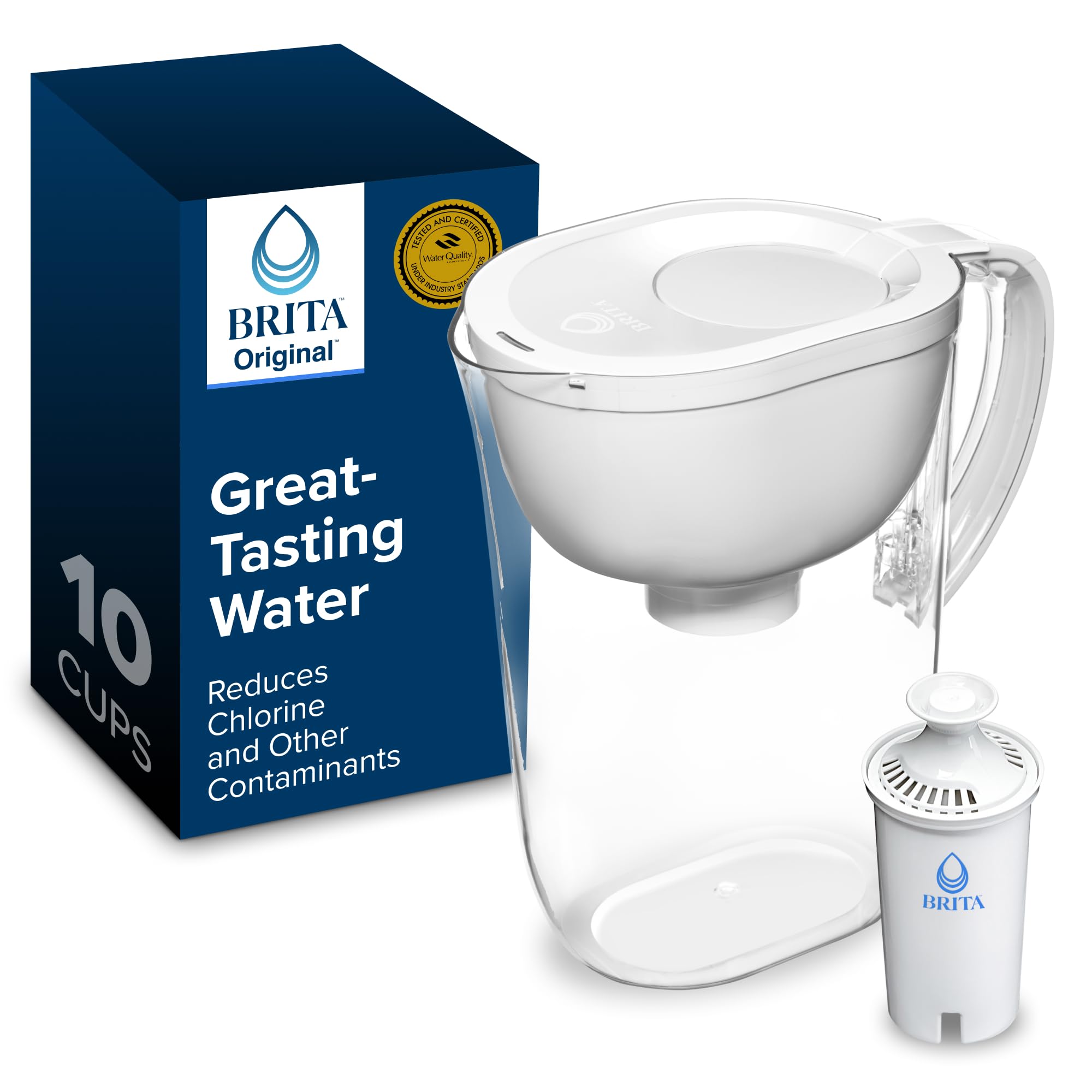
Brita Large 10 Cup
Key Features
- Capacity: 10 cups
- Dimensions: 10.7"L x 5.4"W x 10.1"H
- Filter Life: 2 months (included filter)
- Certifications: WQA and NSF/ANSI
- Price: Midrange
The Brita Large 10 Cup is the pitcher we suggest to readers who want the familiar Brita routine: a locking lid, a wide fill opening, and a body that accepts both the standard filter and the longer-life Longlast cartridge. The included filter is rated for about two months, but the Longlast option stretches that to 120 gallons or roughly six months. That flexibility is the reason this one stays in the roundup even though newer pitchers have eclipsed it on filter life.
At 10 cups, it is sized for a couple or a small family, and the 10.7 by 5.4 by 10.1-inch body fits a fridge shelf without dominating it. The locking lid is a practical touch: it stays put when you carry a full pitcher, and the wide opening makes refilling from the sink easy. We also like that the standard filter is easy to find, which matters more than a fancy indicator when you are buying replacements every couple of months.
The filtration claim covers chlorine taste and odor plus mercury, copper, zinc, and cadmium, and the pitcher carries WQA and NSF/ANSI certification. That is a useful baseline for municipal tap water, not a promise to fix every water problem. If your water is harder or has a specific contaminant concern, check the filter’s certification before you count on it.
The Brita is not the most exciting pitcher to look at, and the all-plastic body is a reminder that this is a utility piece. But the capacity, the locking lid, and the filter compatibility make it an easy recommendation for someone who wants a known quantity.
Pros
- 10-cup capacity for couples and small families
- Locking lid stays put when carrying
- Accepts standard and Longlast filters
- Certified chlorine and metal reduction
Cons
- Body and handle can crack if dropped
We recommend the Brita Large 10 Cup to anyone who already buys Brita filters or wants a familiar locking lid and a big reservoir without fuss.
Best for Tight Fridge Spaces
Brita Metro 6 Cup
Key Features
- Capacity: 6 cups
- Dimensions: 9.8"L x 9.37"W x 4.45"H
- Filter Life: 2 months
- Filter Indicator: Electronic
- Price: Midrange
At 4.45 inches wide, the Brita Metro is the pitcher we reach for when fridge space is the deciding issue. It slips into a door bin or a narrow shelf that leaves no room for a 10-cup body, and the 1.4-pound weight makes it easy to lift with one hand.
Six cups is a realistic size for one or two people, and the electronic indicator takes the guesswork out of filter changes. The filter is rated for about two months, and the pitcher is designed for the same Brita cartridge family, so replacements are easy to find. Setup is simple, and the filter is easy to install.
We think the Metro makes the most sense as a secondary pitcher or a small-kitchen primary. It is not the one for a family that drains 10 cups before lunch, but it is the one that fits where a bigger pitcher cannot. For a tight fridge and a two-person household, that trade is worth making.
The Metro also has a clean, narrow profile that looks tidy on a counter, and the lid seals well enough to carry a full pitcher from the sink to the fridge. It is a small pitcher that knows what it is for.
Pros
- Slim 4.45-inch body fits tight spaces
- Electronic filter indicator
- Light 1.4-pound body is easy to lift
- 6 cups suits one or two people
Cons
- Lid must be fully removed for every refill
We recommend the Metro for tight fridge doors and one- or two-person kitchens, where its slim 6-cup body and electronic filter indicator earn their space.
Best for Small Kitchens
Waterdrop PT-05P
Key Features
- Capacity: 7 cups
- Dimensions: 9.7"L x 3.8"W x 10"H
- Filter Life: Up to 200 gallons
- Certifications: NSF/ANSI 42 & 372
- Price: Budget
The PT-05P is the pitcher you notice across the kitchen: the pink finish is saturated, not pastel-washed, and the compact body looks more like a design object than a utility jug. That first impression matters if the pitcher is going to sit on the counter rather than hide in the fridge.
The 3.8-inch width is the practical reason to choose it. It slips into a crowded fridge door, and the 7-cup capacity is enough for one or two people without making the pitcher heavy to lift. The 200-gallon filter is the standout: it is rated to last about three months, roughly five times the standard 40-gallon Brita filter.
The NSF/ANSI 42 and 372 certifications cover the filtration and materials claims, and the hands-free fill lid is convenient at the sink. The 7-cup body is small enough to carry with one hand, and the filter indicator makes the replacement schedule easy to track.
Seven cups is a personal or two-person size, not a family reservoir. For a student, a small apartment, or a desk-side setup, that is the right trade: the pitcher is easy to carry and does not hog the fridge.
Pros
- Compact 3.8-inch body fits crowded fridges
- 200-gallon filter lasts about three months
- NSF/ANSI 42 and 372 certified
- Pink finish stands out on a counter
Cons
- Lid can come loose while pouring
We recommend the PT-05P as a budget compact for small kitchens and design-minded buyers, as long as you can live with a lid that needs care when pouring.
Best for Small Apartments
PUR 7 Cup

Key Features
- Capacity: 7 cups
- Dimensions: 9.6"L x 9.6"W x 10.1"H
- Filter Life: 2 months / 40 gallons
- Filter Light: Yes
- Price: Midrange
The filter-change light is the reason to look at the PUR 7 Cup. It takes the guesswork out of replacement, and the 7-cup body is compact enough to live on a fridge shelf without crowding the milk.
The pitcher is certified by IAPMO to reduce chlorine and other chemical and physical substances, and the filter is rated for up to two months or 40 gallons. That is a shorter interval than the 200-gallon Waterdrop filters here, so the purchase price is not the whole ownership story. We like the light for exactly that reason: it makes the shorter filter life harder to forget.
The 9.6-inch square footprint is less narrow than the slim Brita Metro, so it is better for a shelf than a door bin. The filter change light is easy to read, and the pitcher is designed for quick, everyday refills. The body is simple to fill, and the reservoir is easy to reach with the lid off.
Where the PUR earns its place is as a small-apartment pitcher with a helpful reminder system. It is not the one for a big family or a fridge door that barely closes, but for a one-person kitchen that wants a clear signal before the filter fades, it is a sensible choice.
Pros
- Filter-change light removes guesswork
- Compact 7-cup body for small spaces
- IAPMO-certified chlorine reduction
- Fits on a fridge shelf
Cons
- Lid can come loose while pouring
We recommend the PUR 7 Cup for small apartments and anyone who wants a filter-change light, provided the lid is seated carefully before pouring.
How We Tested Water Filter Pitchers
We started by pulling together more than 40 pitchers from brands we’d recommend to a friend, then narrowed the field by filter certification, replacement-filter cost per gallon, stated capacity, and whether the pitcher would clear a standard refrigerator shelf. Fourteen made the cut and went into service for four months, split between two households with different water supplies.
Taste came first, since that’s the whole point. Each pitcher was filled before bed and poured at breakfast, and we compared the results against straight tap and bottled water in unmarked cups, noting chlorine smell, metallic or plastic aftertaste, and whether the water came out tasting flat. We also timed the first fill and the fill just before the filter-change light came on, because a pitcher that slows to a trickle by week six is a pitcher you stop refilling.
For size and ease of use, we measured the footprint and height against real fridge shelves, counted how many glasses a single fill actually poured, and lifted each one full to see whether the handle balanced or the whole thing wanted to tip. We removed and refit every lid one-handed 20 times, watched whether the fill flap stayed open on its own, checked if the lid clicked into place or merely rested there, ran the lids through the dishwasher, and dropped them from counter height to see what cracked. Pitchers got knocked off the counter on purpose, too, to see which ones survived a normal kitchen.
Finally, we did the math on value: the cost of replacement filters spread across their rated life, translated into cents per gallon, and weighed against how the pitcher looks sitting out on a table for anyone who keeps it there.
How to Choose a Water Filter Pitcher
The right pitcher is the one you will actually refill, so start with fridge space and filter life before you compare certifications.
Fit the pitcher to your fridge, not just your thirst
We start with the footprint, because a pitcher that does not fit the fridge is a pitcher you stop using. A 10-cup body can be narrow enough for a door bin or wide enough to need its own shelf; the Waterdrop PT-07B is 5 inches wide, while the Brita Metro is 4.45 inches and holds 6 cups. Measure the shelf height and the door bin before you choose, then decide whether you want a family reservoir or a personal pitcher.
Do the filter math before you buy
Filter life is the ownership cost that outlasts the purchase price. A standard Brita filter is rated for about 40 gallons or two months, while the Waterdrop PT-07B and PT-05P filters are rated for up to 200 gallons or three months. The Brita body can also take a Longlast cartridge rated at 120 gallons or about six months. We compare gallons per filter and the replacement interval, not just the pitcher’s sticker price, because a cheap pitcher with a short filter can cost more over a year.
Lid and pour: the daily make-or-break
The lid is where a good pitcher becomes annoying. A hands-free fill lid lets you refill from the tap without removing the cover, while a lift-off lid has to be taken off and set down every time. The Brita Metro uses a lift-off lid; the Waterdrop PT-07B and PT-05P have hands-free fill lids. We also check that the lid seats firmly for pouring, since a loose lid can send water down the side of the pitcher. If you refill several times a day, pay for the hands-free design.
Read the certification, not just the badge
NSF/ANSI 42 covers chlorine taste and odor, while NSF/ANSI 372 covers lead-free materials; neither is the same as certified lead reduction. The Waterdrop PT-07B and PT-05P carry 42 and 372, and the PUR 7 Cup is IAPMO certified. If lead is your concern, look for a filter with a specific lead-reduction claim and certification, not just a badge that says NSF. For ordinary municipal tap water, a certified chlorine-reduction pitcher is enough to improve taste.
Plan for cleaning and filter changes
A wide reservoir opening makes the pitcher easier to clean, and a filter indicator saves you from guessing. The Brita Metro and PUR 7 Cup use electronic reminders, while the Waterdrop models use an indicator as well. We prefer a pitcher you can rinse without dismantling the whole lid, and we keep a spare filter on hand so a spent cartridge does not sideline the pitcher. Check the care instructions before washing; the filter itself never goes in the dishwasher.
Frequently Asked Questions
Can I use a water filter pitcher with well water?
Only with caution. These pitchers are designed for treated municipal tap water, not for making private well water or water under a boil-water notice safe to drink. If you have a well, test for bacteria, nitrate, and other local contaminants first, then choose a treatment system certified for what the test finds. A pitcher is a taste and chlorine solution, not a microbiological safeguard.
Will a water filter pitcher remove PFAS?
Some models claim PFOA/PFOS reduction, but the certification matters. The Waterdrop PT-07B listing says it reduces PFOA/PFOS and chlorine, while NSF/ANSI 42 covers taste and odor rather than PFAS. If PFAS is your specific concern, look for a filter certified to NSF/ANSI 53 or 58 for that contaminant, not just a general taste badge.
Do I need a pitcher if my fridge already has a filter?
A pitcher earns its place when your fridge filter is slow, expensive, or inconvenient to change. It also lets you keep filtered water on the counter or in a second fridge, and you can take it to a desk or bedroom. If your fridge dispenser already gives water you like and the filters are easy to find, a pitcher is optional; if you want colder water without plumbing, it is the simpler upgrade.
Final Verdict
For most kitchens, the Waterdrop PT-07B is the pitcher we recommend. It holds 10 cups, fills without lifting the lid, and its 200-gallon filter stretches changes to about three months, which makes it the easiest one here to live with day after day.
If your fridge door is the constraint, the slim Brita Metro is the better fit; its 4.45-inch body slides into spaces the Waterdrop cannot. For a small apartment that wants a filter-change light, the PUR 7 Cup is the other sensible alternative.