This post contains affiliate links. We may earn a small commission when you buy through our links — at no extra cost to you.
A French press is the simplest way to get the heavy, slightly oily body a drip machine can’t produce: the grounds steep in hot water, then a mesh filter drops and pins them to the bottom. That same simplicity is the problem. Glass gives up heat the second you pour, mesh lets silt through into the last sip, and a carafe that felt solid in the store can chip the first time it meets the sink. What you’re actually shopping for is a press that stays hot through a four-minute steep, filters cleanly, and can be washed every single morning without complaint.
Size complicates everything. A big press is a joy when friends stay over and a chore when you want one mug before work; a small one leaves you grinding a second batch. Over the past four months my team and I brewed with 12 French presses, checking how warm the coffee stayed, how much grit reached the cup, and how each one held up to daily washing and the occasional clumsy knock against the faucet. The winners weren’t the most expensive ones, and a couple of good-looking presses brewed mediocre coffee.



Best for Everyday Strong Coffee
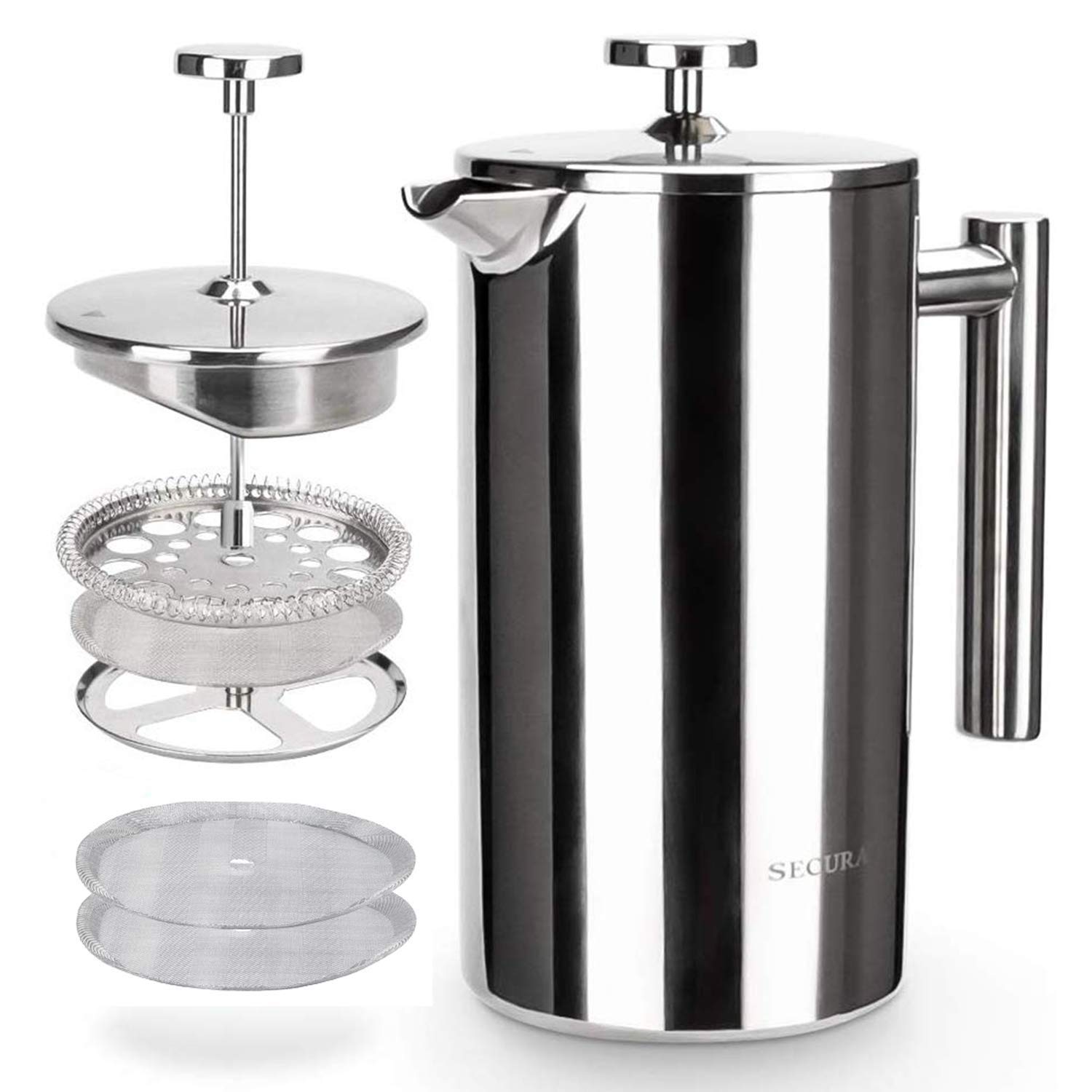
Secura Insulated French Press
Key Features
- Body: Double-wall 304 stainless
- Filter: 3-layer stainless
- Capacity: 34 oz (1 L)
- Cleaning: Dishwasher safe
- Price: Midrange
The filter stack is the first thing we examine on any press, and Secura’s is the best-equipped in this group: a three-layer stainless assembly, plus two spare screens in the box so you can add a layer when your grind comes out finer than you planned. That stack is why the cup lands heavy and clean rather than gritty.
It is also why this is our top pick for strong coffee, though not the only reason. The one-liter carafe is 304 stainless inside and out, double-walled, so the brew holds its heat through a four-minute steep and the second mug still drinks hot. Every part is dishwasher safe, the handle and knob stay cool, and there is a two-year warranty behind it. For a press with nothing in it that can shatter, that is a lot of press.
What you give up is the view. Steel hides the bloom and the color of the brew, so you cannot judge by eye when it is ready; we brew to a timer instead, which is the more repeatable habit anyway. The lid turns to close the spout before you pour, so a full press does not dribble down the side.
The spare screens matter more than they sound. Mesh bends, and a bent screen is the usual reason a press starts letting grit through; having two in the drawer means one bad wash does not end the brewer. That is the kind of small forward thinking we like in something this utilitarian.
Pros
- Three-layer filter with two spare screens
- Double-wall steel keeps coffee hot
- Every part is dishwasher safe
- Two-year warranty backs it
Cons
- Heavier to lift than the glass presses
- One liter fills roughly three mugs
The best all-round press here for strong coffee: a three-layer filter, spare screens, and double-walled steel that keeps the brew hot. Buy it if you want one press for kitchen, office, and campsite.
Best for Slow Morning Drinking
Coffee Gator French Press
Key Features
- Body: Double-wall 304 stainless
- Filter: Spring-loaded double screen
- Height: 11.9 in
- Capacity: 34 oz
- Price: Midrange
Coffee Gator’s party trick is time. The vacuum-layered double wall holds heat noticeably longer than the glass presses here, so the second and third mug pour hot rather than lukewarm, which is what actually matters when you brew a liter and drink it slowly at a desk.
The body is 304 stainless with a spring-loaded double screen, and it comes apart for cleaning without fuss. What we noticed in a normal kitchen is the height: at 11.9 inches it is the tallest press here, tall enough that a low wall cabinet will stop it sitting where you want it. Measure the gap above the counter before you commit a spot.
We rate it the heat-retention pick rather than the all-rounder, and that is a narrow but real job. Drink one mug and walk away, and the Secura covers it; nurse a pot through a morning of calls and this is the one still hot at the end. It also looks purposeful on a counter in a way the plainer steel presses do not.
Pros
- Holds heat far longer than glass
- Spring-loaded double screen keeps grounds out
- Unscrews for straightforward cleaning
Cons
- Two screens versus the top pick’s three
- Costs more than the Secura at the same size
For anyone who brews a pot and sips it slowly, this is the pick: the double wall holds heat longer than anything else here, and the two-screen filter keeps the cup clean.
Best for Small Households
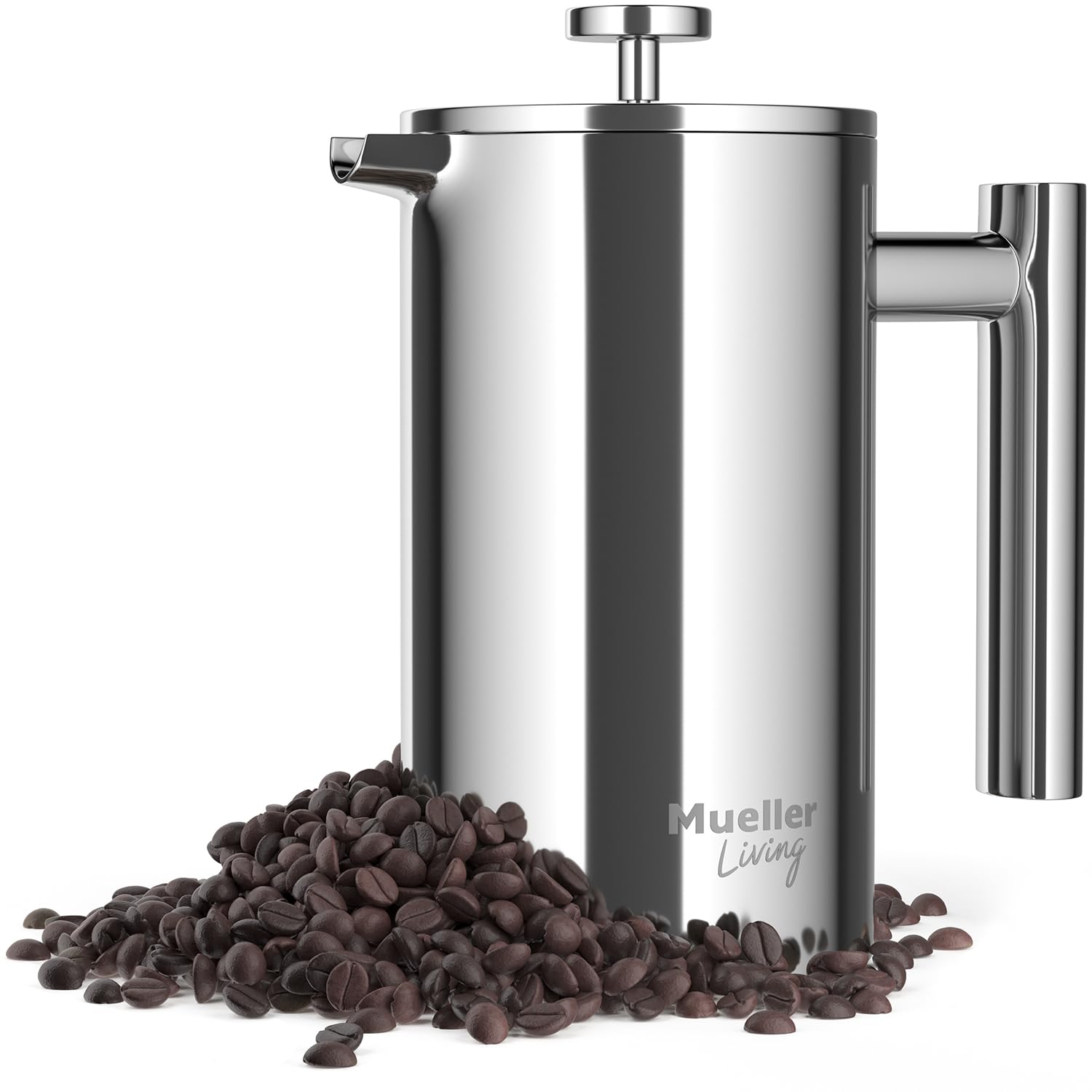
Mueller 20 oz French Press
Key Features
- Body: Double-wall insulated
- Filter: 4-level filtration
- Capacity: 20 oz
- Cleaning: Dishwasher safe
- Price: Midrange
Twenty ounces suits one kind of coffee drinker, the one who wants a big mug now and maybe a refill before it goes cold, and Mueller has built that small press better than it needed to. Four filter levels, a double wall, and a body light enough to carry to a campsite: this is the press we reach for when we are brewing for one.
The four-level stack, a coiled filter, two steel screens and a cross plate, is the same approach the big presses use, and it keeps the cup clean. At 1.3 pounds and 8.25 inches tall it stows in a cupboard or a duffel without a fight, and everything is dishwasher safe. Mueller rates it at four five-ounce cups, which is honest: two decent mugs, not a carafe.
Two things to weigh. There are no volume markings inside, so measure your water in a jug first rather than eyeballing it against the carafe. And the price is high for the size, since you are paying close to full-size money for a small brewer, which we think is fair for the build but worth knowing before you pick it over a liter press.
Pros
- Four-level filtration keeps the cup clean
- Light 1.3 lb body travels well
- Dishwasher safe, rust-free steel
Cons
- Premium price for a 20 oz brewer
Small-batch brewing done properly, with four filter levels and a genuinely tough body, as long as you accept two mugs for close to full-size money.
Best for Entertaining a Crowd
SterlingPro 64 oz French Press
Key Features
- Body: Double-wall 18/10 stainless
- Filter: Dual filter
- Capacity: 64 oz (2 L)
- Brew yield: 59 oz
- Price: Premium
This is the most expensive press in the group, and the only one that will brew for eight people without a second round. That sounds like a niche until you count the places it is not one: offices, rented cabins, and households where everyone leaves at the same time all want a pot, not a mug.
Two liters is the headline, though the useful number is 59 ounces of brewed coffee once the grounds have taken their share, still comfortably more than any other press here. The body is double-walled 18/10 stainless, the filter is a dual-screen stack, and it comes apart for washing. The mirror finish is the most decorative thing in this roundup, and it will show water spots if you let it drip dry.
Brewing in it is uneventful in the best way: the double wall holds heat through the longer steep a big batch needs, the dual filter keeps the cup clean, and the wide body makes loading and rinsing straightforward.
We recommend it to anyone who regularly brews for four or more, and to nobody else. For a solo drinker it is a pot of coffee going cold in a cup, and the Secura makes a better-sized batch for a fraction of the price.
Pros
- Two liters, 59 oz of brewed coffee
- Double-wall 18/10 stainless holds heat
- Dual filter keeps big batches clean
Cons
- The most expensive press here
- Awkward to pour when completely full
The one to buy if you regularly brew for four or more: nothing else here comes close on capacity, and the dual filter keeps a big batch tasting clean.
Best for Budget First Press
Bodum Brazil French Press
Key Features
- Frame: BPA-free plastic
- Carafe: Borosilicate glass
- Filter: Stainless steel plunger
- Capacity: 34 oz
- Price: Budget
The Brazil is the least expensive press here, and it does not hide what that buys: a borosilicate glass carafe, a BPA-free plastic frame and lid, and a stainless plunger that does the one job that matters. Bodum labels it eight cups, which counts four-ounce cups, so in mugs expect about two.
We keep it in the roundup because glass is still the nicest way to brew. You can watch the bloom, read the color, and press at the moment the brew looks right, which is how you learn to make a strong cup rather than just a hot one. And the parts that matter, the plunger, filter and carafe, are stainless and borosilicate, so the low price does not change what you are drinking.
Pre-warm the carafe with hot tap water before you brew and the coffee holds its temperature better through the steep. It is a small habit, and it is the difference between a budget press that punches above its price and one that just makes hot water taste like coffee.
Pros
- Borosilicate glass shows the whole brew
- Stainless plunger and filter where it counts
- Lowest price in this group
Cons
- Glass carafe and plastic frame are wear points
The cheapest way into real French press coffee, and still the best way to watch a brew develop, provided you treat the glass as the wear item it is.
Best for Value Stainless
Utopia Kitchen Stainless French Press

Key Features
- Body: Double-wall 304 stainless
- Filter: 4-layer stainless
- Weight: 2 lb
- Capacity: 34 oz
- Price: Budget
Utopia’s stainless press is the same idea as our top pick for less money: double-walled 304 steel, a four-layer filter stack, and a liter of capacity. We think that is the right place to start if the Secura’s price gives you pause, because nothing about the brewing changes.
The four layers are the reason to pick it over a cheap glass press: a finer stack means fewer fines in the cup, and the double wall means the second mug is still warm. At two pounds it has the heft you want from steel without feeling like a kettle, and it comes apart for washing.
What you do not get is the extras. Secura ships spare screens; Utopia ships the filter and the press, so a bent mesh means ordering a part instead of reaching into the box. That is a small thing until it is not, since mesh is what fails first on any press, and it is the main reason this sits below the top pick rather than beside it.
Pros
- Double-wall 304 steel at a budget price
- Four-layer filtration for a clean cup
- Keeps coffee hot between cups
Cons
- No spare screens in the box
A no-drama stainless press that does the top pick’s job for less; you give up the spare screens and the longer record, not the quality of the cup.
Best for Glass, Easy Cleaning
Veken French Press

Key Features
- Carafe: Borosilicate glass
- Filter: 4-level stainless
- Capacity: 34 oz (1 L)
- Glass rating: -40°F to 302°F
- Price: Budget
The feature that sells the Veken is not in the headline specs: the glass carafe lifts out of its metal frame. That turns cleaning into a quick job, carry the glass to the sink, tip the grounds, rinse, instead of wrestling a full steel press under the tap.
The rest is thoughtfully done. Nothing plastic touches the coffee: the seal is food-grade silicone, and the frame and filter are 304 stainless. The four-level filter stack, a spiral plate, cross plate and two mesh screens, keeps grit out of the cup, the borosilicate carafe is rated from -40°F to 302°F, and there is a measuring scoop in the box.
We like it as the glass option for someone who wants to watch the brew and clean up without fuss. In the dark pewter finish it is also the best-looking press here, the sort of thing you leave on the counter rather than hide in a cupboard, and a carafe you can lift out means you will actually keep it clean enough to leave out.
Pros
- Carafe lifts out of the frame to clean
- No plastic in the brew path
- Four-level filter and wide glass temperature range
Cons
- Glass carafe is the part that breaks
Our pick if you want to see the brew and clean up in seconds; the glass carafe lifting out of its frame is worth the price of admission on its own.
Best for Family Batches
Belwares 50 oz French Press

Key Features
- Body: Double-wall 304 stainless
- Filter: 4-level stainless
- Capacity: 50 oz (1.5 L)
- Servings: Up to 12 (4 oz) cups
- Price: Midrange
Fifty ounces sounds enormous until you run the arithmetic the listing uses: twelve cups at four ounces each. In the mugs most of us actually fill, that is four servings, a family breakfast rather than a cafe run.
The build is familiar in the best way: double-wall 304 stainless, a four-level filter stack, and a lid that twists shut between pours so a full press does not drip on the counter. It comes apart completely for washing.
Where it earns its place is the middle of the range. A liter runs out mid-conversation with three people at the table, and two liters is more coffee than most households finish; 50 ounces covers four mugs with a little left over.
We recommend it to the household that brews once and pours for everyone, and to anyone who wants big-press capacity without the biggest-press outlay. Solo drinkers should skip it, since a batch this size is coffee you will be reheating, and the 20-ounce Mueller is the better shape of the same idea.
Pros
- 50 oz covers four mugs comfortably
- Double-wall 304 steel keeps it hot
- Twist lid and drip-free spout
Cons
- Twelve-cup claim counts 4 oz cups
The right size for a household that brews once and pours for four, with insulated steel build in a more usable package than the biggest presses.
How We Tested the Best French Presses
We started by gathering every press we could find in the roughly $20 to $100 range, then cut the list to 12 based on how the carafe was made, how many layers of mesh the filter used, whether replacement parts were sold separately, and whether the stated capacity matched the ounces it actually held. Then we brewed with each one for four months — on weekday mornings when one mug had to be ready in five minutes, and on weekends when a full pot sat on the counter for an hour while we worked through it slowly.
Every press got the same run: coarse grounds, water just off the boil, a four-minute steep, and a thermometer reading at the pour and again 15 minutes later to see which carafes went lukewarm first. We poured the final ounce of each pot through a paper filter and weighed what it caught, which told us how much silt was reaching the cup. We also brewed the same beans ground finer than we’d recommend in each model, to find which plungers jammed and which let grounds slip past the edge of the mesh.
Cleaning was judged on a Tuesday-morning basis: whether spent grounds slid out of the carafe in one motion, whether they wedged into the filter’s mesh, and which parts were dishwasher-safe. Each press went through daily hand-washing and repeated small knocks against the sink edge so we could catch chips, loose rods, and wobbly handles early. We measured every carafe’s real yield in ounces against its advertised cup count, and we left all 12 sitting on a counter for months to see which plastics clouded, which stainless showed water spots, and which still looked good enough to bring to the table.
How to Choose a French Press for Strong Coffee
Strength is mostly technique, but the press decides how much grit reaches your cup and whether the second mug is still worth drinking, so buy for those two things and treat the rest as practice.
Filtration separates strong from muddy
More filter layers mean more fines stopped before they reach the cup, and fines are what make a French press taste muddy rather than rich. Look for at least two mesh screens plus a cross plate; the Secura’s three-layer stack with two spare screens and the Utopia’s four-layer stack are the most thorough here.
The trap is compensating with a finer grind. Fines slip past every stack, clog the mesh, and make the plunge stiff. Stay coarse, give it four minutes, and add a screen before you reach for the grinder.
Stainless or glass: heat against visibility
A double-walled steel press holds heat through the steep and through the second cup. Glass gives it up quickly, especially in a cool kitchen, but it shows you the bloom and the color of the brew, which is genuinely useful while you are learning what a finished brew looks like.
Choose by how you drink. A slow sipper wants the insulation; someone who brews and pours straight away can have the window. If you want both, buy steel and use a timer instead of your eyes.
Match capacity to mugs, not to the cup count
French press cup counts are quoted in four-ounce cups, so a 34-ounce press labeled eight cups is closer to three mugs once the grounds take their share of the volume. Size from the mugs on your shelf: roughly a liter for two people, 50 ounces for four, two liters for a crowd or an office.
Buying too big is the more common mistake. A large batch you do not finish is coffee going cold in a cup, and a press that is awkward to lift gets used less often.
The plunge, the pour, and the cleanup
Two details separate a press you use daily from one that gathers dust. The plunger and filter should come apart by hand, because trapped grounds sour the next brew, and the lid should twist to shut the spout so a full press does not drip between pours.
Dishwasher-safe parts are worth paying for, and so is a cool-touch handle when you are pouring a liter of near-boiling coffee. Our picks all disassemble by hand; the steel ones with a cool-touch handle, like the Secura, are the easiest to pour from when the press is full.
Frequently Asked Questions
Does a French press make stronger coffee than a drip machine?
Usually yes, from the same dose of grounds. Full immersion keeps the coffee in contact with the water, and no paper filter strips out the oils that carry body. Strength is mostly ratio, so if your cup tastes thin, add coffee before you add time; steeping past four or five minutes extracts bitterness rather than more flavor.
Can I pour boiling water straight into the carafe?
Give it half a minute off the boil, and pre-warm a glass carafe with hot tap water first. Thermal shock is one way a glass carafe cracks, and it is the failure that ends most glass presses. A steel press does not care, which is part of why we lean that way for daily brewing.
How long can I leave coffee in the press?
Do not leave it sitting. The grounds keep extracting, so a press left on the counter turns bitter and sludgy, and a steel body keeps that coffee hot without stopping the process. Pour the whole brew into a second carafe if you are not finishing it, then press a fresh batch when you want one.
Final Verdict
If you want one press that makes a strong, clean cup and does not need careful handling, buy the Secura. Its three-layer filter and spare screens are the difference between rich and gritty, and the double wall keeps the brew hot to the last mug.
Brew slowly and alone, and the Coffee Gator holds heat longer. Brewing for a table, and the SterlingPro’s two liters is the only real answer here. And if you want to watch the coffee while it steeps, the Bodum Brazil still does that for the least money.