This post contains affiliate links. We may earn a small commission when you buy through our links — at no extra cost to you.
A sourdough starter needs a home that can handle daily feeding, occasional doubling, and the occasional bump. Yet many specialty jars crack within weeks or overflow because the capacity is too small. The real problem isn’t finding a jar labeled ‘sourdough’ – it’s finding one that fits your actual routine.
This guide focuses on the two factors that matter most: glass durability and usable capacity. A 24 oz jar might look right on the shelf, but once your starter doubles, it will climb right out. And thin glass can shatter when you least expect it.
The trade-off comes down to whether you want a simple, thick-walled jar that will last for years, or a kit packed with tools that gets you baking from day one. Both are valid – the right choice depends on whether you value long-term reliability or immediate guidance.


Best for Durable Showpiece Jar
Weck Tulip 1L Set of 2
Key Features
- Capacity: 1L (2 jars)
- Mouth Width: 3.87 in
- Lid System: Glass lid, ventable
- Glass Durability: Thick, heat-resistant
- Price: Premium
The Weck Tulip jar’s thick glass and wide mouth create a stable, easy-to-use container for maintaining a sourdough starter. The gentle slope of the tulip shape lets spatulas reach the bottom without scraping, and the wide opening simplifies feeding and cleaning. This build quality sets it apart from thinner jars that crack under thermal shock or daily handling.
The lid system includes a glass lid, rubber gasket, and metal clips. Leaving the clips off allows the lid to sit loosely for gas release during active fermentation — useful for starters that need to breathe. Securing the clips provides a near-airtight seal for fridge storage, though the gasket may require careful positioning to avoid minor leaks. The glass lid is chipping-prone if dropped, so hand washing is recommended despite the dishwasher-safe rating.
This set is best for sourdough enthusiasts who want a durable jar that doubles as countertop décor and appreciate being able to adjust the seal for different stages of starter care. It is less suited for those who need a fully airtight container with no fiddling — the gasket adjustment can be fussy — or budget shoppers looking for the cheapest option.
Pros
- Wide mouth and gentle slope make mixing and cleaning easy
- Thick glass with a clean, attractive design
- Lid system can be used with or without clips for venting
- Smooth shape and wide opening simplify washing
Cons
- Glass lids may chip if handled roughly
- Rubber gasket can be difficult to seat, leading to an imperfect seal
A sturdy jar that handles the daily demands of a sourdough starter with an adaptable lid — requires a bit of attention to the gasket for best results.
Best for Guided Beginner Kit
KNEADACE Pro 34oz Kit
Key Features
- Capacity: 34 oz
- Mouth Width: Wide funnel
- Lid System: Cloth + silicone lid
- Glass Durability: Moderate thickness
- Accessories: Spatula, thermometer, band
- Price: Mid-Range
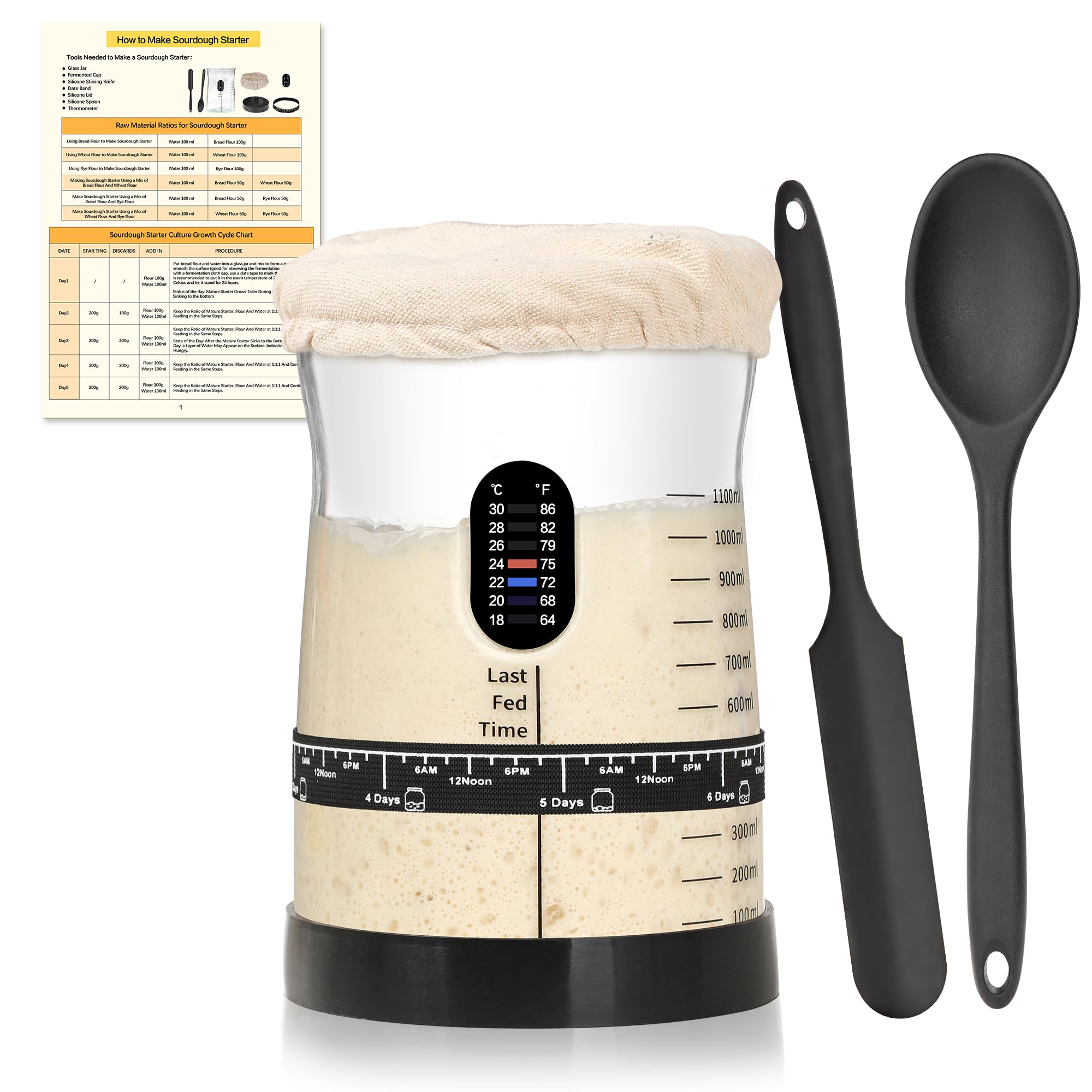
The KNEADACE Pro kit bundles every accessory a beginner needs—a wide-mouth 34 oz glass jar, cloth cover, silicone lid, thermometer, feeding band, spatula, and a video guide—eliminating the guesswork of maintaining a sourdough starter. However, the glass jar can crack over time, especially if handled roughly or placed in a dishwasher; hand washing is recommended to mitigate this. The included feeding band tracks feedings clearly, and the silicone lid flips to become a non-slip base—sensible touches for daily use.
This kit suits first-time sourdough bakers who want a guided experience with all tools included. The feeding band and thermometer simplify maintenance, and the jar works for both counter and fridge storage. The 34 oz capacity gives ample room for starter growth, and the wide mouth makes stirring and scraping easy. Experienced bakers who prefer a minimalist jar or need dishwasher-proof glass should look to the Weck Tulip instead.
Pros
- Complete beginner starter kit with detailed instructions and all essential accessories.
- Large 34 oz capacity provides enough room for starter growth without overflow.
- Silicone lid serves as a non-slip base, and the feeding band helps track feedings.
Cons
- Glass jar can crack over time; hand washing is recommended to minimize risk.
- Thermometer sticker may not be accurate for all users; cloth cover can allow drying in very dry conditions.
For beginners who value a ready-to-use kit over glass durability, the KNEADACE Pro delivers a complete setup at a mid-range price. If long-term jar longevity is a priority, the Weck Tulip is a better fit.
Best for Value Bulk Jars
ComSaf 88oz 2-Pack
Key Features
- Capacity: 88 oz each
- Mouth Width: 4 in wide
- Lid System: Wire clamp + silicone
- Glass Durability: Medium thickness
- Accessories: Scoop included
- Price: Mid-Range
These ComSaf jars hold 0.7 gallons each, giving home bakers room to maintain a large sourdough starter and store flour in the same set. The wire clamp lid creates a strong airtight seal—handy for fermenting but noticeably harder to open than a threaded lid. The glass feels solid for the price, though occasional breakage near the rim has been noted during washing.
This set suits bakers who want maximum storage per dollar and are comfortable with a two-handed lid operation. For those with arthritis or who open jars multiple times daily, the clamp’s suction may be a frustration—better suited to less frequent access like weekly feeding or bulk pantry storage.
Pros
- Airtight seal keeps dry goods and ferments fresh for extended periods
- Large capacity ideal for bulk storage or feeding a high-volume starter
- Sturdy glass that feels solid and looks clean on the counter
Cons
- Lids can be difficult to open due to strong suction – a tradeoff for the airtight seal
- Occasional glass breakage near the rim during washing – handle with care
Best suited for bakers who want two large, airtight jars without spending premium prices, provided they can manage the firm clamp closure.
Best for Compact Small Starter
Bormioli Fido 25oz
Key Features
- Capacity: 25 oz
- Mouth Width: 4.25 in square
- Lid System: Glass lid + wire clamp
- Glass Durability: Heavy glass
- Price: Budget
The Bormioli Rocco Fido jar delivers the classic European canning design at a budget price. Its glass lid with wire clamp creates a tight seal that works for both preserves and, when left unclamped, countertop fermentation. The wide square mouth makes feeding easy, but the 25-ounce volume is noticeably smaller than the top pick’s tulip jar. For bakers who keep a modest starter (under 100g), this jar keeps costs low while offering the same airtight closure as pricier alternatives.
This jar suits bakers who maintain a small starter (50–100g) and bake one loaf at a time. It also pulls double duty as a canning jar for jams or pickles. The tradeoff: if your starter doubles to 200g or more, you risk overflow. Some users note that the glass lid can chip if dropped, and the wire clamp may loosen with heavy use—but for typical kitchen handling, the durability is on par with other glass storage.
Pros
- Classic design with a heavy glass feel and tight sealing for canning or fermentation.
- Budget-friendly price for a well-known European brand with solid glass construction.
- Tight seal works for countertop fermentation when lid is left unclamped.
Cons
- 25-ounce capacity may require frequent feeding to avoid overflow if your starter doubles significantly.
- Glass lid can chip if dropped, and the wire clamp may loosen over time with heavy use.
Best for bakers with a small starter who want an attractive, affordable jar that also works for canning—but check your starter’s peak volume before buying.
Best for Large Batch Baking
Coco Bird 50oz Kit
Key Features
- Capacity: 50 oz
- Mouth Width: 4.7 in wide
- Lid System: Silicone lid (also base)
- Glass Durability: 5mm thick
- Accessories: Spatula, spoon, loofah, recipes
- Price: Mid-Range
The Coco Bird Pro kit’s 50-ounce jar can hold starter for up to six loaves, making it the largest dedicated sourdough container in this price range. It comes with 17 unique flavor recipes, a silicone spoon, and a loofah for cleaning – extras that serious hobbyists will appreciate. However, the included thermometer sticker may lose adhesion within weeks, and some jars have a slight bottom hump that can make scraping starter awkward.
This kit suits bakers who regularly bake multiple loaves and enjoy experimenting with flavored starters. The large capacity reduces feeding frequency, and the recipe book offers variety. The thick glass feels solid, but the bottom hump and occasional cracking reported by some users suggest quality control can vary. Those who want a straightforward jar with a reliable temperature indicator or a perfectly flat bottom may prefer other options.
Pros
- Large 50-ounce capacity supports baking multiple loaves without frequent feedings.
- Thick 5mm glass feels durable and stable in daily use.
- Includes 17 unique flavor recipes plus a silicone spoon and loofah for easier maintenance.
Cons
- Thermometer sticker may detach over time, reducing its usefulness.
- Some jars have a bottom hump that complicates mixing, and glass may crack after extended use in rare cases.
Best for bakers who need the extra capacity and want the included recipes, but not for those who rely on the thermometer or expect a perfectly smooth interior.
Best for Affordable Weck Entry
Weck Mold 0.75L

Key Features
- Capacity: 0.75L
- Mouth Width: 3.88 in
- Lid System: Glass lid + steel clips
- Glass Durability: Thick
- Price: Mid-Range
The Weck Mold jar offers the same thick glass construction and wide mouth as the brand’s larger sets, making it a durable option for a single sourdough starter. Its vented lid system works well for both fermentation and storage. The tradeoff: 0.75L capacity requires more frequent feeding to avoid overflow, and the metal clips can be a bit tricky to secure. Sold as a single jar, it’s best for those who only need one starter and value Weck quality over the tulip set’s better value.
Pros
- Thick glass handles temperature changes without cracking
- Well-suited for maintaining a single small to medium sourdough starter
Cons
- 0.75L capacity demands more frequent feeding to prevent overflow during active fermentation
A compact, single-jar entry into the Weck lineup — ideal for bakers who maintain a small starter and prefer quality over capacity.
Best for Beginner Cookbook Kit
Ayerphalo 38oz Kit

Key Features
- Capacity: 38 oz
- Mouth Width: Wide
- Lid System: Cloth + silicone lid
- Glass Durability: Borosilicate
- Accessories: Cookbook, cup, spatula
- Price: Budget
The Ayerphalo kit bundles a helpful cookbook and wide-mouth 38 oz jar at a budget price, making it an attractive entry point for sourdough beginners. However, the glass jar’s durability is a notable risk – some units may crack under normal handling, which limits long-term value compared to similarly priced alternatives. This kit serves best for those willing to handle the jar gently and accept the possibility of replacement.
Pros
- Includes a detailed cookbook and feeding guide tailored for beginners.
- 38 oz capacity is generous for family baking without hogging fridge space.
Cons
- Sticker thermometer can be tricky to apply and may give inconsistent readings.
- Glass jar can crack from routine handling or temperature changes – requires careful use.
This kit is a reasonable gamble for beginners on a tight budget who will handle the jar with extra care.
Best for Budget Large Jar
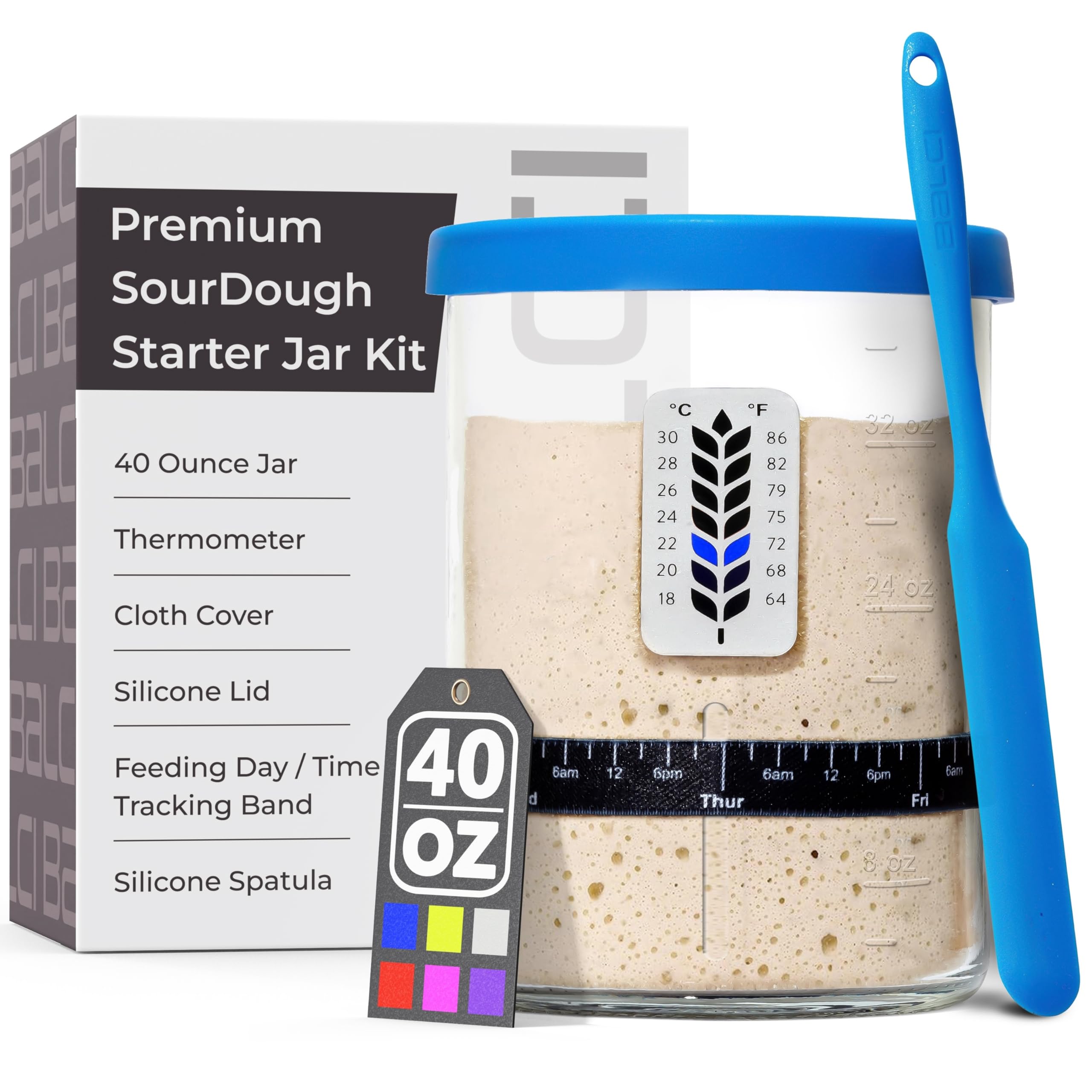
BALCI 40oz Kit
Key Features
- Capacity: 40 oz
- Mouth Width: Wide
- Lid System: Cloth + silicone lid
- Glass Durability: Soda-lime
- Accessories: Spatula, thermometer, band
- Price: Budget
The BALCI jar delivers a generous 40 oz capacity at a budget price, and the wide mouth combined with a silicone lid that also works as a non-slip base makes feeding and stirring convenient. However, the soda-lime glass can develop cracks within weeks if handled less gently or placed in a dishwasher. This makes the jar best suited for bakers on a tight budget who need a large container and are willing to hand-wash and handle it carefully. The temperature sticker is a minor added feature, though its adhesion and accuracy may be inconsistent.
Pros
- Large 40 oz capacity at a budget price – ideal for feeding large starters.
- Wide mouth and silicone lid that doubles as a non-slip base for easy stirring.
Cons
- Temperature sticker may not adhere reliably or give accurate readings.
- Glass can develop cracks after a few weeks under regular handling or in a dishwasher.
This jar works well for budget-conscious bakers who need a large starter container and are careful with hand-washing and gentle handling.
Best for Two Cheap Jars
Mfacoy 24oz 2-Pack

Key Features
- Capacity: 24 oz each
- Mouth Width: Wide
- Lid System: Cloth + metal screw lid
- Glass Durability: Standard
- Accessories: Spatula, thermometer, band
- Price: Budget
The Mfacoy set gives beginners two jars and essential accessories at a budget-friendly price. However, the 24-ounce capacity suits discard storage better than active starter maintenance, and the glass can crack during regular washing. Occasional missing accessories have also been reported. For casual baking or experimenting with different starters, this kit offers a low-cost option, but daily bakers will want a larger, stronger jar.
Pros
- Two jars allow rotating between active starter and discard.
- Good value for two jars with thermometer, feeding band, and cloth cover.
Cons
- 24 oz capacity can be small for active starter maintenance.
- Glass can crack during washing, limiting long-term use.
A viable option for occasional bakers who want two jars to experiment without a larger investment, but not for daily sourdough use.
Best for Well-Packaged Starter
Superbaking 34oz Kit

Key Features
- Capacity: 34 oz
- Mouth Width: 3.94 in
- Lid System: Cloth + screw metal lid
- Glass Durability: Standard
- Accessories: Spatula, cups, brush, recipes
- Price: Mid-Range
Superbaking’s kit bundles a wide-mouth glass jar with cloth lid, spatula, measuring cups, thermometer, brush, and a recipe book — everything a new baker needs to start a sourdough starter. The clear instructions are a strong point. But the glass can crack or shatter within the first month if handled roughly or dishwashed, so it requires gentle hand-washing. The spatula is also short. For beginners who commit to careful handling, this is a convenient guided set at a mid-range price — but those wanting durability for daily use should consider sturdier jars.
Pros
- Complete beginner kit with clear instructions and recipe book
- Includes custom-fit cleaning brush and measuring cups
Cons
- Glass jar may crack or shatter under rough handling or dishwasher use
- Spatula length is insufficient for scraping deep jars
Best for beginner bakers who are comfortable hand-washing glass and want a guided starter experience with extra accessories. Not ideal if you need a jar that withstands bumps or frequent washing.
How to Choose
The most important decision is not the brand – it’s the glass thickness and jar size, because many jars crack or overflow within weeks.
Capacity
A starter doubles in volume after feeding, so a jar that’s too small will overflow onto your counter. A 24 oz jar is fine for a 50g starter but will quickly become cramped once you scale up. Aim for at least 32 oz if you bake one loaf per week, and 40 oz or more if you bake multiple times or want to keep discard.
Overflow not only creates mess but also throws off your feeding ratio. A larger jar gives you room to stir without spilling and reduces the risk of the starter climbing over the rim.
Mouth Width
A wide mouth (3.5 in or more) makes it easy to mix in flour and water with a spatula, and to scrape down the sides after feeding. Narrow jars force you to tilt the jar or use a long tool, and they’re harder to clean when starter dries on the upper walls.
For daily use, look for a jar where you can comfortably fit your hand or a soft sponge. The best designs have a gentle slope from top to bottom, letting you reach every corner.
Lid System
Sourdough starter produces CO₂, so the lid must allow gas to escape during countertop fermentation. Breathable cloth covers or silicone lids with a vent work well – just set them loosely. A fully airtight lid can build pressure and cause the jar to burst or the lid to pop off.
For fridge storage, an airtight seal is useful to prevent odor absorption. Some jars offer both options: a cloth cover for the counter and a solid lid for the fridge. Look for compatibility with your daily routine.
Glass Durability
This is the category’s hidden weak point. Many jars use thin, soda-lime glass that cracks from thermal shock – going from a warm counter to a cold rinse, or even from hot tap water. Thicker glass (borosilicate or heavy soda-lime) handles temperature changes better and survives accidental bumps.
Check recent reviews for breakage reports, especially around the rim and bottom. A jar that seems fine on arrival may develop stress fractures after a few weeks of regular use.
Included Accessories
Kits often come with a thermometer sticker, feeding band, and spatula. The thermometer sticker is a nice extra but many are inaccurate or fall off after a few washes. The feeding band helps track feedings – a simple but useful tool.
The spatula is the most valuable accessory, as it’s the correct length and shape for scraping the narrow bottom. If you buy a bare jar, budget a few dollars for a long, narrow silicone spatula.
FAQ
Why does my sourdough starter overflow in a small jar?
A healthy starter doubles or triples after feeding, so a 24 oz jar with 100g of starter will overflow quickly. Use a jar at least twice the volume of your starter (after feeding). For a typical 150g starter, a 32–40 oz jar gives enough headroom. Mark a ‘max fill’ line with a rubber band to monitor growth.
Can I use a regular mason jar for sourdough starter instead of a special jar?
Yes, a wide‑mouth mason jar works fine if it’s at least 32 oz. The main drawback is the narrow shape – cleaning dried starter from the shoulders is harder. Also, the glass in standard mason jars is thinner than in premium options and more prone to cracking if you pour hot water in. If you use one, handle it gently and avoid thermal shocks.
How do I know if a jar is safe for sourdough starter?
The jar should be food‑grade glass (borosilicate or soda‑lime), BPA‑free, and free of lead or cadmium. Avoid any jar with painted designs or metal trim that could react with the acidic starter. The lid must allow gas to escape – never use a fully sealed jar on the counter. A simple cloth cover or a loosened lid works.
What size jar do I need for a mature sourdough starter?
For a starter you feed once a day and use for one loaf per week, a 32–40 oz jar is ideal. If you bake multiple loaves or maintain a larger starter (200–300g), go with 50 oz. Smaller jars (24 oz) work for very small starters (under 50g) but will overflow as you scale up. Aim for a jar where the starter fills less than a third after feeding.