This post contains affiliate links. We may earn a small commission when you buy through our links — at no extra cost to you.
Espresso is the least forgiving thing you can make with coffee. Nudge the grind by a hair and a shot that took 28 seconds suddenly chokes the machine or races through in 14, tasting sour one morning and bitter the next — and no amount of careful puck prep will rescue you if the grinder can’t repeat itself. What these machines actually do is turn beans into the same fluffy, clump-free, predictable bed of grounds, shot after shot. A great espresso machine paired with a sloppy grinder makes worse coffee than a cheap machine paired with a good one, which is why I’d spend the money here first.
Over the past six months I’ve kept ten grinders on my kitchen counter, and the gaps between them surface within a day of pulling shots — some are quiet enough for a 6 a.m. routine, others sound like a blender full of gravel. Here’s what nobody tells a first-time buyer: the grinder that’s brilliant for espresso can be a fuss to live with if you also brew pour-over, and paying more doesn’t automatically buy you better burrs. The picks below sort that out.


Best for Dialing in Espresso
Breville Smart Grinder Pro
Key Features
- Burrs: Stainless steel conical
- Dose timer: 0.2-second increments
- Grind settings: 60
- Hopper capacity: 1.1 lb
- Price: Premium
Espresso is a timing problem as much as a grinding one, and the Smart Grinder Pro is the only grinder in this set that lets you set a dose to two-tenths of a second. Find the number that fills your basket and the next shot is the same shot. That repeatability is why it takes the top spot over cheaper electrics that grind just as fine.
Sixty settings run from Turkish-fine to French press, but the useful part is that the espresso band is wide: you get several workable positions between a shot that chokes the machine and one that gushes. The cradle holds a portafilter hands-free, and the same chute fills an airtight container or a paper filter when you switch to drip. A 1.1-pound hopper covers a week of doubles in most kitchens before a refill.
It is at its loudest doing the job you bought it for. Grinding fine makes any burr work harder, and you will hear this one from the next room sooner than you hear the Aromaster or the Ollygrin. What you get in return is a 165-watt motor that holds speed at the fine end instead of bogging down, which is the point where cheap grinders start producing a mix of dust and chunks.
Pros
- Repeatable doses in 0.2-second steps
- 60 settings with a wide espresso band
- Portafilter cradle grinds hands-free
- 1.1-pound hopper lasts most of a week
Cons
- Plastic impeller wears and stops feeding grounds
- Static clings to grounds in dry kitchens
We tell anyone buying their first serious espresso grinder to start here: the timed dose and 60 usable steps make a repeatable shot possible without a scale in one hand.
Best for Value Espresso Dosing
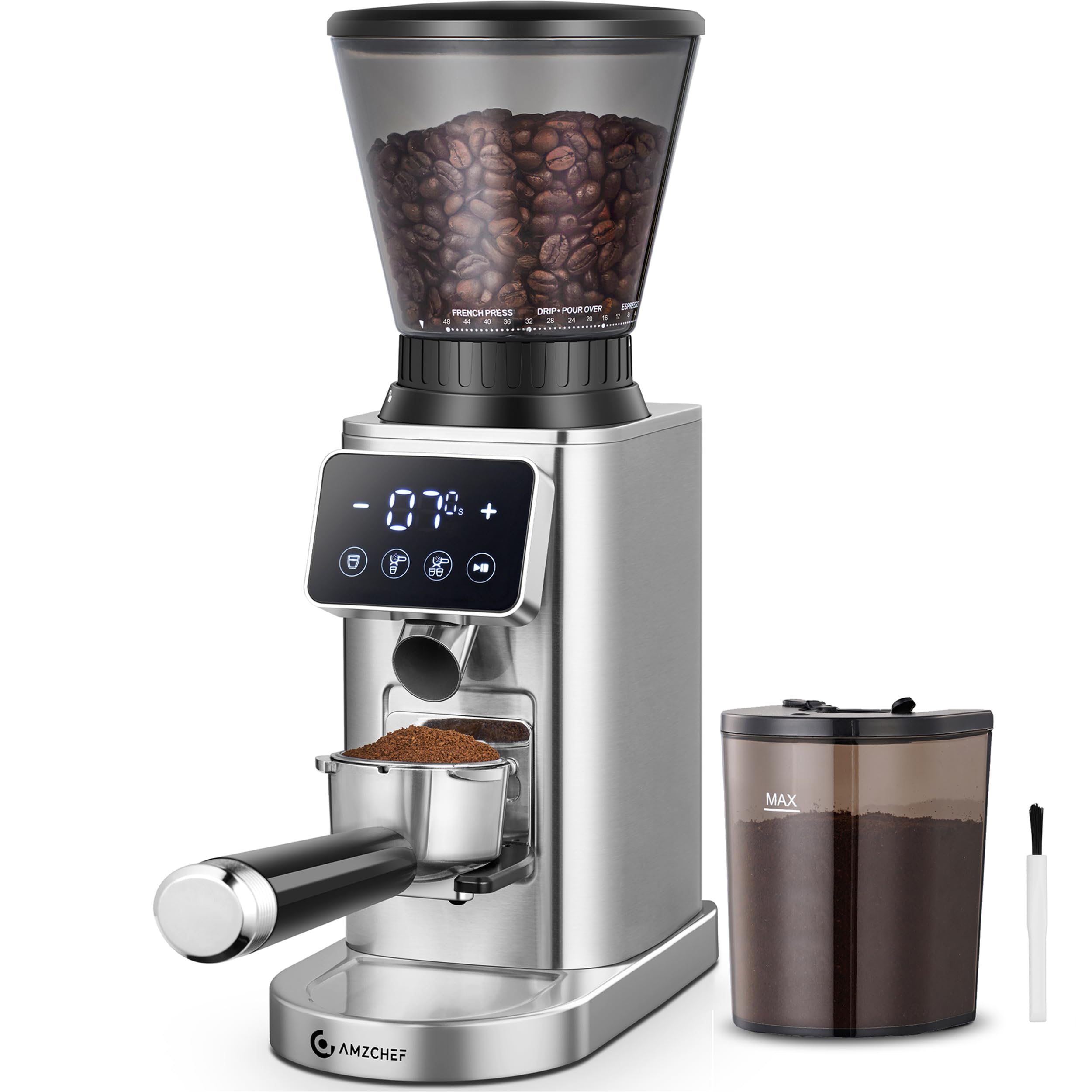
AMZCHEF Burr Coffee Grinder
Key Features
- Burrs: 40mm stainless steel conical
- Grind settings: 48
- Hopper capacity: 10.6 oz
- Portafilter fit: 51-54mm and 58mm
- Price: Midrange
The AMZCHEF does the two things espresso actually asks for — a fine, even grind and a dose you can repeat — for a good deal less than the Breville. Forty-millimeter conical burrs, 48 settings, a 40-second timer adjustable in half-second steps, and a cradle that takes both 51-54mm and 58mm portafilters: the espresso-specific parts are all here rather than saved for the expensive model.
The timer is what turns it from a coffee grinder into an espresso grinder. Half-second steps are fine enough to hold a dose steady while you spend your adjustments on grind size instead of chasing grams. The touchscreen takes an evening to feel natural — the instructions printed on the side of the body do most of the work — and after that it is one button and a cup count.
The anti-static claim holds up in use: the stainless catch container drops grounds in a tidy mound instead of throwing a dusting across the counter, which matters more in a dry winter kitchen than any figure on the box. What it gives up to the Breville is granularity — half-second doses against two-tenths, 48 steps against 60 — and that shows up in the last few minutes of a dial-in, not in the shot you drink every morning.
Pros
- Timed dosing in half-second steps
- Anti-static bin keeps the counter clean
- Cradle fits 51-54mm and 58mm portafilters
- 48 settings cover espresso through cold brew
Cons
- Half-second timer steps are coarser than the Breville’s
The smart buy if you want espresso dosing without the top pick’s price: the timed touchscreen and anti-static bin do the daily work, and you only feel the coarser steps when dialing in.
Best for Hand-Grinding Espresso
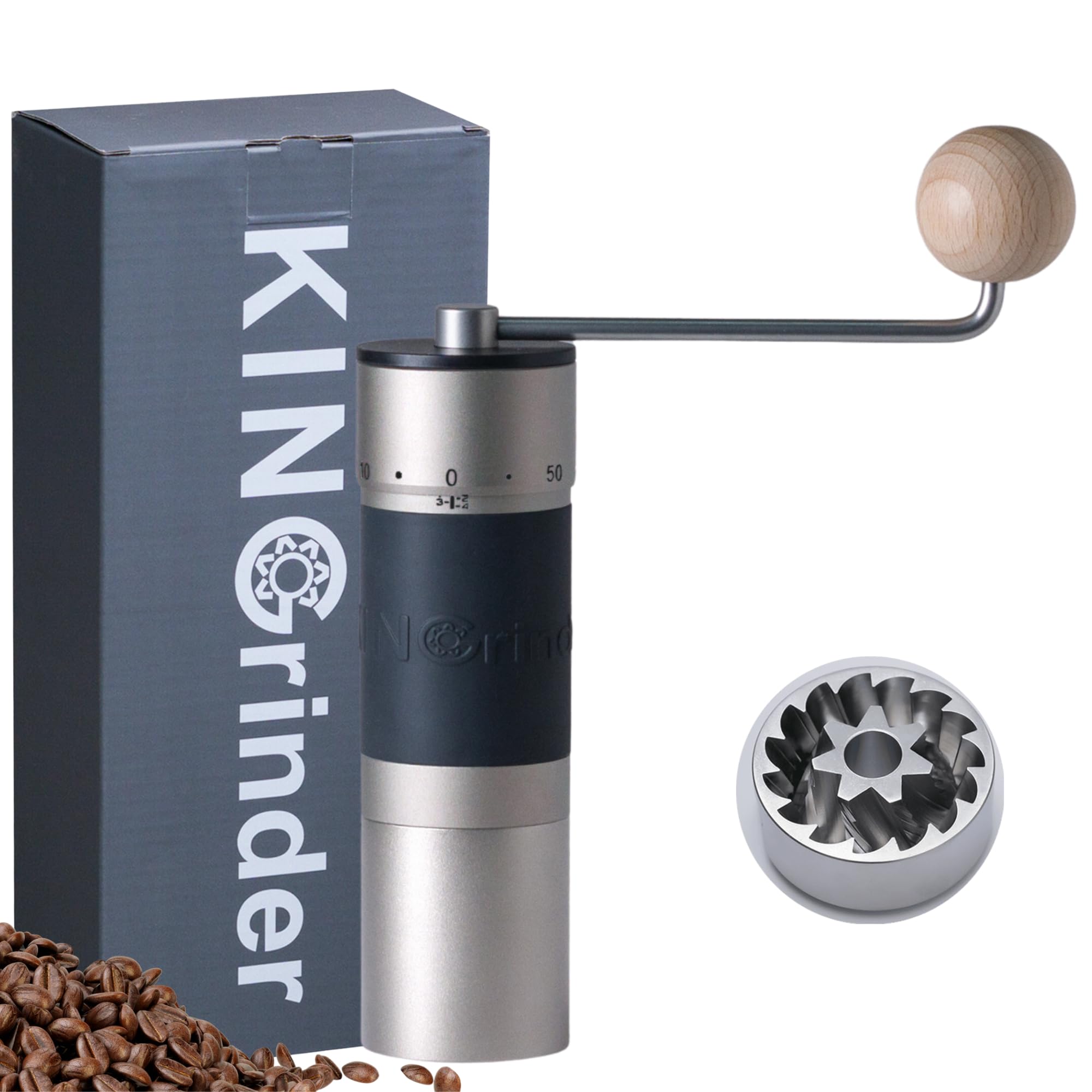
KINGrinder K6
Key Features
- Burrs: Stainless steel conical
- Weight: 1.39 lb
- Capacity: 1.06 oz
- Adjustment: 16 microns per click
- Price: Midrange
Sixteen microns per click is the number that sells this grinder. The adjustment ring is external, so you change setting without emptying the hopper or counting turns up from zero, and because the clicks are countable you can go from espresso to pour-over and back to the same place. In a category where most hand grinders ask you to feel your way, that is a real advantage.
The body is aluminum with a stainless conical burr and no plastic in the grind path, and at 630 grams it has enough mass to sit steady while you crank. A double shot’s worth takes about 35 seconds at espresso fineness — slow enough to notice, quick enough to finish before the kettle boils — and the whole thing is quiet enough that the loudest part of the morning becomes the kettle.
What you accept is that you are the motor. Thirty grams of capacity covers two doubles or one decent brew, so a household of milk drinks means refilling between rounds. What you get back is burr quality that electrics at this price cannot match, because there is no motor, timer or hopper to pay for — and nothing to wear out in the usual way, since the impeller, chute and dosing flap that fail in electrics simply are not there.
Pros
- Sixteen-micron clicks repeat exactly
- All-metal body, no plastic in the grind path
- A double shot in about 35 seconds
Cons
- You supply the effort for every dose
- 30-gram capacity means refilling between shots
The hand grinder we point espresso drinkers to: 16-micron clicks on an external dial give you repeatable settings, and the burr quality beats electrics at the same money.
Best for Small Quiet Kitchens
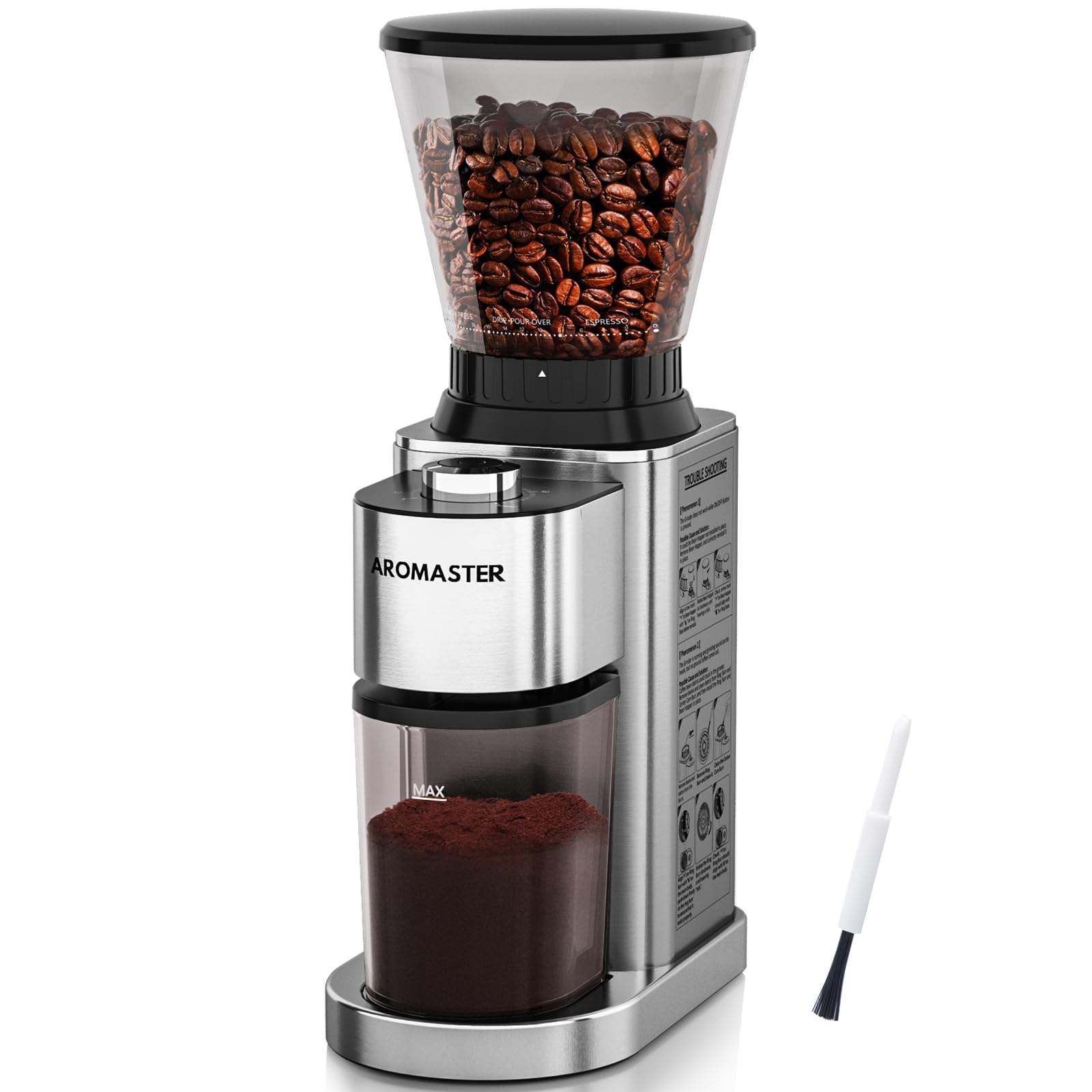
Aromaster CG204
Key Features
- Timer: Up to 40 seconds
- Warranty: 12-month repair service
- Grind settings: 48
- Hopper capacity: 3.9 oz
- Price: Midrange
A grinder is the loudest thing in most coffee routines, and the Aromaster is near the top of this set on noise — the burrs turn slowly and the sound stays soft enough that a conversation does not stop. In a small kitchen or an apartment with thin walls, that is the detail that decides whether you grind at six in the morning or wait until the neighbors are up.
The rest of the machine is built for a narrow slot: 8 inches wide, 5 deep and 16 tall, with 48 settings, a 40-second timer and a removable ring burr that lifts out for a brush. The burr chamber is small, so the whole thing feels more like a hand grinder’s guts than a hopper-fed appliance.
The anti-static bin does what it claims: grounds drop into the catch cup in a mound and stay there, and the cup seals well enough to carry to the machine without leaving a trail across the counter. Cleaning is a twist-and-lift job rather than a project, which is the difference between a grinder that gets brushed out and one that quietly accumulates a season of stale grounds.
There is also a 12-month repair service behind it, which is more cover than most of the electrics here come with. What settles it for us is the combination — quiet, tidy and small enough to leave out on the counter — virtues no other electric in this set puts together at this size.
Pros
- Quiet enough to grind before the house wakes
- 48 settings and a 40-second timer
- Anti-static bin drops grounds in a mound
Cons
- Hopper holds only 3.9 ounces
Our pick for a small, shared kitchen: it grinds finely, drops grounds without a static storm, and stays quiet enough to run before anyone else is awake.
Best for Budget Electric Grinding
Ollygrin BG702S-PG
Key Features
- Burrs: 40mm stainless steel conical
- Dimensions: 5.4 x 7 x 12 inches
- Grind settings: 30
- Hopper capacity: 10 oz
- Price: Budget
The Ollygrin is the least expensive electric here that still uses conical burrs, and it gives up less than the price suggests: 40mm stainless burrs, 30 settings, a 10-ounce hopper and a body 12 inches tall that slides under a wall cabinet.
What you give up is granularity, not grind quality. Thirty steps leave fewer places to land at the espresso end than the 48 and 60 of the picks above, and grounds fall into a removable container rather than a cradle that holds a portafilter. Cup-size selection from 2 to 12 does most of the dosing work, which is a blunter tool than a timer but quicker on a work morning.
One thing to confirm before you order: the listing states 220 volts, which will not run on a standard US outlet, so check the variant on the page you are buying from. Get that right and it is a likable machine — it finishes a dose in a few seconds and runs quieter than its price suggests, which is more than we expected from the cheapest electric in the group.
Pros
- Conical burrs at the lowest electric price here
- Quieter than its price suggests
- 10-ounce hopper in a 12-inch-tall body
Cons
- 30 steps leave few positions at the espresso end
- Static clings in some kitchens
The budget electric worth buying: conical burrs and a calm grind for the least money here, as long as you confirm the voltage and accept fewer steps at the fine end.
Best for Stepless Hand Grinding
TIMEMORE Chestnut C3S

Key Features
- Burrs: S2C stainless steel conical
- Weight: 1.17 lb
- Capacity: 0.88 oz
- Adjustment: Stepless
- Price: Midrange
There are no clicks to count on the Chestnut C3S: the adjustment collar is stepless, so you tune the grind by feel and by the shot in the cup rather than by a number. Inside is Timemore’s S2C steel burr in an all-metal body with no plastic part in the grind path, and at 52mm across and 530 grams it feels like a machined tool rather than an accessory.
The burr set is the reason to look here. Steel conical burrs at this price, turning slowly enough that heat never becomes the variable, give you a grind you can adjust in increments too small to count — which is exactly what a stubborn basket wants when a single click on another grinder is the difference between slow and stopped.
Stepless is a gift and a tax. You can land precisely on the setting your espresso wants, which is more than a click-based grinder with a coarse thread can promise; you also cannot write the setting down and come back to it next month. Our answer is to count your own turns from fully closed and keep the number in your phone. Capacity is 25 grams — a double with a little spare — so this is a one-or-two-shot grinder, not a batch machine, and it wants a brush rather than a rinse.
Pros
- Stepless adjustment lands on exact settings
- All-metal body with the S2C steel burr
- 25 grams is a double with spare
Cons
- Stepless collar makes saved settings harder to return to
A stepless, all-metal hand grinder for someone who wants to land exactly on a setting and doesn’t need to write it down — the most precise-feeling manual here.
Best for Batch Hand Grinding
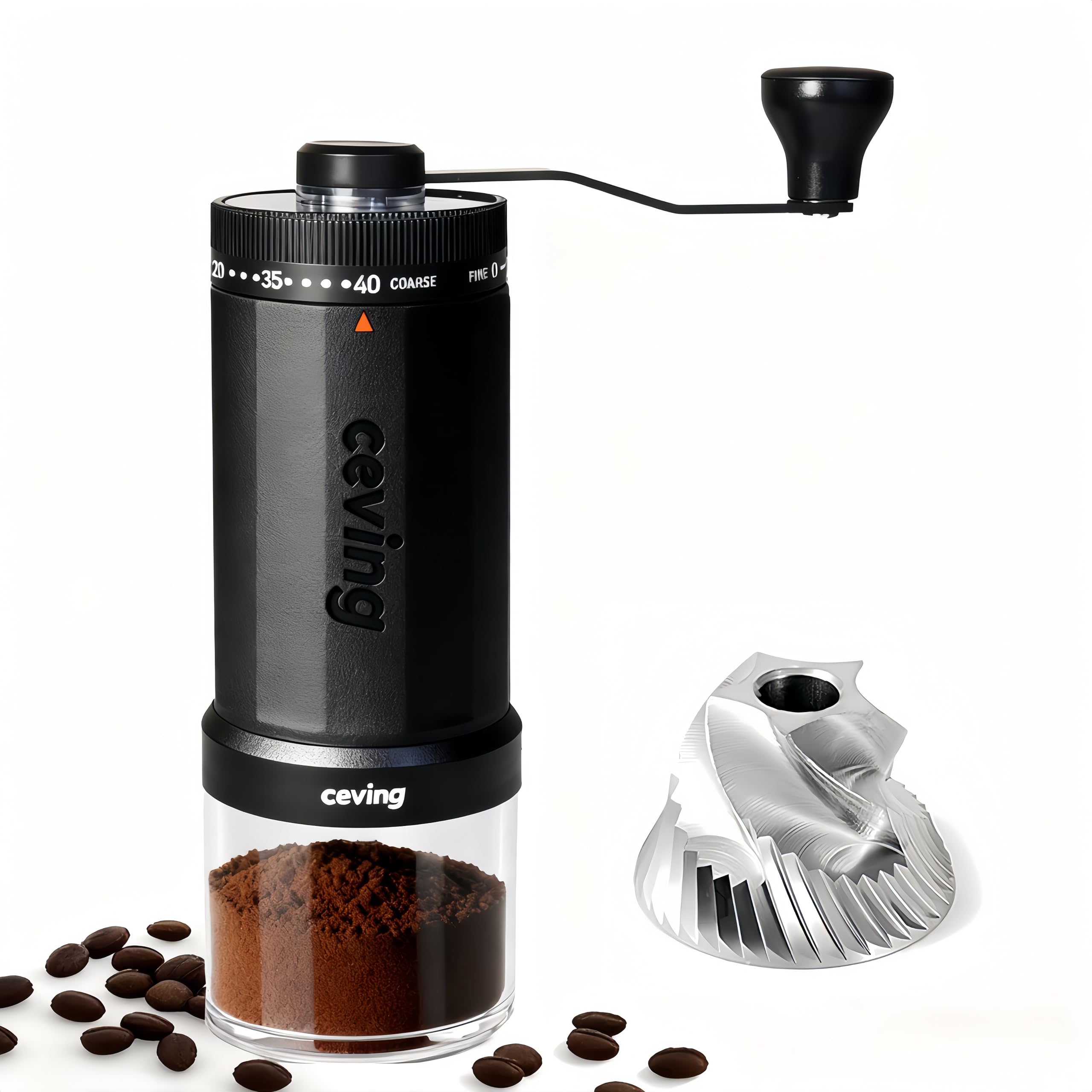
CEVING 60g Manual Grinder
Key Features
- Burrs: Stainless steel conical
- Capacity: 2.12 oz
- Dimensions: 2.7 x 7.8 x 5.3 inches
- Grind settings: 40 external
- Price: Budget
Sixty grams is the whole argument. This is the hand grinder for someone making coffee for the table rather than one shot — a full hopper covers a 12-cup percolator or several doubles, so you are not refilling between rounds. The burrs are stainless, the adjustment is external with 40 settings, and at 500 grams it is light enough to travel and heavy enough to sit still on a counter.
The catch cup is the weak point: it is plastic, and it is the part that has cracked in use. Treat the grinder as something to set down gently rather than toss into a pack, and the rest of the build holds up — the shaft runs on smooth bearings and the lid and handle stay put while you crank.
The cranking is honest work rather than punishment. A single dose takes a fraction of the time a full hopper does, the handle is long enough for leverage, and the external dial means a change of brew method costs a few clicks rather than a disassembly.
For espresso, the step size is the catch. Each click is 0.05mm, which works out to roughly 50 microns — about three times the KINGrinder’s 16 — so this is comfortable control for pour-over, French press and percolator and a coarse instrument for chasing a dial-in. It will grind fine enough for a shot; it just will not let you move in the increments shot tuning asks for. That is not a flaw in the grinder so much as a statement of what it is for.
Pros
- 60-gram hopper grinds for the whole table
- External 40-setting dial adjusts quickly
- Bearings keep a full hopper smooth to turn
Cons
- 50-micron clicks are coarse for espresso
- Plastic catch cup is the fragile part
Buy it for capacity rather than espresso: 60 grams in one fill suits percolator and pour-over duty, while its 50-micron clicks are blunt tools for shot tuning.
Best for Travel and Camping
CEVING Mini Manual Grinder

Key Features
- Burrs: Ceramic conical
- Capacity: 1.06 oz
- Dimensions: 7.4 x 2.3 x 6.7 inches
- Grind settings: 40 external
- Price: Budget
Under a pound and about seven inches tall, the CEVING Mini is the grinder that lives in a bag rather than on a counter. Forty external settings and a ceramic conical burr are more hardware than the price suggests, and 30 grams of capacity means a hotel-room double or two without reloading.
The trade is time. Fine settings take a couple of minutes of steady cranking — the finer you go, the more turns — and ceramic cuts more slowly than steel, which is fine for a shot a day and tedious for a household. The handle is the part to watch: it is the piece that can snap if you lean on it, so crank smoothly and let the burrs do the work.
Pros
- Under a pound and about seven inches tall
- 40 external settings and a ceramic burr
- Three parts strip down for cleaning
Cons
- A fine dose takes a couple of minutes of cranking
- Handle can snap under heavy pressure
A travel grinder rather than a daily driver: under a pound and under a hundred turns to a dose, it is the cheapest way to find out whether hand grinding suits you.
How We Tested Ten Espresso Grinders
The shortlist started with the burrs themselves: flat versus conical, burr size, and how fine the adjustment steps actually go. From there I filtered by price, counter footprint, and whether replacement burrs and parts were available at all — a grinder you can’t service is a grinder with a countdown clock. That cut a long list to ten models, ranging from single-dose hand-fed units to hopper-fed all-purpose machines, and each one lived on my counter for the full six months.
Every session ran the same way: a fresh bag of the same medium-roast espresso beans, marked with the roast date, and a target of a 1:2 ratio in 25 to 30 seconds. I weighed doses to a tenth of a gram, ground into the same basket, and counted how many clicks it took to move from a gushing shot to a choked one — a narrow window means real resolution at the dial, a wide one means you’re guessing. I timed each dose start to finish, noted whether the grounds fell fluffy or landed in a clump, and checked the catch cup for static cling afterward.
Noise got checked at ear level from two feet away at 6 a.m. in a quiet house, because a grinder loud enough to wake a sleeping kid changes how often you reach for it. Controls were judged with coffee on my hands: could I nudge the setting mid-dial-in without losing my place, did the hopper lid survive a hundred openings, did the plastic flex under a firm twist. Every two weeks I broke each one down, brushed the burrs, and looked for retention, burr wear, and grounds packed into corners. A few that looked strong on paper lost ground for a drifting dial or a body that rattled.
How to Choose an Espresso Grinder
Espresso is the one brew method where the grinder matters more than the machine, because the gap between a shot that runs long and one that chokes is a couple of clicks.
How fine the steps go, not how many there are
A settings count tells you how far a grinder travels, not how precisely it lands. Espresso lives in a narrow window, so what matters is the size of one step inside that window. The Breville’s 60 positions and the KINGrinder’s 16-micron clicks both let you move in small increments near the fine end; a grinder whose 40 clicks are stretched across the whole espresso-to-French-press range gives you two or three usable positions and a lot of guessing.
Before you buy, ask what one click changes. If the answer is vague, assume the espresso band is compressed, and plan to spend your first week fighting the grinder instead of the coffee.
Timed dosing or a scale
A timer doses by time, which works because grind and dose move together: set the grind, then trim the time. Two-tenths-of-a-second steps hold a dose closer than half-second steps, and a portafilter cradle lets you grind hands-free while the kettle heats.
A scale is still the more accurate instrument, and if you change beans often or single-dose, weighing every shot is the habit that keeps results steady. Choose the timer for speed on a work morning and the scale for consistency across a rotating bag.
Static, clumping, and your counter
Ground coffee carries a charge, and where it lands decides how much you enjoy the ritual. Bins with anti-static treatment, like those on the AMZCHEF and the Aromaster, drop grounds in a tidy mound instead of dusting the counter, and a stainless catch cup helps too.
If yours still clings, stir a single drop of water into the beans before grinding, or wait half a minute after grinding before you dose. Both give the charge somewhere to go, and neither costs anything.
Electric or hand
A hand grinder puts the money into the burr rather than the motor, which is why a manual at the KINGrinder’s price grinds as evenly as electrics that cost more. What it costs is your arm: around 35 seconds for a double at espresso fineness on a good steel burr, a couple of minutes on a cheap ceramic one.
One or two shots a day, or a grinder that travels — go hand. Several milk drinks, or a household of drinkers — go electric and spend the difference on adjustment resolution rather than on extra features.
Will it fit under the cabinet?
Height is where espresso grinders surprise people. Most upper cabinets leave roughly 18 inches above the counter, and the tall hopper-fed models here — the Breville at 15.3 inches, the Aromaster at 16 — leave almost nothing to lift a lid. Measure the gap before you order.
If it is tight, look at shorter bodies: the AMZCHEF stands 13.4 inches and the Ollygrin 12. Or plan to slide the grinder out from under the cabinet every time, which stops being charming within a week.
Frequently Asked Questions
What grind setting should I start with for espresso?
Start at the fine end of the espresso range and change one step at a time, not five. Aim for a double shot that runs in roughly 25 to 30 seconds: if it gushes out in ten, go finer; if it barely drips, go coarser.
On a stepless grinder, note how far you turned from fully closed so you can find that spot again after cleaning.
How often does an espresso grinder need cleaning?
Brush the chute and the catch cup weekly, and lift the ring burr out once a month for a proper brush-out. Never rinse burrs under the tap — moisture rusts steel and cakes in the chute.
Dark, oily roasts need it more often than light ones. If the grind starts drifting coarser for no reason, a partly clogged chute is usually the explanation.
Conical or flat burrs for espresso at home?
Nearly everything in this guide is conical, and that is the right answer at home: conical burrs are easier to turn by hand, run cooler at slow speeds and cost less to make well.
Flat burrs belong to bigger commercial grinders and to a price bracket where burr alignment matters as much as shape. At this level, spend the difference on adjustment resolution instead.
Can I leave beans in the hopper?
You can, but a hopper is a storage container with a window in it. Beans fade within a couple of weeks of roasting, and the larger hoppers here hold 10 to 12 ounces, which is more than most people drink in that time.
If you pull a few shots a day, fill the hopper with a week’s worth and keep the rest sealed. If you rotate beans, single-dose and skip the guesswork.
Final Verdict
For most people buying a grinder for espresso, the Breville Smart Grinder Pro is the one to get. Two-tenths-of-a-second dosing turns the dose into a number you can repeat, and 60 settings leave enough room at the fine end to actually dial in — that combination is what a home espresso setup asks of a grinder and rarely gets at once.
If the budget is tighter, the AMZCHEF keeps the timed dose, the tidy anti-static bin and the portafilter cradle for a good deal less, with coarser timer steps as the trade. And if you prefer to put the money into the burr and don’t mind cranking, the KINGrinder K6 is the hand grinder to buy.