This post contains affiliate links. We may earn a small commission when you buy through our links — at no extra cost to you.
Pour over is a fussy little brewer: the same beans, the same water, and the same recipe can taste sweet one morning and hollow the next, and the difference is almost always the grind. Too many fines and the bed stalls and turns bitter; too many boulders and the cup comes out thin and sour. A good burr grinder solves both problems at once — it gives you an even spread of particles and a setting you can actually return to tomorrow morning.
I’ve brewed pour over at home for years, and grind is the one variable I’ve stopped trying to solve by hand. For the past eight months, my team and I have run 11 burr grinders through our morning routines — weighing doses, sifting grounds, measuring how loud each one gets before the rest of the house wakes up — and the gap between a competent grinder and a great one shows up in the cup, not on the spec sheet. Here’s what held up.

Best for Pour-Over All-Rounder
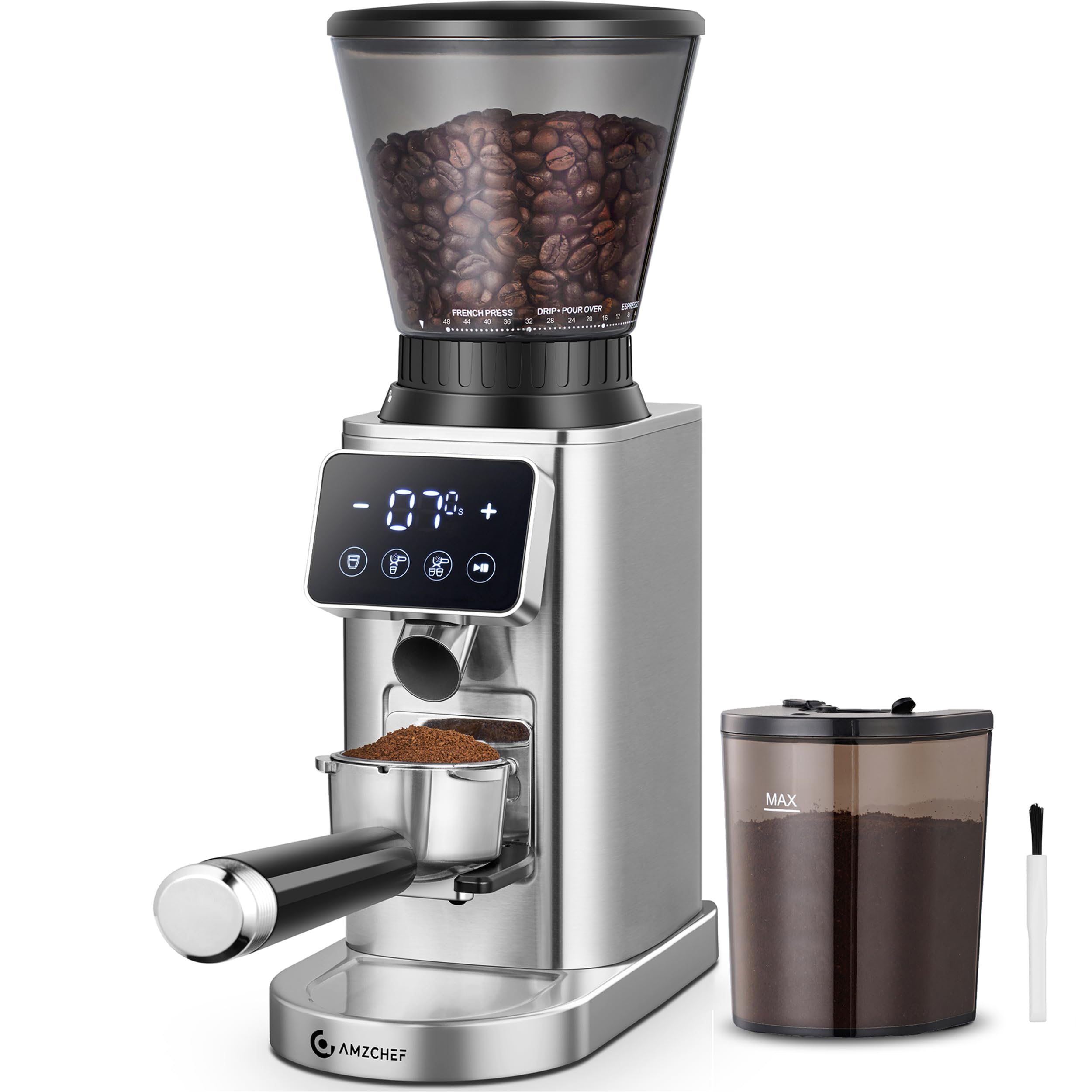
AMZCHEF Burr Coffee Grinder
Key Features
- Burrs: 40mm stainless conical
- Anti-static: Yes
- Grind settings: 48
- Hopper capacity: 10.6 oz
- Price: Midrange
The anti-static catch cup is the first thing we noticed on the AMZCHEF, and it is why this is our top pick for pour-over. A 40mm conical burr set and 48 settings give plenty of room to dial in a medium-fine grind, but the real win is how little coffee clings to the stainless container when you tip it into a V60. We have scraped enough static-charged grounds out of other catch cups to appreciate that.
The touchscreen is more capable than a pour-over brewer strictly needs. You can choose 2 to 12 cups or set a grind time in half-second steps, and we found the timer useful once we settled on a dose. The controls took a few sessions to learn; the mode switching is not as immediate as a single dial. A 10.6-ounce hopper is generous for a household, and the UV-blocking tint is a nice touch if the grinder lives near a window.
What matters most is that the grind range covers the whole pour-over window and then some. We liked being able to move from a fine drip setting to a coarser bed without losing our place, and the stainless cup pours cleanly. The 48 settings are more than you need for one brew method, but they do not get in the way. This is the electric grinder we point to for a clean, repeatable morning.
Pros
- 48 settings cover pour-over through espresso
- Anti-static cup keeps the counter cleaner
- Large 10.6-ounce hopper
- 40mm conical burrs support even extraction
Cons
- Touchscreen controls take time to learn
We recommend the AMZCHEF as our top pick for pour-over: 48 settings, a 40mm conical burr, and an anti-static cup cut the mess without complicating the morning.
Best for Big-Batch Brewing
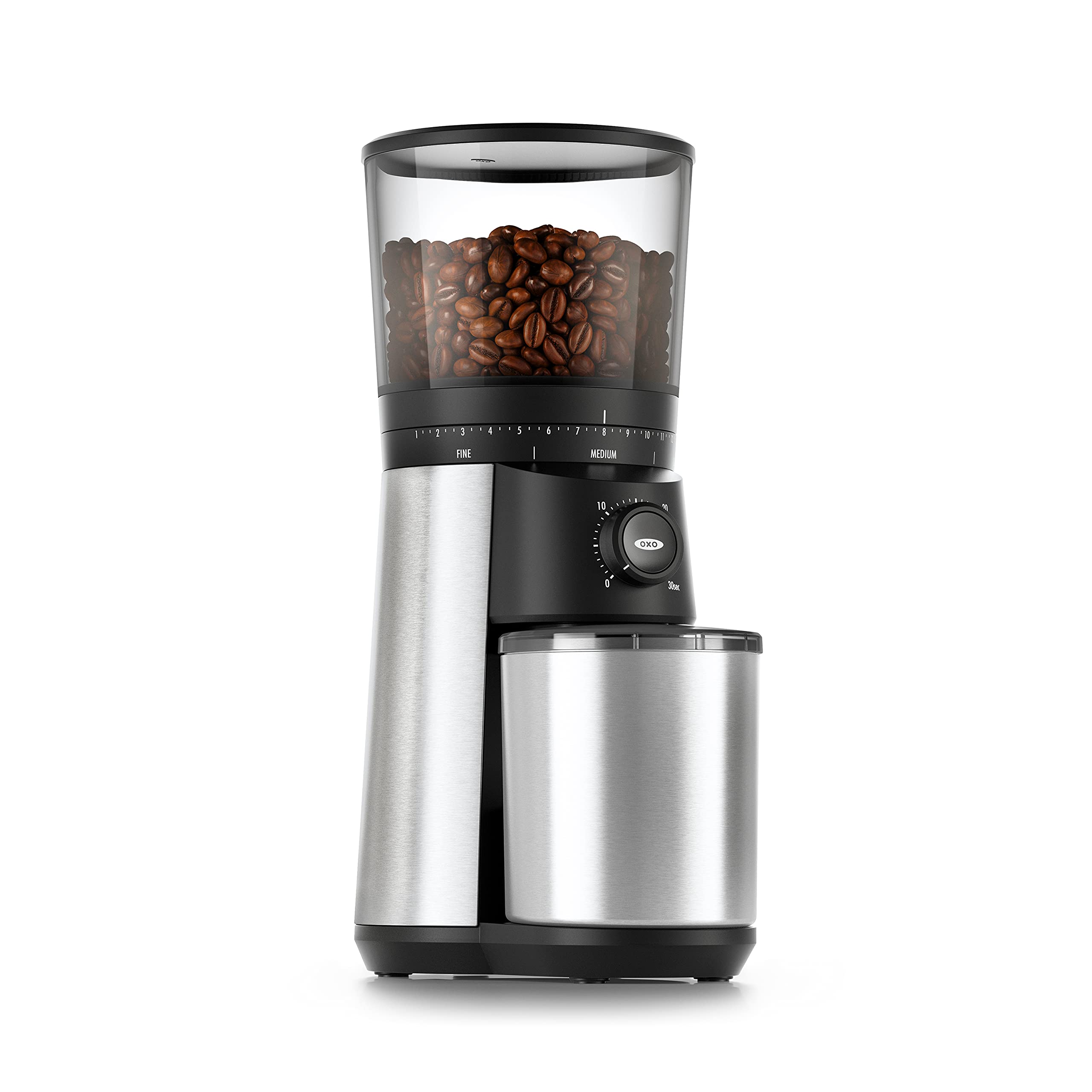
OXO Brew Conical Burr Grinder
Key Features
- Burrs: 40mm stainless steel conical
- Grind settings: 15 plus 43 micro-adjustments
- Hopper capacity: 12 oz
- One-touch memory: Yes
- Price: Midrange
A 12-ounce hopper and a one-touch start button are the OXO’s calling cards. If you brew for two or more people, the hopper is genuinely useful: you can fill it and work through several mornings without topping up. The button also remembers the last setting, so a repeat pour-over does not require a dial ritual.
We liked the OXO most for that repeatability. The 40mm conical burrs and the 15 main settings plus 43 micro-adjustments give you enough range to move between drip and pour-over, and the micro clicks are the part that lets you fine-tune a medium-fine bed. The one-touch start is the feature we used most, and it makes a second pot just as easy as the first. It is not the most precise grinder here, but it is one of the easiest to live with when the same dose happens every day.
The weak spot is durability. The two-year warranty is a real cushion, but the motor and burr assembly are the parts to watch over time; that risk is why it sits below our top pick. For a big-batch household, though, the convenience is hard to beat.
Pros
- One-touch memory repeats your last setting
- 12-ounce hopper reduces refills
- 43 micro-adjustments fine-tune the grind
Cons
- Cleaning around the chute takes patience
We recommend the OXO for anyone brewing several cups at once; the 12-ounce hopper and one-touch memory make repeat pots easy, though cleaning takes more patience.
Best for Brew-Method Range
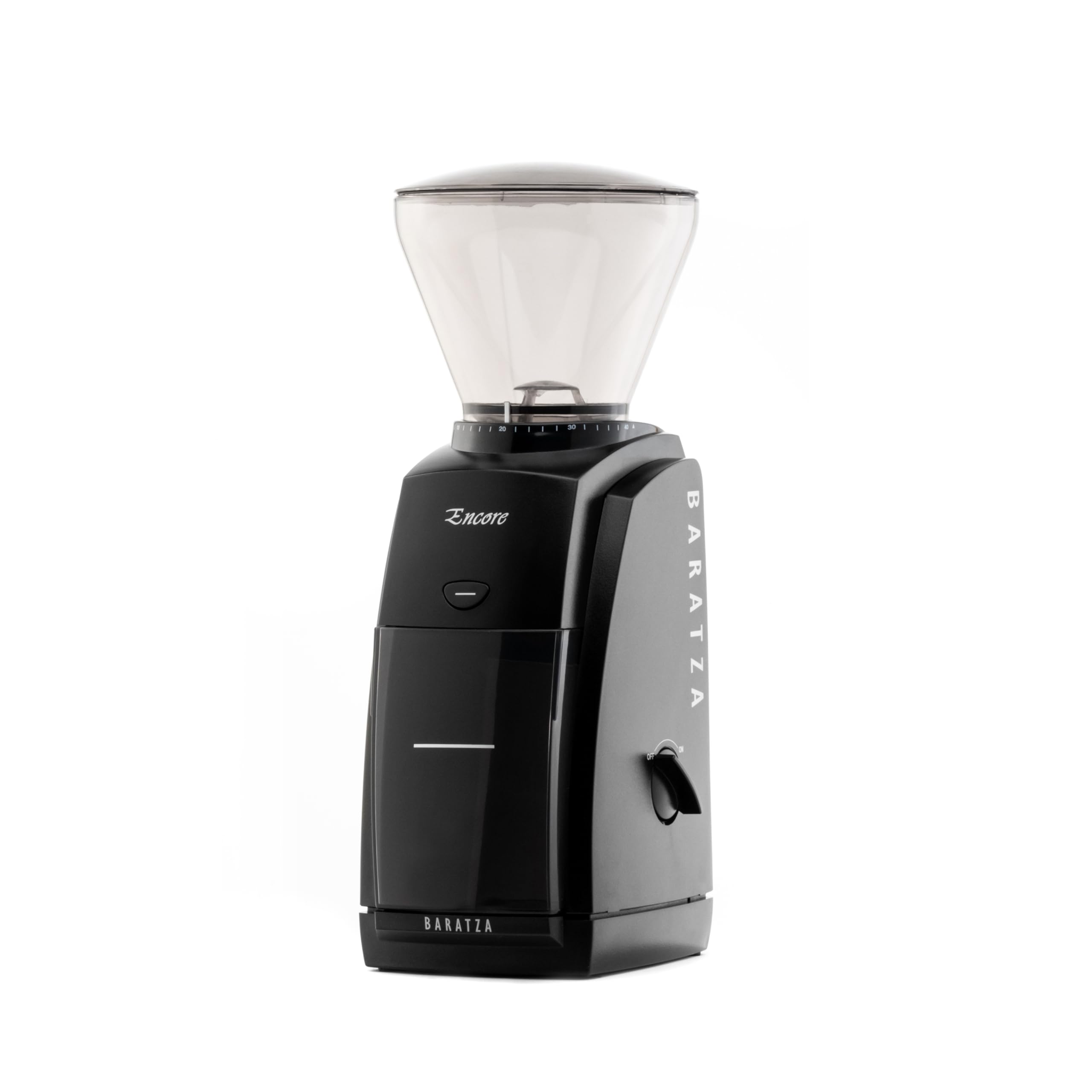
Baratza Encore
Key Features
- Burrs: 40mm conical steel
- Warranty: 1 year
- Grind settings: 40
- Hopper capacity: 5 oz
- Price: Premium
The Encore’s dial lists brew methods instead of just numbers, and that tells you what Baratza built it for. Forty settings run from espresso to French press, with Hario V60 and Chemex called out in the same range. For a pour-over brewer who also keeps an AeroPress or a French press on the shelf, that breadth is the appeal.
The 40mm commercial-grade conical burrs are the heart of it. We found the grind range easy to move through, and the front-mounted pulse button is simple to use for a single dose. The five-ounce hopper is small, but that suits the way many pour-over brewers work: weigh what you need, grind it, and leave the rest in the bag.
What keeps the Encore from the top spot is the chute. It can clog, especially with oily beans, and the one-year warranty is shorter than the OXO’s two-year coverage. Those are real ownership costs, not dealbreakers for everyone. If you want one grinder to cover several brew methods and you are willing to brush the chute regularly, the Encore remains a convincing choice.
Pros
- 40 settings cover several brew methods
- 40mm commercial-grade conical burrs
- Front-mounted pulse button is simple
Cons
- Chute can clog with oily beans
We recommend the Encore when you switch between pour-over, AeroPress, and French press; its 40 settings cover the range, but the small hopper and clog-prone chute ask for care.
Best for Quiet, Tidy Kitchen
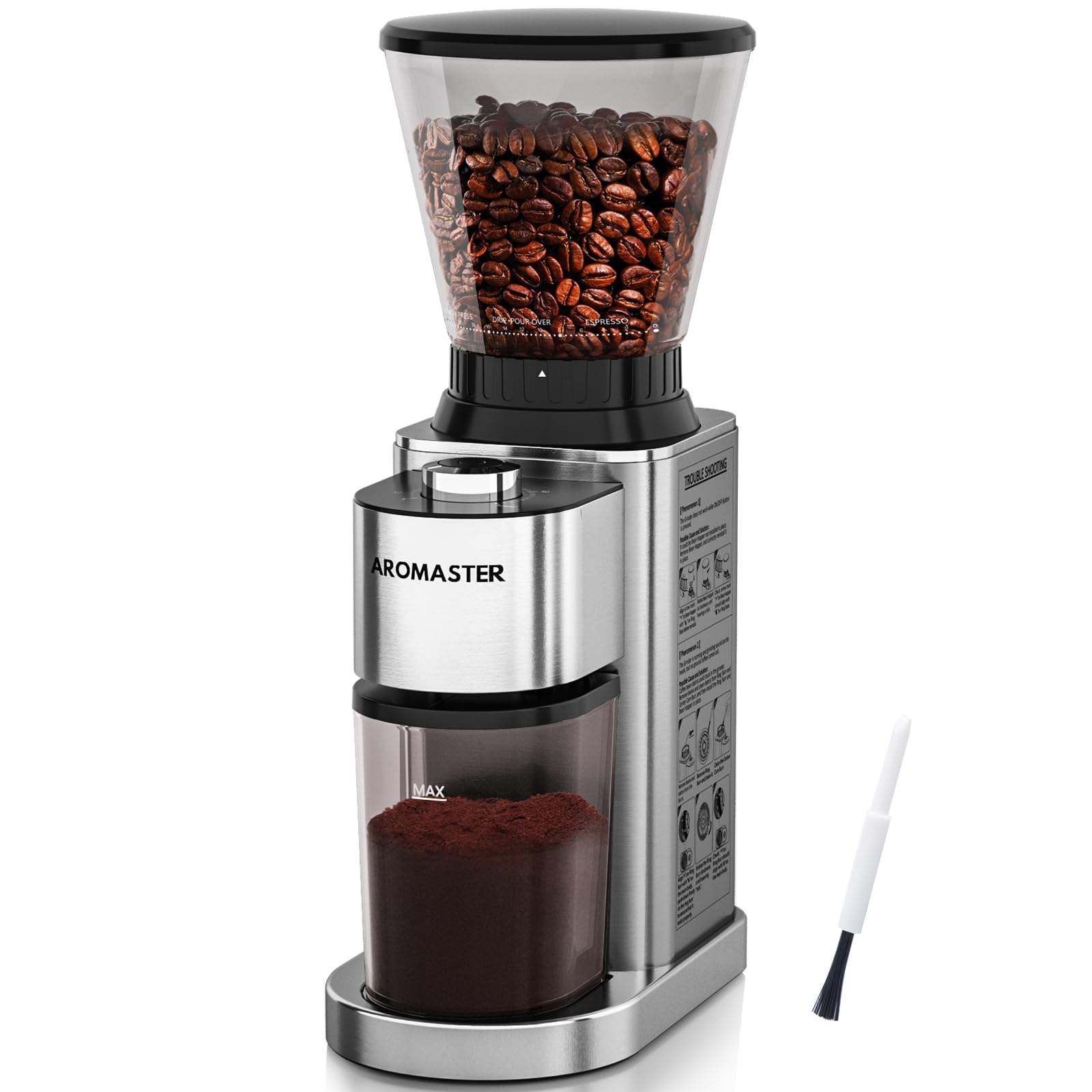
Aromaster Conical Coffee Grinder
Key Features
- Burrs: Stainless steel conical
- Capacity: 3.9 oz
- Anti-static: Yes
- Grind settings: 48
- Price: Midrange
The Aromaster is the grinder we notice least in the morning, which is the point. Its motor is soft enough that we can grind while the rest of the house is still quiet, and the narrow body leaves room for a scale and dripper on a small counter. The anti-static bin is the other detail that makes it easy to live with: grounds drop into the cup instead of decorating the counter.
The 48-step dial covers the usual range from espresso to French press, and the stainless steel conical burrs produce an even medium grind for pour-over. We liked that the settings are easy to adjust and that the removable ring burr comes out for cleaning. The built-in brush is a small thing, but it means the cleanout tool is always with the grinder.
The 3.9-ounce capacity is the compromise. That is fine for one or two cups, and it keeps the footprint small, but it is not the grinder for a full pot when company arrives. You can refill it, of course; it just turns a one-and-done grind into two batches.
For a quiet, tidy pour-over station, the Aromaster is the one we choose. It gives up hopper capacity, not grind quality, and the anti-static bin is worth more day to day than a larger hopper you rarely fill.
Pros
- 48 settings cover fine to coarse
- Anti-static bin keeps grounds contained
- Quiet motor suits early mornings
- Removable burr ring simplifies cleaning
Cons
- Small 3.9-ounce hopper
We recommend the Aromaster for a quiet, tidy solo setup; its anti-static grind and 48 settings make pour-over easy, provided a small hopper suits your batch size.
Best for Solo Hand Grinding
Alpaca Ventures Manual Grinder
Key Features
- Burrs: 420 stainless conical, 57 HRC
- Weight: 1 lb
- Capacity: 0.88 oz
- Grind settings: 45 clicks
- Price: Midrange
The Alpaca Ventures grinder puts the adjustment on the bottom as a 45-click ring and runs the crank on dual bearings. That sounds like spec-sheet detail until you use it: the clicks are audible and repeatable, and the handle turns smoothly when the burrs are loaded. It feels like a tool rather than a gadget.
We liked the 420 stainless conical burr, hardened to 57 HRC, because it gives the grinder a substantial feel without making the body heavy. The 25-gram capacity is one generous pour-over or two small cups, so this is a solo brewer’s grinder. The one handling note to learn is to hold the crank steady while you turn the dial; otherwise the dial spins without clicking into place.
For a manual grinder, speed matters, and the dual bearings make a medium-fine dose feel less like a workout than the small ceramic mills here. The open question is long-term durability: the handle and bearing area are the parts to watch. We still reach for this one when we want a hand grind that feels precise.
Pros
- 45 clicks are audible and repeatable
- Dual bearings keep the crank smooth
- 420 stainless burr at 57 HRC
- Compact 1-pound body travels well
Cons
- Handle and bearing failures can develop
We recommend the Alpaca Ventures for a solo pour-over brewer who wants a fast, repeatable hand grind; the 45-click dial and dual bearings make the ritual feel precise.
Best for Budget Travel Kit
Hario Ceramic Coffee Mill

Key Features
- Power: Manual
- Weight: 11.2 oz
- Capacity: 2 cups
- Grind adjustment: Adjustable ceramic burr
- Price: Budget
The Hario is the least expensive way we found to get a genuine burr grind for pour-over, provided you are willing to turn the crank. For a solo brewer on a tight budget, that trade is worth it. The ceramic burr and the compact body have been around long enough that the appeal is easy to understand.
The grind is even enough for a medium-fine pour-over bed, and the adjustment holds its setting once you find the right notch. We liked the removable handle and the small footprint; it disappears into a drawer or a travel bag. The catch cup is simple, and the grinder comes apart for cleaning without a drawer full of tools.
This is a solo brewer’s tool. The two-cup capacity and the hand-cranking pace make it a poor fit for a household that brews a pot at a time, and the grind takes longer than an electric. For one cup, though, the ritual is part of the point, and the Hario makes it affordable. If you mostly make a single V60, that is not a hardship.
Pros
- Ceramic burr produces an even grind
- Compact and light for travel
- Adjustment holds its setting
Cons
- Takes a minute or more per cup
- Two-cup capacity limits bigger brews
We recommend the Hario for a tight budget or a travel kit; it delivers a genuine burr grind for pour-over, as long as you accept the slower hand-cranking.
Best for Large Manual Batches
CEVING 60g Manual Grinder
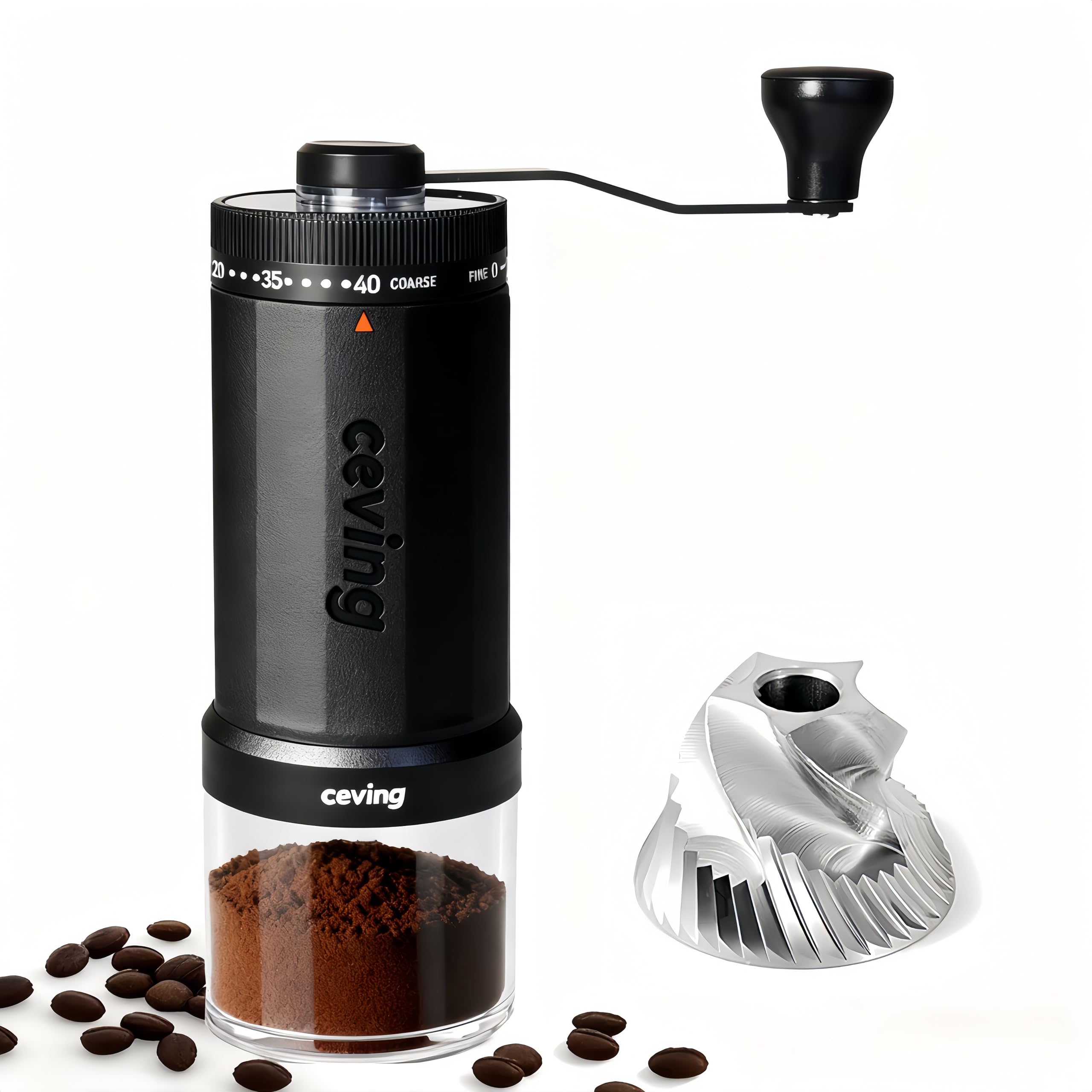
Key Features
- Burrs: Stainless steel conical
- Weight: 1.1 lb
- Capacity: 2.12 oz
- Grind settings: 40 external
- Price: Budget
The 60-gram capacity is the reason to look at this CEVING. Most hand grinders here top out around a single dose, while this one holds enough for a batch brew or two large pour-over doses. If you routinely make coffee for more than one person, that changes the calculation.
The 40 external settings are easy to adjust without taking the grinder apart, and the click ring is marked clearly enough to return to a setting. The stainless steel burrs grind quickly for a manual, and the 0.5 kg body is light enough to travel. We liked that the adjustment is on the outside; it makes switching from pour-over to French press a quick twist rather than a disassembly job.
The build is where the compromises show. The plastic catch cup and lid feel less substantial than the metal body, and the lid and handle have some wobble. None of that affects the grind, but it is the difference between a tool you baby and one you toss in a bag.
For manual brewing beyond one cup, this is the one we recommend. It solves the capacity problem that sends most hand grinders back to the cupboard when guests arrive, and the external clicks make it easy to dial in. It is not the most refined hand grinder here, but it is the most useful for a batch.
Pros
- 60 g capacity handles batch brewing
- 40 external settings adjust without disassembly
- Stainless steel burrs grind quickly
- Light 0.5 kg body travels well
Cons
- Plastic catch cup and lid feel fragile
- Static can cling to the cup
We recommend the CEVING 60g for manual brewing beyond one cup; its large capacity and external clicks solve batch pour-over, while the plastic catch cup is the weak point.
Best for Simple Electric Value
Ollygrin Burr Coffee Grinder

Key Features
- Burrs: 40mm stainless conical
- Cup selector: 2-12 cups
- Grind settings: 30
- Hopper capacity: 10 oz
- Price: Midrange
The Ollygrin does without the AMZCHEF’s touchscreen and timer, and that is not a bad thing for pour-over. It has 30 settings instead of 48, a 40mm conical burr set, and a 10-ounce hopper. The controls are simple dials, and the narrower body fits under a cabinet more easily than the taller electrics here.
We found the simple dials quicker to live with than a touchscreen for a single pour-over. The cup selector runs from 2 to 12 cups, but we ignored it and weighed our dose; it is more useful for drip pots than for a V60. The 150-watt motor is quieter than we expected, and the grind range covers a medium-fine bed without fuss.
For a no-frills electric, this is the one we recommend. It gives up timer precision, not grind range, and the compact body is easy to keep on the counter. If you want to set a dose and walk away, the AMZCHEF is the better choice; if you weigh your beans anyway, the Ollygrin is simpler.
Pros
- 30 settings cover medium-fine pour-over
- Quiet 150-watt motor
- 10-ounce hopper and cup selector
- Compact 5.4-inch-wide body
Cons
- Static can cling to the grounds cup
We recommend the Ollygrin for a simple, quiet electric pour-over setup; 30 settings and a 10-ounce hopper cover daily cups without the touchscreen fuss.
How We Tested 11 Burr Grinders for Pour Over
We started with about 30 grinders — hand cranks, countertop electrics, flat burrs, conical burrs — and cut the list to 11 based on what you can check before buying: whether the range actually reaches the medium-fine zone pour over wants, whether replacement burrs and parts are sold separately, how much counter space the thing eats, and whether the price was fair for the build. Then we bought them and brewed with them for eight months.
Each grinder made at least a cup a day. I brewed two most mornings — a light washed bean at medium-fine for a cone dripper, a darker, oilier bean ground coarser for a flat-bed brewer — and once a week I ground 20 grams on a set setting and shook it through a kitchen sieve, noting how much passed through as dust versus how much stayed on top. I also ground the same dose at three neighboring settings to see how far apart those clicks really sat.
The unglamorous parts got equal time. I timed a 20-gram dose from switch-on to last bean and weighed what stayed behind in the chute after a firm tap, since retained grounds go stale. Every grinder ran at 5:30 a.m. in a small kitchen with a decibel meter app and a sleeping household upstairs. Weekly, I opened the burr chamber, brushed it out, and noted where grounds packed in, and for two weeks I pushed an oily dark roast through at a fine setting to see which chutes clogged.
After eight months I checked for burr wobble, cracked plastic, stiff dials, and static that got worse instead of better, then brewed a cup to compare against my notes from week one. A few grinders that impressed me out of the box had drifted by month six; the quieter, simpler ones mostly just kept working.
How to Choose a Burr Grinder for Pour-Over
The right pour-over grinder gives you a repeatable medium-fine bed with as little static and cleanout fuss as possible.
Consistency Beats a Big Setting Count
Pour-over wants a medium-fine grind with few fines and few boulders, and that is a burr-alignment job more than a numbers game. A grinder with 15 main settings and 43 micro-adjustments, like the OXO, can be easier to dial in than one with a long list of steps that are hard to repeat. We prioritise a burr set that produces an even bed and a dial you can return to. Check the range covers fine drip to coarse French press; ignore the total if the useful pour-over zone is cramped.
Manual or Electric: Match the Ritual to the Morning
A hand grinder is quiet, compact, and easy to travel with, but it asks for effort every cup. A 25-gram model like the Alpaca suits one large pour-over; a 60-gram CEVING is better for two people or a batch. Electric grinders trade that effort for speed and a counter footprint, and most add motor noise. If you brew before work, an electric with a repeatable dose is easier to keep; if you enjoy the ritual or camp often, a manual earns its space.
Static, Retention, and the Cleanout You Will Actually Do
Static is the quiet annoyance of pour-over grinding: grounds cling to the catch cup, the last gram refuses to fall, and the counter gets a dusting. Anti-static bins and stainless catch cups help, as on the AMZCHEF and Aromaster, but no grinder is completely free of cling. Look at how the chute and burrs come apart, too. A grinder that needs a full teardown for a weekly brush, like the Baratza’s chute, is one you may clean less often than you should.
Capacity and Footprint: Buy for the Batch You Brew
Hopper size is not the same as useful capacity. A 10- to 12-ounce electric hopper, like the OXO’s, is convenient for a household, but you can single-dose it and keep beans fresher. A 25-gram manual, like the Alpaca, is a solo tool; a 60-gram CEVING is the hand grinder for two cups at once. Measure the height under your cabinet before you commit, especially if the grinder lives beside a dripper. The footprint matters more than the hopper on a small counter.
Noise and Long-Term Support
Electric burr grinders are not uniformly loud, and the difference matters in a small kitchen. A soft motor, as on the Aromaster, makes an early grind less disruptive; a louder model is tolerable but noticeable. We also look at warranty length and how easy the burrs are to reach. A two-year warranty, like the OXO’s, is a useful cushion on a motorized grinder; the Baratza’s one-year coverage is shorter. Check the chute and burr access before you buy, because those are the parts that decide how long the grinder stays pleasant.
Frequently Asked Questions
Do I really need a burr grinder for pour-over?
If you want a repeatable medium-fine bed, yes. A blade grinder chops beans into a mix of dust and chunks, so the water runs through unevenly and the cup can taste both sour and bitter. A burr grinder gives you a setting you can return to. Buy whole beans and grind just before brewing; that is the bigger upgrade over pre-ground.
What grind setting should I start with?
Start medium-fine, close to the texture of table salt, and adjust by taste. If the bed drains very fast and the cup tastes thin or sour, go finer; if it drains slowly and tastes harsh or bitter, go coarser. Change one click or one small step at a time, and keep the dose and water weight steady while you dial in.
Can I use one grinder for both pour-over and espresso?
Usually yes, if the grinder has a broad range and repeatable settings. Espresso needs a finer, more tightly controlled grind, so a grinder with 40 or more steps or a micro-adjustment ring is easier to live with. Return to the same mark when you switch back; a grinder that loses its setting makes the crossover frustrating.
How often should I clean a burr grinder?
Brush out the chute and catch cup after every few uses, and do a deeper clean of the burrs about once a month. Oily dark roasts leave residue faster, so shorten that interval if the grind starts to clump or the chute slows. Unplug the grinder before you remove the burr ring, and use a dry brush rather than water.
Final Verdict
For most pour-over brewers, the AMZCHEF is the grinder we recommend: 48 settings, a 40mm conical burr, and an anti-static catch cup turn a daily dose into a clean, repeatable habit. If you brew one cup at a time and want to spend less, the Alpaca Ventures hand grinder is the better match; its 45 clicks are easy to return to, and the 25-gram capacity suits a solo pour-over.