This post contains affiliate links. We may earn a small commission when you buy through our links — at no extra cost to you.
Shopping for a food processor to make nut butter often starts with wattage. But peak power doesn’t guarantee creamy results — many high-wattage models leave grit because of flat blade designs that fail to pull ingredients downward.
The real factor is blade geometry and bowl shape. Curved S-blades that create a vortex force nuts against the walls, breaking them down into a smooth paste. A wide, shallow bowl dilutes that action, so a 7–9 cup bowl often outperforms a larger one for small batches.
This guide focuses on processors that actually puree — not just chop — so you can turn almonds or peanuts into butter without scraping chunks halfway through.



Best for Smooth Nut Butters
Cuisinart DLC-8SY
Key Features
- Motor Power: 625W
- Bowl Size: 11 cups
- Blade Type: Chopping blade + discs
- Price: $$
The S-shaped blade and bowl geometry work together to pull ingredients into the blade path, producing uniformly smooth nut butter and hummus without the need to scrape down the sides repeatedly.
625 watts of power drive through dense almond paste, cold butter for pastry, and heavy doughs with minimal strain. The extra-large feed tube accommodates whole apples or tomatoes, reducing pre-cutting. Owners note that the motor maintains consistent speed even under load, and the 11-cup bowl handles meals for a family of four without being oversized on the counter.
This processor fits cooks who make nut butter, pureed soups, or hummus weekly and want a single appliance that won’t wear out after a few years. Plastic cracking in the bowl or lid has been noted with sudden temperature changes (e.g., pouring hot liquid into a cold bowl) or after extended heavy use; treating the parts gently and avoiding dishwasher heat extends their life. The model suits those who prefer replaceable parts availability and a track record spanning decades over newer designs.
Pros
- Motor handles dense ingredients like nuts and cold butter without stalling
- 11-cup bowl fits family-sized batches without dominating counter space
- Extra-large feed tube accepts whole fruits, cutting prep time
- Decades of consistent manufacturing mean replacement bowls and blades are easy to find
Cons
- Bowl and lid may crack if exposed to sudden temperature changes or after extended heavy use
- Aligning the lid and feed chute can take a few tries before the motor will start
For nut butter and daily family prep, this machine delivers consistent results without fuss — the mid-range price is justified if you handle the plastic parts with care.
Best for Budget Nut Butters
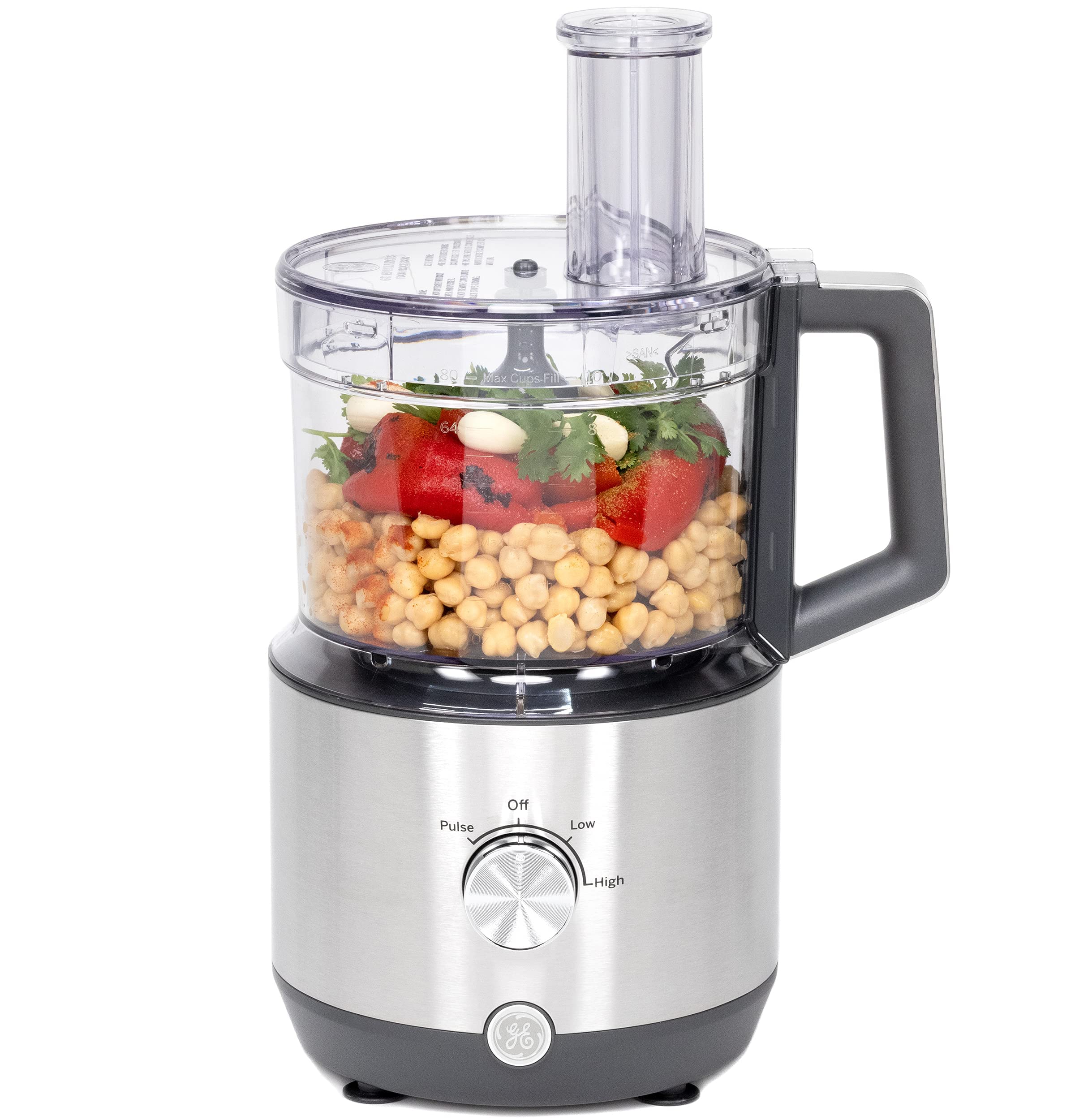
GE G8P1AASSPSS
Key Features
- Motor Power: 550W
- Bowl Size: 12 cups
- Blade Type: Multiple discs + mini bowl
- Price: $$
The GE 12-cup food processor delivers smooth peanut butter at a price that undercuts many alternatives, with a 550W motor and an accessory set that includes a mini bowl for small tasks. While the top pick Cuisinart offers more consistent long-term performance, the GE costs significantly less and has direct user feedback confirming its nut butter capability.
This processor suits the budget-conscious buyer who needs a large bowl for occasional big batches and specifically wants to make nut butters, but is comfortable with a modest tradeoff in precision engineering. Some units have been noted to stop working after a few months, so checking the unit upon arrival is wise. Additionally, the feed tube is narrower than the ‘whole ingredient’ claim suggests, meaning tomatoes or potatoes need halving.
Pros
- Creates smooth peanut butter consistently – a key need for buyers targeting nut butters.
- Good value with multiple accessories at a mid-range price, including grating disc and mini bowl.
- Large 12-cup bowl plus a mini bowl for small tasks adds convenience.
Cons
- Feed tube is narrower than advertised, requiring pre-cutting for larger items.
- Some units may stop working after a few months of use – quality control varies.
This GE is a smart buy for budget-focused cooks who need a large bowl and reliable nut butter performance, provided they accept the possibility of unit variance.
Best for Quiet Compact Kitchen
Breville BFP610
Key Features
- Motor Power: 625W
- Bowl Size: 9 cups
- Blade Type: S-blade, slicer, shredder, dough
- Price: $$$
The Breville BFP610 stands out for its exceptionally quiet induction motor and clever design that stores all accessories inside the bowl – a rare feature for a 9-cup machine. The 625-watt brushless motor runs smoothly enough to handle nut butter without the loud whine typical of comparably sized processors.
The precision adjustable slicer offers 15 levels for consistent cuts, and the included S-blade, reversible shredder, and dough blade cover most prep tasks. For nut butter specifically, the curved blade design and bowl shape work well – users report smooth results, though the 9-cup capacity means processing larger batches requires multiple rounds.
This is a strong fit for home cooks who prioritize quiet operation and compact storage over maximum capacity. The premium price and smaller bowl make it less suited for bulk meal prep or households that regularly process more than 9 cups at once. Long-term reliability under heavy use is a known vulnerability – the low number of reviews means potential failure modes haven’t surfaced yet.
Pros
- Whisper-quiet operation suitable for open kitchens or early mornings.
- Onboard storage caddy keeps all accessories inside the bowl, saving counter space.
- Precision adjustable slicer with 15 settings delivers consistent thickness every time.
Cons
- 9-cup bowl capacity may require multiple batches for large meal prep or bulk nut butter.
- Premium price may feel steep for a 9-cup unit with a relatively unproven track record.
A beautifully engineered compact processor for those who value quiet and storage – but if you need a proven workhorse for heavy nut butter production, the Cuisinart DLC-8SY offers greater capacity and decades of user feedback.
Best for Smoothie & Processor
NutriBullet NBKS50100
Key Features
- Motor Power: 1500W
- Bowl Size: 7 cups
- Blade Type: Chopping blade, dough, slice/shred
- Price: $$
The 1500-watt motor turns frozen fruit and raw almonds into smooth purées and nut butters in under a minute. The 64-ounce pitcher handles large smoothie batches, while the 7-cup processor bowl chops vegetables and kneads dough — all from a single base that frees up counter space.
The processor bowl’s vessel recognition system can be temperamental: the motor may not engage until the bowl is perfectly seated, and occasional stops mid-cycle have been noted. This attachment suits occasional slicing and chopping rather than heavy daily grinding. Those who need a dedicated food processor for weekly nut butter production will find dedicated units more consistent.
Blending at full power produces a loud noise, comparable to other high-wattage blenders — less of an issue in a busy kitchen than a quiet apartment. The 7-cup bowl is fine for dips and small salads but limits larger prep tasks like shredding several heads of cabbage.
Pros
- 1500-watt motor crushes frozen fruit and tough nuts into silky smoothies and nut butters in seconds.
- Three-in-one design with pitcher and processor bowls reduces kitchen clutter and eliminates the need for separate appliances.
- Mid-range price point offers good value for a multi-function machine that handles both blending and food processing tasks.
Cons
- In a quiet kitchen, the blending noise will be noticeable – less of an issue in a busy household.
- The 7-cup processor bowl means you can’t process large batches of dough or shred entire heads of cabbage at once.
- Processor attachment’s sensor detection can be intermittent; the bowl may need to be reseated or reset to start processing.
If smoothies are your daily driver and you occasionally process small batches of nuts or vegetables, the NutriBullet Triple Prep delivers impressive power in a space-saving package – just be prepared to double-check the processor bowl seating on the days you need it.
Best for Coarse Chopping Dough
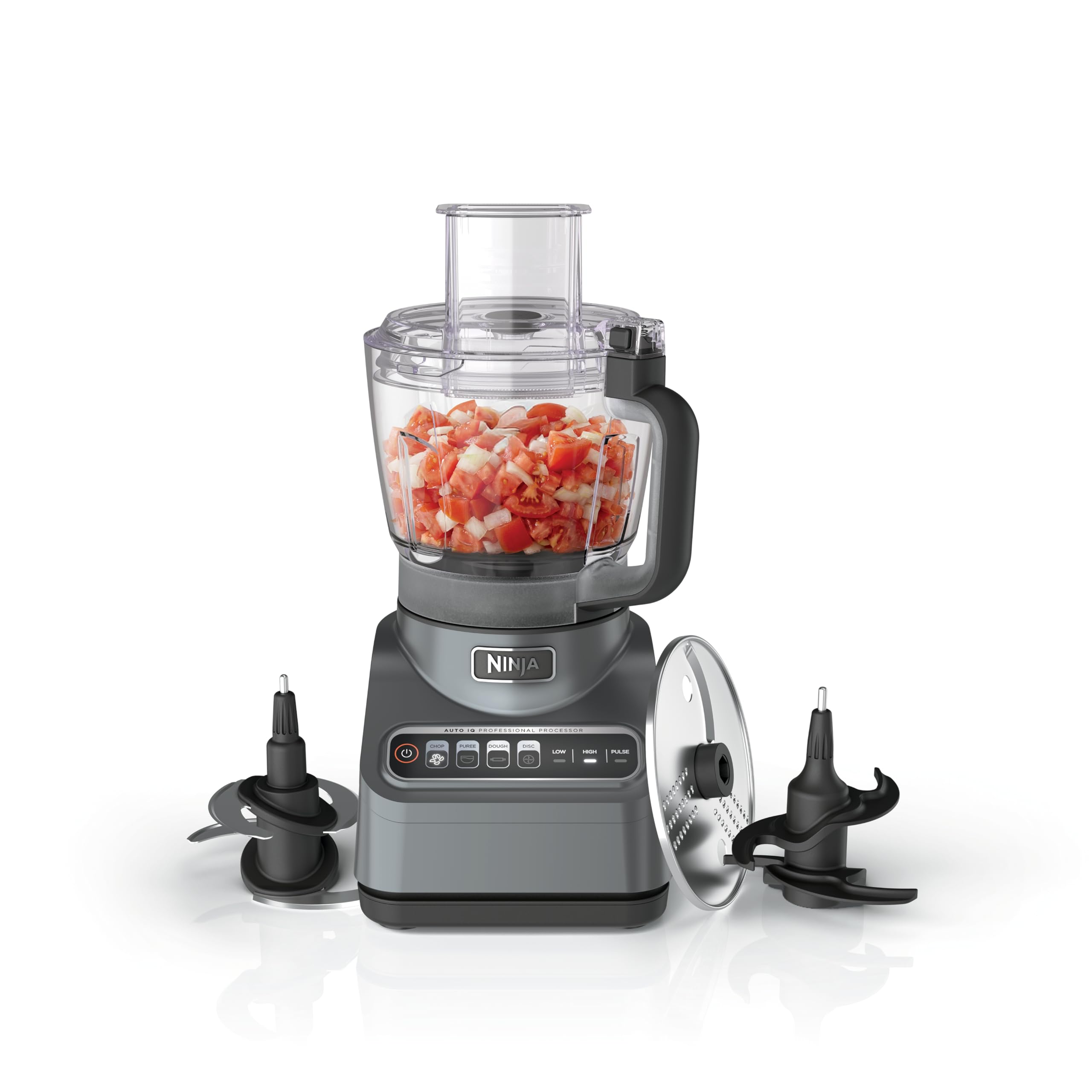
Ninja BN601
Key Features
- Motor Power: 1000W
- Bowl Size: 9 cups
- Blade Type: Chopping, dough, slice/shred discs
- Price: $$
The Ninja BN601 delivers 1000 peak watts for fast chopping and dough mixing, outperforming many competitors at its price. Unlike the top pick in this category, its flat blade design prioritizes coarse results over fine purees, making it a strong choice for rough chopping, slicing, and kneading stiff doughs.
This model suits anyone who needs a workhorse for coarse chopping, slicing, and dough — tasks where speed and torque matter. If you’re looking for a machine to make smooth nut butters, this is not the fit: the blade geometry leaves chunks regardless of run time, confirmed by multiple reports. The plastic bowl can crack under thermal stress or heavy use, so handle it with care.
The Auto-iQ presets simplify common jobs, and dishwasher-safe parts make cleanup quick. Given the mid-range price, the performance for non-puree tasks is strong — buyers find it delivers good value for chopping, slicing, and dough preparation.
Pros
- 1000-watt motor powers through tough ingredients and stiff doughs quickly.
- Simple controls and dishwasher-safe parts make setup and cleanup fast.
- Good value for the performance — buyers find it outpaces its mid-range price.
Cons
- Plastic bowl can crack under thermal shock or extended use — worth handling gently.
- Does not produce smooth purees; leaves chunks even after extended processing.
A capable chopping and dough machine that falls short for nut butter — choose the Cuisinart top pick if smooth purees are a priority.
Best for Bulk Heavy-Duty Prep
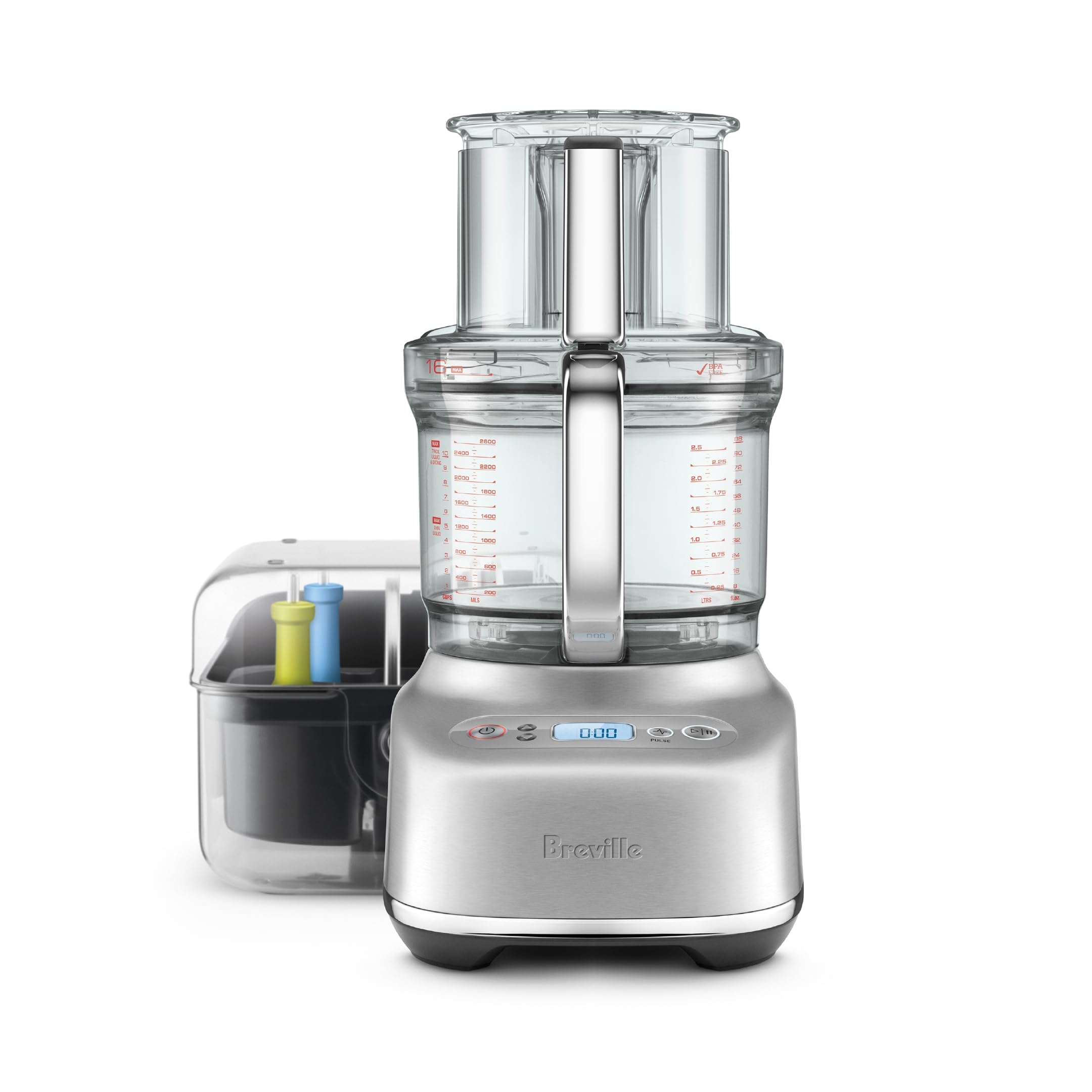
Breville BFP810
Key Features
- Motor Power: 1450W
- Bowl Size: 16 cups
- Blade Type: S-blade, slicer, shredder, mini bowl
- Price: $$$$
The Breville BFP810 Sous Chef brings commercial-scale power to home kitchens with a 1450W induction motor that pulses through dense nut batches and dough without strain. Its 16-cup bowl handles large quantities of peanut butter in a single run, and the included mini bowl and French fry disc add flexibility. However, the unit weighs over 20 pounds and requires permanent counter space — it is not something you tuck away after use. The premium price also limits its appeal to casual cooks. This machine is best suited for serious meal preppers or small businesses where heavy use justifies the investment.
Pros
- Motor power sufficient to handle the toughest jobs, from dense nut butters to stiff doughs
- Large 16-cup capacity reduces batch work for bulk processing
- Accessory set includes mini bowl and French fry disc for added versatility
Cons
- Premium price may not make sense for occasional use
- Heavy and bulky design requires dedicated counter space
For serious meal preppers or small businesses needing bulk nut butter production, this machine handles it without hesitation – but lighter users should look at smaller, more affordable options.
Best for Blending & Dough
Ninja Foodi SS201

Key Features
- Motor Power: 1400W
- Bowl Size: 9 cups
- Blade Type: Crushing blade, dough blade
- Price: $$
This 1400W machine powers through frozen fruit, ice, and stiff dough with ease, thanks to its Smart Torque motor and Auto-iQ presets. The 72-ounce pitcher and included dough blade make it a capable tool for large batches of smoothies and bread dough. However, the tall, narrow pitcher design reduces blade contact with small amounts of dense ingredients, and there is no verified feedback on how well it handles pureeing nuts into butter. For that task, a traditional food processor bowl with a shorter, wider shape would be more effective.
Pros
- 1400W motor with Smart Torque powers through tough ingredients without stalling.
- One pitcher replaces both blender and processor for dough and smoothie tasks.
Cons
- Tall, narrow pitcher limits blade contact with small batches of nuts, reducing puree efficiency.
- Not intended for smooth nut butter production due to blade and bowl geometry.
Best for users who need a high‑powered blender for smoothies and occasional dough mixing, but skip this if smooth nut butter is a primary need.
Best for Dicing Specialist
Breville BFP638

Key Features
- Motor Power: 625W
- Bowl Size: 9 cups
- Blade Type: S-blade, shredder, slicer, dicing
- Price: $$$
The Breville BFP638’s dicing kit produces consistently uniform vegetable cubes that rival manual knife work. Build quality and compact onboard storage earn consistent praise, and the 9‑cup bowl suits small to medium recipes well. However, the 625‑watt induction motor and premium price make this a niche choice for dicing enthusiasts rather than a candidate for nut‑butter grinding. Home chefs who primarily need precise dice will find a well‑executed tool; those expecting a full‑power processor for heavy nut purees should look to higher‑wattage alternatives.
Pros
- Consistently uniform dicing – clean, even cubes
- Solid build quality and compact storage with integrated caddy
Cons
- At this premium price point, the 9‑cup capacity lacks a mini bowl – a miss for small‑batch tasks
- The dicing grid may crack under repeated heavy use; reports are isolated but worth checking
Best for home chefs who prioritize precise vegetable cubes and space‑saving storage over nut‑butter capability – the Breville delivers on its dicing promise within that boundary.
How to Choose
For smooth nut butter, blade design and bowl shape matter more than peak wattage.
Motor Wattage
A 500W motor handles continuous nut grinding, but wattage alone doesn’t determine creaminess. Higher wattage (1000W+) reduces stall risk when processing dense almonds, but if the blade is flat, power won’t fix chunks.
Look for at least 500W with thermal overload protection that resets. Motors that overheat and shut off permanently are a sign of poor design for nut butter tasks.
Bowl Capacity
7 to 9 cups concentrate nuts better for small to medium batches, reducing the need to scrape sides. A 12-cup bowl spreads ingredients thin, requiring more liquid or longer runs to achieve a vortex.
Larger bowls (12+ cups) work for batch cooking but demand more nuts per batch to maintain blade contact. For occasional nut butter, a 7–9 cup bowl is more efficient.
Blade Design
Curved S-blades or quad blades that pull ingredients downward are essential for smooth purees. Flat chopping blades, common in multipurpose processors, shear nuts into coarse bits instead of grinding them into paste.
Models that include a dedicated puree or dough blade often indicate better downward force. Check user comments for ‘creamy’ or ‘smooth’ — if reviews mention chunks regardless of run time, the blade geometry is wrong.
Ease of Cleaning
Nut butter leaves oily residue that clings to nonstick coatings. Dishwasher-safe parts (bowl, lid, blade) save time, but the blade hub and seal often trap oils — hand-washing those prevents rancid odors over time.
Processors with fewer crevices (e.g., one-piece blade assemblies) are easier to clean than those with multiple stacked discs. A quick rinse immediately after use prevents oil buildup.
Bowl and Lid Durability
Plastic bowls and lids are the most common failure point across brands. Thermal shock from hot nuts or dishwasher heat can cause cracks. Look for reinforced polycarbonate and avoid models with thin locking tabs.
If you plan to process hot roasted nuts, let them cool before adding to the bowl. A cracked lid often prevents the motor from engaging, rendering the processor unusable until replaced.
Noise Level
Nut grinding is inherently loud, but induction motors (like Breville’s) run significantly quieter than universal motors. If you process nuts early morning or in an open kitchen, a quieter model improves daily usability.
Decibel ratings aren’t standard, but user descriptions like ‘whisper-quiet’ vs ‘jet engine’ give a reliable signal. Noise is a quality-of-life trade-off, not a performance issue.
FAQ
Why does my food processor leave chunks when I make nut butter?
The blade design is likely flat or angled upward, failing to pull nuts into a vortex. Curved S-blades that force ingredients downward create the friction needed for smooth paste. If your processor has a chopping blade, switch to a dough or puree blade (if included) or upgrade to a model with a true S-blade.
Can a 500W food processor really make smooth peanut butter?
Yes, if the blade geometry is right. The GE G8P1AASSPSS (550W) and Cuisinart DLC-8SY (625W) produce creamy nut butter because their curved blades force nuts into the walls. Wattage above 600W reduces stall time but isn’t required for small batches.
How long should a food processor run continuously for nut butter?
Most processors can run 1–2 minutes before needing a 30-second rest to avoid overheating. For a full batch of creamy nut butter (2–3 cups), expect 3–5 total minutes with intermittent pauses. Models with thermal overload protection reset automatically; those without risk permanent motor damage if run too long.
Is a blender or food processor better for making nut butter?
A food processor with a curved S-blade is better because its wide bowl allows the paste to circulate and release oils. Blenders with narrow pitchers often trap nuts under the blades, requiring constant scraping and liquid addition. For dry nut butter, a processor is the right tool.