This post contains affiliate links. We may earn a small commission when you buy through our links — at no extra cost to you.
Low-carb cooking has a texture problem. Steam broccoli and sear chicken and you end up with a plate that’s perfectly healthy and a little sad. An air fryer fixes that by blasting food with fast-moving hot air, so vegetables come out blistered and chicken skin crackles — no flour, no breadcrumb, no vat of oil. It’s the difference between a meal you eat because you should and one you actually look forward to.
Over the past eight months, my team and I have cooked our way through 12 air fryers, from compact basket models to larger oven-style units, and the gap between a good one and a frustrating one shows up fast. A model that preheats slowly or runs cool will leave your zucchini pale and your salmon uneven, no matter how carefully you season it. We kept notes on crispness, how easily the baskets wiped clean, and whether the controls made sense without a manual. The picks below are the ones that earned a permanent spot on the counter — and the ones you won’t mind lifting out of a cabinet.

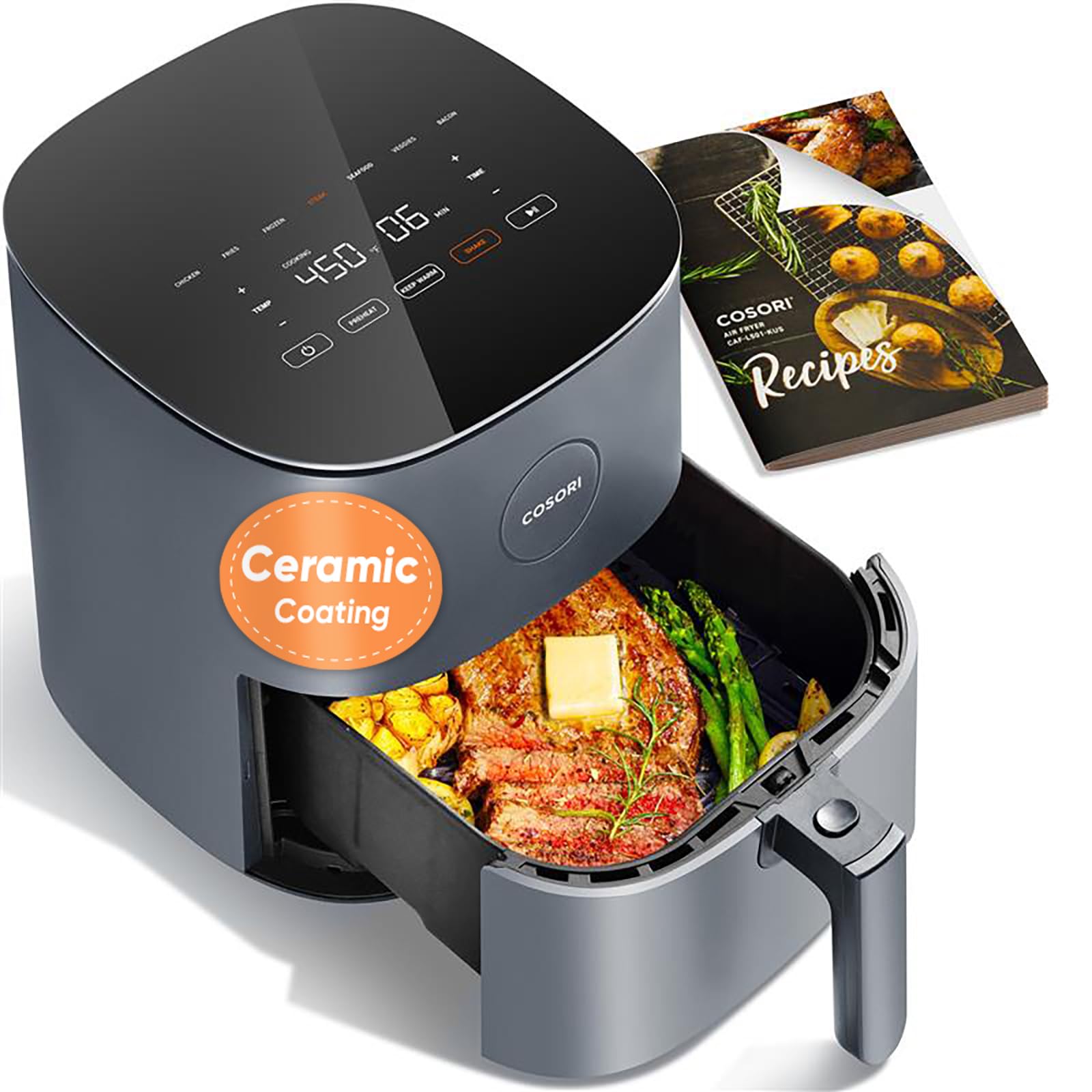


Best for Everyday Low-Carb Cooking
Cosori TurboBlaze 6 Qt
Key Features
- Power: 1,725 watts
- Capacity: 6 quarts
- Basket coating: PFAS-free ceramic
- Temperature range: 90–450 °F
- Price: Midrange
Ninety degrees is the number we keep coming back to. That’s the bottom of this Cosori’s range, and it’s low enough to dry beef for jerky or hold a plate warm without cooking it further — ground the picks that stop at 390°F or 400°F can’t cover. The top end runs to 450°F, which is where chicken skin and a steak crust happen without oil.
That spread is why the TurboBlaze is our top pick for low-carb cooking. One machine handles the whole rotation: 400 to 450°F for wings, thighs and roasted vegetables, 350°F and below for reheating and drying, and a 6-quart square basket that lays food flat instead of piling it. The 1,725-watt element and five fan speeds matter most when the basket is full, which is exactly where a weaker fryer starts steaming instead of browning.
The ceramic coating is PFAS-free, and the basket and crisper plate both go in the dishwasher. In a category where a tray of wings leaves a film of fat behind, that’s not a small thing — this is a basket that wipes out rather than soaking. The touch panel sits on top under glass, so the front of the machine stays clean even when you’re cooking something sticky.
The one number worth checking against your kitchen is depth: 14.4 inches, which is more than a shallow counter run gives you. Measure before you order and the rest of the machine is easy to live with.
Pros
- 90–450°F covers dehydrating and searing
- PFAS-free ceramic basket releases food without soaking
- 6-quart square basket lays a full tray flat
- 1,725 watts and five fan speeds hold heat under a load
Cons
- 13.2 pounds is a two-hand lift
Our top pick, because 90°F to 450°F covers the whole low-carb rotation: jerky and dried snacks at the bottom, crackling chicken skin at the top, and a ceramic basket that rinses clean.
Best for Small Households
Cosori Air Fryer Pro LE 5 Qt
Key Features
- Power: 1,500 watts
- Capacity: 5 quarts
- Basket coating: Ceramic
- Max temperature: 450 °F
- Price: Midrange
If there are two of you, the Pro LE’s 5-quart square basket is the size that stops feeling like a compromise. Four chicken thighs and a heap of green beans fit in one layer, the machine doesn’t swallow the counter, and at 10 pounds it’s light enough to move when you need the space back.
The cooking ceiling is the part worth lingering on: 450°F, same as our top pick. The 1,500-watt element is 225 watts down on the TurboBlaze, which shows when the basket is packed and barely registers with two portions in it. Seven presets, a preheat, a keep-warm and a shake reminder that beeps halfway through handle the routine work.
Cleaning is a ceramic basket and crisper tray, both dishwasher safe, and the touch controls sit under a glass top panel that wipes in one pass. A three-foot cord gives you some slack to work with on a short counter run.
What you give up against the top pick is a quart of basket and 225 watts of heating muscle, not cooking temperature. For a household of two or three that cooks protein and vegetables most nights, that’s the trade we take.
Pros
- 450°F ceiling matches the top pick
- Ceramic basket and tray are dishwasher safe
- Shake reminder takes the guesswork out of flipping
- 10 pounds with a 3-foot cord is easy to place
Cons
- A family of four cooks in two batches
For two or three people, this is the low-carb air fryer we hand people: the same 450°F ceiling as our top pick in a lighter, smaller body.
Best for Big Batches
Ninja Air Fryer XL AF181
Key Features
- Capacity: 6.5 quarts
- Batch capacity: 5 lbs fries or 9 lbs wings
- Max temperature: 450 °F
- Cooking functions: 6
- Price: Premium
Set this Ninja beside our top pick and the difference is the basket: 6.5 quarts against 6, and wide enough to take five pounds of fries or nine pounds of wings in a single go. It’s the batch machine of the group, and the one for feeding people rather than feeding a plan.
MaxCrisp at 450°F is what earns it a place. Frozen food goes in cold and comes out with a crust — no thawing, no oil, no par-cooking. Around that sit air fry, air roast, bake, reheat and dehydrate, so a Sunday of meal prep runs through one appliance: chicken thighs, a tray of vegetables, then jerky at the low end.
The trade is refinement. Where the Cosori offers five fan speeds and a 90°F floor, this one offers six programs and a wide nonstick basket, and the simpler controls reflect that. Some nights that’s exactly what you want. The basket is the argument for this machine; everything else is ordinary.
Pros
- MaxCrisp hits 450°F straight from frozen
- 6.5-quart basket holds up to 9 lbs of wings
- Dehydrate and roast round out six functions
Cons
- More capacity than a one- or two-person kitchen needs
Buy this one when quantity is the point: a 6.5-quart basket that takes nine pounds of wings straight from the freezer at 450°F.
Best for Coating-Free Cooking
Ninja Crispi Pro Glass Air Fryer
Key Features
- Power: 1,800 watts
- Capacity: 6 quarts and 2.5 quarts
- Max temperature: 450 °F
- Container material: Borosilicate glass
- Price: Premium
You can watch the skin on a chicken thigh go from pale to gold without opening anything. That’s the appeal of the Crispi Pro’s glass: no lost heat, no guesswork, and a container that goes from the freezer into the pod because the borosilicate is thermal-shock resistant.
In the box you get two CleanCrisp glass containers — 6 quarts for a whole bird, 2.5 quarts for a portion — plus crisper plates and two lids that turn either one into fridge storage. The pod is the heating unit, and its 1,800-watt element reaches 450°F, the highest power figure in this group. Six modes cover max crisp, air fry, bake and proof, roast, recrisp and dehydrate.
For anyone who wants PFAS-free glass rather than a coated basket holding dinner, this is the pick, and it’s the only one here that doubles as the container you put away afterwards. We also like that the 2.5-quart vessel makes a single portion worth bothering with — a whole appliance for one chicken breast is where most air fryers lose people.
What gives us pause is value. This is the priciest setup in the roundup, and what you’re buying is the container system and the wattage, not a wider temperature range or more modes than the Cosoris offer. If those glass containers won’t replace bowls you already own, the argument thins out fast.
Pros
- Glass containers go freezer to fryer to fridge
- 1,800 watts is the most power in this group
- 6-quart and 2.5-quart containers cover a bird or a portion
- 450°F with six cooking modes
Cons
- Heavy, hot glass containers need two hands
We recommend it to anyone who wants glass instead of a coated basket in contact with dinner; the 1,800 watts and twin containers justify the package.
Best for Tight Counters
bella Fits-anywhere Slim 4 Qt
Key Features
- Width: 8.22 inches
- Capacity: 4 quarts
- Basket coating: PFAS-free ceramic
- Max temperature: 400 °F
- Price: Budget
Eight and a quarter inches of width is what this bella asks for — about the footprint of a stand mixer’s base, and narrower than the big-basket models here. On a counter that’s a short run between the sink and the wall, that’s the difference between owning an air fryer and storing one in a cupboard.
Four quarts and 3.3 pounds of food is right for two people, and the ceramic coating lists five exclusions: PFAS, PFOA, PTFE, lead and cadmium. At 1,300 watts it comes up to temperature quickly for its size, and six presets cover air fry, bake, roast, broil, reheat and dehydrate. That makes it our budget pick for a small kitchen.
The panel is the one irritation: small white lettering on a dim faceplate, hard to read unless the machine is angled toward the light. Give it a week and your fingers find the presets without looking, which takes most of the sting out.
Pros
- 8.22-inch body fits a narrow counter
- Ceramic coating free of PFAS and PTFE
- 4-quart basket holds up to 3.3 lbs
- Six presets from air fry to dehydrate
Cons
- 400°F ceiling is below the 450°F picks
The budget pick we reach for in a small kitchen: 8.22 inches of counter, 4 quarts of food, and a ceramic basket that stays PFAS-free.
Best for Watching Food Cook
NutriChef 5.8 Qt Glass Bowl

Key Features
- Power: 1,200 watts
- Capacity: 5.8 quarts
- Bowl material: Glass
- Max temperature: 390 °F
- Price: Midrange
The moment that defines this air fryer is lifting the bowl out. It’s glass, it’s thick, and a full one wants two hands under it. For us the visibility is worth the weight — being able to see the edges of a chicken thigh catch without pulling the bowl and dumping the heat is the reason to choose glass in the first place.
The numbers are 5.8 quarts, 1,200 watts and 390°F at the top. That’s the modest end of this group, and it shows up in recovery time more than in results: a packed bowl takes longer than the preset suggests, so plan around it rather than trusting the label on the panel.
Presets cover shrimp, steak, fries, wings, fish, chicken and defrost, the mesh tray lifts out for washing, and the unit runs quietly enough to hold a conversation next to. For gentle, watchable cooking at a midrange outlay, that’s the deal.
Pros
- Glass bowl lets you watch without opening
- 5.8-quart bowl at a midrange outlay
- Dishwasher-safe tray and bowl
- Quiet enough for an open kitchen
Cons
- 390°F and 1,200 watts limit browning headroom
A quiet, watchable glass-bowl fryer for two, as long as you accept 390°F and a full bowl that wants both hands.
Best for Small Glass Basket
Cuisinart Glass Basket 4 Qt

Key Features
- Capacity: 4 quarts
- Basket material: Borosilicate glass
- Max temperature: 450 °F
- Temperature increments: 5 °F
- Price: Premium
Opening the basket to check on dinner costs you heat every time, and this Cuisinart is built around that habit. The borosilicate basket and clear window let you watch the edges of a chicken thigh brown from the outside, and the heat and airflow pause when you do pull the basket, so the clock isn’t running while you look.
The rest of the spec is unusually precise for the size: 450°F adjustable in five-degree steps, five functions — air fry, bake, broil, recrisp and keep warm — and a 4-quart basket rated for 1.5 pounds of fries or 2 pounds of wings. Basket and window included, it’s dishwasher safe and PFAS-free.
The basket also serves. Prepping ahead, cooking, carrying it to the table and putting the leftovers in the fridge with the same piece of glass is a small convenience that turns into a reason to use it on a Tuesday rather than saving it for a project.
For a two-person kitchen that wants to watch dinner and not lose heat doing it, this is the one we point to. Five-degree steps make it easier to dial in a low-carb bake than the preset-driven machines here, and the glass does the rest.
Pros
- Clear basket shows food without opening
- 450°F in 5-degree increments
- Basket doubles as serving and storage dish
- Dishwasher-safe PFAS-free glass
Cons
- 4-quart basket is small for a family
The nicest small glass fryer here; we recommend it to couples who want to watch dinner cook without losing heat every time they check.
Best for First Air Fryer
DOMEM 4.2 Qt 8-in-1

Key Features
- Power: 1,200 watts
- Presets: 8
- Capacity: 4.2 quarts
- Max temperature: 400 °F
- Price: Budget
Eight presets run across the top of this one — fries, wings, steak, fish, ribs, pizza, cake and vegetables — and that’s the honest pitch. Choose the food and the machine sets time and temperature, so you don’t need to know what 375°F feels like to get dinner out of it.
Behind the panel it’s a 4.2-quart basket, 1,200 watts and a 400°F ceiling in a body nine inches square and just under a foot tall. The basket and rack are dishwasher safe, and the interior is stainless steel under a nonstick coating. It’s the smallest set of numbers in this roundup, and the cheapest way into air frying here.
Low-carb cooking with it is a manual exercise: you set 400°F and check, because the presets are built for frozen fries and cake rather than a tray of chicken thighs. As a first air fryer in a small kitchen, or a second one for a cabin, that’s fine — 1,200 watts against 4.2 quarts is a matched pair rather than an underpowered machine.
Pros
- Eight presets set time and temperature for you
- 4.2 quarts in a 9-inch-square body
- Dishwasher-safe basket and rack
Cons
- Presets are aimed at fries and cake, not low-carb cooking
An honest first air fryer for a small kitchen: eight presets do the thinking, and the basket is sized right for two to three people.
How We Tested Air Fryers for Low-Carb Cooking
We started by pulling together a shortlist of 20 air fryers based on specs, capacity, price, and the features that matter for low-carb cooking — things like a wide temperature range, a basket that can handle a whole chicken breast without crowding, and presets that don’t lock you into breaded foods. From that list, we bought 12 units at retail and cooked in them for eight months.
Testing happened in home kitchens, not a lab. We ran each fryer through a week of typical low-carb meals: blistered broccoli and cauliflower on Monday, chicken thighs with the skin on Tuesday, salmon fillets and zucchini noodles later in the week. We timed how long each unit took to preheat and how long vegetables actually needed to crisp, then compared those numbers to the manufacturer’s claims. We also noted how evenly food browned across the basket — whether the pieces at the front cooked faster than the ones at the back — and whether the machine kept temperature steady when we opened the drawer to shake.
Ease of use got judged on a tired weeknight: could we set the time and temperature without digging out the manual, and did the presets make sense for low-carb food rather than just frozen fries? Cleaning was equally practical — we washed the baskets by hand after sticky marinades and ran the dishwasher-safe parts through a cycle to see what emerged. We also weighed each unit and lifted it in and out of a lower cabinet, since a fryer that’s awkward to store tends to stay stored. Finally, we compared what each model cost against how well it cooked, because a $200 machine that turns out rubbery shrimp is worse value than a $90 one that nails them every time.
How to Choose an Air Fryer for Low-Carb Cooking
The right low-carb air fryer gets hot, holds its heat when the basket is full, and lets food release without a slick of oil — everything else is a preset you stop using by the second week.
Look at the top of the temperature range first
Low-carb cooking leans on browning: chicken skin, the crust on a steak, the dark edges of roasted cauliflower. With no flour or breadcrumbs doing the work, heat is what creates texture, which makes 450°F worth paying for and 400°F the practical floor. The gap shows up on skin-on chicken and thin proteins, where an extra fifty degrees is the difference between golden and pale.
Our top pick and the Cosori Pro LE both reach 450°F. The bella and the NutriChef stop at 400°F and 390°F, which is fine for wings and vegetables and thinner for searing. If your cooking never goes above 400°F, don’t pay for headroom you won’t use.
Check the bottom of the range if you want jerky
Dehydrating is where a wide range earns its keep: beef jerky, dried zucchini, kale that crisps instead of scorching. Those jobs sit below normal cooking temperatures, so a 90°F floor — which the Cosori TurboBlaze has — leaves room to work. A machine that bottoms out at 150°F can still dry fruit and vegetable chips, but it narrows your options.
Plenty of fryers advertise a dehydrate mode without saying what temperature it runs at. Check the lowest set temperature on the panel or in the specs before you buy for jerky, not the word. If dried snacks aren’t part of your week, drop this criterion entirely.
Size the basket to the food, not the number on the box
Quarts describe volume; what you cook on is flat area. A square 6-quart basket lays a full tray of wings in one layer, while a round basket of the same capacity stacks them and steams the middle. Two people are comfortable with 4 to 5 quarts; four or more want 6 to 6.5.
Then match power to size. A 1,200-watt element under a 5.8-quart bowl recovers more slowly than a 1,725-watt element under 6 quarts, and a packed basket is where you feel it. Counter depth catches people out too — our top pick runs 14.4 inches front to back, so measure the run before you order.
Decide what you want touching your food
Three surfaces turn up here: standard nonstick, PFAS-free ceramic, and glass. Ceramic releases food with less oil and takes high heat well; glass shows you everything and never wears out, but it’s heavy and holds heat. Standard nonstick is usually the first to show wear after years of 450°F batches.
Whichever you choose, dishwasher-safe parts are worth having. A tray of wings leaves plenty of fat behind, and a basket that needs scrubbing after every batch is how air fryers end up in cupboards. Rinse while the basket is still warm and keep abrasive sponges off any coated surface.
Frequently Asked Questions
Do you need oil to cook low-carb in an air fryer?
Not for anything with fat in it. Chicken thighs, wings, steak, salmon and pork release enough of their own to brown and release cleanly. Lean vegetables, and anything dusted with almond flour or parmesan, need a light coat so the surface doesn’t scorch before it crisps.
Use a spray bottle rather than a pour: toss the food in a bowl, spray, toss again, then spread it in one layer. That gives an even film with a fraction of the oil, which is the whole point.
How do you get crispy food without breadcrumbs?
Dry the surface and give it room. Pat proteins and vegetables thoroughly dry, salt them, and let them sit while the machine preheats to 400°F or above — surface moisture is what makes food steam instead of brown.
Then spread everything in a single layer with a little space between pieces and cook in two batches rather than one deep pile. Flip once, halfway through. Crowding is the most common reason a low-carb batch comes out limp.
Does an air fryer use a lot of electricity?
Less than a full-size oven for the same job, because the cavity is small and the cook is short. Run the arithmetic on the label: a 1,725-watt model going for 20 minutes uses a little over half a kilowatt-hour, and a 900-watt compact about a third.
Compare wattage against cook time rather than wattage alone. A fast 1,725-watt machine can use less energy overall than a 1,200-watt one that needs ten extra minutes to finish.
Final Verdict
Our pick is the Cosori TurboBlaze. A 90°F floor for jerky and dried snacks, a 450°F ceiling for skin-on chicken and steak, a square 6-quart basket and a ceramic coating that rinses clean — that combination covers a low-carb week better than anything else here, and it sits in the middle of the group on price.
Change the requirement and the answer changes. Cooking for two in a small kitchen, the Cosori Pro LE delivers the same 450°F in a lighter, smaller body. If you want no coated basket in contact with food at all, the Ninja Crispi Pro’s glass containers are the reason to spend more.