This post contains affiliate links. We may earn a small commission when you buy through our links — at no extra cost to you.
Many beginner espresso machines promise barista-quality shots but deliver lukewarm coffee or fail within months. Temperature instability and early breakdowns are the most common complaints, even on models with flashy pressure ratings.
This guide focuses on machines that actually maintain consistent heat and have a proven track record of staying in service beyond the first year. Whether you want push-button simplicity or room to grow, the right pick balances temperature stability with your daily routine.


Best for Real Pump Espresso
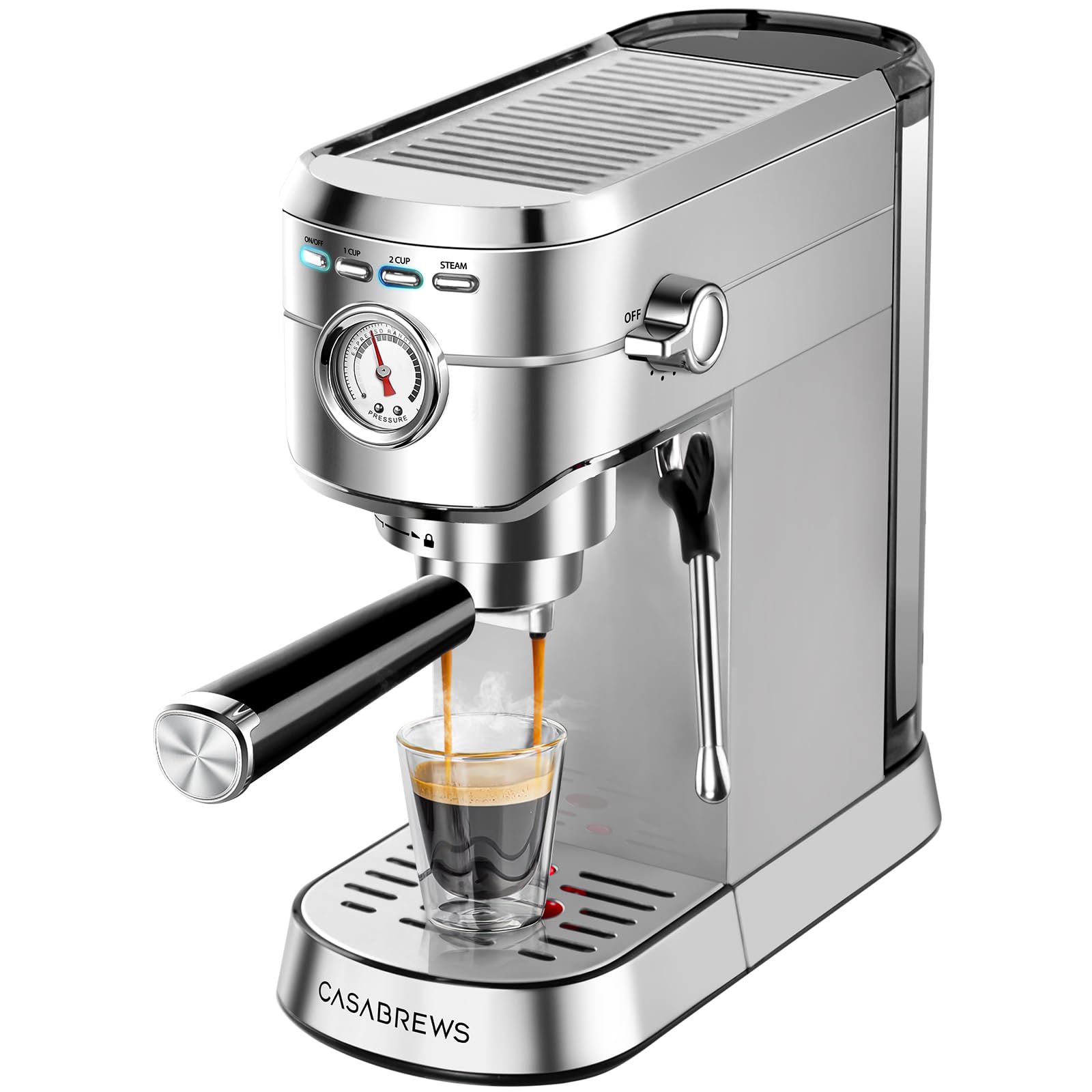
CASABREWS CM5418
Key Features
- Pump Pressure: 20 bar
- Frother Type: Manual steam wand
- Ease of Use: Semi-Auto
- Integrated Grinder: No
- Tank & Heat-Up: 34 oz
- Price: $$
Genuine 20‑bar pump pressure and a built‑in pressure gauge give beginners a clear way to dial in espresso extraction. The compact body fits small counters, and the steam wand allows milk frothing for cappuccinos or lattes.
Because the heating system can overheat after steaming, you may need to wait a few minutes before pulling another shot to avoid lukewarm espresso. This tradeoff is manageable for households making one or two drinks per day. The steam wand’s output is adequate for basic frothing, though it may not satisfy those expecting powerful microfoam. For budget‑conscious buyers who want real espresso without capsule costs, the CM5418 offers solid extraction at an entry‑level price.
Pros
- Pressure gauge helps beginners dial in extraction for consistent crema.
- Compact 5.47‑inch width fits tight kitchen counters.
- 20‑bar pump produces genuine espresso at a budget‑friendly price.
Cons
- After steaming, you may need to let the machine cool down before pulling a shot to avoid lukewarm espresso.
- Steam wand may produce weak froth for those expecting powerful microfoam.
For beginners making one or two milk‑based drinks daily, this machine delivers real pump espresso and dial‑in control without the premium price.
Best for Zero Hassle Espresso
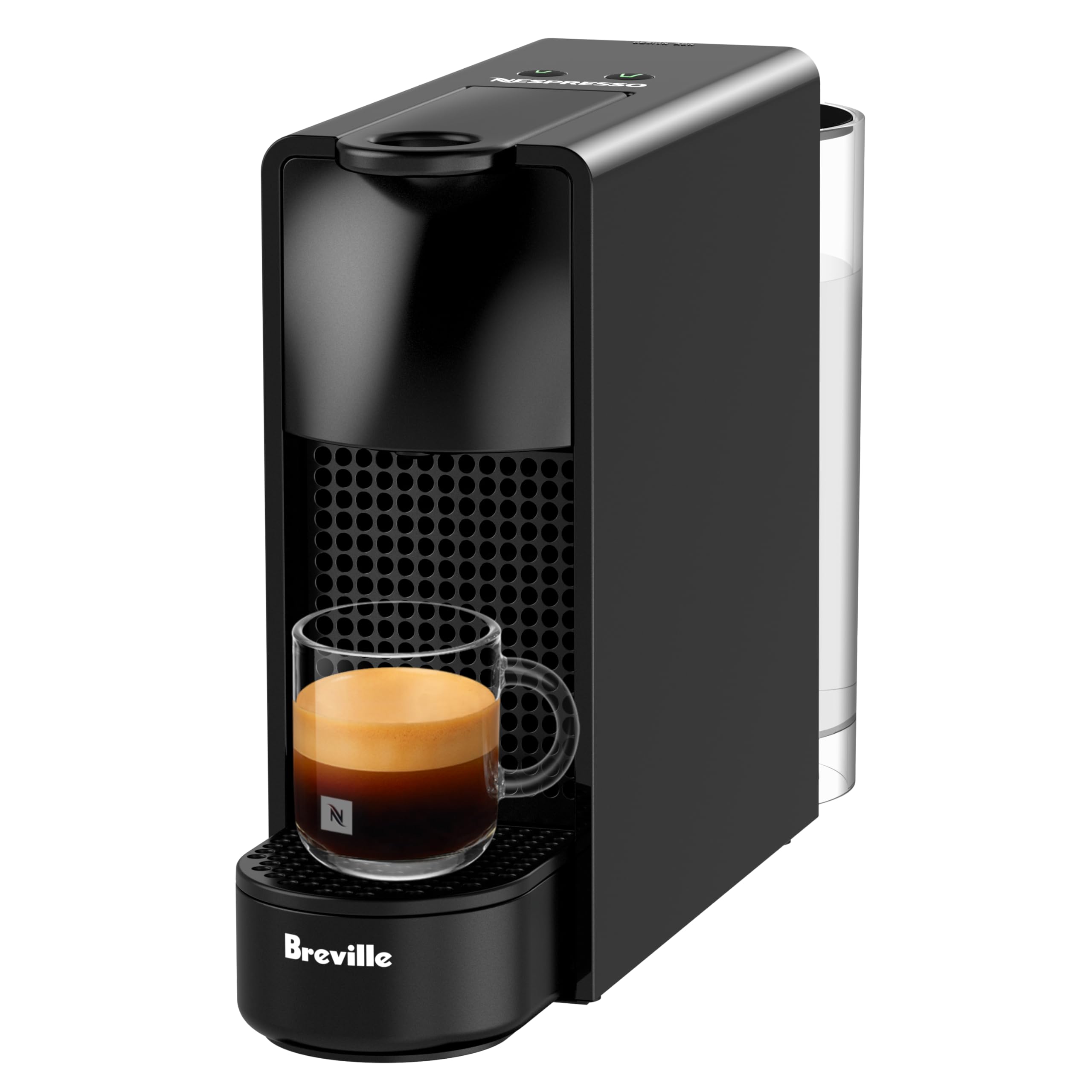
Nespresso Essenza Mini
Key Features
- Pump Pressure: 19 bar
- Frother Type: No
- Ease of Use: One-Touch
- Integrated Grinder: No
- Tank & Heat-Up: 20 oz
- Price: $$
The Nespresso Essenza Mini delivers one‑touch espresso from capsules with consistent crema – no grinding or dialing in needed. Its compact profile fits tight counters, making it a low‑fuss addition to any small kitchen or office.
This machine suits absolute beginners who value convenience over customization and mainly drink straight espresso. The lack of a built‑in frother means lattes require a separate purchase, which the top‑pick semi‑auto handles directly.
Pros
- Extremely easy to use – one‑touch brewing, no learning curve
- Compact size saves counter space
- Consistent espresso with good crema from Nespresso pods
Cons
- Proprietary capsules add ongoing expense compared to ground coffee
- No milk frother included – separate purchase needed for lattes and cappuccinos
The easiest path to espresso, but only if you drink it black – milk lovers should budget for an Aeroccino.
Best for Budget Pro Pressure
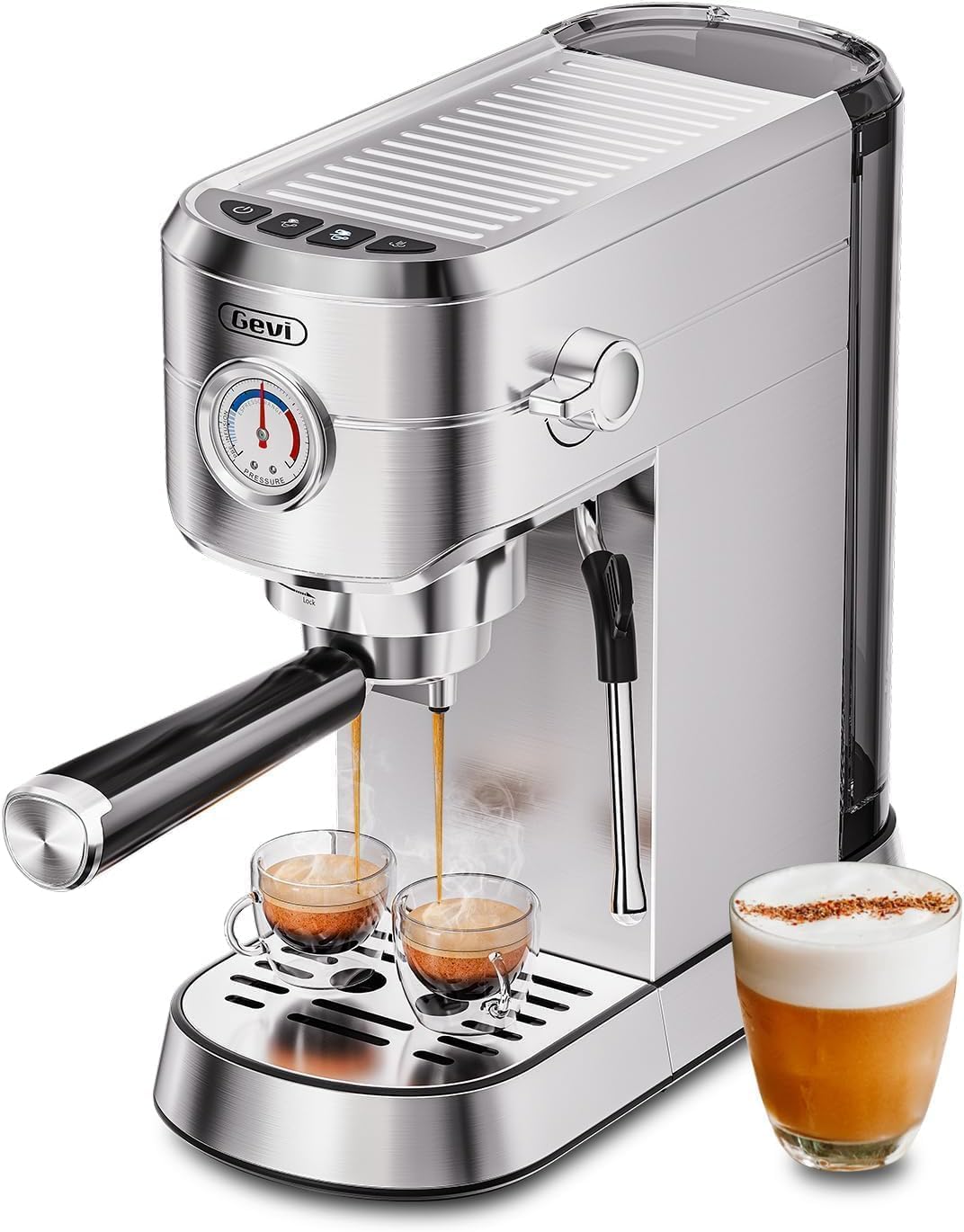
Gevi 20 Bar Espresso
Key Features
- Pump Pressure: 20 bar
- Frother Type: Manual steam wand
- Ease of Use: Semi-Auto
- Integrated Grinder: No
- Tank & Heat-Up: 33.8 oz
- Price: $$
The Gevi provides the same 20-bar pump and pressure gauge as the top pick, with notably quieter operation — a real advantage for early-morning brewing. Its NTC temperature control helps maintain consistent shots, and the espresso quality with rich crema rivals many café drinks. This machine suits budget-conscious newcomers who want professional specs without the premium cost, but be prepared: the cleaning process can be messier than competitors, and the steam wand may require patience to produce consistent froth.
Pros
- Exceptional value: 20-bar pump, pressure gauge, and NTC control at a mid-range price.
- Quiet operation compared to many competitors.
- Produces café-quality espresso with thick crema.
Cons
- Cleaning can be messy; coffee grounds may scatter during disposal.
- Steam wand performance varies between units; some may not froth evenly.
For beginners who are willing to trade a bit of cleaning time for professional pressure and quiet brewing, the Gevi is one of the best values under $130.
Best for All-In-One Versatility
Ninja Luxe Café Premier
Key Features
- Pump Pressure: 19 bar
- Frother Type: Auto frother
- Ease of Use: Guided Auto
- Integrated Grinder: Yes, conical burr
- Tank & Heat-Up: 4.4 lbs
- Price: $$$
The Ninja Luxe Café Premier combines espresso, drip coffee, and rapid cold brew in a single machine guided by Barista Assist technology. First-timers get step-by-step prompts for each brew mode, and the hands‑free milk frother self‑cleans after each use. This makes it the most versatile option for households that want multiple brew methods without buying separate appliances.
That breadth of features comes with a trade‑off: some units have shown grinder or funnel issues that produce error messages or require part replacement. Long‑term reliability under daily use is not yet established across the 2,187 reviews. This machine suits beginners who value variety over simplicity and are comfortable with occasional quirks, rather than pure espresso lovers on a tight budget.
Pros
- All‑in‑one: espresso, drip, and cold brew from a single machine
- Barista Assist guides beginners through the entire process
- Hands‑free milk frother with self‑cleaning cycle
Cons
- Grinder or funnel can produce error messages or jamming in some units
- Premium price includes drip and cold brew features you may not use if you only want espresso
Best for coffee enthusiasts who want one machine that does espresso, drip, and cold brew — but check grinder reliability before committing if espresso is your daily driver.
Best for Learn Espresso Craft
Breville Barista Express
Key Features
- Pump Pressure: 15 bar
- Frother Type: Manual steam wand
- Ease of Use: Semi-Auto
- Integrated Grinder: Yes, conical burr
- Tank & Heat-Up: 67 oz
- Price: $$$
The Breville Barista Express combines a conical burr grinder and a manual steam wand in one unit, giving you direct control over grind size, dose, and extraction. For a novice willing to learn the nuances of dialing in, this all-in-one builds a solid foundation for café-quality shots at home. The learning curve is notable — expect a few weeks of trial and error. Build quality has been inconsistent; some units have required repairs early on.
Pros
- Freshly ground beans on demand with integrated conical burr grinder
- Capable of producing espresso with thick crema comparable to coffee shop quality
- All-in-one design reduces counter clutter and initial investment for a grinder+espresso setup
Cons
- Learning curve for grind size and tamp pressure may frustrate those expecting push-button simplicity
- Some units show paint chipping or grinder issues within weeks of use
For the price of a standalone grinder and espresso machine, you get an integrated system that teaches you espresso fundamentals — if you can accept the learning curve and occasional build inconsistencies.
Best for Ultra-Budget Pump
CASABREWS 3700 Essential
Key Features
- Pump Pressure: 20 bar
- Frother Type: Manual steam wand
- Ease of Use: Semi-Auto
- Integrated Grinder: No
- Tank & Heat-Up: 43.9 oz
- Price: $
20‑bar pump espresso at an unbeatable price — genuine crema for under $100. This machine skips the pressure gauge found on the next step up, so dialing in requires more trial and error. It’s best for ultra‑budget beginners making occasional lattes or cappuccinos where heat is less critical. Temperature can run lukewarm, and durability varies between units. If you want real pump espresso on a tight budget and are willing to accept these tradeoffs, this is the cheapest way in.
Pros
- Unbeatable value: genuine 20‑bar pump espresso for under $100.
- Compact vintage design fits small kitchens.
- Simple operation with good results for beginners.
Cons
- Espresso temperature can be lukewarm – noticeable when adding cold milk.
- Durability can be inconsistent; some units may stop working after a few months.
For the buyer who needs a real pump espresso machine on the tightest budget and doesn’t mind monitoring water temperature, this is the most affordable entry point.
Best for Aspiring Barista
Gaggia Classic Evo Pro

Key Features
- Pump Pressure: 9 bar
- Frother Type: Manual steam wand
- Ease of Use: Semi-Auto
- Integrated Grinder: No
- Tank & Heat-Up: 71 oz
- Price: $$
Built from commercial-grade Italian steel with a 9-bar pump, the Gaggia Classic Evo Pro produces excellent espresso once mastered. Its modding community allows upgrades, but the lack of PID means temperature surfing is required for consistency. This machine suits those who want to learn the craft, not those seeking push-button ease.
Pros
- Italian steel housing and 9‑bar pump for durable, commercial‑grade construction.
- Modifiable design with community support – allows upgrades for better espresso over time.
Cons
- No PID temperature control; manual surfing required for consistent shots – a learning commitment.
Best for home baristas who want a machine they can grow with – skip if you prefer automated convenience.
Best for Tech-Friendly Luxury
Breville Barista Touch

Key Features
- Pump Pressure: 15 bar
- Frother Type: Auto wand
- Ease of Use: Touch-Screen
- Integrated Grinder: Yes, conical burr
- Tank & Heat-Up: 67 oz
- Price: $$$$
The Barista Touch’s touch‑screen guides you through brewing, and the auto frother handles milk without manual effort. For a beginner who wants a do‑everything machine and has the budget, this delivers. However, the premium price and occasional durability issues make it a leap of faith — many beginners are better served by a more predictable, lower‑cost option.
Pros
- Touch screen with step‑by‑step guidance simplifies the brewing process.
- Automated milk frother with adjustable temperature and texture settings.
Cons
- Long-term durability can be inconsistent for a machine at this price point.
Best for beginners who prioritize convenience over cost and are prepared for possible repair expenses after the warranty period.
Best for Speed and Precision
Breville Barista Pro

Key Features
- Pump Pressure: 15 bar
- Frother Type: Manual steam wand
- Ease of Use: Semi-Auto
- Integrated Grinder: Yes, conical burr
- Tank & Heat-Up: 67 oz, 3s heat
- Price: $$$
The Barista Pro delivers café-quality espresso with minimal wait: the ThermoJet system heats in seconds, and the PID keeps water temperature steady. The LCD interface and dose-control grinder make dialing in simpler than the Barista Express. However, this premium-priced machine shares the same durability risks as its lower-cost sibling — some units have experienced grinder or steam wand issues within months. For beginners who prioritize speed and don’t mind a possible reliability tradeoff, it’s a capable option, but budget-conscious buyers should look at alternatives with more consistent long-term feedback.
Pros
- Heats in 3 seconds; brew and steam back-to-back without waiting.
- LCD interface with integrated grinder simplifies dose adjustments for novices.
Cons
- Durability can vary — grinder or steam wand may need servicing sooner than expected.
Worth considering if fast heat-up and integrated grinding matter more than long-term certainty; otherwise, the top pick offers better reliability at a lower price.
Best for Durable Semi-Auto
Breville Infuser

Key Features
- Pump Pressure: 15 bar
- Frother Type: Manual steam wand
- Ease of Use: Semi-Auto
- Integrated Grinder: No
- Tank & Heat-Up: 61 oz
- Price: $$$
The Breville Infuser delivers reliably consistent espresso thanks to PID temperature control and pre-infusion, backed by a build that holds up for years. Its pressure gauge helps beginners dial in without guesswork. The catch: no integrated grinder means you need to budget an additional $200–400 for one, pushing total cost past $800 – a steep entry for newcomers seeking an all-in-one solution.
Pros
- PID and pre-infusion produce repeatable, well-extracted shots.
- Stainless steel body and components hold up over years of daily use.
Cons
- No built-in grinder; requires a separate purchase that adds significant cost.
Best reserved for buyers who already own a quality grinder and value long-term durability over upfront convenience.
Best for Cuban-Style Coffee
IMUSA Electric Moka Pot

Key Features
- Frother Type: No
- Ease of Use: Manual
- Integrated Grinder: No
- Price: $
The IMUSA Electric Moka Pot is an extremely affordable option for making strong, concentrated coffee quickly — akin to a stovetop moka pot with electric convenience. It suits occasional use or travel, especially for Cuban coffee enthusiasts. However, it does not produce true espresso with crema; it produces moka-style coffee.
Pros
- Extremely affordable compared to pump espresso machines
- Quick brew time of a few minutes for a full pot
Cons
- Plastic parts and heating element may not endure frequent daily use
Perfect for occasional Cuban coffee at home or when traveling, but not a substitute for a pump-driven espresso machine.
Best for Ultra-Budget Milk Drinks
IMUSA 4‑Cup with Frother

Key Features
- Frother Type: Steam wand
- Ease of Use: Manual
- Integrated Grinder: No
- Price: $
This machine is one of the cheapest ways to make frothy milk drinks at home, with a simple fill-and-switch operation. However, it produces steam-extracted coffee rather than true espresso with crema, and durability can be inconsistent, with some units becoming inoperable within months. It belongs in the same moka-style category but suffers from lower longevity.
Pros
- Budget-friendly price includes an attached steam wand for frothing milk.
- Simple one-switch operation with no complicated settings.
Cons
- Some units can become inoperable within months – best for occasional or temporary use.
A budget-friendly option for occasional milk-based drinks in dorms or temporary setups, but not for those expecting real espresso or long-term daily use.
Best for Lavazza Pod Lover
Lavazza Classy Mini

Key Features
- Pump Pressure: 19 bar
- Frother Type: No
- Ease of Use: One-Touch
- Integrated Grinder: No
- Tank & Heat-Up: 23.7 oz
- Price: $$
Consistent Lavazza BLUE capsule espresso with one-touch operation in a compact size. If you’re already a Lavazza fan, this machine delivers the same taste with minimal effort. However, it only accepts Lavazza BLUE capsules – no alternatives – and the pump noise is loud enough to be noticeable in quiet kitchens or early mornings.
Pros
- One-touch operation – insert capsule, press button, no fiddling.
- Rich, consistent flavor from Lavazza’s capsule lineup.
Cons
- Only works with Lavazza BLUE capsules – no alternative pod brands.
Fits Lavazza loyalists who value simplicity and don’t mind the noise, but not for households wanting pod variety or whisper-quiet operation.
Best for Auto Frother Budget
Mr. Coffee Café Barista

Key Features
- Pump Pressure: 15 bar
- Frother Type: Auto reservoir
- Ease of Use: Semi-Auto
- Integrated Grinder: No
- Tank & Heat-Up: 50 oz
- Price: $$
The built-in automatic milk reservoir simplifies making milk-based drinks, and the 15-bar pump delivers acceptable espresso for the price. Under regular daily use, the pump and electronics can develop issues within a year, and the frother may produce inconsistent foam. This machine works best for beginners who make a few lattes per week and are comfortable with the possibility of component issues over time.
Pros
- Automatic milk frother prepares lattes and cappuccinos with minimal effort.
- Good value for an espresso machine with integrated frothing at a mid-range price.
Cons
- Pump and electronic components can develop issues within a year under daily use, making this best for occasional brewing.
For a beginner who makes a couple of lattes per week and doesn’t expect years of service, this machine delivers automated frothing at a low entry cost.
Best for Occasional Pump Use
De’Longhi Stilosa

Key Features
- Pump Pressure: 15 bar
- Frother Type: Manual steam wand
- Ease of Use: Manual
- Integrated Grinder: No
- Tank & Heat-Up: 33.8 oz
- Price: $$
The De’Longhi Stilosa offers a low-cost way to try pump espresso with a manual steam wand for milk frothing. However, the coffee temperature can be inconsistent, sometimes lukewarm, and durability may be limited – some units may need replacement within a year. It fits occasional use where heat isn’t critical and budget is tight.
Pros
- Very affordable entry to pump espresso
- Easy to use and clean
Cons
- Coffee temperature can be inconsistent – may come out lukewarm
Best for those on a very tight budget who only make espresso occasionally and don’t mind tepid coffee.
How to Choose
The single most important factor for a beginner espresso machine is temperature stability — a 15‑bar pump means nothing if your shots come out lukewarm.
Pump Pressure
Pump pressure (15–20 bar) creates the foamy crema that distinguishes espresso from strong coffee. However, higher pressure alone doesn’t guarantee quality; the machine must maintain stable temperature during extraction.
A 20‑bar pump on a machine with poor thermal control can overextract and produce bitter shots. Real commercial machines use 9 bar with precise temperature regulation. For beginners, look for a model that keeps water between 195–205°F consistently.
Milk Frother Type
Manual steam wands require practice to create microfoam but give you full control for latte art. Automatic frothers simplify the process with a push‑button but often produce large, airy bubbles that collapse quickly.
If you drink mostly straight espresso, a manual wand is fine. For daily milk drinks, an automatic frother saves time but check reviews for foam quality — many budget auto frothers underperform.
Ease of Use
Capsule machines (Nespresso, Lavazza) offer one‑touch brewing with zero learning curve. Semi‑automatic machines require grinding, dosing, and tamping, but allow you to experiment with fresh beans and adjust flavor.
The trade‑off is convenience versus ongoing costs: capsules cost 50¢–$1 per shot, while whole beans run 10¢–20¢. For absolute beginners who value time over tinkering, capsule systems are the easiest path to a consistent cup.
Integrated Grinder
Built‑in grinders deliver freshly ground coffee on demand, but they add complexity and a potential failure point. The Breville Barista Express’s grinder is widely praised, while others can be inconsistent or clog.
If you already own a quality grinder, skip the integrated model — a separate grinder gives you better control over grind size and allows you to upgrade components independently. Beginners without a grinder will appreciate the all‑in‑one convenience.
Water Tank and Heat-Up
A larger water tank (60+ oz) means fewer refills for multiple drinks, but heat‑up time matters for your morning routine. Some machines reach temperature in 30 seconds, while others take 15 minutes.
ThermoJet technology heats in 3 seconds, but older thermoblock designs may require a cool‑down period after steaming before you can pull another shot. Check whether the machine allows simultaneous brewing and steaming if you make milk drinks often.
FAQ
Why is my espresso machine coffee not hot enough?
Insufficient preheating is the most common cause. Let the machine warm up for 15–20 minutes and preheat your cup and portafilter with hot water. If the problem persists, the machine may lack proper thermal stability — budget units often brew at 185°F instead of the ideal 200°F. Models with PID control or a brass boiler maintain temperature more reliably.
Do I need a separate grinder for a beginner espresso machine?
Only if the machine lacks a built‑in grinder. Integrated grinders (like those in Breville Barista Express) offer convenience for beginners. A separate grinder gives you finer control over grind size and is easier to upgrade, but adds $100–$200 to your setup. For most beginners, an all‑in‑one machine is the simpler, more affordable path.
How long does a typical beginner espresso machine last before breaking?
Budget steam‑driven units often fail within 6 months to a year. Mid‑range pump machines can last 2–5 years with proper maintenance, but many models — including the Breville Barista Express — have reports of pump or grinder failures within the first 12 months. Capsule machines like Nespresso tend to be the most reliable because they have fewer moving parts.
Can a capsule espresso machine make real espresso or is it just strong coffee?
Yes, capsule machines with 19‑bar pumps (like Nespresso) produce genuine espresso with crema. The difference is that the flavor is locked into the pod, so you can’t adjust grind or dose. For many beginners, the consistency and convenience outweigh the limited customization.