This post contains affiliate links. We may earn a small commission when you buy through our links — at no extra cost to you.
A $900 espresso machine can stop working within its first year, while a $20 stovetop pot lasts decades. In this category, price is a poor predictor of longevity. The more you spend, the more complex the machine — and complexity adds failure points.
That doesn’t mean you should avoid espresso machines altogether. It means matching the machine to your daily habits matters more than brand or pressure rating. A heavy coffee drinker needs a different build than someone who uses it on weekends.
We sorted through the options to find the machines that deliver consistent shots and survive real-world use. Our picks prioritize performance, repairability, and honest assessments of durability — not marketing claims.




Best for Home Baristas
Breville Barista Express BES870XL
Key Features
- Brew Pressure: 15 bar
- Grinder Type: Integrated burr
- Water Tank: 67 oz
- Milk Frothing: Manual steam wand
- Price: Mid-Range
The built-in conical burr grinder feeds fresh grounds directly into the portafilter, removing the hassle of a separate grinder. PID temperature control keeps water stable during extraction, and the 15-bar pump with low-pressure pre-infusion supports espresso with a thick crema layer.
Steam wand produces microfoam suitable for latte art, though dialing in grind size and dose takes a few sessions. Once that initial learning curve is behind you, the machine delivers consistent shots and milk texture. The all-in-one design makes this a strong value proposition for home baristas who want fresh grounds without buying two appliances.
This machine fits home baristas who enjoy hands-on espresso making and are willing to invest time to learn proper technique. That said, durability is a vulnerability – the grinder or pump may develop issues after one to three years, and individual units can show inconsistency. It works best for moderate daily use, not heavy commercial-style throughput.
Pros
- Integrated grinder delivers fresh grounds on demand, no separate purchase needed
- PID temperature control produces consistent extraction and rich crema
- Manual steam wand creates microfoam for latte art
- Good value for an all-in-one espresso and grinder package
Cons
- Grinder or pump may fail after one to three years of use
- Reliability can vary; some machines stop working within weeks of arrival
The Barista Express delivers fresh-ground espresso with good crema for home baristas who value the learning process, but the durability risk makes it a considered buy for those with moderate, not heavy, daily use.
Best for Convenience Seekers
De’Longhi Vertuo Plus
Key Features
- Grinder Type: None (capsule)
- Water Tank: 1.1 L
- Price: Mid-Range
The Vertuo Plus produces espresso and coffee reliably with a simple one-button operation, drawing on Nespresso’s established brewing system. Unlike the Vertuo Next bundle, this model skips the milk frother, keeping the footprint compact and the workflow minimal — a cleaner setup for those who don’t need steamed milk daily.
This machine fits buyers who already prefer Nespresso capsules and want the most straightforward path to a decent cup. Coffee temperature can be lukewarm for some, and the ongoing cost of Vertuo capsules adds up — something to factor into the long-term budget. Quality control varies between units, so a little extra care during setup pays off.
Pros
- Consistently good coffee and espresso with the convenience of capsule brewing.
- Simple setup and one-button operation make it accessible for any skill level.
- Sleek grey design fits modern kitchen aesthetics without taking up extra counter space.
Cons
- Individual unit performance can vary, with some machines requiring service early on.
- Proprietary Vertuo capsules cost more than third-party alternatives, raising per-cup expense over time.
If you already stock Vertuo capsules and value no-fuss operation, this is a dependable daily driver — just factor in potential temperature and ongoing capsule costs.
Best for Budget/travel
Primula Classic Moka Pot
Under $20, the Primula Classic Moka Pot produces a rich, concentrated coffee that rivals much pricier machines. The brewing process is straightforward once you learn the timing — fill the basket, tamp lightly, and watch for the gurgle that signals your coffee is ready.
This moka pot suits budget-conscious coffee lovers and anyone who enjoys the hands-on ritual of stovetop brewing. It’s lightweight and works on gas, electric, ceramic, and propane stoves, making it a natural companion for camping or travel. However, the handle can melt if left on high heat, and the aluminum body may discolor or develop leaks over time — tradeoffs that matter less if you use it occasionally.
Pros
- Makes authentic espresso-style coffee for a fraction of the cost of electric machines.
- Simple stovetop operation with no electricity required — works anywhere.
- Produces a rich, strong coffee concentrate suitable for lattes, americanos, or straight shots.
Cons
- Coffee may leak from the seam when pouring — a minor annoyance that can be avoided by pouring slowly.
- The handle can melt if the pot is left on high heat after brewing completes, so close attention is required.
For the price of a few cafe lattes, the Primula delivers genuine stovetop espresso for camping trips, travel, or anyone who doesn’t need daily use — just monitor the heat.
Best for Budget Beginners
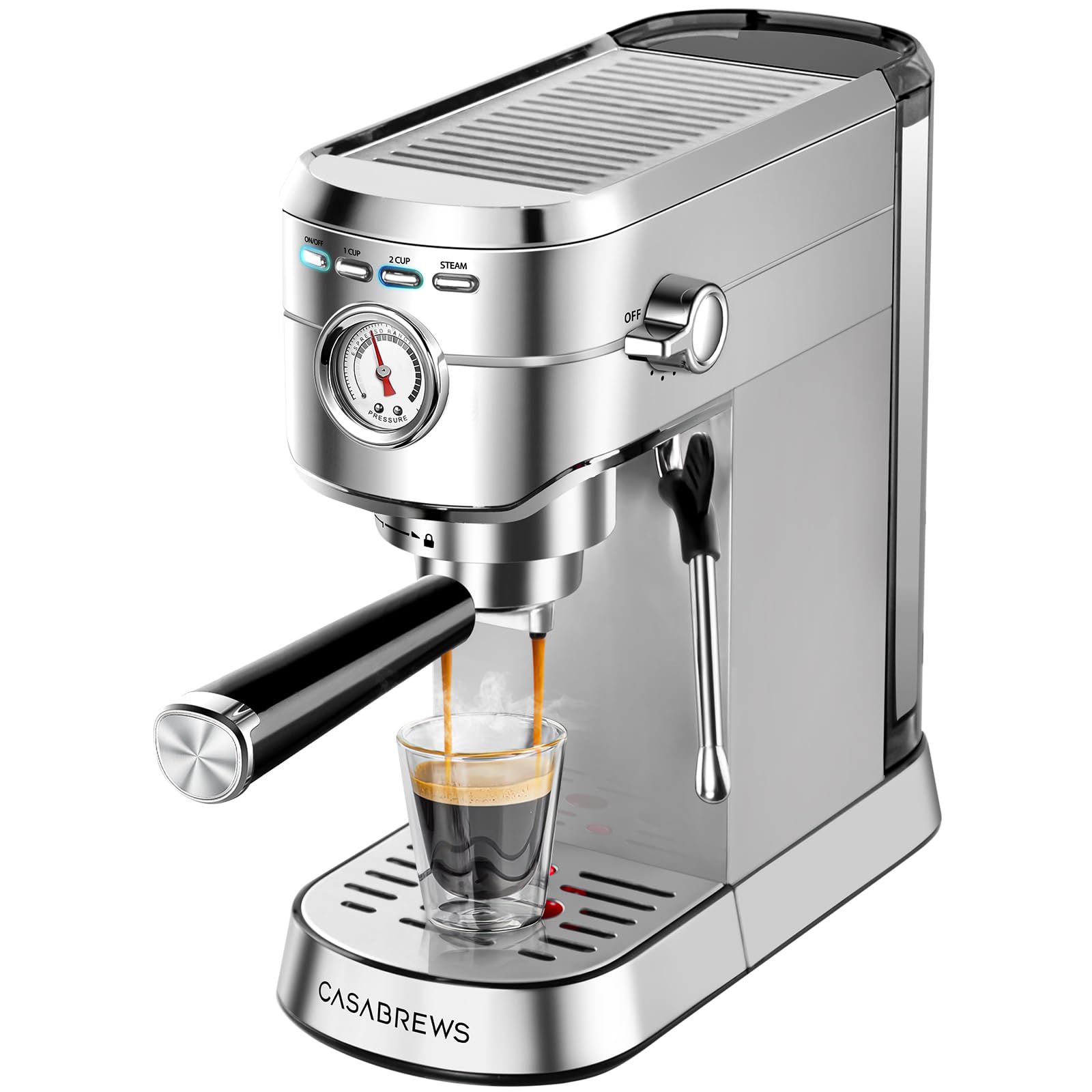
CASABREWS CM5418
Key Features
- Brew Pressure: 20 bar
- Grinder Type: External
- Water Tank: 34 oz
- Milk Frothing: Manual wand
- Price: Budget
The CASABREWS CM5418 uses a 20-bar pump and a pressure gauge to deliver espresso with noticeable crema, a feature usually found on machines costing twice as much. Its small footprint frees up counter space, and the setup process is straightforward even for those new to espresso. The manual steam wand provides control for texturing milk, though it requires some practice to get consistent results.
This machine suits home baristas who want to learn espresso without a large upfront investment and have limited kitchen space. The tradeoff is that reliability can vary between units, and the machine may trigger overheat protection between consecutive drinks, so it works best for single or occasional use rather than back-to-back rounds for multiple people.
Pros
- Produces espresso with rich crema at a low price point
- Great value for money among budget espresso machines
- Compact size saves counter space in small kitchens
Cons
- Some units may experience operational issues after months of use
- Machine can trigger overheat protection between back-to-back drinks, requiring a short pause
For casual espresso drinkers on a budget, the CM5418 offers impressive performance and a low entry cost, especially if you can accept the possibility of unit variation.
Best for Espresso Purists
Gaggia Classic Evo Pro
Key Features
- Brew Pressure: 9 bar
- Grinder Type: External
- Milk Frothing: Commercial steam wand
- Price: Mid-Range
The Gaggia Classic Evo Pro uses a 58 mm commercial portafilter and a true 9-bar pump to extract espresso that rivals machines costing twice as much. This focus on foundational mechanics means you’ll need to master grind size, dose, and tamping — there’s no automated assistance here. The tradeoff is a steep learning curve, but for those who invest the time, the payoff is thick crema and balanced shots.
This machine is for espresso enthusiasts who enjoy dialing in and want a platform they can repair and upgrade over time. It’s not for buyers seeking convenience or quick morning drinks — the manual workflow requires patience. Be aware that some units have reported steam wand or pump concerns, so check warranty coverage and community fix guides before committing.
Pros
- True 9-bar extraction delivers authentic espresso with thick crema and rich flavor.
- Commercial 58 mm portafilter and steel housing provide a solid foundation for daily use.
- Highly moddable — aftermarket parts and community guides allow performance upgrades.
Cons
- In a fast-paced morning routine, the manual workflow and dial-in process will slow you down — this is a hands-on machine.
- Some units may experience steam wand or pump concerns over time — worth checking warranty and community repair resources.
For espresso purists willing to learn and mod, the Gaggia delivers professional-grade results at a mid-range price.
Best for Versatility Lovers
Ninja Luxe Café
Key Features
- Grinder Type: Built-in burr
- Water Tank: 70 oz
- Milk Frothing: Hands-free auto
- Price: Premium
The Ninja Luxe Café Premier covers espresso, drip coffee, and cold brew from a single unit, aided by an assisted tamper that helps achieve consistent pucks without guesswork. It offers more drink variety than the Breville Barista Express, though espresso output, while producing a decent crema, isn’t at the level of a purpose-built espresso machine. For households that regularly switch between drink styles, this tradeoff is easy to accept.
This model suits households that value convenience over espresso purity — a single countertop appliance for all brew methods. The hands-free milk frother and guided Barista Assist make daily operation straightforward. That said, some units may have grinder or funnel defects that require service. Long-term durability is still unproven given the model’s recent release, so it’s best for those willing to accept some uncertainty in exchange for multifunction capabilities.
Pros
- Three brew methods (espresso, drip, cold brew) in one machine
- Guided Barista Assist simplifies operation for newcomers
- Hands-free milk frother with preset programs works well
Cons
- Some units may have grinder or funnel defects that require service
The Ninja Luxe Café covers three brew styles in a single footprint, making it a practical choice for mixed-drink households. If you need a machine with a longer track record, the Barista Express is the more established option.
Best for Speed Enthusiasts
Breville Barista Pro BES878

Key Features
- Grinder Type: Integrated burr
- Water Tank: 67 oz
- Milk Frothing: Manual wand
- Price: Premium
ThermoJet heating delivers brewing temperature in seconds, and the LCD screen makes adjustments straightforward. Espresso quality is on par with café standards. That speed comes at a premium — the Barista Pro costs significantly more than the top pick Barista Express, with only marginal improvements. Additionally, grinder and pump reliability varies between units; some may require service. This machine is best for buyers who prioritize speed and digital control over long-term consistency.
Pros
- Fast heat-up time and transition to steam
- Intuitive interface with LCD display
Cons
- Coffee temperature may be lower than expected for those who prefer very hot drinks
- Grinder or pump may require service in some cases
Best for espresso drinkers who want speed and digital controls and accept the possibility of variable durability.
Best for First-Time Buyers
De’Longhi Stilosa

Key Features
- Brew Pressure: 15 bar
- Grinder Type: External
- Water Tank: 33.8 oz
- Milk Frothing: Manual wand
- Price: Budget
De’Longhi’s Stilosa offers a very affordable entry into espresso with a 15-bar pump and manual steam wand, making it easy to learn on. Some units may have reliability concerns within the first year, and coffee temperature can be lukewarm — the CASABREWS CM5418 delivers more consistent heat for a similar price.
Pros
- Great entry-level machine with solid espresso quality for the price
- Easy to use and clean
Cons
- Reliability concerns: some units may stop working within the first year
- Coffee temperature may not be hot enough for those who prefer piping hot drinks
This machine works well for light, occasional use or as a learning tool for espresso beginners who are willing to accept some temperature variability.
Best for Lavazza Fans
Lavazza BLUE Classy Mini

For Lavazza fans who want a tiny machine that serves up the brand’s authentic espresso, the Classy Mini delivers. Its compact footprint fits on any countertop, and operation is as simple as inserting a capsule and pressing a button. However, the noise level is high enough to be disruptive in quiet spaces, and the machine only accepts Lavazza BLUE capsules — limiting your options.
Pros
- Delicious espresso with authentic Lavazza flavor
- Very easy to use – insert capsule, press button
Cons
- Operation noise may be bothersome in quiet spaces
- Only compatible with Lavazza BLUE capsules, narrowing pod choices
Best for Lavazza loyalists who prioritize compact size and authentic flavor over noise level and pod variety.
Best for Budget No Grinder
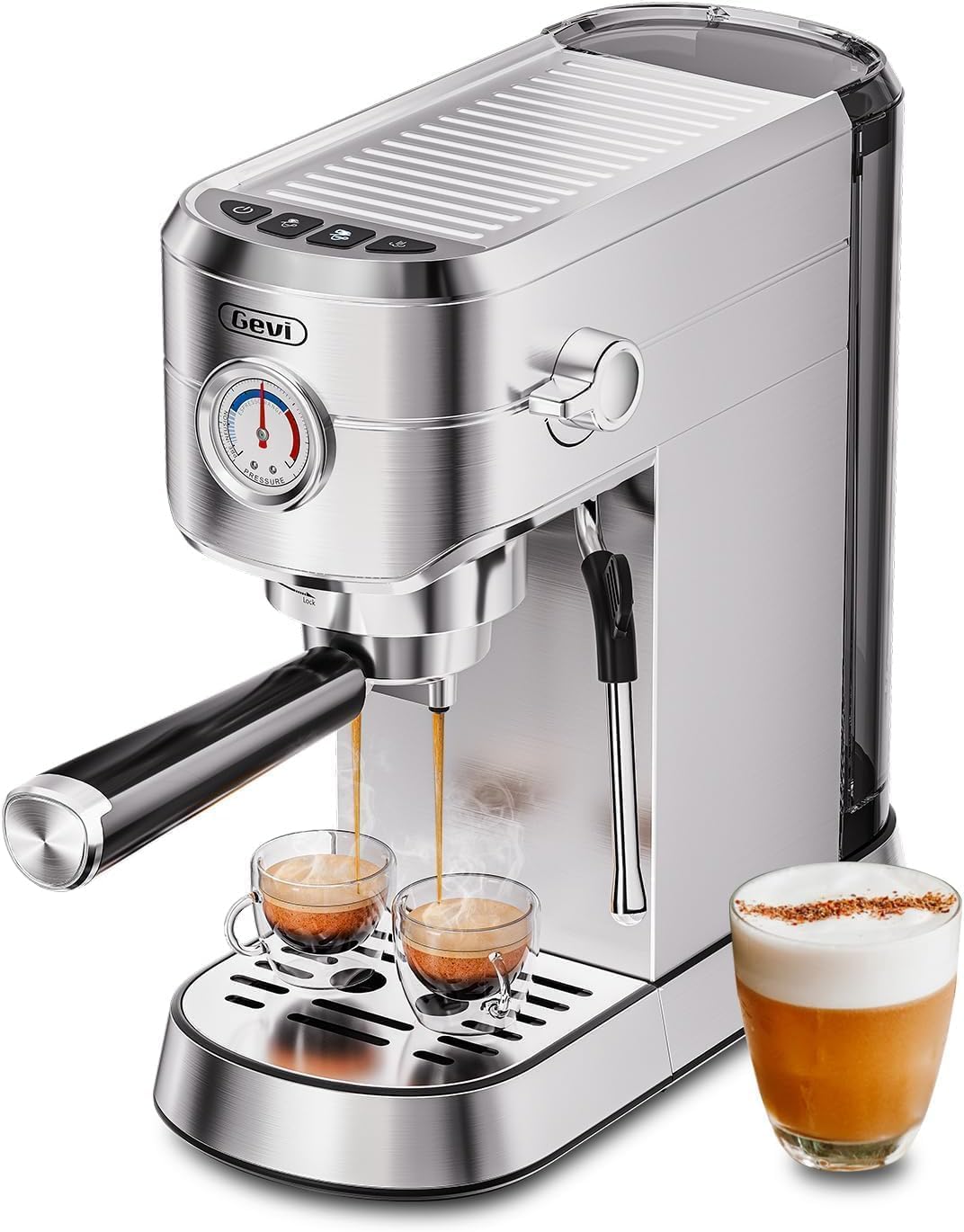
Gevi ECMG0
Key Features
- Brew Pressure: 20 bar
- Grinder Type: External
- Water Tank: 1 L
- Milk Frothing: Manual wand
- Price: Budget
Stainless steel housing and a 20-bar pump deliver consistent espresso at a budget-friendly price, with an intuitive setup that works well for home baristas who already own a grinder. The lack of an integrated grinder means you’ll need one separately, and the pump can be loud enough to notice in quiet kitchens. Cleanup may require extra attention to avoid mess. For buyers who prioritize build quality over an all-in-one design, this is a straightforward entry into semi-automatic espresso without unnecessary complexity.
Pros
- Good espresso quality for the price point
- Stainless steel build feels sturdy and compact
Cons
- Pump noise may be noticeable in quiet settings, less of an issue in busy kitchens
- Cleaning can be messy due to certain design aspects
Best suited for budget-conscious espresso drinkers who already have a grinder and don’t mind occasional noise or extra cleanup.
Best for Extreme Budget
CASABREWS 3700 Essential

Key Features
- Brew Pressure: 20 bar
- Grinder Type: External
- Water Tank: 43.9 oz
- Milk Frothing: Manual wand
- Price: Budget
This machine delivers on its promise of a 20-bar pump and large water tank at a budget-friendly price, producing espresso with decent crema for occasional use. However, temperature consistency can vary between units, and some may experience reliability issues over time—limitations that suit extreme budget shoppers who prioritize low upfront cost over long-term guarantees.
Pros
- Exceptional value for a 20-bar espresso machine at a budget price.
- Produces espresso with good crema and flavor for the price.
Cons
- Reliability can vary between units – some may experience issues after months of use.
- Coffee temperature may be lukewarm for some tastes.
Best for extreme budget shoppers who want a cheap 20-bar machine and are willing to accept possible temperature quirks and unit variance.
How to Choose
The most important factor in choosing an espresso machine isn’t the pressure or brand — it’s matching the machine’s build quality and complexity to how often you’ll use it.
Brew Pressure
Most home machines advertise 15 to 20 bar pumps, but actual extraction happens around 9 bar. Higher pump pressure doesn’t mean better espresso — it’s often a marketing number that helps push water through a pressurized basket. Machines with a dedicated 9-bar OPV (over-pressure valve) like the Gaggia Classic deliver more consistent shots because they regulate pressure at the group head.
For beginners, a 15 or 20 bar machine with pressurized baskets is fine and easier to dial in. Enthusiasts should look for true 9-bar machines or moddable options that allow pressure adjustment.
Integrated Grinder vs. Separate
An integrated grinder saves counter space and lets you grind fresh beans directly into the portafilter. The trade-off is that if the grinder jams or wears out, the entire machine may need service. Separate grinders are easier to replace and often offer more consistent grind size from stepless adjustments.
For casual users who make one or two drinks a day, an integrated grinder is convenient enough. If you drink multiple shots daily or want to experiment with different beans, a separate grinder gives you more control and longevity.
Water Tank Capacity
A larger tank means fewer refills, but also takes up more counter space. For households that brew several drinks back-to-back, a 60-ounce tank (like the Breville Barista Express) easily handles a morning routine. Smaller tanks around 1 liter require refilling every two or three drinks, which can be annoying during busy mornings.
However, a smaller tank can be an advantage if you use filtered water and want to refill it fresh each day to prevent bacterial growth. Consider your daily volume: two Americanos need about 12 ounces, so a 34-ounce tank lasts three days.
Milk Frothing Method
Manual steam wands give you full control over milk texture and are better for latte art, but they require practice. Automatic frothers (like the Aeroccino or Ninja’s hands-free wand) produce consistent microfoam at the push of a button, but limit texture options and can be harder to clean thoroughly.
If you drink straight espresso or americano, frothing method is less important. For daily lattes and cappuccinos, a manual wand with a powerful steam boiler is worth the learning curve — it delivers hotter milk and finer foam.
Ease of Cleaning and Maintenance
All espresso machines require descaling, backflushing, and wiping down steam wands. Machines with removable brew groups (like many super-autos) are easier to clean but add complexity. Capsule machines are the simplest — just run a descale cycle every few months.
The most overlooked maintenance step is using filtered water. Hard water accelerates scale buildup that can clog pumps and cause overheating. Descaling every 2-3 months in moderate water areas, or monthly in hard water, can double the machine’s lifespan.
FAQ
Why does my espresso machine stop working after a few months?
Many home espresso machines rely on small pumps and plastic components that aren’t built for daily heavy use. Frequent descaling, using filtered water, and avoiding back-to-back shots can extend life. If you brew multiple drinks per day, consider a machine with commercial-grade parts like a brass boiler or 58 mm portafilter.
Is it worth buying an espresso machine with a built-in grinder?
A built-in grinder saves counter space and ensures fresh grounds on demand, but it creates a single point of failure. If the grinder breaks, the entire machine may need repair. A separate grinder often offers better grind consistency and is cheaper to replace. For occasional use, integrated is fine; for daily use, consider separate.
How often should I descale my espresso machine to prevent breakdowns?
Descaling every 2-3 months is standard for most home machines, but check your water hardness. Hard water accelerates scale buildup, which can clog pumps and cause overheating. Descaling more frequently in hard water areas can double the machine’s lifespan.