This post contains affiliate links. We may earn a small commission when you buy through our links — at no extra cost to you.
Opening a box to find dents or scratches on a brand-new freezer is frustrating. Combine that with frost building up every few weeks, and a compact freezer can feel like more work than it’s worth.
The reality is that most small freezers share these two quirks: shipping damage is common regardless of brand, and manual defrost is standard at this size. But not all freezers handle them equally—some arrive with fewer cosmetic issues, and others manage frost better through design choices like tighter seals or better insulation.
The key is knowing which type—chest or upright—matches your space and tolerance for maintenance. This guide focuses on models that minimize surprises and keep your food frozen without constant babysitting.


Best for Garage, Apartment
Midea 3.5 cu ft Chest Freezer
Key Features
- Capacity: 3.5 cu ft
- Type: Chest
- Defrost Type: Manual
- Temperature Control: Adjustable
- Price: Mid-Range
This chest freezer provides 3.5 cubic feet of storage – enough for several weeks’ worth of frozen food for a small household. The interior LED light and removable basket make organization straightforward, and the unit is rated for garage temperatures, expanding placement options beyond the kitchen.
Operation is notably quiet for a chest freezer, making it suitable for living areas or bedrooms if needed. Temperature remains stable, keeping food frozen even during power outages up to 48 hours. Owners note consistent freezing performance over several years of use.
This freezer is a good fit for apartment dwellers or homeowners seeking extra capacity for a garage or basement. It offers a cost-effective way to store bulk purchases or meal prep ingredients. Note that some units sustain cosmetic dents during shipping – inspect the box immediately and file a claim if needed, especially if the freezer will be in a visible area.
Pros
- Spacious interior for its footprint – holds large quantities without dominating floor space.
- Quiet operation – low noise level won’t disrupt daily activities.
- Consistent freezing performance over years – maintains temperature dependably.
- Good value for the price – delivers capable storage at a budget-friendly cost.
Cons
- Can arrive with cosmetic dents or scratches – less of an issue in a garage or basement where appearance is not a priority.
This chest freezer offers dependable cold storage for the long haul – ideal for anyone needing extra freezer space in a garage or basement, as long as you’re prepared to deal with possible shipping blemishes.
Best for Quiet Homes
Midea 3.0 cu ft Upright Freezer
Key Features
- Capacity: 3.0 cu ft
- Type: Upright
- Defrost Type: Manual
- Price: Premium
The Midea upright runs at 42 dB – quiet enough to be barely audible in an open-plan apartment. It cools quickly and holds temperature consistently, while the reversible door adds flexibility for tight layouts. Compared to the top pick chest freezer, you sacrifice capacity and pay a premium, but gain upright organization and whisper-quiet operation.
This freezer suits households where noise is the primary concern – dorm rooms, home offices, or small kitchens. It is not rated for unheated garages, and the premium price runs about 40% higher than the top pick chest freezer. Some units may show cosmetic dents from shipping, so inspect upon arrival.
Pros
- Runs at 42 dB – barely audible in a quiet room.
- Cools down quickly and maintains consistent temperature.
- Interior holds over 30 frozen meals with upright shelves.
Cons
- Arrival cosmetic damage possible despite packaging – not a functional issue but worth checking before installing.
If quiet operation and upright organization matter more than capacity and price, the Midea upright delivers on both – just plan to inspect the unit upon delivery.
Best for Budget Buyers
Kismile 2.0 cu ft Chest Freezer
Key Features
- Capacity: 2.0 cu ft
- Type: Chest
- Defrost Type: Manual
- Temperature Control: 7 settings
- Price: Budget
At 2.0 cubic feet, the Kismile chest freezer offers a compact footprint that fits into tight spaces—smaller than the larger top pick—while still providing two removable baskets for sorting frozen foods. Its temperature control with seven settings and energy draw of 0.68 kWh/day make it an efficient option for supplemental freezing. Owners consistently note that it holds temperature well for its price point.
This freezer is best for singles, couples, or meal preppers seeking extra capacity without overspending. The chest design requires bending to access items, and manual defrost is necessary—plan to clear frost every few months, more often in humid climates. Additionally, shipping packaging is minimal, so some units can arrive with cosmetic dents or cracks; inspect the box upon delivery. If you prefer upright shelves and no defrost, consider an upright model instead.
Pros
- Compact footprint fits tight spaces while offering 2.0 cu ft storage with two wire baskets.
- Seven-setting temperature control keeps contents consistently frozen with low energy use.
- One of the most affordable chest freezers, delivering solid performance for the price.
Cons
- Manual defrosting is needed periodically, especially in humid environments.
- Units can arrive with cosmetic damage from insufficient packaging.
For buyers with limited floor space who want a budget-friendly chest freezer, the Kismile is a capable runner-up—just be prepared for manual defrost and potential shipping dings.
Best for Office, Dorm
Whynter 1.1 cu ft Upright Freezer
Key Features
- Capacity: 1.1 cu ft
- Type: Upright
- Defrost Type: Manual
- Temperature Control: -11°F to 10.4°F
- Price: Mid-Range
The Whynter CUF-112SS fits 1.1 cubic feet of frozen storage into a footprint that slides under a desk or sits on a countertop. The stainless steel door locks, and the compressor is quiet enough for an open office or dorm room. Interior shelf design makes the most of the small space.
This is a freezer for a specific need — extra frozen stash in a tight spot, breast milk storage where temperature consistency and a lock matter, or a mini freezer in an RV. The tradeoff: it requires manual defrost, and frost can build up if the door is opened frequently in humid conditions.
Pros
- Compact footprint fits nearly anywhere — under a desk, on a counter.
- Quiet operation — barely audible in an office or dorm.
- Interior holds more than its 1.1 cu ft suggests thanks to shelf design.
Cons
- Some units can arrive with cosmetic dents from shipping — inspect on delivery.
- Manual defrost required; frost may accumulate in humid environments if door is opened often.
Best for anyone who needs a lockable, quiet freezer in a very small space — just be prepared for manual defrost.
Best for Garage Mobility
EUHOMY 3.5 cu ft Chest Freezer
Key Features
- Capacity: 3.5 cu ft
- Type: Chest
- Defrost Type: Manual
- Temperature Control: 7 settings
- Price: Mid-Range
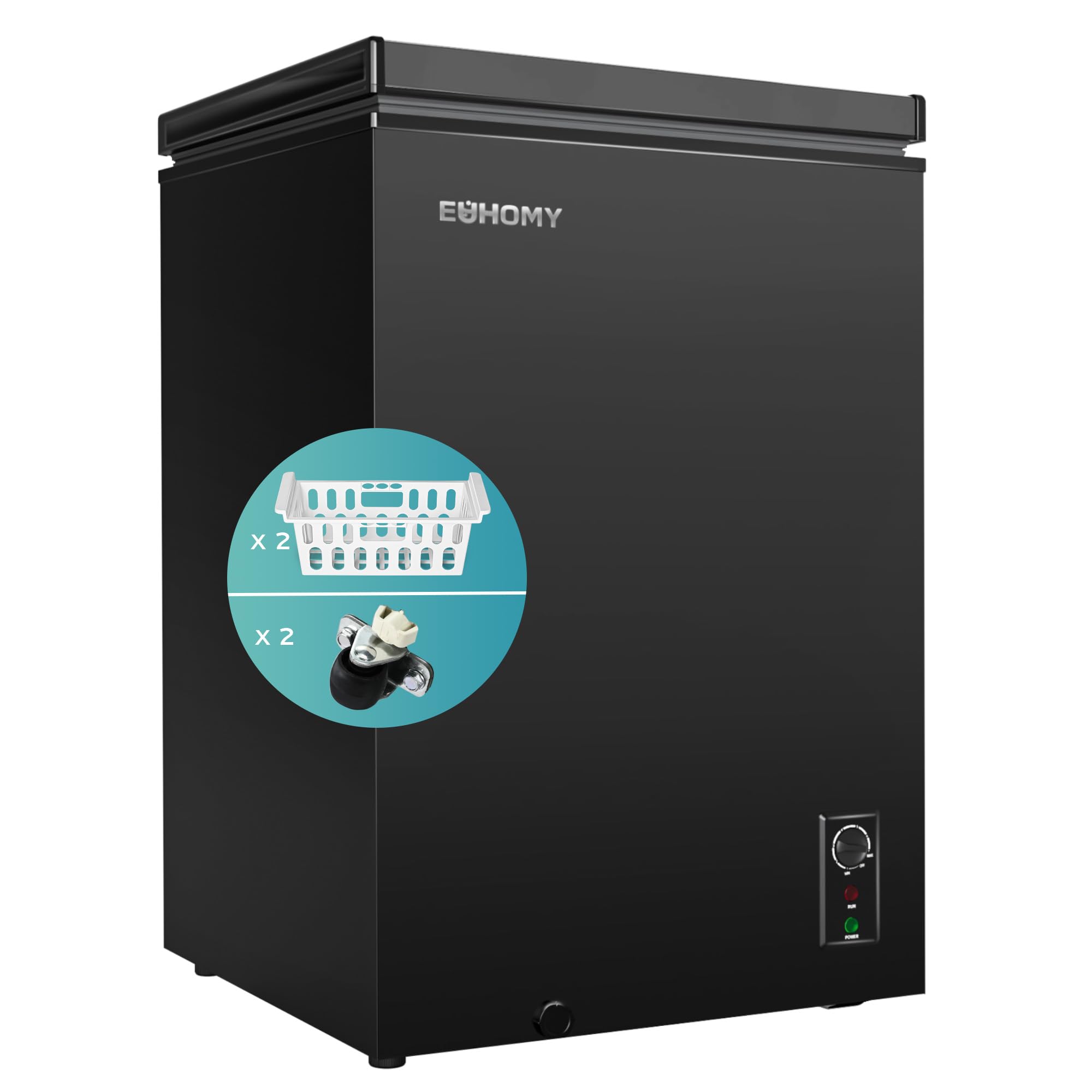
One of the quietest compact freezers its size, the EUHOMY 3.5 cu ft chest freezer uses a 38 dB compressor that is barely audible in a bedroom or home office. Its rolling wheels make it easy to pull out for cleaning or repositioning in a garage or basement. Energy use is low at 0.53 kWh/day, and owners report frost-free performance with rock-hard freezing.
This freezer suits buyers who prioritize mobility and quiet over a long track record. The sample of owners is still small, so durability after several years is less certain than with the Midea chest freezer, which has been field-tested by tens of thousands of users. If you accept that uncertainty and want a freezer you can easily move and barely hear, the EUHOMY is a capable choice.
Pros
- Quiet operation – nearly silent in most rooms.
- Integrated wheels allow easy mobility for cleaning or repositioning.
- Energy-efficient with minimal frost buildup and consistent freezing.
Cons
- Long-term durability under heavy use is less certain compared to models with years of user feedback.
For buyers who need a freezer that can be moved easily and operates quietly, the EUHOMY offers a strong feature set even if its long-term reliability is still being established.
Best for Dorm, Office
EUHOMY 1.1 cu ft Upright Freezer

Key Features
- Capacity: 1.1 cu ft
- Type: Upright
- Defrost Type: Manual
- Temperature Control: 7 settings
- Price: Budget
The EUHOMY 1.1 cu ft upright fits on countertops or under desks, runs quietly, and costs less than many similar-sized alternatives. Its compact size and reversible door suit dorms, offices, or apartments where every inch counts. However, frost can accumulate within weeks, requiring manual defrosting, and temperature consistency may vary between units—making this a viable option only for low-risk freezing like ice packs or occasional leftovers.
Pros
- Ultra-compact footprint fits on countertops or under desks.
- Operates quietly enough for bedrooms or offices.
Cons
- Limited to small batches – the 1.1 cu ft capacity holds only a few frozen meals or bags of vegetables.
For a dorm room or office needing a compact freezer for ice cream and frozen dinners, this upright works if you’re prepared to defrost every few weeks.
Best for Renters, Students
Kismile 3.0 cu ft Upright Freezer

Key Features
- Capacity: 3.2 cu ft
- Type: Upright
- Defrost Type: Manual
- Price: Mid-Range
The Kismile 3.0 cu ft upright provides a convenient shelved layout and reversible door at a mid-range price, fitting easily in small rooms with quiet operation. However, frost builds up quickly inside, so manual defrosting is needed every few weeks—making it better suited for those who plan to use it consistently and can manage the maintenance rather than for low-attention storage.
Pros
- Removable shelves and reversible door allow flexible organization of frozen foods.
- Compact size and quiet operation suit bedrooms, dorms, and apartments.
Cons
- Units may show cosmetic dents from shipping—inspect upon delivery.
- Frost accumulates quickly, requiring manual defrosting every few weeks.
Best for renters or students who want an upright with shelves and don’t mind a regular defrost routine in exchange for the space-saving design.
Best for Tight Budget
Antarctic Star 1.1 cu ft Upright Freezer

Key Features
- Capacity: 1.1 cu ft
- Type: Upright
- Defrost Type: Manual
- Temperature Control: 7 settings
- Price: Budget
The Antarctic Star 1.1 cu ft upright freezer offers the lowest entry price for a brand-new compact freezer, and its small footprint fits on a counter or under a desk. However, temperature consistency can vary between units, and some owners have noted the freezer struggling to maintain cold temperatures. This makes it a high-risk buy—best suited for those who need a tiny freezer immediately and have the ability to return it if it underperforms.
Pros
- Very compact design fits into tight spaces like dorms or offices.
- Affordable price point for a brand-new upright freezer.
Cons
- Temperature consistency can vary, with some units struggling to stay cold enough for safe freezing.
Best for someone on an extremely tight budget who needs the cheapest freezer right now and can easily return it if cooling performance is inadequate.
How to Choose
Every compact freezer under 5 cu ft requires manual defrost and has a real chance of arriving with cosmetic dings—plan for both before you buy.
Capacity: How Much Space You Actually Need
Capacity is measured in cubic feet, but usable space varies by layout. A 3.5 cu ft chest freezer holds roughly 122 pounds of frozen food—enough for a small family’s backup supply or a month of meal prep.
Smaller uprights (1.1 cu ft) fit under a desk but only store a few frozen meals or a bag of ice. Overfilling any freezer reduces airflow and makes the compressor work harder. Match capacity to your typical grocery load, not your aspirational one.
Chest vs. Upright: The Layout Trade-Off
Chest freezers lose less cold air when opened because cold air sinks—making them more energy efficient and better at holding temperature during power outages. They also offer more flat storage for bulk items like meat packs or frozen vegetables.
Uprights give you shelves and a smaller footprint, but every door opening dumps cold air out, causing the compressor to run more often. They’re easier to organize for frozen pizzas and bags of vegetables, but they tend to be noisier and more prone to frost buildup near the door seal.
Noise Level: How Quiet Is Quiet Enough
Noise is measured in decibels (dB)—a difference of 4 dB is roughly double the perceived loudness. Many compact freezers run between 38 and 42 dB, which is quieter than a refrigerator’s typical 40–45 dB.
In an open-plan kitchen or a bedroom, even a 42 dB compressor can be noticeable during its cooling cycle. Chest freezers generally hum less than uprights because the compressor is better insulated by the top lid. If silence matters, prioritize models with explicit noise ratings below 40 dB.
Manual Defrost vs. Frost-Free
Almost no compact freezers under 5 cu ft are frost-free—the auto-defrost mechanism adds cost and complexity that manufacturers skip at this size. Manual defrost means you’ll need to empty, unplug, and scrape ice every 1–3 months depending on humidity and how often you open the door.
Frost buildup is accelerated if you store warm food directly or open the lid frequently. A simple routine: defrost when the ice layer reaches ⅛ inch thick. Models with a defrost drain (like the Frigidaire chest) make cleanup faster, but all require some elbow grease.
Temperature Range and Control
The ideal freezer temperature is 0°F. Most compact freezers have a dial with 7 settings, but the actual range varies—some go down to -11°F (like the Whynter) for faster freezing, while others hover near 10°F at the warmest setting.
Digital controls are rare at this price point; rotary dials are common but can drift over time. Place a separate thermometer inside to verify the temperature, especially if you store breast milk or expensive meat. A consistent 0°F is more important than the lowest possible number.
FAQ
Why does my new small freezer have so much frost after just a few weeks?
Frost builds fast when humid air enters the freezer each time you open the door. If you live in a humid climate or store freezer in a garage, condensation freezes quickly. Check the door seal for gaps—if it’s not airtight, moisture sneaks in. Defrost every 1–2 months in summer, less in winter.
Is it normal for a compact freezer to arrive dented?
Unfortunately, yes—shipping damage is the most common complaint across nearly every brand in this size class. The packaging often isn’t robust enough for rough handling. Inspect the unit immediately upon delivery. Cosmetic dents rarely affect performance, but if the damage is structural or the door doesn’t seal, refuse delivery or file a claim.
How often should I defrost a manual-defrost chest freezer?
Expect to defrost every 1 to 3 months. The frequency depends on humidity, how often you open it, and whether you store food hot. When the ice layer exceeds ¼ inch, efficiency drops. Chest freezers hold cold longer than uprights, so you can usually push to 3 months. Use the defrost drain if your model has one to speed up the task.
Can I put a small freezer in an unheated garage?
Only if the freezer is marked “garage ready”—many compact models are not rated for temperatures below 32°F or above 90°F. The Midea 3.5 cu ft chest freezer is explicitly garage ready and can handle temperature swings. In a freezing garage, a non-garage-ready unit may stop cooling or have oil flow issues. Check the manual before installing.