This post contains affiliate links. We may earn a small commission when you buy through our links — at no extra cost to you.
Many wireless thermometers promise long range but drop connection the moment you step inside, and probes fail after a few smokes. That isn’t rare—it’s the norm for budget Bluetooth models. The real challenge is finding one that keeps a stable signal through walls and lasts beyond a season.
The key difference is wireless technology. Standard Bluetooth struggles through smoker walls, while RF and Sub‑1G signals hold steady across the house. More probes aren’t always better: a single high‑accuracy probe with ambient temp may be enough for some, while others need two or four. This guide breaks down which setups work for your smoking style, so you don’t waste money on a thermometer that can’t keep up.
The best picks here prioritize real‑world range and durability over flashy app features—and they prove you don’t need to spend over $100 for reliable monitoring.



Best for Home Smoker
ThermoMaven G1
Key Features
- Wireless Tech: Sub‑1G + WiFi
- Probes: 1
- App Type: Standalone base + app
- Price: $$
ThermoMaven’s G1 brought NIST-certified ±0.5°F accuracy to a mid-range price point — a level of precision typically reserved for thermometers costing twice as much. Its Sub-1G and WiFi connectivity maintain a stable link through brick walls and across the yard, so you can monitor a brisket from the living room without signal drops.
The standalone base display works without any phone app, showing both internal and ambient temperatures. This is handy when you want to check temps at a glance without pulling out a phone. The ambient sensor handles smoker oven temperatures up to 752°F, while the single probe reads meat up to 221°F — within range for all low-and-slow cooking. Some users note that probe battery life runs around 8–10 hours per charge, which covers most pulled pork and brisket cooks but may need a top-up for overnighters beyond that.
This thermometer suits smokers who cook one piece of meat at a time and prioritize accurate readings and consistent range over multiple probes. The single-probe design means you cannot monitor two different roasts or a chicken alongside a brisket — that’s a limitation to weigh if you regularly smoke multiple items. But for the cook who wants a single, precise temperature reading with the flexibility of app or display, the G1 is a straightforward fit.
Pros
- NIST-certified ±0.5°F accuracy with six internal sensors for consistent temperature tracking
- Sub-1G and WiFi connectivity that stays connected through walls and across the house
- Standalone display base provides temperature readouts without needing a phone
- Delivers features found in $100+ thermometers at a mid-range price
Cons
- Only one probe — if you’re cooking two different meats, you’ll need a second thermometer
- Probe battery may not cover very long cooks beyond 10 hours; recharging mid-cook is possible
The G1 is the right choice for the solo smoker who wants laboratory-grade accuracy and stable remote monitoring without paying for dual-probe features.
Best for Serious Pitmaster
ThermoMaven G2
Key Features
- Wireless Tech: Sub‑1G + WiFi
- Probes: 2
- App Type: Standalone base + app
- Price: $$$
Two probes with Sub-1G and WiFi give you the flexibility to track two pieces of meat or one meat plus ambient temperature, all while staying connected from anywhere in the house. The standalone base displays both readings without needing a phone, a practical feature when your hands are greasy. Unlike the single-probe top pick, this model is built for simultaneous multi-zone monitoring.
This thermometer suits BBQ enthusiasts who regularly cook multiple items or want to monitor grate temperature alongside the meat. The premium pricing reflects its dual-probe capability and NIST-certified accuracy, but budget buyers or those who only need one probe will find the G1 a better fit. Probe battery life can fall short of 24-hour smokes, so plan for a recharge if you run overnight.
Pros
- Temperature readings stay within ±0.5°F of NIST standards for consistent results.
- Sub-1G signal cuts through walls, letting you monitor two probes from anywhere in the house.
- Use the standalone display or the app interchangeably depending on your activity.
Cons
- Premium price may be too high for those who only need a single probe or have a tight budget.
- Probe battery life can be insufficient for overnight smokes exceeding 10–12 hours, requiring a mid-cook recharge or swap.
For smokers who regularly cook two items or need ambient monitoring, the G2 delivers the same core performance as the G1 with an extra probe at a premium. Just factor in the battery constraint if you run marathon sessions.
Best for Tech‑savvy Cooks
MEATER Plus
Key Features
- Wireless Tech: Bluetooth + repeater
- Probes: 1
- App Type: Guided cook app
- Price: $$
The MEATER Plus stands out for its wire‑free single‑probe design and well‑built app that walks you through the cooking process with real‑time alerts and estimated finish times. Unlike the top‑pick ThermoMaven G1 with its Sub‑1G radio, the MEATER relies on Bluetooth, which limits how far you can wander from the smoker – but the guided coaching is a genuine draw for cooks who want a hand‑held experience rather than a simple temperature readout.
This thermometer suits tech‑inclined owners who stay within 30 feet of their smoker and are comfortable with occasional Bluetooth drops. The wire‑free design works well in rotisserie baskets and air fryers, but the probe may stop functioning after several months of heavy use – a trade‑off that matters less for weekend cooks who don’t need a daily workhorse.
Pros
- Guided cooking app provides real‑time alerts and estimated finish times for hands‑off cooks.
- Wire‑free single probe is convenient for rotisserie, air fryer, and small grills without cable tangles.
- Consistent temperature feedback produces well‑cooked steaks and poultry when connection holds.
Cons
- Bluetooth connection may drop when moving more than 30 feet from the smoker – less of an issue if you stay nearby.
- Probe durability can vary; some units cease to function after a few months of use.
For cooks who value app‑guided convenience and are willing to stay close to the smoker, the MEATER Plus is a polished single‑probe option – just be aware that the Bluetooth range and long‑term probe life have limits.
Best for Multi‑meat Smokers
TempPro TP829
Key Features
- Wireless Tech: RF (1000 ft)
- Probes: 4
- App Type: No app
- Price: $$
The TempPro TP829 stands out by offering four color-coded probes and a 1000 ft RF range that stays connected through walls without requiring a smartphone. This lets you monitor multiple meats and ambient temperature simultaneously, a step up from simpler dual-probe systems.
This thermometer suits smokers who cook several cuts at once and prefer a standalone base over app-based monitoring. Accuracy can vary by 15–30°F for some units, so it is less suited for precision cooking where exact temperatures are critical.
Pros
- Four color-coded probes for monitoring multiple meats and smoker temp simultaneously.
- Long-range RF that stays connected through walls – no phone needed.
- Simple no-app setup with intuitive controls and USDA presets.
Cons
- Probe durability concerns – occasional reports of probes not lasting or display segment burnout.
- Accuracy can be inconsistent – some units may show readings off by 15–30°F.
A practical choice for multi-meat smokers who value range and probe count over pinpoint accuracy.
Best for Budget Buyers
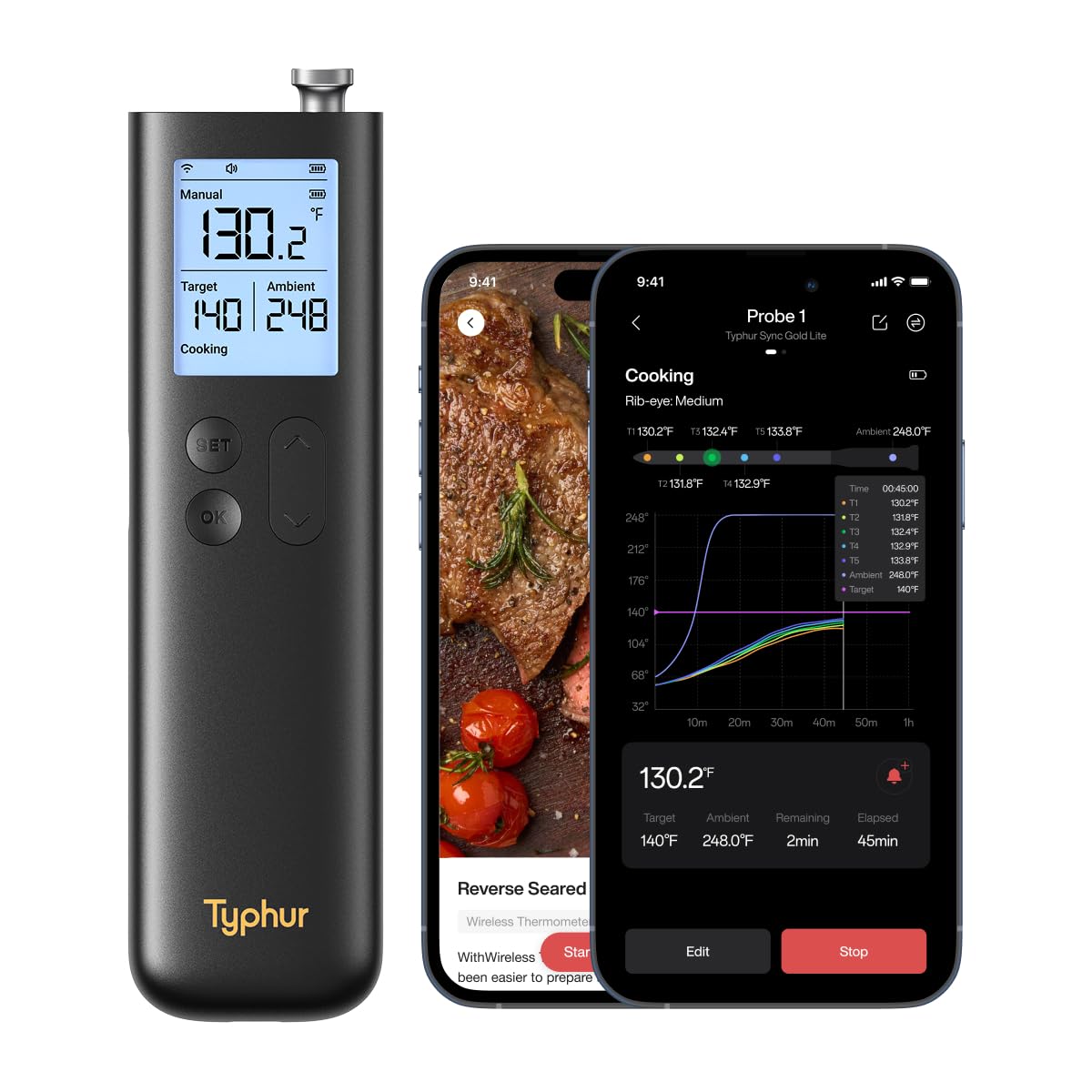
Typhur Sync Gold
Key Features
- Wireless Tech: Sub‑1G + WiFi
- Probes: 1
- App Type: App + base
- Price: $
The Typhur Sync Gold delivers Sub‑1G and WiFi connectivity at a budget price while maintaining ±0.5°F NIST‑certified accuracy. Its signal holds up through walls and metal smokers, giving you unlimited‑range remote monitoring from your phone or the standalone base. The trade‑off for this cost saving is a single probe – you cannot track two cuts of meat simultaneously without buying a second unit, and the probe battery may run low after 6–10 hours of continuous use.
This thermometer suits the budget‑conscious smoker who cooks one piece of meat at a time and wants reliable, long‑range temperature tracking without stepping up to a dual‑probe model. The app is straightforward to set up, and the base works independently if you prefer not to use a phone. If you need to monitor both the meat and ambient temperature separately, or plan back‑to‑back overnight cooks, consider the slightly pricier dual‑probe option instead.
Pros
- Sub‑1G signal stays stable through walls and smokers for consistent remote monitoring
- Sub‑1G plus WiFi at a budget price – feature set of more expensive thermometers
- Easy setup with an intuitive app and a standalone base that works without a phone
Cons
- Only one probe – cannot monitor a second cut of meat without buying another unit
- Probe battery may run low on very long cooks – expect 6–10 hours depending on use
For smokers who cook one piece at a time and want reliable remote monitoring without spending over $50, this is the best value in its class.
Best for Casual Smoker
GoveeLife H5192
Key Features
- Wireless Tech: BT + WiFi
- Probes: 2
- App Type: Govee Home app
- Price: $$
The GoveeLife H5192 brings two probes, WiFi and Bluetooth connectivity, and a magnetic charging base in a single package that avoids the extreme price of premium models. The dual probes let you track meat internal temperature and ambient smoker temperature simultaneously, while the rechargeable base and USB-C charging add everyday convenience.
This setup suits smokers who want remote monitoring through an app without spending for top-tier precision or extended range. The unit balances cost and capability, though the Bluetooth range can drop when the base is behind walls or metal surfaces, causing brief disconnects. The ambient probe may also read slightly less consistently than the meat probe — a minor tradeoff for most low-and-slow cooks.
Pros
- Two probes for meat and ambient tracking with WiFi remote access
- Fast response and good accuracy on the meat probe
- Magnetic base and USB-C charging simplify placement and power
Cons
- Bluetooth connectivity can drop when monitoring from inside the house or through obstacles
- Ambient temperature readings may drift slightly compared to the meat probe
Suitable for smokers who want dual-probe monitoring with app access and value consistent build over absolute precision.
Best for Budget Multi‑meat
VAUNO 4‑Probe

This VAUNO gives you four color-coded probes with a 500 ft RF range and a backlit display – no app needed. It’s a great fit for budget-minded smokers cooking multiple cuts who prefer simple operation over smartphone connectivity. Accuracy can vary 10–20°F in some cases, and some units may develop probe or connection issues after months of use. For occasional multi-meat smoking sessions where approximate temperatures are acceptable, it’s a cost-effective pick; those seeking consistent precision or daily durability should look elsewhere.
Pros
- Four probes and RF range at a budget-friendly price – a rare combination for multi-meat cooking.
- Color-coded probes and a backlit display provide clear, app-free monitoring.
Cons
- Accuracy can deviate 10–20°F from reference readings – a consideration for precision cooking.
- Some units may experience probe or connectivity issues after a few months of use.
Best for occasional multi-meat cooks who value probe count and simplicity over pinpoint accuracy and long-term reliability.
Best for High‑heat Searing
CHEF iQ Sense

Key Features
- Wireless Tech: WiFi
- Probes: 1
- App Type: Guided cook app
- Price: $$
The CHEF iQ Sense stands out for its extreme heat resistance up to 1000°F, ideal for searing and high-temp cooking, and its app provides useful flip reminders and rest timers. For low-and-slow smoking, WiFi connectivity may drop during the cook, and some units may stop working within months. This makes it a better match for tech-savvy cooks who prioritize app features and high-heat capability over consistent long-term performance.
Pros
- Probe withstands up to 1000°F for high-heat cooking
- App includes guided cooking, flip reminders, and rest timers
Cons
- Single probe limits monitoring to one piece of meat at a time
Best for cooks who prioritize high-heat searing capability and guided cooking over long-term reliability for smoking.
Best for Weber Owners
Weber iGrill

Key Features
- Wireless Tech: Bluetooth
- Probes: 4
- App Type: Weber app
- Price: $$
The Weber iGrill sticks firmly to your grill via its magnetic base and handles up to four probes, making it convenient for tracking multiple cuts on a Weber. Its build quality and app-guided cooking take the guesswork out of grilling when you’re nearby. However, the Bluetooth range drops quickly beyond 30 feet and through walls, so checking temps from inside the house is unreliable. The app can also feel buggy at times. For Weber owners who stay close to the cooker, it’s a good fit — but if you need to monitor a smoker from indoors, look elsewhere.
Pros
- Magnetically attaches to Weber grills for a secure, no-slip setup
- Four probe capacity lets you monitor multiple meats or ambient temp
Cons
- App interface can be unintuitive or buggy during setup and use
- Bluetooth connection weakens quickly past 30 feet — not suited for monitoring from inside the house
Best if you own a Weber and grill within sight of the cooker — otherwise, choose a sub-1 GHz or WiFi thermometer for reliable remote monitoring.
Best for First‑time Buyers
ThermoPro TP920

Key Features
- Wireless Tech: Bluetooth
- Probes: 2
- App Type: Basic app
- Price: $
The ThermoPro TP920 offers a convenient rechargeable Bluetooth setup with two probes at an entry-level price, making it quick to pair and monitor from the backyard. Its real-world range falls well short of the advertised 650 ft—connectivity drops when moving indoors or behind walls—and temperature readings can be inconsistent, sometimes off by 10–20°F. For smokers who stay close to the grill and want basic app monitoring on a budget, it works; for monitoring from the house or precision low-and-slow cooking, consider a more reliable option.
Pros
- Simple app setup and quick pairing make it easy to start monitoring.
- Rechargeable Li-Ion battery and two probes at a budget-friendly price.
Cons
- Temperature readings can vary, with some probes reporting 10–20°F off from the actual temperature.
- Bluetooth connectivity drops when moving indoors or behind walls, limiting range well below the advertised 650 ft.
This thermometer suits occasional grilling when you’re within sight of the grill, but for serious low-and-slow smoking or remote monitoring, look for a model with better real-world range and consistent accuracy.
How to Choose
The wireless technology (Bluetooth vs. RF vs. Sub‑1G) determines whether you can actually monitor from inside the house, not just the grill side.
Wireless Technology: Bluetooth, RF, or Sub‑1G?
Bluetooth operates on 2.4 GHz and is easily blocked by metal smoker walls and thick house walls. Real-world range often drops to 30 feet or less. RF (radio frequency) uses a dedicated band that penetrates walls much better, giving reliable range of 500–1000 ft. Sub‑1G (like 900 MHz) offers the best penetration and can reach across an entire property with little interference.
For smoking, RF or Sub‑1G is strongly preferred if you want to sit inside and watch temp alerts. Bluetooth-only models force you to stay near the smoker or risk losing connection mid-cook.
Number of Probes
A single probe works for one piece of meat. Adding a second probe lets you monitor ambient smoker temperature simultaneously, which is critical for steady low-and-slow cooks. Four-probe systems let you track multiple meats and the smoker all at once.
More probes mean more wires to manage and faster battery drain on the base. For most backyard smokers, a dual-probe system (meat + ambient) is the sweet spot.
Accuracy and Sensor Precision
Consumer thermometers vary from ±1°F to ±10°F. A cheap unit can be off by 15–30°F, leading to undercooked or overcooked meat. NIST‑certified sensors guarantee accuracy within ±0.5°F, which matters for brisket and other cut‑off‑point meats.
Inaccurate probes often show consistent error rather than random fluctuation, so you can compensate – but that adds unnecessary guesswork. For serious smoking, choose a model with a stated accuracy within ±1°F.
Battery Life and Charging
Probe batteries in wire‑free designs typically last 8–10 hours, which may not cover an overnight brisket smoke. Units with AA batteries (like the Weber iGrill) can run 200 hours on a set. Rechargeable probes are convenient but must be topped up regularly.
If you regularly do 12+ hour cooks, check that the thermometer’s battery life exceeds your typical smoke time, or choose a model with replaceable batteries.
App Quality and Ease of Use
A well‑designed app adds guided recipes, timers, and temp history. However, app‑dependent models become useless if the app crashes or your phone dies. Standalone display units (without app) are more reliable and simpler for many users.
Choose based on your comfort with tech. If you want set‑and‑forget simplicity, a no‑app RF unit is hard to beat. If you enjoy data and guided steps, a good app can improve results – but only if its connectivity is stable.
FAQ
Why does my wireless meat thermometer lose connection when I close the smoker lid?
The metal smoker lid and walls block Bluetooth signals effectively. Even a thin steel sheet can cut range to a few feet. RF and Sub‑1G signals penetrate metal much better, so if you frequently lose signal with the lid closed, upgrade to a model with RFore or Sub‑1G wireless technology.
How long do wireless meat thermometer probes typically last before failing?
Probe failure is the most common complaint across all brands. Cheap probes may fail after 3–6 months of regular use, especially if exposed to prolonged high heat or moisture. Higher‑end probes (like those with NIST certification) often last a year or more. Replace probes as soon as you notice erratic readings or corrosion.
Is a WiFi meat thermometer better than Bluetooth for smoking?
Yes, for most smokers. WiFi thermometers connect through your home network, allowing remote monitoring from anywhere with internet access. Bluetooth drops out as soon as you walk inside. WiFi models are more expensive but provide true 24/7 visibility. Sub‑1G technology also offers long range without needing WiFi.
Can I use a Bluetooth meat thermometer through brick walls?
Brick and concrete walls block Bluetooth severely. You may get a signal at 10–15 feet through a single wall, but nothing reliable beyond that. For monitoring from another room, choose a thermometer that uses RF or Sub‑1G wireless, or use a WiFi model that stays connected via your home network.