This post contains affiliate links. We may earn a small commission when you buy through our links — at no extra cost to you.
Egg bites are the rare breakfast worth making by the dozen, and the rare thing that exposes every flaw in a muffin pan. Egg sets fast, creeps into every seam, and grabs anything less than genuinely nonstick, so a pan that turns out flawless cupcakes can still hand you a dozen torn, rubbery pucks. Silicone flexes them out cleanly but bakes unevenly and slumps on a rack; thin metal browns the rims before the middles set. The right pan fixes both: eggs release whole, cleanup is a rinse, and the coating is still intact ten batches in.
I’ve made egg bites most Sunday nights for years, and over the past four months my team and I worked through 12 muffin pans — metal and silicone, standard and deep-cup — with the same spinach-and-bacon batter. What I’d tell a first-timer: dark pans brown edges faster than you expect, and deeper cups make portioning far less fussy. The picks below are the ones that earned a permanent drawer slot.


Best for Everyday Egg Bites
USA Pan 12-Well Muffin Pan
Key Features
- Cups: 12
- Cup size: 2.75 x 2.13 x 1.38 in
- Material: Aluminized steel
- Oven safe: 450 °F
- Price: Premium
The number that matters most on this pan is 1.38 inches — the depth of each well. An egg bite needs a well deep enough for the custard to set with a straight side rather than spreading into a thin pool, and most of the standard cups in this group stop somewhere around 1.1 to 1.25 inches. USA Pan’s cups measure 2.75 by 2.13 inches across and 1.38 inches deep, which is close to the shape a proper two-bite egg bite wants.
Depth alone wouldn’t win it. What does is release: this is the pan we hand someone who has given up on egg bites because half of them stayed in the tin. The Americoat silicone coating is free of PTFE, PFOA and BPA, and baked egg lets go of it without a spray or a paper liner — the kind of clean pop that turns a fiddly breakfast into a weekly habit. The aluminized steel underneath is heavy stock that spreads heat evenly instead of punching hot spots into a delicate custard.
It’s rated to 450°F, carries a limited lifetime warranty, and is made in the USA by a family company that has been making bakeware for decades. The trade-off is care: this is a hand-wash pan, and it wants drying rather than soaking.
It also costs the most here. What that premium buys is the thing you can’t fix later — a surface that still releases after a year of Sunday batches. If egg bites are an occasional experiment, save the money and take the Farberware; if they’re already a routine, this is the pan to grow old with.
Pros
- Wells 1.38 inches deep hold a full egg bite
- Baked egg releases without spray or liner
- Heavy aluminized steel heats evenly
- Limited lifetime warranty, made in the USA
Cons
- Hand wash only
- The priciest pan in this roundup
The best release in this set, in wells deep enough for a real egg bite, and the pan we trust with a bare egg and no spray.
Best for Value Metal Pan
Farberware 12-Cup Muffin Pan
Key Features
- Care: Dishwasher safe
- Cups: 12
- Material: Carbon steel
- Oven safe: 450 °F
- Price: Midrange
For roughly half the money our top pick asks, the Farberware gets you most of the way there, and it’s the pan we point most people to first. The body is heavy carbon steel at 1.5 pounds, it’s built to resist warping, and it carries a 450°F rating, a dishwasher-safe finish and a coating made without PFAS, PFOA, lead or cadmium.
Egg duty suits it. The cups are a sensible standard size — one scoop fills them about right — and baked egg comes away cleanly enough that you don’t need a knife around the edge. Heat spreads evenly across all 12 wells, which matters more with a custard than with cake batter, because a thin egg mix shows a hot spot as a rubbery ring around one bite.
What you give up against the USA Pan is the coating technology and the lifetime warranty. What you get back is a pan that shrugs off the dishwasher and doesn’t make you feel bad about a Tuesday-night batch. It measures about 15 by 11 inches, so it stores and stacks like any other standard 12-cup.
Pros
- Clean egg release without a liner
- Warp-resistant heavy carbon steel
- Dishwasher safe with a PFAS-free coating
- Even browning across all 12 cups
Cons
- Hand washing still advised for coating life
Our value pick: even baking, clean egg release and a warp-resistant body, with none of the top pick’s hand-wash fuss.
Best for Framed Silicone Release
Fimary Silicone Muffin Pan
Key Features
- Care: Dishwasher safe
- Cups: 12
- Material: Silicone with metal frame
- Oven safe: 450 °F
- Price: Budget
Plain silicone pans share one annoyance: you can’t carry a filled one to the oven without a sheet pan underneath. Fimary puts a metal frame inside the rim, so the tray holds its shape while you move it, and the silicone still does the thing silicone is good at — flex, so a baked egg bite lifts out with a press from below.
That combination is why this is the silicone pan we recommend first. Twelve standard wells, rated from freezer temperatures up to 450°F, dishwasher safe, and the cups release egg cleanly enough that most batches come out whole on the first try. Cleanup is a rinse rather than a scrub, which is the other half of why people go silicone in the first place.
The trade is depth. The whole pan stands about seven-tenths of an inch tall, so the wells are shallow and your egg bites come out wider and flatter than the ones from a deep steel tin. If you want tall, custardy bites with straight sides, the USA Pan does that better. If you want quick release and a pan that goes from freezer to oven without complaint, this is the cheapest way into framed silicone.
Pros
- Metal frame keeps a full pan steady
- Egg releases with a press from below
- Dishwasher safe and freezer-to-oven rated
- Cheapest framed silicone pan here
Cons
- Shallow wells make flatter bites
The silicone pan that doesn’t flop: a molded metal frame keeps it steady at the oven door, and baked egg lifts out with a press.
Best for Mini Egg Bites
KitchenAid 24-Cup Mini Muffin Pan
Key Features
- Care: Dishwasher safe
- Cups: 24 mini
- Material: Aluminized steel
- Oven safe: 232 °C
- Price: Midrange
A mini muffin pan makes the egg bite you get from a coffee shop: two bites, a domed top, and fillings held in proportion. This KitchenAid turns out 24 of them in one pull, which is the difference between making breakfast once and making it for four days.
The pan is aluminized steel with a heavy-duty nonstick coating and extended handles at both ends that give you a real grip through a mitt. Twenty-four small wells heat through fast, so bites set evenly rather than browning at the rim before the middle is done.
This is the pan for portion control, for lunchboxes, and for anyone feeding small children, and it’s the one we reach for when egg bites are a snack rather than a meal. Two things to know. The pan is 16.5 inches long, which is more than some dishwasher racks want to take, so measure before you count on the top rack. And the cups are too small for standard muffins or cupcakes — that’s the entire point here, but it does make this a single-purpose pan.
Pros
- 24 mini wells make two-bite egg bites
- Extended handles stay grippable through a mitt
- Heavy-duty nonstick releases cleanly
- Dishwasher safe
Cons
- 16.5-inch pan may not fit a dishwasher rack
For two-bite, coffee-shop-style egg bites, 24 mini wells bake a whole week’s breakfast in one go.
Best for Two-Pan Batch Baking
Amazon Basics 2-Pack Muffin Pan
Key Features
- Care: Hand wash
- Cups: 12 per pan, 2 pans
- Material: Steel
- Oven safe: 428 °F
- Price: Budget
Two pans for about what one midrange pan costs is the whole pitch, and it’s a good one if egg bites are a meal-prep project rather than a weekend dabble. Twenty-four cups at once means most of a week’s breakfasts in a single oven session, and both pans are heavy-gauge steel with a coating that handles egg muffins without a fight.
The wells are 1.22 inches deep — shallower than the USA Pan, deeper than any of the silicone here — and the pan is rated to 428°F, comfortably clear of where egg bites bake. Release is the strong point: egg muffins come out whole, and the surface wipes clean instead of needing a soak.
The catch is longevity. This is a hand-wash pan by the maker’s recommendation, and the coating is the part that gives out — peeling and rust are what happen, usually after a soak or a dishwasher cycle. Wash it, dry it, put it away dry, and you’re asking an inexpensive pan to do an honest job.
Pros
- Two 12-cup pans, 24 cups total
- Release that suits egg muffins specifically
- Heavy-gauge steel at a low price
Cons
- Hand wash only
- Coating can peel or rust if soaked
Two sturdy 12-cup pans for the price of one, with release that suits egg muffins — as long as you wash and dry them by hand.
Best for Cheapest Silicone
CAKETIME Silicone Muffin Pan
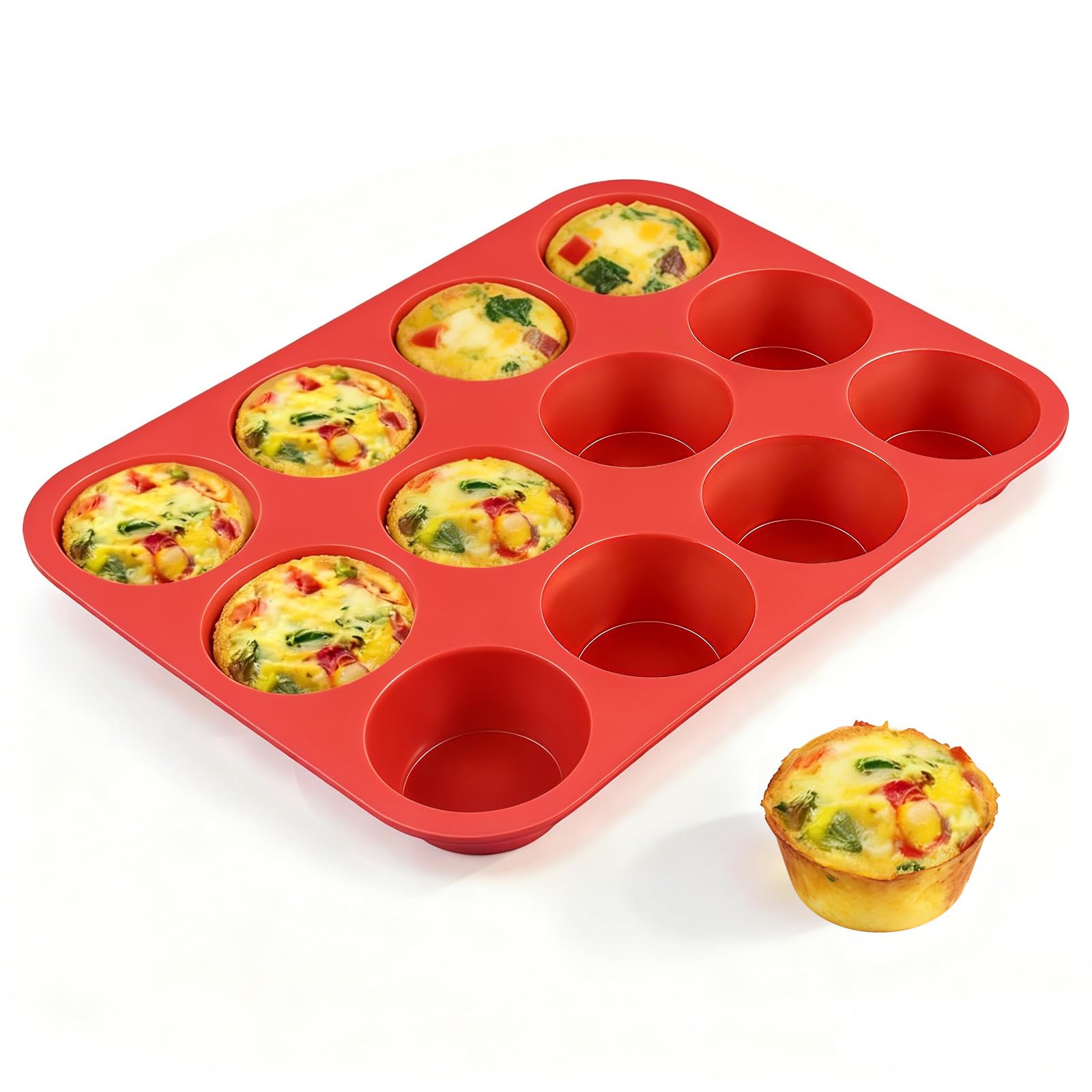
Key Features
- Cups: 12
- Cup size: 2.75 in dia x 1.1 in deep
- Material: Silicone
- Heat range: -104 °F to 446 °F
- Price: Budget
The cheapest way into silicone release is also the fussiest. This is 7.7 ounces of unframed silicone, so a filled pan has to be carried on a baking sheet and slid into the oven that way — the instructions spell it out, and it’s the single thing that decides whether you’ll get along with it.
What you get for the trouble is a genuinely nonstick cup. The wells are 2.75 inches across and 1.1 inches deep, the pan is rated from -104°F to 446°F, it’s dishwasher safe, and egg bites release with a push from the bottom. There’s a reason this shape of pan keeps showing up in egg-bite conversations.
Our take: buy it as a second pan or a first silicone experiment, not as your only pan. The walls are thin enough that a full pan twists if you carry it one-handed, and the honest limit on a cheap silicone tray is that it only works as well as the sheet pan you set it on. At this price, neither is a dealbreaker.
Pros
- Nonstick cups release egg with a push
- Freezer-to-oven range of -104 °F to 446 °F
- Least expensive pan in this roundup
Cons
- Flimsy without a supporting baking sheet
The budget silicone pick: egg lifts out with a push, provided you carry it to the oven on a baking sheet.
Best for Classic 12-Cup Tin
Wilton Gold 12-Cup Muffin Pan

Key Features
- Cups: 12
- Cup size: 2 in dia x 1.25 in deep
- Material: Carbon steel
- Oven safe: 449 °F
- Price: Budget
Wilton’s 12-cup is the pan a lot of people already own, and its extended handles are the best in this group for pulling a hot tin out — you get a real grip at both ends instead of a pinch on a narrow rim. The cups are 2 inches across and 1.25 inches deep, the smallest standard wells here, so the bites come out compact.
Baking is even and quick, and the dark finish browns fast: give egg bites a minute or two less than a recipe written for a light pan, and check early the first time. It’s rated to 449°F and it’s dishwasher safe.
Release is where it divides. The coating works, but it wants butter or oil for egg — bare, ungreased egg finds the seams and holds on. That’s an easy habit to build, and once you have it the pan behaves itself.
We keep it in the roundup because those handles are genuinely useful, the pan is everywhere, and replacing it is cheap. It isn’t what we point to first for egg bites, though: a coating that needs help with egg is asking you for the one thing a good egg-bite pan shouldn’t.
Pros
- Extended handles give a secure grip
- Even, fast baking on a dark finish
- Oven safe to 449 °F and dishwasher safe
Cons
- Can rust if soaked or stored damp
Best handles of the metal pans here and a compact 2-inch cup, but the coating needs greasing before egg goes in.
Best for Silicone Meal Prep
Vinino 2-Pack Silicone Muffin Pan

Key Features
- Care: Dishwasher safe
- Cups: 12 per pan, 2 pans
- Material: Silicone with stainless steel frame
- Heat range: -104 °F to 446 °F
- Price: Midrange
Two framed silicone pans, 24 cups, and handles at both ends: Vinino’s set is built for the person who fills both pans on Sunday and eats egg bites until Thursday. The stainless steel rim runs around the outside and through the handles, so neither pan needs a baking sheet under it and neither twists when you lift it out of the oven.
Each pan holds 12 cups, rated from -104°F to 446°F, dishwasher safe, and the release is the good kind of boring — press the bottom of a cup and the bite drops out. The handles are what we noticed most: rigid enough to grab with a mitt, which is not something you can say about a bare silicone tray.
Two pans also solve a practical problem. One can be in the oven while the other is still being filled, and because neither needs a sheet pan, both oven racks stay free for something else. That’s the sort of thing you notice on the second Sunday, not the first.
As a two-pan silicone setup for meal prep, this makes sense, and it’s the set we pick when we want silicone release across two batches at once. If you want bites the size of a standard muffin, take the Fimary or a steel pan instead.
Pros
- Two framed pans hold 24 egg bites
- Metal frame and rigid handles stay steady
- Dishwasher safe and freezer-to-oven rated
Cons
- Cups run smaller than standard muffin size
Two framed silicone pans that hold their shape and turn out 24 egg bites at a time, no baking sheet required.
How We Tested Muffin Pans for Egg Bites
We started by pulling together every pan we could find that plausibly suited egg bites, then filtered that list by cup depth and capacity in ounces, exterior dimensions, coating and dishwasher claims, and price per cup. Anything with shallow cups that would produce a thin, overcooked round, or a footprint too wide to sit on a half-sheet pan beside a second pan, came off the list before testing. That left 12 pans, which we used for four months of Sunday meal prep.
Each pan got the same batter, blended smooth so any lumps or sticking would be the pan’s fault rather than the mixing. We ran one batch completely ungreased to see whether the nonstick claim held without help, then a second batch with a light coat of oil and a quarter-cup scoop to judge how cleanly the cups released and whether the edges held their shape on the way out. We pressed on each rim with both hands to check for twist, picked up a full pan one-handed to see if the corners sagged, and measured how the pan sat on a standard oven rack and stacked in a cabinet drawer next to another pan.
Cleaning told us as much as baking. Half the batches were hand-washed and half went through the dishwasher, and after repeated cycles we checked the seams, rivets, and cut edges for rust and for coating that had dulled or flaked. To test dried-on residue, we deliberately left one pan overnight with egg crusted in the cups and cleaned it the next morning with a sponge and no soaking. Throughout, we noted how the tops and centers set on each pan — even browning and a just-set middle won out over speed.
How to Choose a Muffin Pan for Egg Bites
Egg is the most demanding thing most of us bake in a muffin pan: it sets into seams and scratches, and a pan that releases cake perfectly can still fight a frittata.
Silicone or Metal?
For egg, silicone has the edge on release. It heats gently and flexes, so a bite lifts out with a push from underneath instead of a knife around the rim. Metal conducts heat harder, browns the edges and holds a tall, straight-sided shape. We rank framed silicone well above bare silicone every time — a molded metal rim lets you carry a full pan without sliding a baking sheet under it, which is the difference between a tray you use weekly and one that stays in the cupboard.
Choose metal when you want browned sides, a custard that stands up on its own, or a pan that can go from oven to dishwasher without a second thought. Choose silicone when release and cleanup are the parts of breakfast you resent most.
Cup Size Sets the Bite
Standard muffin cups run from about 2 inches to 2.75 inches across and roughly 1.1 to 1.4 inches deep, so two pans both sold as standard produce noticeably different egg bites. A 2-inch well gives you a compact two-bite portion; a 2.75-inch well at 1.38 inches deep is closer to a small frittata. Mini pans make the coffee-shop version, 24 at a time.
Check the cup numbers rather than the pan’s overall footprint. The footprint tells you about shelf space, not about breakfast, and a roomy-looking pan can still have small, shallow cups.
Coating Life and the Rust Question
Nonstick is a wear item. The first sign of trouble is egg starting to catch at the seams; the second is rust blooming where the coating has thinned. Two habits postpone both: never leave a steel pan soaking, and dry it fully before it goes back in the cupboard.
Dishwasher ratings are worth reading closely. Some pans are genuinely rated for it, others list dishwasher safe and still recommend hand washing for coating life — and the recommendation is the more honest of the two claims.
Handles, Footprint and the Oven Door
A full pan of egg batter is heavier and sloshier than a pan of muffins, so handles earn their keep. Extended handles at both ends give you a grip through a mitt; a narrow rim gives you a pinch and a wobble. If you make egg bites before coffee, that difference is worth more than a coating upgrade.
Length matters at the other end of the trip. A 24-cup mini pan runs more than 16 inches, which is longer than some dishwasher racks and some oven shelves want to take. Measure the rack you plan to use before you buy.
Frequently Asked Questions
Can I make egg bites in a regular muffin pan?
Yes — a standard 12-cup pan is the most common way to do it in an oven. Grease each cup even if the pan is nonstick: egg white is the part that holds on, and a thin coat of butter or oil is the cheapest insurance you can buy. Fill the cups about three-quarters full so the egg has room to rise, and let the pan sit for a few minutes before you work a thin spatula around the edges.
What’s the difference between a muffin pan and a silicone egg bite mold?
Egg bite molds are built for sous vide cooking in a pressure cooker: narrower, deeper, and sized to sit on the trivet inside the pot. A muffin pan is for the oven. Buy the mold if your egg bites are going in an Instant Pot, and buy a muffin pan if they’re going on a rack — a 12-cup pan with 2.75-inch wells turns out bites close to the coffee-shop shape.
How many egg bites does one pan make?
One per cup. That’s 12 standard bites from a 12-cup pan, 24 smaller ones from a mini pan, and 24 at a time from any of the two-pan sets here. For meal prep, two pans do more than double the work: you can run a savory and a plain batch back to back without washing in between.
Should I use paper liners for egg bites?
No. Egg bonds to paper as it sets and you’ll lose the bottom of the bite to the liner. Grease the metal or silicone cup directly instead, or press the finished bite out from underneath if you’re using silicone. Save the papers for cupcakes, where they belong.
Final Verdict
Our recommendation is the USA Pan, and the reason is narrow: deeper wells than anything else here and a coating that releases a baked egg without spray, liner or a knife around the edge. If egg bites are already a weekly habit, that is the difference between a routine and a chore.
Two good reasons to go elsewhere. The Farberware does the same job with a dishwasher-safe body for a lot less money. And if the bites you want are the two-bite coffee-shop kind, the KitchenAid’s 24 mini wells beat any standard pan — provided the pan fits your dishwasher.