This post contains affiliate links. We may earn a small commission when you buy through our links — at no extra cost to you.
A gas smoker is the least romantic way to make barbecue, and that’s the point: you turn a dial, the heat stays put, and nobody is feeding charcoal at 2 a.m. The catch is that plenty of them run so clean and steady the brisket comes out closer to a Sunday roast than to pit barbecue — pale, mild, and missing that smoke ring. A good one fixes that without giving back the convenience.
I’ve cooked on everything from a kettle to a cabinet smoker the size of a refrigerator, and over the past nine months my team and I ran seven gas smokers through real cooks — assembling them in the driveway, seasoning them, and living with them until the tanks ran dry. One thing first-timers rarely account for: the gas supplies the heat, but the wood supplies the flavor, so how a smoker loads and holds its chips matters as much as the burner count on the box. Here’s what earned a permanent spot on the patio.



Best for All-Round Backyard Smoking
Dyna-Glo DGY784BDP
Key Features
- Racks: 4 adjustable wire
- Burner: 15,000 BTU cast iron
- Weight: 54 lb
- Cooking space: 784 sq in
- Price: Midrange
The split door is what sold us. On the Dyna-Glo the upper and lower panels open independently, so you can slide the chip box out or top up the water bowl without emptying the cabinet’s heat onto the patio. On a long cook that is most of the battle, and it also means fewer excuses to stand there with the whole door open watching the temperature fall.
There’s 784 square inches over four adjustable wire racks, enough for two pork butts on one level and ribs on another, and the racks move so a holiday turkey drops straight in. Of everything here, this is the cabinet we recommend to the backyard cook who wants real barbecue without a project: the 15,000 BTU cast iron burner lights on the first push of the button, and the sliding dampers on the top and sides give you something to trim airflow with when the weather changes its mind.
The dial is a suggestion rather than a setting, so plan on a probe at grate level, a full water pan, and small damper adjustments through the first hour. That is honest advice for any gas cabinet, and here the dampers give you somewhere useful to go. It’s a working smoker rather than a showpiece, and that’s the right trade at this size.
Pros
- Split upper and lower doors keep heat in
- 784 sq in across four adjustable racks
- Straightforward, one-person assembly
- Sliding dampers on top and sides
Cons
- Powder coat can crack at the seams over time
- Cabinet reads smaller in person than the photos
Our pick for most backyards: split doors, four racks, and the least fuss on assembly of anything here.
Best for Low-Temperature Smoking
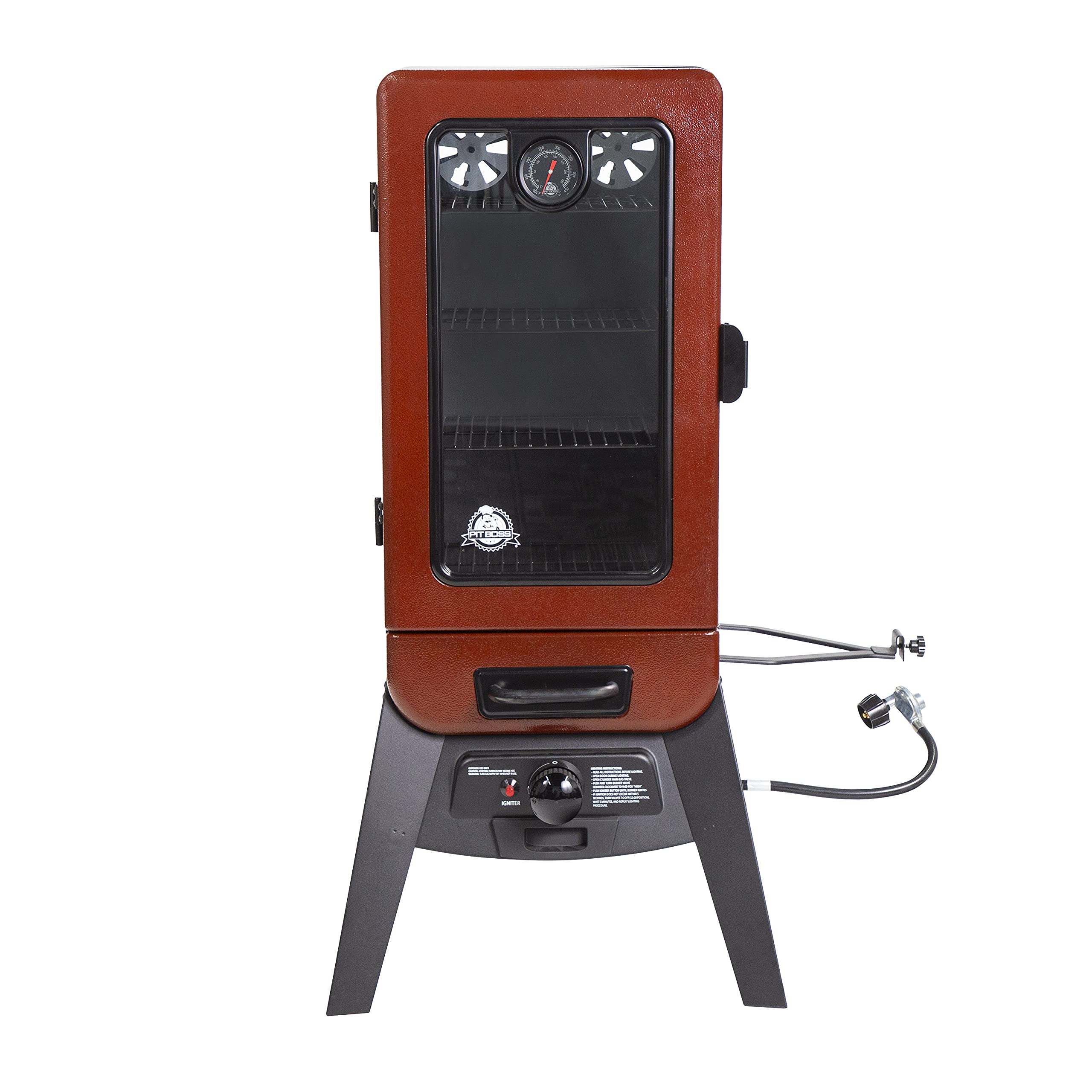
Pit Boss 3-Series
Key Features
- Weight: 63 lb
- Burners: Dual valve, 12,500 BTU
- Cooking area: 880 sq in
- Temperature range: 100°F – 320°F
- Price: Premium
One hundred degrees Fahrenheit isn’t a cooking temperature, it’s a drying temperature, and it’s the reason the Pit Boss is on this list. A dual valve and dual burner carry the cabinet from 100°F to 320°F, so at the bottom of the range you can make jerky, smoked salmon, or snack sticks without the cook running away from you. Nothing else here publishes a floor that low.
The build backs up the range. Four racks measuring 14.75 by 12.25 inches each add up to 880 square inches, the most cooking area in this group, and the red hammertone finish is the only cabinet here with any personality on the patio. Assembly is a two-hour job with instructions that actually read clearly, and at 63 pounds one person can walk it into place.
What keeps it off the top spot is control at the edges. Gaps around the door let smoke and heat escape, and in a breeze that shows up as a temperature that won’t settle where you set it. A cover and a spot out of the weather are worth the extra money here — rust at the base is how cabinets in this class end their lives, and this one is no exception.
Pros
- 100°F floor for jerky and salmon
- 880 sq in across four racks
- Dual burner for finer low-end control
- Clear instructions for a two-person build
Cons
- Door seal gaps leak smoke and heat
- Highest price in this group
Buy it if your smoking goes below 225°F — the 100°F floor is the real feature, and nothing else here matches it.
Best for First-Time Buyers
Masterbuilt MPS 230S
Key Features
- Racks: 4 chrome-coated
- Burner: 15,400 BTU stainless steel
- Weight: 66.5 lb
- Ignition: Push-button
- Price: Midrange
The flame disk bowl is the detail worth knowing about. The burner flame passes up through a porcelain-coated pan to reach the chips, while the pan itself shields the burner from the fat that drips off a pork butt. It’s a small piece of engineering, and it makes this 30-inch cabinet feel more considered than a mid-priced smoker usually does.
It’s a friendly first smoker. Four chrome racks, a 15,400 BTU stainless burner, push-button ignition, and a door-mounted gauge so you aren’t guessing. Assembly is straightforward and the whole thing weighs 66.5 pounds, which means two people set it up and one can drag it across the patio. We came away thinking this is the one to hand someone who has never run a smoker and wants to stop being nervous about it.
Two things to plan around. Chips flare in the pan rather than smolder, and a cheap cast iron skillet laid over the flame disk is the standard fix: it shields the chips, keeps them smoking, and steadies the cabinet at the same time. The other is patience at the start — the box comes up to heat quickly, so wait for the smoke to run thin and blue before the meat goes anywhere near it.
Pros
- Flame disk shields the burner from drips
- 15,400 BTU burner lights with a button
- Four chrome racks in a 30-inch cabinet
- Easy to run for a first-timer
Cons
- Lowest dial setting runs hot
- Door gauge reads optimistic
A simple, well-made cabinet for a first gas smoker, best for anyone cooking at 250°F and above who wants one dial and no drama.
Best for Small Patios
PIQUEBAR Vertical Smoker
Key Features
- Racks: 3 removable
- Weight: 55 lb
- Dimensions: 19.7 in D x 16.5 in W x 40.9 in H
- Price: Budget
The limit shows up at the bottom of the dial: this cabinet doesn’t like to hold below about 210°F. For ribs, chicken, and pork shoulder that’s irrelevant. For jerky, bacon, or a long salmon cure it’s disqualifying, and it’s why we rank this as the budget choice rather than the all-rounder. Above that line it does very well — the door shuts tight, the three racks slide out on their rails even when loaded, and the water bowl and chip tray pull free without opening the main chamber.
At 16.5 inches wide it’s the narrowest cabinet here, which matters if your patio is really a balcony, and 55 pounds makes it a two-hands carry rather than a furniture move. A weather cover comes in the box, a small thing that saves a separate purchase and keeps the cabinet out of the rain between cooks.
Flavor is where it earns its keep: ribs and chicken come off with a real smoke taste, which is most of what you’re paying for. Budget time for assembly, though — more screws than you’d expect and a door that wants two pairs of hands — and plan on a gasket kit if the door seams weep smoke, which is the usual first upgrade on a cabinet at this price.
Pros
- Chip and water trays pull out without opening the door
- Racks slide out even when loaded
- Narrow footprint for small patios
Cons
- Won’t hold below roughly 210°F
The budget pick for anyone smoking ribs and chicken at 225°F and up, and the one we point to when space is tight.
Best for Feeding a Crowd
Maison Backyards 4-Rack

Key Features
- Racks: 4 chrome-coated, adjustable
- Weight: 60 lb
- Dimensions: 18.3 in D x 23.5 in W x 42.3 in H
- Price: Budget
Four racks and a cover in the box, for less than most of the cabinets here — the Maison Backyards is aimed squarely at the cook who wants to feed a crowd without paying for temperature precision. At 23.5 inches wide it’s the second-widest cabinet in this group, and 60 pounds is manageable for two people to reposition.
It heats fast and spreads heat evenly, the kind of behavior that makes a first brisket less nerve-wracking, and assembly takes about an hour. Smoke does escape at the door seam, so a gasket is the sensible first addition if you cook in a breeze.
Where it falls down is the temperature floor. The lowest setting lands somewhere between 250°F and 300°F and the gauge doesn’t read below 275°F, so this is a 275-and-up cabinet: fine for chicken, ribs, and hot-and-fast brisket, useless for bacon or jerky. Buy it for capacity and price, and keep a probe on the grate.
Pros
- Four adjustable racks at a budget price
- Heats fast and spreads heat evenly
- Weather-resistant cover included
Cons
- Won’t hold below about 250°F
- Small wood box needs frequent refills
A roomy, budget-friendly cabinet for hot-and-fast barbecue at 275°F and above; look elsewhere for low-and-slow.
How We Tested the Gas Smokers
We started by pulling every gas smoker sold by the major outdoor retailers — roughly 30 models — and cut the list by cooking surface, footprint, burner layout, and whether the spec sheet listed real dimensions instead of "serves 6 to 8." Seven made it through, from compact two-burner boxes to wide cabinet styles with windowed doors. Each arrived flat-packed, and I assembled every one alone with a stopwatch running, noting skipped steps, mislabeled hardware, and the moment it genuinely needed a second set of hands.
Temperature control got the most attention. I clipped a separate digital probe at grate level and logged readings every 15 minutes through whole cooks, which showed how far each built-in dial drifted from reality, how fast the chamber recovered after the lid came up, and whether a windy 40-degree evening pushed it around. The steady smokers let me walk away for an hour; the twitchy ones had me standing over them with the dial.
Every unit cooked the same menu: pork butt overnight, spare ribs, whole chickens at higher heat. We judged smoke by whether chips kept going past the first hour or flamed out in one acrid burst, how the exhaust smelled, and how deep the ring ran on the meat — then by how easily the tray could be refilled mid-cook and how much ash it left behind.
Between cooks we checked weld quality, door seams, and whether lids still sat flush at month eight, and we wheeled each smoker across a patio to see how the casters and side shelves held up. Size was measured in real terms — cooking surface, footprint, headroom for a standing roast — and weighed against how many people it actually fed. Every session ended with cleanup: drip tray, water pan, grease, and the honest question of whether the thing was worth what it cost.
How to Choose a Gas Smoker
On a propane cabinet the dial is a starting point rather than a thermostat, so the two things that decide a good purchase are how low the burner will go and how well the box holds what it makes.
Find the temperature floor first
You want 225°F to 250°F for ribs, butts, and brisket, and something under 200°F for jerky, bacon, and salmon. Those are two different cabinets. The Pit Boss 3-Series publishes a 100°F floor; the Maison Backyards won’t hold below roughly 250°F, which makes it a hot-and-fast cabinet no matter how carefully you turn the dial.
Pick a smoker whose lowest setting sits at least 25°F below your target, because the dial drifts and wind pushes it around. A cabinet that only goes down to 275°F is a grill with a lid on it.
Square inches, and the racks you’ll actually use
Four racks is not twice the capacity of two. Heat rises, so the top rack of a vertical cabinet runs hotter than the bottom, and the food you care about usually ends up on the middle shelves with a pan underneath. Compare rack dimensions rather than the headline number: 880 square inches over four racks of about 15 by 12 inches feeds a party better than a wider cabinet with two big grates.
Measure the patio, too. These cabinets run from 16.5 inches wide to 27, and the narrow ones are the difference between smoking and not smoking on a balcony.
Doors, seams, and keeping the smoke in
Smoke that leaks around the door is fuel you paid for and heat you then have to chase. A split upper and lower door, as on the Dyna-Glo, lets you work the chip box and water pan without emptying the cabinet, and side dampers give you a way to correct for a cool evening without touching the dial.
At home, shut a strip of paper in the door at three points; if it slides out with no drag, plan on a gasket kit. That kit is a common first purchase in this category, and it is cheaper than a second propane tank.
Chips, water, and refuelling mid-cook
The chip pan is where cheap cabinets fight you. You want a tray or drawer you can pull without opening the main cooking chamber, which is what the PIQUEBAR’s removable bowls and the Dyna-Glo’s handled chip box give you. If chips flare instead of smoldering, a cast iron skillet set over the burner pan tames them.
Keep the water pan full. It works as a heat buffer first and a moisture source second, and a dry pan is one of the quickest ways to overshoot the temperature you were carefully holding.
Frequently Asked Questions
Can you run a propane smoker in a garage or under a porch roof?
No. Propane burners produce carbon monoxide, and a garage, tent, or screened porch holds it whether or not the door is propped open. Set the smoker outdoors on a level, non-combustible surface, with the vent side away from siding, doors, and windows.
Keep the main door shut between checks so the heat stays in the cabinet rather than under your roof.
How much propane does a long cook use?
More than a grill, less than a patio heater, and wind is the variable that decides the difference. Have a spare full tank before your first brisket so a cool evening doesn’t end the cook, and set the cabinet where a fence or wall breaks the wind.
Weigh your tank before and after one long cook to learn your own rate. That figure is worth more than any estimate.
Do you need to burn in a new gas smoker before cooking?
Yes, and it’s the step people skip. Coat the interior walls and racks lightly with cooking oil, then run the smoker empty at a high setting until the paint stops smoking and the smell turns from factory to hot metal.
Cool it, wipe the racks, and cook. Follow the manual’s own burn-in settings, and your first brisket won’t taste like the shipping crate.
Do wood chips need soaking before they go in?
Usually not. Dry chips light faster and give cleaner smoke, while a wet pile mostly steams until it dries out and then goes up all at once.
Start with a small handful in a hot pan, add more when the smoke thins, and leave the exhaust vent open. Thick white smoke means you’re oversmoking the meat, not flavoring it.
Final Verdict
Buy the Dyna-Glo DGY784BDP. It’s the cabinet that asks the least of you: a split door for chips and water, dampers you can correct with, four racks, and the broadest record of good cooking behind it of anything here. It sits mid-priced rather than cheap, which is the right place to land on a smoker you plan to keep.
If your cooking goes below 225°F — jerky, salmon, snack sticks — the Pit Boss 3-Series is the only cabinet here that promises that range, and the extra money buys the bottom of the dial rather than more metal.