This post contains affiliate links. We may earn a small commission when you buy through our links — at no extra cost to you.
An electric smoker promises the one thing charcoal and offset cookers never will: you can set a temperature and walk away. The catch is that plenty of them make convenience feel like a tradeoff, with lackluster smoke, wide temperature swings, and thin metal that struggles in a stiff breeze. A good electric smoker should erase both problems: steady heat you can trust and real wood-fired flavor without tending a fire every 20 minutes. That balance is what I went looking for when I cleared space on my patio.
Over eight months, my team and I cooked on seven electric smokers, running them through weeknight chicken, weekend ribs, and a few overnight pork butts. What separated the keepers wasn’t a spec sheet—it was how little I had to fuss, how evenly heat held, and whether the smoke tasted clean rather than acrid. Some nailed the set-and-forget promise but left food bland; others made beautiful smoke but demanded more attention than they should. The picks below got both right, whether you’re feeding four or a backyard full of neighbors.


Best for Everyday Backyard Smoking
East Oak 30-Inch Electric Smoker
Key Features
- Racks: 4 chrome-coated
- Weight: 52.3 lb
- Cooking area: 725 sq. in.
- Max temperature: 275°F
- Price: Midrange
A double-wall steel body with foam between the panels, plus a side chip loader that keeps smoking for two to three hours on one fill — those are the two details that put this cabinet at the front of this group. An electric smoker earns its keep by holding temperature while you do something else, and the East Oak is built around that idea: you feed chips from outside, the door stays shut, and the element doesn’t spend twenty minutes clawing back the heat you just let out.
There’s more room inside than the footprint suggests. Four chrome racks add up to 725 square inches — six whole chickens or two large turkeys by the listing’s count — and the cabinet is only about 17 inches wide and 15 deep, narrow enough for a small patio or the strip beside a garage door. At 52.3 pounds it’s a two-person lift out of the box; after that the wheels do the work.
The panel runs to 275°F with a 12-hour timer, comfortable territory for butts, ribs and brisket. One thing matters more than any figure on the page: the chamber runs hotter than the display, by something in the 25-to-60-degree range depending on how much cold meat just went in. Set the panel below your target and cook to a separate thermometer for the first few sessions; once you know your offset, it stops being a problem.
Cleanup is genuinely easy — racks, water bowl and chip box lift out and the grease tray slides free. There’s no app to set up and nothing to pair. What you get instead is a cabinet that smokes steadily for hours without being fussed over, which is the part that decides whether you use it on a Tuesday night or only on Labor Day.
Pros
- Double-wall insulation holds heat in wind
- Side loader gives 2-3 hours per fill
- 725 sq. in. across four chrome racks
- Wheels make a 52.3-lb cabinet movable
Cons
- Tops out at 275°F, so no high-heat roasting
- No meat probe in the box
Our pick for most backyards: the East Oak holds heat, feeds chips without opening the door, and fits 725 square inches into a patio-sized footprint.
Best for Cold-Weather Smoking
SmokinTex 1400 Pro Electric Smoker
Key Features
- Weight: 75 lb
- Food capacity: 38 lb
- Rack positions: 5
- Temperature range: 100-250°F
- Price: Premium
This is the most expensive smoker in this group, and the only one built like a commercial cabinet: stainless inside and out, 75 pounds of it, with a 700-watt element and a working range of 100°F to 250°F. You are paying for metal and sealing rather than for features, and there is no screen to program.
What the money buys is a box that barely moves. The door closes tight, the insulation holds, the exterior stays cool to the touch while it runs, and the element cycles far less than it does in a thin steel cabinet. It also sips wood — a couple of chunks carry an all-day cook because so little escapes. For anyone who smokes through the winter or cooks on an exposed deck, that steadiness is the entire argument, and it’s the thing we kept coming back to.
The catch is space. The 1400 holds 38 pounds of food across its rack positions, but it won’t swallow a full packer brisket, and the interior is compact for the money. Two locking wheels and two fixed ones make it movable, though at 75 pounds you want a level spot and a second pair of hands. It suits the cook who does fish, ribs, butts and jerky often and wants a cabinet to outlast the hobby.
Pros
- Stainless steel inside and out
- Holds temperature with almost no cycling
- Burns very little wood per cook
- Exterior stays cool while running
Cons
- 250°F ceiling rules out high-heat roasting
The premium pick: a sealed stainless cabinet that holds temperature with almost no cycling, sized for fish, ribs and butts rather than a whole packer brisket.
Best for First-Time Buyers
Charbroil Analog Electric Smoker
Key Features
- Racks: 3 chrome-plated
- Weight: 56.4 lb
- Cooking area: 544 sq. in.
- Heating element: 1200 watts
- Price: Budget
Five hundred and forty-four square inches across three chrome grates, a 1,200-watt element, an insulated chamber and a gauge set into the door — the Charbroil covers the useful parts of a cabinet smoker and leaves out the panel entirely.
The control is a numbered dial rather than one marked in degrees, which sounds like a nuisance and turns into a small ritual: find the number that puts your thermometer at 225°F, then go back to it every time. Assembly is legs onto the body, done in minutes, and the door gauge gives a rough read without opening anything. At 56.4 pounds it sits steady on a deck and is awkward for one person to carry far.
Value is where this one earns its place — it’s the budget end of this group, and you still get a full-size insulated cabinet that holds temperature and turns out proper ribs. The analog control means you adjust by hand when the weather turns, and cleanup is a three-piece job: aluminized water pan, chip tray, grease tray. What you don’t get is precision, and for the money we think that’s the right thing to give up.
Pros
- Large cooking area at the budget end
- Assembly is legs onto the body
- Holds temperature once you know its dial
Cons
- Smoke escapes around the door seams
The budget pick: a big analog cabinet that holds temperature once you learn its dial, with no electronics to fail and nothing to program.
Best for Small Patios
Royal Gourmet SE2805 Electric Smoker

Key Features
- Racks: 3 chrome-plated
- Weight: 42.1 lb
- Cooking area: 454 sq. in.
- Heating element: 1350 watts
- Price: Budget
Thirteen hundred and fifty watts is the biggest element among the analog cabinets here, and it shows in how quickly the Royal Gourmet comes up to heat. You get 454 square inches over three chrome grates, a 28-inch cabinet, an analog controller paired with a built-in thermometer, and 42.1 pounds of steel — light enough for one person to shift around a small yard or roll out of the way for a party.
It’s a good small-space cabinet and a cheap way into smoking, with one real annoyance: the chip box wants refilling about every hour, which means opening the door and giving back some of the heat you built. The analog dial is coarse enough that fine-tuning 225°F takes patience, and the built-in gauge is the only readout you get. Set beside the Charbroil it heats faster but holds a steady temperature less reliably, and that comparison is what keeps it out of our top two.
Pros
- 1350-watt element heats quickly
- 42.1 lb is easy to move alone
- Analog control with a built-in thermometer
Cons
- Chip box needs refilling about every hour
A light, inexpensive cabinet for a small yard that heats fast and turns out good ribs; the coarse dial and hourly chip refills are why it sits behind our budget pick.
Best for Higher-Heat Roasting
PIQUEBAR Digital Electric Smoker

Key Features
- Racks: 4 chrome-coated
- Meat probe: Built-in
- Cooking area: 633 sq. in.
- Temperature range: 100-350°F
- Price: Midrange
A 350°F ceiling is the headline. This is the only cabinet here that climbs past 275°F, which makes it the one to choose if you want crisp poultry skin or a roast finished at higher heat than a smoking cabinet normally allows. There’s also a built-in meat probe that beeps when the food reaches your target, and a 24-hour timer for long unattended cooks.
The rest is generous for the money: 633 square inches over four chrome racks, a side grease tray that slides out without tipping the unit, and a rain cover in the box. Assembly takes an evening, and the directions for the first cook are skimpy enough that you’ll want to season it and run it empty before trusting it with a brisket.
Our reservation is calibration. Units can run well below the number on the panel, so treat the display as a suggestion and cook to a separate thermometer for the first few sessions — which is good practice on any cabinet and close to mandatory on this one. Do that and it’s the most versatile smoker here: higher heat than the East Oak, and a probe the East Oak doesn’t include, for a little more money.
Pros
- 350°F ceiling for poultry and roasting
- Built-in meat probe with an alert
- 633 sq. in. across four racks
- Rain cover included
Cons
- Can run 50-60°F below the set temperature
- Assembly directions leave gaps
For higher-heat roasting and cooking to a probe, this is the cabinet to buy; calibrate the display before you trust it.
Best for Fish and Jerky
Smokehouse Little Chief Smoker
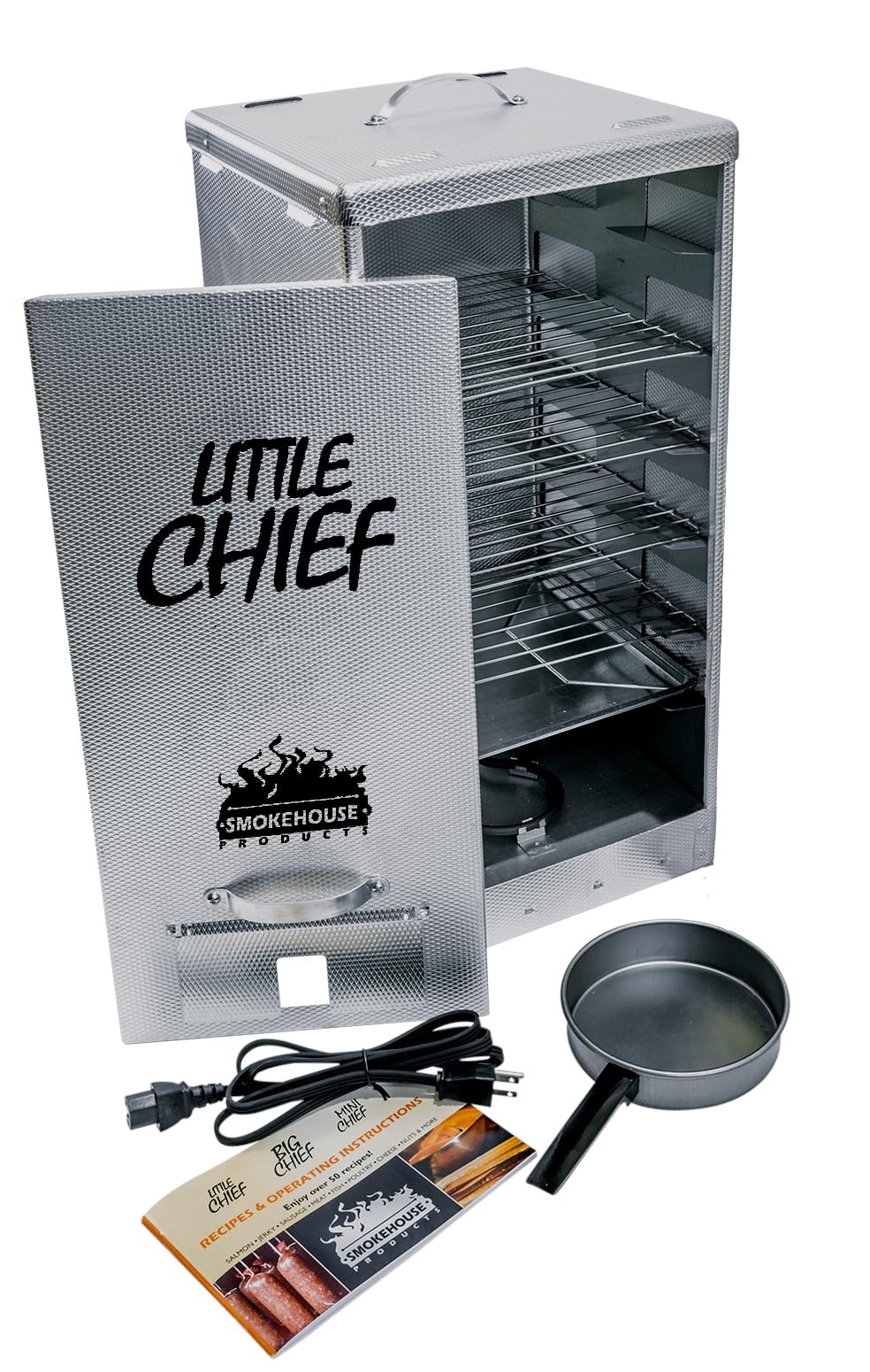
Key Features
- Weight: 12.2 lb
- Temperature: Steady 165°F
- Cabinet size: 11.5 x 11.5 x 24.5 in.
- Smoking capacity: Up to 25 lb
- Price: Budget
This one won’t cook your brisket, and that is the point. The Little Chief holds a steady 165°F, which makes it a smokehouse for fish, jerky, cheese and sausage rather than a barbecue for shoulders and ribs — and at that job we haven’t found anything in this group that’s easier to live with. Plug it in, load the pan, walk away.
At 12.2 pounds it’s a one-handed carry, and it’s small enough to live on a shelf between uses. The door loads from the front, the chip pan pulls out without opening it, and the box takes up to 25 pounds of fish at a time, which is a serious batch for a home setup. No app, no panel, no probe: one element, one pan, one vent.
The limits are real, though. It sheds heat in wind and cold, so a sheltered corner or a blanket over the box matters more here than on an insulated cabinet, and anything thick has to finish in the oven. The aluminum is thin and the edges could stand to be rolled. Given how good it is with a side of salmon, we’re happy to make that trade twice a month.
Pros
- Steady 165°F for fish and jerky
- 12.2 lb, easy to carry and store
- Chip pan pulls out without opening the door
Cons
- Loses heat in wind and cold
- Thin aluminum with unfinished edges
The one to buy for salmon, jerky and cheese: a steady 165°F smokehouse that asks for almost nothing, provided something else cooks dinner.
How We Tested Electric Smokers in Real Backyard Conditions
We started by pulling together the electric smokers that kept surfacing in owner reviews and retail best-seller lists, then filtered for digital temperature control, an accessible chip or chunk tray, a usable cooking footprint, and parts that owners said held up over multiple seasons. I also ruled out anything whose controller or door seal had a pattern of early failures, and anything so wide or heavy that it would be a nuisance on a normal patio. That left seven models, which we tested for eight months.
Those seven smokers moved onto my patio and into a rotation of real meals: weeknight chicken thighs, weekend racks of ribs, salmon fillets, and overnight pork butts, including a few cooks on a windy 45-degree evening. I timed assembly and first-fire startup, loaded chips exactly as each maker instructed, and noted whether the smoke settled into a thin blue wisp or poured out thick and white. We clamped calibrated probes at grate level and logged temperatures through long cooks, watching for swings and how quickly each unit recovered after I opened the door to spritz or check bark.
Ease of use showed up in the small stuff: whether the chip tray was reachable without yanking hot racks, whether the water pan was easy to refill, and how much scrubbing the drip tray needed the next morning. To judge heat retention, I compared how hard the element worked to hold temperature as the evening cooled. Durability got checked after every cook—door seals, welds, rust at seams, warping on racks—and at the end we compared build quality and features against what each smoker cost. The finalists all turned out moist chicken and ribs with clean smoke flavor, but the best ones made the whole process feel almost boring, which is exactly what I want from an electric smoker.
How to Choose an Electric Smoker
The thermostat decides almost everything: a smoker that holds the temperature you set turns barbecue into a background task, and one that swings turns a brisket into a babysitting job.
Start with the thermostat, not the feature list
Digital or analog matters less than whether the cabinet settles at the temperature you asked for. Both kinds of controller cycle the element on and off; a digital panel lets you type in a number, while a dial makes you find one and remember it. Across the cabinets here, a gap of 25 to 60 degrees between what the panel says and what the chamber actually reads is ordinary, and it isn’t automatically a reason to walk away — a steady offset you can set around is much easier to live with than a display that is accurate at 225°F and guesses at 275°F.
So test the one you buy. Put an inexpensive oven thermometer on a middle rack, run the smoker empty for an hour at 250°F, and write down what the thermometer says. If the number repeats, you have your setting; if it wanders, you have a cabinet that needs watching.
Cooking area is not one number
Listings add up every rack, so a four-rack cabinet always looks roomier than a three-rack one. What actually matters is the gap between racks and the shape of what you cook. A 30-inch cabinet with four racks takes two large turkeys or half a dozen chickens; a 28-inch model with three is a family-of-four machine for ribs, wings and a couple of butts.
Two practical notes. Racks come out for a standing roast or a beer-can chicken, so count the height you gain, not just the square inches. And the top rack runs cooler than the bottom on most cabinets, which is why the thing you want finished last goes up there.
Smoke is a separate system from heat
A cabinet can hold 225°F perfectly and still make no smoke, because heat and smoke come from different places. The chip tray has to sit close enough to the element to char the wood, and it has to be seated where the maker intended — a tray that has shifted an inch will blacken chips without ever lighting them.
The loader design decides your afternoon. A side loader buys two or three hours between fills and keeps the door shut; a tray you reach by opening the door means feeding it hourly and losing heat every time. Judge it by what leaves the vent: thin and blue is right, thick and white means the wood is smoldering badly.
Insulation decides your season
Double walls with foam between them hold temperature in wind and cold; a single-wall steel box recovers, but the element runs far more and the cook takes longer. Weight is the other side of the same coin — a 75-pound stainless cabinet is a permanent fixture, while a 42-pound one you can shift alone.
It’s an outdoor appliance either way: clear of siding, deck rails and anything combustible overhead, on a grounded outlet you can keep dry. If it lives outside, buy the cover.
Build quality is where cheap cabinets show their age
The problems that turn up on inexpensive cabinets are rarely dramatic. Paint bubbles around the door and frame after a few hot cooks, hinges work loose, and the electronics quit somewhere in the second season — none of which shows up in the first month, which is exactly why the warranty terms are worth reading before you order and why the cover matters.
Stainless interiors and a door that seals properly cost more and last longer. If you’re buying a first smoker to find out whether you’ll stick with it, buy the inexpensive one and expect to replace it; if you already cook every weekend, spend once.
Frequently Asked Questions
Electric, pellet or propane — which should I buy?
Electric if you want to load chips, set a temperature and walk away: there’s no fuel to haul and nothing to relight. Pellet grills give more smoke character and reach higher heat, but they need a hopper of pellets and more attention. Propane is faster but adds a tank to manage, and it’s harder to hold a low temperature precisely.
For butts, ribs and poultry at home, where repeatability matters more than fire management, buy electric.
Do I need to soak wood chips before smoking?
No. Dry chips light faster and give cleaner smoke, and soaking mostly steams the wood before it ever chars. Load a small handful at a time and add more when the smoke thins to a faint blue wisp.
If your tray is the kind you reach by opening the door, keep the loads small so the chamber recovers quickly.
How long does a pork butt take at 225°F?
Plan on roughly 1.5 hours per pound at 225°F, so an 8-pound shoulder is a 12-hour cook, and expect it to stall somewhere between 150°F and 165°F for an hour or more. Start early rather than turning up the heat, wrap it through the stall if you want to save time, and pull it at 200°F to 205°F.
A cabinet that holds temperature makes that timeline predictable instead of hopeful.
Final Verdict
The East Oak is the one we point most people to. It holds temperature, feeds chips from outside the cabinet, and gives you room for two turkeys without taking over a patio — which is the whole job of an electric smoker. Go a tier up only if the smoker lives outside through the cold months: the SmokinTex’s sealed stainless cabinet keeps its temperature where thin steel starts cycling.
And if your list is salmon, jerky and cheese rather than shoulders and ribs, buy the Little Chief, give it a sheltered corner, and let the oven handle dinner.