This post contains affiliate links. We may earn a small commission when you buy through our links — at no extra cost to you.
A brisket that stalls at 165°F at two in the morning is no time to discover your thermometer dropped its signal. I’ve sat up with enough overnight cooks to know the thing most likely to ruin dinner isn’t the smoker — it’s the gadget telling you when to pull the meat. A good wireless thermometer buys you a night’s sleep: an accurate read from inside the house, an alarm that actually reaches you, and a graph that shows the stall is normal.
Over the past eight months, my team and I put 12 units through brisket, pork butt, weeknight chicken thighs, and one stressful Thanksgiving turkey. Nobody tells a first-time buyer this: the meat probe is usually the honest one, while the ambient reading on most wireless models drifts, so check it against a dial you trust before blaming yourself for a dry cook. Ease of use, app polish, probe count, and battery life sorted out the rest — the picks below held their numbers and their connection when it mattered.



Best for Low-And-Slow Smoking
TempPro TempSync Plus TP829
Key Features
- Probes: 4, corded
- App required: No
- Wireless range: 1000 ft RF
- Max temperature: 572 °F
- Price: Budget
Most cable-free probes here fight the same physics problem: a radio has to escape a steel cooking chamber, cross a patio, and get through a wall to reach you. TempPro dodges it by keeping the probes on cables and moving the long hop to a dedicated radio link, 1000 feet of RF between the transmitter by the smoker and a receiver on the kitchen counter. That is the single reason it is our top pick. No app, no account, no pairing to redo at five in the morning.
Four probes is what turns this from a steak gadget into a smoking tool. Clip one to the grate to watch pit temperature, put one in the brisket, and you still have two for a pork butt or a pan of beans. The receiver shows all four, current and target, on a backlit screen, and the ten USDA presets are a shortcut rather than a cage, since you can set any target you like.
Accuracy is the part that needs a little help from you. Agreement between four probes is not something to take on faith, so run each one through ice water and a rolling boil before a long cook and note which reads furthest off. That probe goes on the grate, not in the brisket. The probes also prefer a wipe to a soak, so keep the ends out of the sink.
What you accept in return is a different kind of fiddling. Four cables have to be routed out of the lid or through the vent gasket, they collect grease, and they are the parts that eventually need replacing. If cables are the dealbreaker, the ThermoMaven WT02 Lite below is the cable-free answer, and it asks more money for two probes instead of four.
Pros
- Radio range that reaches into the house
- Four probes for pit and meat together
- No app, account, or pairing
- Costs less than the cable-free picks
Cons
- Four cables to route and wipe down
- Receiver runs on its own AAA batteries
This is the one we hand people first: radio that reaches the kitchen, four probes, and nothing to pair at five in the morning.
Best for Remote Monitoring
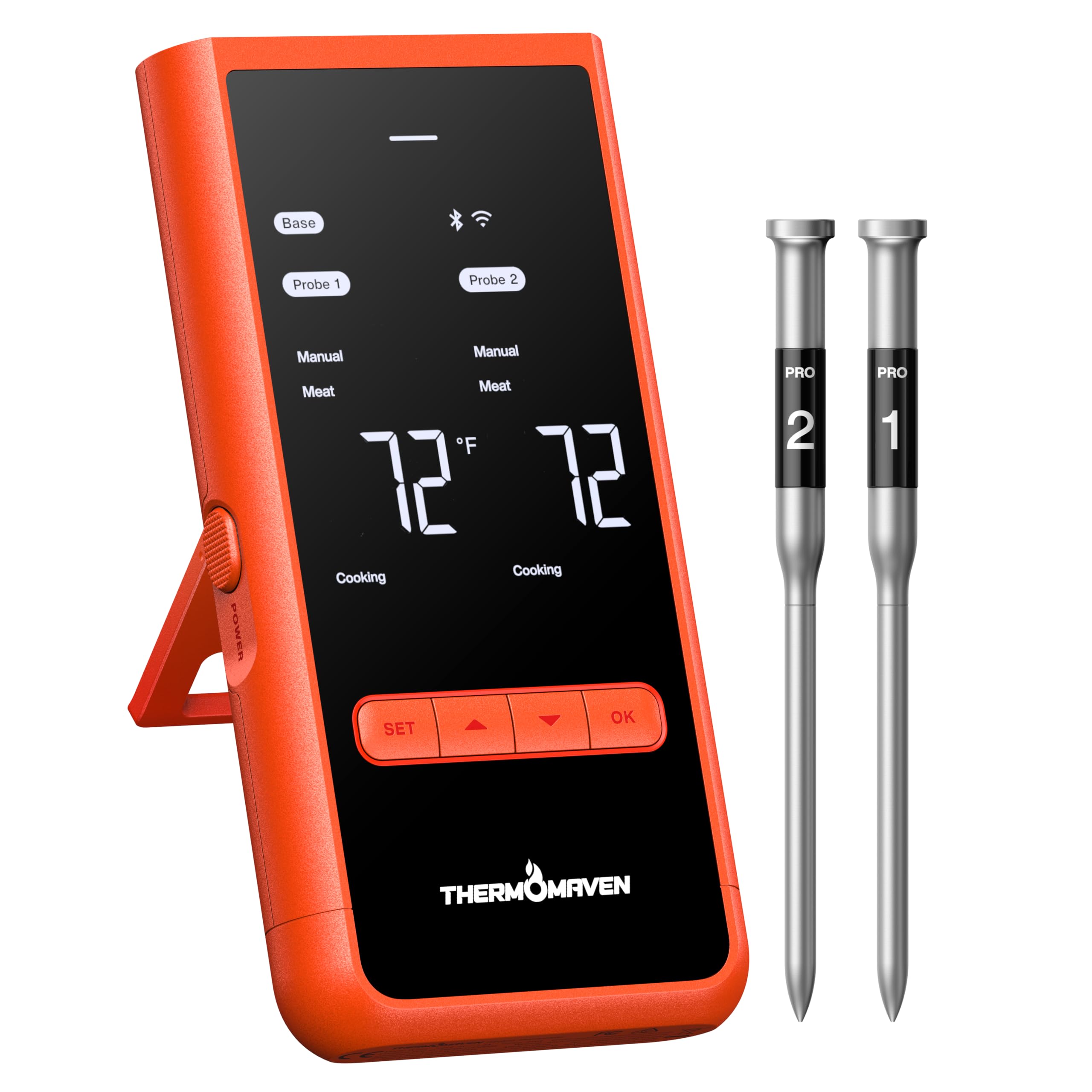
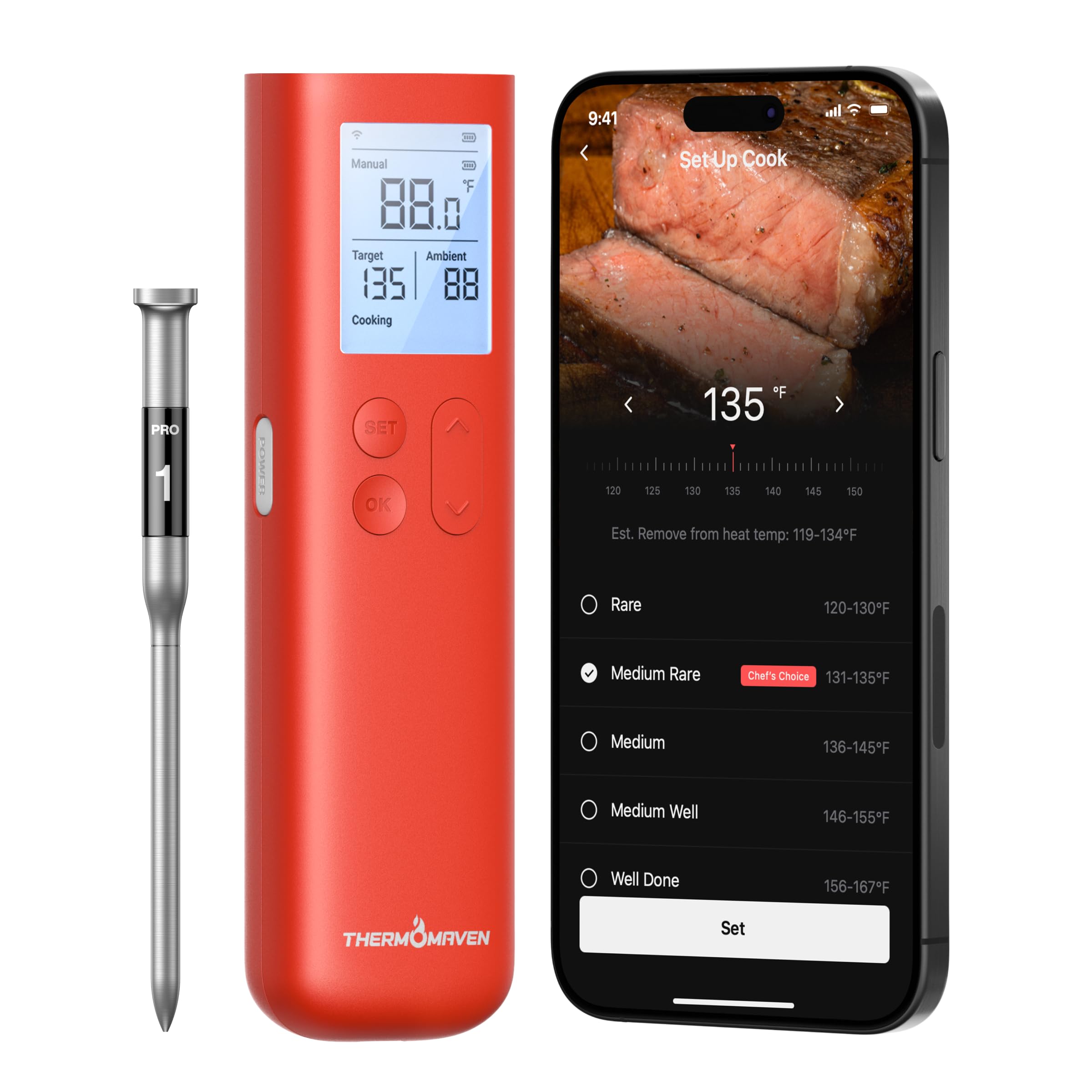
ThermoMaven WT02 Lite
Key Features
- Probes: 2, cable-free
- Display: Base plus app
- Range to base: 1000 ft
- Max temperature: 752 °F
- Price: Midrange
The thing the WT02 Lite does that most of this group cannot is leave the property. The base sits by the smoker, talks to two cable-free probes over a 1000-foot link, and joins your home WiFi so the readings reach your phone at the hardware store. That is a different kind of remote monitoring from Bluetooth in your pocket, and it is worth the extra money if you have ever driven home early to check a stall.
We got more use out of the base than out of the app, which is exactly how a cooking thermometer should work. It sets targets, shows both probes at once, and alarms on its own, so the phone is optional rather than required. Two probes is the honest ceiling, though: a brisket and a pork butt at the same time is fine, a smoker loaded with four cuts is not.
The probes are the thin sort that leave a small hole, with six sensors apiece and an ambient side rated to 752 °F, so a hot finish or a flare-up does not end the cook. The weak point on every cable-free probe we have handled is the collar where steel meets electronics, and that is the end to treat gently when you ease one out of a shoulder.
What it will not tell you is the temperature at the far end of the grate, which is where a hot spot quietly ruins the burnt ends. If that matters more to you than range, one of the four-probe picks below covers it.
Pros
- Two probes with no cables at all
- WiFi bridge reaches you anywhere with signal
- Base reads and alarms without the phone
- 752 °F ambient rating
Cons
- Only two probes for a packed smoker
We recommend this one when the cook has to follow you out of the house: two cable-free probes, a base you can read without a phone, and WiFi carrying the numbers anywhere.
Best for Budget Cooks
ThermoMaven G1
Key Features
- Probes: 1, cable-free
- Warranty: 18 months
- Range to base: 3000 ft Sub-1G
- Max temperature: 752 °F
- Price: Budget
The cheapest route into a genuinely wireless probe is not a stripped-out toy. The G1’s probe carries five internal sensors plus an ambient one, shrugs off 752 °F on the outside, and is IPX8 rated, so a rinse under the tap after a pork shoulder is fine. The base talks to it over Sub-1G at a claimed 3000 feet, and that base has its own screen, which means the cook does not depend on a phone at all.
Sub-1G is the quiet hero of this whole category. Bluetooth wilts when a steel lid closes; this band pushes through the wall of a house, and in a yard with a shed between you and the smoker that matters more than any app feature. One probe is the catch. It reports the meat and the air around it, but only at one spot, so a hot end of the grate stays invisible to you.
The probe is the part to look after. Wireless probes fail at the joint where the metal meets the electronics, and pulling one straight out of a hot shoulder is how that happens rather than the sensor giving up. An 18-month warranty is a real cushion here, and registering the unit on day one is the five minutes that makes it useful.
Buy it as a first wireless thermometer, or as the second one that lives in the camper and comes out at a friend’s house, because losing it stings less than losing a four-probe kit. For one cut at a time, which is most of us on a Tuesday, it does the whole job.
Pros
- Cheapest cable-free probe here
- 3000-foot Sub-1G link
- 752 °F rating and IPX8 probe
- 18-month warranty
Cons
- One probe covers one spot
We call this the budget pick because it is the least expensive cable-free probe here and still gives you a display base, a 3000-foot Sub-1G link, and an 18-month warranty.
Best for Four-Probe Cooks
InkGrill 4-Probe Wireless
Key Features
- Probes: 4, cable-free
- Display: App only
- Runtime: 25 hours
- Max temperature: 572 °F
- Price: Premium
A full smoker is a scheduling problem. Brisket at one end, pork butt at the other, a rack of ribs that has to come off two hours earlier. Four independently marked probes with two sensors apiece is the most direct answer to that in this group, because each one reports both the meat and the air around it, so you can watch two cuts and both ends of the grate without moving anything.
Three connection modes sound like marketing until you are standing in a driveway with a stubborn phone. Bluetooth for the backyard, WiFi when the readings need to reach the shops, and a local mode for when the network is the problem rather than the solution. The probes are dishwasher safe, which is a small thing right up until the fifth brisket.
Where it gives ground is the interface. There is no base with a screen, just four probes, a charging cable, and an app, so every glance at temperature goes through your phone and a flat battery means you are cooking blind. For a four-hour rib cook that is fine. For an overnight brisket, plug the phone in and leave it on the nightstand.
Charging is quick, with a 25-minute top-up covering a full day of cooking, and the probes are rated to 572 °F, which is plenty inside a smoker but not for finishing a steak directly over coals. The 28 USDA presets are a decent starting map if you have not memorized pull temperatures yet.
Pros
- Four wireless probes for a packed smoker
- Each probe reads meat and pit
- Dishwasher-safe probes
- 25 hours on a charge
Cons
- No screen without your phone
We recommend this one when the smoker is loaded with different cuts: four wireless probes, each reading meat and pit at once, with an app running the whole cook.
Best for Overnight Cooks
ROUUO M02-M1
Key Features
- Probes: 2, cable-free
- WiFi range: 360 ft
- Base runtime: 150+ hours
- Max temperature: 572 °F
- Price: Midrange
Two in the morning is the real test of a smoker thermometer. The brisket is in, the stall is hours away, and nobody wants to be squinting at a phone that is down to nine percent. The ROUUO’s repeater base is rated for 150 hours on a charge, with 15 minutes of charging buying another 12 hours of cooking. That is headroom for the cook, the wrap, and the cleanup the next day.
We appreciate the ceramic heads for a different reason. A flare-up in a charcoal smoker is a sudden, local burst of heat, and a probe rated to 572 °F has margin for it where a plastic-collared probe does not. That is a more useful kind of toughness than a bigger number printed on a spec sheet, and it is why this is our pick for cooks that run past midnight.
Two probes cover two cuts, each reporting the meat and the air around it, and the LCD repeater shows both without waking a phone. The limits are worth knowing: the probes are hand-wash only, and the 360-foot WiFi figure is modest for a big yard, fine for a house and a driveway but not for running errands across town.
It is the least flashy piece of kit on this page, and for a long cook that is a compliment. Nothing here lights up, nothing needs an account, and a probe that survives a grease fire is worth more than one that graphs beautifully.
Pros
- Base rated for 150+ hours
- 15-minute charge buys 12 hours
- Ceramic heads rated to 572 °F
- Two probes for two cuts
Cons
- Hand-wash probes only
- 360 ft WiFi reach is modest for a big yard
For an overnight cook we reach for this one: a base rated for 150 hours, ceramic-headed probes with margin for flare-ups, and a 15-minute charge that buys 12 hours.
Best for Tight Budgets
Govee Bluetooth H5055

Key Features
- Probes: Corded, not wireless
- Battery life: 200 hours
- Wireless range: 230 ft Bluetooth
- Max temperature: 572 °F
- Price: Budget
The Govee is not a wireless probe, and it does not pretend to be one at the business end. Probes on 40-inch steel cables run from the lid to a base with a magnet, a fold-out stand, and a hook, and the wireless part is the Bluetooth hop from that base to your phone. That reads like a downgrade, and for a rotisserie it is, but the cable is also why it costs so little and why there is no charging ritual before a cook.
For low-and-slow work in the 225 to 275 °F range, the arrangement is fine. The probes are rated to 572 °F, the base runs on two AA cells for something like 200 hours, and the app carries USDA presets for anyone still learning pull temperatures. We have used it as the thermometer that lives in the drawer and comes out for a weeknight chicken, which is a different job from a fourteen-hour brisket.
Two things to know before you buy. Accuracy is quoted at ±1.8 °F under 302 °F, which covers smoking but not a hot oven roast, and the plastic where the cable meets the probe is the part that suffers if you finish over direct heat. Keep the probe ends away from the coals and this is a lot of thermometer for very little money, and owning one alongside a better smoker unit is not an either-or.
Pros
- Cheapest thermometer on this list
- 200-hour battery life on two AA
- Magnet, stand, and hook
- USDA presets in the app
Cons
- Probes are corded, not wireless
- Accuracy claim stops at 302 °F
We keep this on the list as the cheapest way in, and it is a fair one if you stay under 300 °F and do not mind two cables running out of the lid.
How We Tested a Dozen Wireless Meat Thermometers
We started by pulling every wireless model we could find that had at least two probes and a real ambient sensor, then cut anything with a reputation for dropped connections or an app that hadn’t been updated in years. That left brands you’ll recognize and a few you won’t. Twelve made the final cut, from single-probe sticks to four-probe kits with a base station, and we kept price in view the whole way — a four-probe kit priced like a two-probe one is only a bargain if the extra probes still read true.
Accuracy came first. Each probe went into the same pork butt or brisket beside a calibrated instant-read, and we logged both numbers at the stall, at the finish, and again in an ice bath before the first cook. We also set every unit’s pit reading against a trusted dial on the smoker lid, because a thermometer that nails the meat and lies about the chamber will still cost you a cook.
Then came the parts that decide whether you sleep. I carried each unit to the far end of the yard and into a back bedroom to find where the signal quit, and left them paired overnight to watch the battery fall from a full charge. In each app we timed pairing, counted the taps it took to set a high-temp alarm, and checked whether the graph was legible at 3 a.m. Durability was tested by attrition: probes stayed in the smoker across dozens of cooks, got coiled into drawers, and were rinsed while still hot. We noted which cables stiffened, which seals loosened, and which probes drifted a few degrees after a month of that abuse.
How to Choose a Smoker Thermometer That Stays Connected
Every thermometer here is really an answer to one question: how do you get a number out of a steel box full of hot air and into the room where you are sitting?
Start with the radio, not the app
Bluetooth is the cheapest way to connect and the first to give up. The signal has to leave a closed steel lid, cross a patio, and pass through a wall, and a 165-foot rating assumes open air between two devices that can see each other. The trap is buying on that number and discovering the real reach is the length of your deck.
If your phone stays in the kitchen, choose a unit with its own radio link between the cooker and a base, or one whose base joins your home WiFi. The distance that matters is smoker to display, not display to pocket.
Decide how many probes you actually need
A brisket and a pork butt on the same cook want two meat probes, and a probe on the grate tells you what the smoker is doing rather than what the meat is doing, which is the difference between catching a runaway fire and finding out at the end. Four probes covers two cuts and two ends of the grate; two is enough for one cut and one spot.
Truly wireless probes carry an ambient sensor in the same body, so each one reports both meat and pit temperature at its own position. A single probe still only knows about one place in the cooker.
Heat ratings and the part that fails first
Smoking lives between 225 and 275 °F, so almost anything survives it. The ceiling matters for searing, for a kamado running hot, and for the flare-up that turns a probe housing soft, so look for 572 °F at minimum and 752 °F if you finish over coals.
What fails is almost never the sensor. It is the joint where the metal meets the electronics, or the cable on a corded probe, so ease a probe out of the meat instead of yanking it. Check that replacement probes are sold before you buy: a four-probe kit with no spares is a two-year thermometer.
Choose a base you can read at 3 a.m.
A phone is a wonderful display until it is flat, asleep, or in another room. A base with its own screen and its own alarm lets you set a target and walk away, and it keeps working when the WiFi drops, which is why the top two picks here both have one. If you want to leave the house entirely, look for a base that joins your home network.
Then check the power. A long cook outlasts a small battery, and cells you can swap at midnight are worth more than a charging cable you forgot.
Frequently Asked Questions
Do I still need an instant-read thermometer if I buy one of these?
They do different jobs, and the best setups carry both. A leave-in probe watches the whole cook and tells you when to wrap and when to pull; an instant-read confirms doneness at the end and checks a second cut in ten seconds.
If you are buying one thermometer for a smoker, buy the leave-in first. It is the one that changes how a long cook goes.
What does one of these cost to keep running?
Batteries and probes, in that order. Rechargeable bases and probes need a charge before a long cook; units that run on AAA or AA cells cost little over a season and can be swapped mid-cook.
Probes are the real consumable, because they take the heat, the grease, and the yanking. Check that replacements are sold separately and priced sensibly before you commit to a kit with four of them.
Can I leave a wireless thermometer out in the rain or overnight cold?
Overnight is the easy part, which is what the runtime figures are for. Weather is where you need to be careful: the probes on several of these are rated for immersion, but the base is electronics with a screen, so treat it as something that wants shelter.
Set it in a lidded box or under a side table, and bring it in when the cook is done.
Final Verdict
Start with the TempPro TempSync Plus. Radio range is the whole game when the smoker is outdoors and you are not, four probes let you watch the pit and two cuts at once, and there is no app to log into at midnight.
If you want the readings to follow you off the property, pay for the ThermoMaven WT02 Lite and its WiFi base. If four cable-free probes are the requirement, look at the InkGrill. The right answer is the one whose radio reaches the rooms you actually sit in.