This post contains affiliate links. We may earn a small commission when you buy through our links — at no extra cost to you.
A wireless grill thermometer is supposed to buy you the freedom to walk away from the smoker. The catch is that plenty of them technically let you — the signal quits at the far end of the yard, the app drops the cook mid-brisket, or the probe reads twenty degrees off. What you’re really buying is confidence that the number on your phone is the truth.
The thing nobody tells a first-time buyer: the ambient reading matters as much as the meat number, because a pit swinging 50 degrees will dry out a brisket no matter how good the probe is. My team and I have spent the past eight months cooking with 12 wireless thermometers, and the differences showed up fast — some paired in under a minute, others needed the manual twice. Accuracy and battery life did most of the sorting; value came down to probe count and what a replacement probe costs, and the picks below earned their spots on all of it.



Best for Smoking and Grilling
TempPro TempSync Plus TP829
Key Features
- Probes: 4, color-coded
- App required: No
- Connectivity: RF, up to 1000 ft
- Max temperature: 572 °F
- Price: Midrange
The TempSync Plus is built on an old idea that still beats Bluetooth out by the grill: a radio link that has nothing to do with your phone. The probes plug into a base unit, the base transmits to a battery-powered receiver you can carry into the house, and that is the whole system — no app, no account, no pairing ritual before a cook. We have started enough long cooks by prodding a sleeping phone back to life to appreciate a thermometer that just switches on.
Four probes is what earns it the top spot. The plugs are color-coded, the backlit receiver shows current and target for all four at once, and ten USDA presets with doneness levels mean you can set a brisket and a chicken thigh without opening a manual. The range claim is 1000 feet; the practical version is that we left the receiver on the kitchen counter through a long smoke and never walked back outside to read a number. Between the probe count, the no-phone design, and a midrange price, it is the best value in this group.
Two things to accept. The probes are tethered to the base by cables, so the meat is not truly free — you can close a lid over one if you route it carefully, but a rotisserie is out. And accuracy is where to hedge: readings can drift enough to matter, so check the probe you will use most in an ice bath and note the offset before a long cook. Two minutes of that is the difference between slicing a brisket and apologizing for one. The listed ceiling is 572°F, fine for a smoker or a covered grill, and the probes are wipe-clean only.
Pros
- Four color-coded probes for a full smoker
- RF remote needs no app or account
- Backlit screen shows all four readings
- Ten USDA presets with doneness levels
Cons
- Probes are wired to the base unit
- Probes are wipe-clean only
For most people cooking on a grill or smoker, this is the one to buy: four probes, a remote that works without a phone, and a price that undercuts the cable-free options.
Best for Phone-Free Cooks
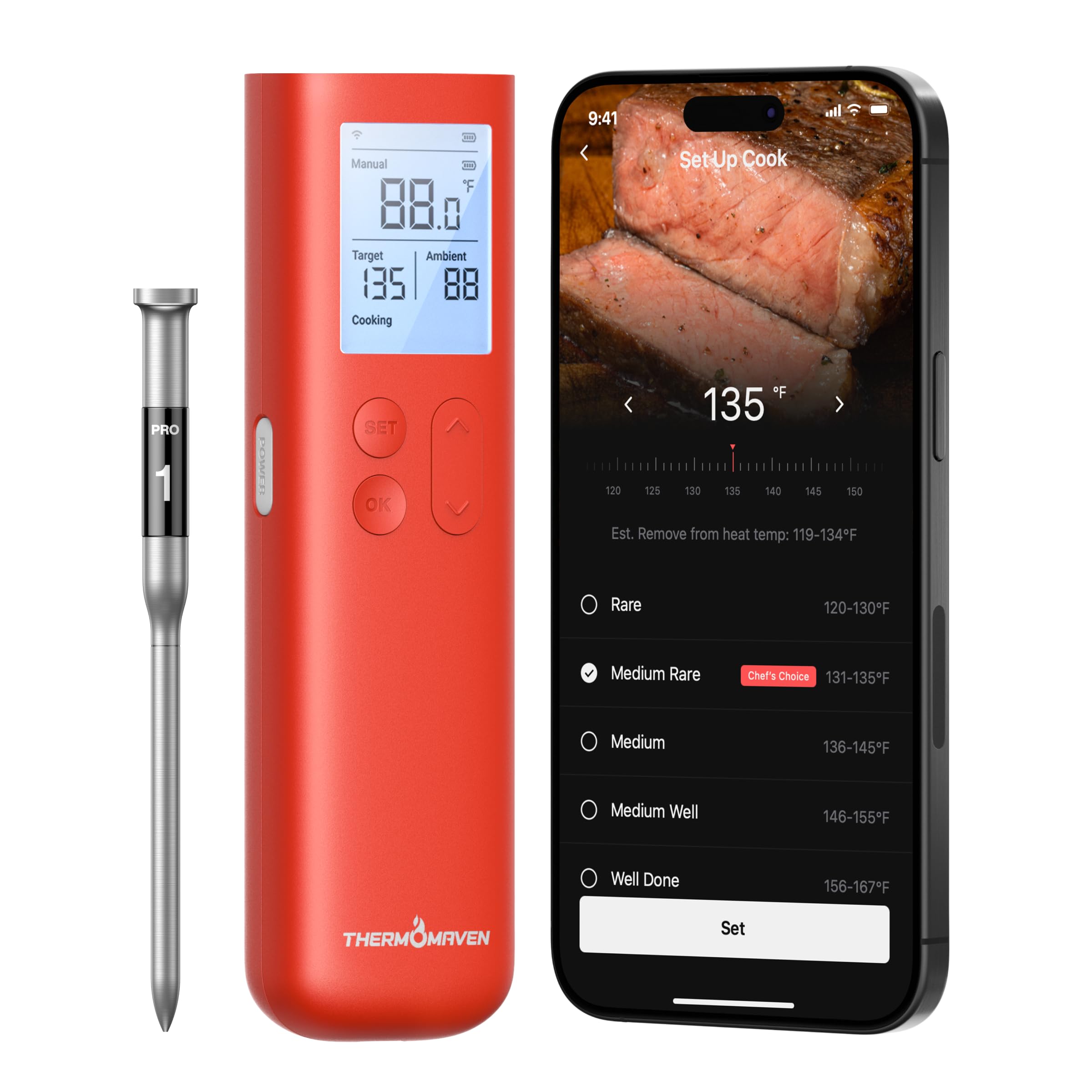
ThermoMaven X2
Key Features
- Probes: 2, fully wireless
- Accuracy: NIST ±0.5 °F
- Max ambient: 752 °F
- Connectivity: Sub-1G, up to 3000 ft
- Price: Midrange
Two probes, a small base with real buttons, and no phone anywhere in the picture: that is the X2, and it is the one we hand to people who say they do not want another app. Setup is insert, set a target on the base, walk away. After a few cooks we stopped thinking about it, which is the nicest thing you can say about a cooking gadget.
The hardware is more serious than the plain looks suggest. Each probe carries six sensors, NIST-certified accuracy of ±0.5°F, and a fresh reading every half second, and the Sub-1G radio is rated to 3000 feet unobstructed — far more than the walk from the deck to the living room. The probes are IPX8 and rated to 752°F ambient, so a covered grill at full heat is inside their comfort zone, and they are dishwasher-rated, which is rarer in this group than it should be.
What you give up is the app: no cook graph, no finish-time estimate, no alert on your wrist. The base is the interface, and it goes where you go. Two probes also means two targets, so a four-rack smoker is not its job. The probes themselves deserve a little care — let one cool before you pull it out of a roast, and pull straight rather than levering it sideways.
Pros
- Standalone base with no app or account
- Two fully wireless probes, no cable at the meat
- NIST-certified ±0.5 °F accuracy
- IPX8 probes rated to 752 °F ambient
Cons
- Two probes cover two targets only
- Alerts live on the base, not your phone
If you want a wireless thermometer that never asks you to open an app, this is the one: two cable-free probes and a base that simply works.
Best for Rotisserie and Roasts
ThermoMaven G1
Key Features
- Probes: 1, fully wireless
- Accuracy: NIST ±0.5 °F
- Connectivity: Sub-1G, up to 3000 ft
- Max internal: 221 °F
- Price: Budget
Rotisserie is the test that separates a genuinely cable-free probe from everything else. A wired probe cannot spin with the bird, and on a closed kettle or a ceramic cooker the cable is one more thing pinched under a hot lid. The G1’s probe sits entirely inside the meat with nothing trailing out, and the base reads it from across the yard.
Six sensors, five of them internal, NIST-certified to ±0.5°F, and a reading every half second: the specifications match the expensive stuff. Sub-1G carries the signal up to 3000 feet unobstructed, the probe is IPX8, and it is rated to 752°F ambient. The app is the part that surprised us. It estimates a finish time from the rate the meat is climbing, which is far more useful than a bare number when you are deciding whether to wrap the brisket or leave it alone.
At the budget end of the cable-free group, this is the one to buy when one target is all you need. Two limits matter. The probe is rated to 221°F internally, which covers every meat doneness and rules out candy and frying oil. And the probe is the wear item: the seam and the charging contact are where a probe fails first, so charge it the night before a long cook instead of trusting a partial bar, and count the 18-month warranty as part of what you are buying. For a rotisserie chicken or a Sunday roast, neither limit gets in the way.
Pros
- Cable-free probe works on a rotisserie
- App predicts finish time as the meat climbs
- 752 °F ambient rating and IPX8 probe
- Budget price within the cable-free group
Cons
- One probe means one target at a time
- Probe stops at 221 °F internally
The budget way into a genuinely cable-free probe: one probe, app alerts, and enough accuracy for a Sunday roast, as long as one target is all you need.
Best for Four-Protein Cooks
CHEF iQ Sense
Key Features
- Probes: 4, ultra-thin
- Runtime: Up to 50 hours
- Connectivity: WiFi, unlimited range
- Max temperature: 1000 °F
- Price: Premium
Four probes, and thin ones. The Sense’s probes are slim enough that the holes they leave in a prime rib close up on their own, and having four means two racks plus a brisket plus a chicken can all be tracked at once instead of moving one probe from cut to cut. It is the most capable set here, and it is priced like it.
The rest of the sheet backs that up. The probes are rated to 1000°F, so a broiler or a screaming-hot grill does not worry them, and the hub runs up to 50 hours on a charge — enough for an overnight brisket with margin. Each probe pairs four internal sensors with an ambient one, so pit temperature comes free instead of costing you a probe, and the app adds flip reminders, rest timers, and an estimated finish. The three-year warranty is the longest in this group.
The radio is what keeps it off the top of this list. The link between hub and phone was the least settled of the group in our testing — reliable with the hub beside the grill and the phone in a pocket, less so with a wall in between — and the ambient sensor can read low against a clip-on pit probe. Cook in the oven or on a covered grill with the hub within a few feet and neither matters much.
Pros
- Four ultra-thin probes for big cooks
- Probes rated to 1000 °F
- Up to 50 hours per charge
- Three-year warranty
Cons
- Ambient sensor can read low
Four ultra-thin probes rated to 1000°F and a battery that runs all day — the pick for big multi-protein cooks, provided the hub stays close to your phone.
Best for Two-Cut Grilling
JoyBear FM200

Key Features
- Probes: 2, fully wireless
- Runtime: Up to 30 hours
- Accuracy: NIST ±0.5 °F
- Connectivity: Bluetooth
- Price: Midrange
The base is the whole argument for this one: a large, bright display with actual buttons, so you can set targets, read both probes, and adjust alerts without unlocking anything. We have set targets on it with wet hands and never once wished we were in an app. The app exists and mirrors the same cook when you want it, but nothing about the job requires it.
Two ultra-thin probes, six sensors, NIST-certified ±0.5°F accuracy, and half-second updates put it on par with the cable-free picks on paper. The probes are IP67 and dishwasher safe, the base runs on a single AAA with a claimed 30 hours of runtime, and presets cover beef, poultry, seafood, and more, with room to save your own targets — handy if you cook the same two things every weekend.
The limitation is the radio. Bluetooth only, no RF and no WiFi, so the moment you walk inside the link is between your phone and a probe out in the yard. In a backyard it is fine and it is the simplest setup here; for monitoring from the far end of the house, one of the Sub-1G or WiFi picks serves you better. Two probes is also the ceiling, which is the real reason to look elsewhere if you run a packed smoker.
Pros
- Large base runs without a phone
- Two probes at NIST ±0.5 °F
- IP67 probes are dishwasher safe
- Up to 30 hours of runtime
Cons
- Bluetooth only, so range depends on your phone
A big, readable base you can control without a phone, plus an app when you want one — a good fit for two cuts on a backyard grill.
Best for Mixed Grills
InkGrill 4-Probe

Key Features
- Probes: 4, two sensors each
- Runtime: Up to 25 hours
- Max ambient: 572 °F
- Connectivity: Bluetooth, WiFi, local mode
- Price: Premium
Three connection modes is unusual and genuinely useful: Bluetooth for the backyard, WiFi for when you head inside, and a local mode that keeps probe and phone talking directly when the network is being difficult. We set ours up over WiFi and then used Bluetooth all afternoon, which is the honest version of how these modes get used — but the fallback is there the one evening the router drops mid-brisket.
The probes are the interesting part. There are four, and each carries two sensors — one for the meat, one for the air around it — so watching pit temperature does not cost you a probe. Twenty-eight USDA presets, dishwasher-safe probes, and a 25-minute charge rated for 25 hours of cooking cover the practical side. It is the four-probe system we point to when the CHEF iQ’s price feels steep: you give up the 1000°F ceiling and the 50-hour battery and keep the probe count, the app, and the connection options.
Two boundaries are worth knowing. The food sensor is rated 14–212°F, exactly right for meat and useless for candy or frying oil, and the 572°F ambient ceiling is a step below the 752°F of the ThermoMavens. For a mixed grill where four probes matter more than a lid-down sear, it earns its place.
Pros
- Three connection modes, including local
- Four probes with two sensors each
- 25 hours of cooking from a 25-minute charge
Cons
- Food sensor tops out at 212 °F
- Ambient ceiling below the cable-free picks
Four two-sensor probes and three ways to connect, including a local mode for when the network misbehaves — a strong premium alternative to the CHEF iQ.
How We Tested the Best Wireless Grill Thermometers
We started by pulling together every wireless thermometer we could find that sold replacement probes and could run at least two of them, then narrowed by price and by what owners actually complained about in reviews. Twelve made the cut, from single-probe units to four-probe kits, and we lived with each one for the full eight months rather than a single cook.
Testing ran from the first warm weekend in May through a string of cold-weather cooks in December: overnight briskets and pork shoulders on an offset smoker, weeknight chicken thighs on a gas grill, and a few high-heat sears that push a probe as hard as anything. For accuracy, we compared each probe against an instant-read thermometer at three points during a cook and against a pot of boiling water before it ever touched meat, then noted how quickly the number climbed and whether it settled or kept drifting.
Connectivity got tested on foot — I carried the receiver or phone to the back fence, into the house with the door shut, and down the driveway, marking where the signal dropped and whether it reconnected on its own. Battery life meant a 14-hour overnight cook on a fresh charge plus a deliberately started low-battery cook to see how early the warning came. For durability, we coiled and uncoiled cables, dropped units onto concrete, and washed probes repeatedly to see whether water crept into the junction and skewed readings.
Ease of use came last and mattered most: we timed setup from unboxing to first reading and handed each unit to someone who had never used one. Value was judged on probe count and the cost of a replacement probe, not the sticker price alone.
How to Choose a Wireless Grill Thermometer
The word wireless hides the decision that matters most: whether the probe in the meat still has a cable attached to it, and which radio is carrying the number back to you.
Wired probe, wireless remote, or no cable at all
Listings use wireless for two different systems. In the first, the probes have cables running to a transmitter base and only the receiver is wireless — the TempPro works this way. In the second, the probe itself transmits and nothing trails out of the meat. Cable-free probes are what you need for rotisserie, a tight ceramic lid, or a frying basket. Wired probes cost less per probe, never need charging, and put four readings in front of you for less money. Long, low, covered cooks are where wired probes still win on value.
Match the radio to your house, not the box
Advertised range is a line-of-sight number. Walls, foil, a closed metal lid, and a phone that goes to sleep all cut into it, so the radio matters more than the figure. RF and Sub-1G systems (TempPro, ThermoMaven) do not involve your phone at all and hold through a wall better than Bluetooth. WiFi carries the app anywhere the internet goes but adds a network to set up. Bluetooth is the simplest and the shortest. Watch from the couch and you want RF, Sub-1G, or WiFi; stay outside with the grill and Bluetooth is enough.
Count the probes, then count again
One probe per cut is the rule. Two probes handle a pair of steaks or a chicken and a pork loin; four let you run two racks plus two cuts without moving anything. If pit temperature matters, check where it comes from: the CHEF iQ, ThermoMaven G1, and InkGrill probes each pair internal sensors with an ambient one, while on a two-probe kit you may end up clipping a probe to the grate instead of using it on meat. Four sounds like more than you need until the first Thanksgiving.
Decide where the display lives
This is an app question in disguise. An app gives you graphs, finish-time estimates, and alerts anywhere, which is genuinely useful on a fourteen-hour brisket. A base with a screen gives you none of that, but it works without an account, without WiFi, and without a phone charging in the other room. Our preference is a base you can carry with the app as a bonus, which is what the ThermoMaven X2, the JoyBear, and the ThermoMaven G1 offer. App-only systems save hardware and cost you a fallback.
Heat ratings, cleaning, and probe life
Two temperature limits get confused. The internal limit is what the tip survives inside the food — 212°F on the InkGrill, 221°F on the ThermoMaven G1, effectively a non-issue on the CHEF iQ’s 1000°F probes — which is fine for meat and no good for candy or frying. The ambient limit is the heat around the probe: 572°F covers a smoker and most covered grills, 752°F covers a hot grill with the lid down. Cleaning retires more probes than heat does, so look for dishwasher-safe probes and check that replacement probes are sold for the model.
Frequently Asked Questions
Is a wireless thermometer worth it if I already own an instant-read?
They answer different questions. An instant-read tells you the temperature right now, which is all a burger or a steak you are standing over needs. A leave-in probe tells you when to act without opening the lid, which is what a brisket, a pork shoulder, or a whole chicken actually requires. Keep both: use the leave-in for the cook and the instant-read to confirm before you slice.
What happens if a probe runs out of battery mid-cook?
Charge the probes the night before a long cook and keep a spare set of AAA batteries for the base, and the question mostly stops coming up. If one does die, write down the last reading you saw so you know how far the cook had come, then finish with an instant-read at the thickest part.
Can I leave the probe in the meat while it rests?
Yes, and it is worth doing. Carryover cooking continues after the meat leaves the heat, so leave the probe in and watch the number climb on the counter. Pulling a large roast 5 to 10°F below your target is the usual way to land on it after the rest, and the probe tells you whether that worked.
Final Verdict
Buy the TempPro TempSync Plus TP829 if you want one system for a smoker or a big grill and you would rather not involve your phone: four probes, a receiver you can carry indoors, and the best value in this group.
If the cable at the meat is the thing you are escaping — rotisserie, a tight ceramic lid — the ThermoMaven X2 gives you two cable-free probes and a base that never asks for an account, and the G1 does the same job with one probe for less. For four thin probes and an all-day battery, the CHEF iQ Sense is the premium answer, provided the hub sits close to your phone.