This post contains affiliate links. We may earn a small commission when you buy through our links — at no extra cost to you.
A pressure cooker that locks itself shut and starts hissing is a small appliance with a temper, and I mean that fondly. My first steam release had me standing on the far side of the kitchen. What won me over was the clock: dried beans tender in under an hour, stock that tastes like it simmered all day, and rice, yogurt, and a sautéed base from one pot that leaves almost nothing in the sink.
Twelve machines have cycled through my kitchen over eight months — six- and eight-quart models, several with app controls. The presets get all the attention on the box, and they mattered least. What separated the good ones was how evenly they sautéed, how fast they climbed to pressure, whether the sealing ring held onto last night’s chili, and how much cabinet the thing ate. Most cost less than a Dutch oven and replace three appliances, so value is rarely the sticking point.
The picks below are the ones I’d hand a first-timer and the ones I still reached for after the notes were filed.
Best for Everyday Cooking
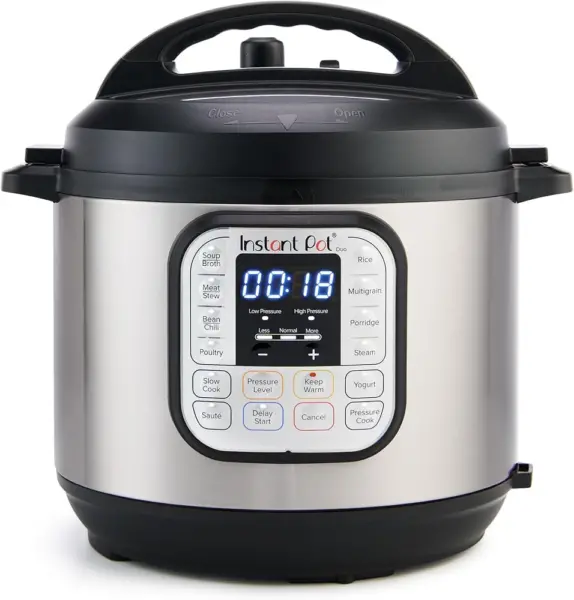
Instant Pot Duo 6 Qt
Key Features
- Wattage: 1000 watts
- Capacity: 6 quarts
- Cooking functions: 7-in-1
- One-touch programs: 13
- Price: Budget
Nobody needs a pressure cooker that talks to the internet. What nearly everyone needs is a pot that gets rice, beans, stock, and a whole chicken right, and that is the case the Duo makes: seven functions and 13 one-touch programs covering pressure cooking, slow cooking, rice, yogurt, steaming, sautéing, and warming. It is the one we point a first-time buyer toward, and the one whose buttons line up with the recipes most people pull up online.
Six quarts suits most kitchens — three to six servings, a whole chicken, a batch of chili with leftovers — and at 12.2 by 13.4 by 12.5 inches it is the shortest body here, which matters when the lid has to swing open under an upper cabinet. We will take that over a bigger pot that has to live in the pantry. The stainless inner pot is the other reason it stays our default: there is no coating to chip, and you can deglaze a fond with wine the way you deglaze on the range.
The lid, inner pot, and accessories all go in the dishwasher, which is what turns this from a weekend appliance into a Tuesday one. Bare stainless does not release a sticky glaze on its own, so rice and oatmeal get a short soak; it is no more scrubbing than the same dish leaves behind in a skillet.
One thing to know going in: most of these cookers run for years, but not all of them. Some quit inside the first twelve months, which is what the one-year warranty is for, and that is half the coverage the Cosori carries.
Pros
- 13 one-touch programs cover the everyday staples
- Stainless pot with no coating to chip
- Lid, inner pot, and accessories are dishwasher-safe
- Shortest body here at 12.5 inches tall
Cons
- Heavier than the Cosori and Duo Plus at 14.6 pounds
- No sous vide or air-frying functions
Our pick for most kitchens: six quarts, 13 one-touch programs, a stainless pot that goes in the dishwasher, and the shortest body here.
Best for Easy Cleanup
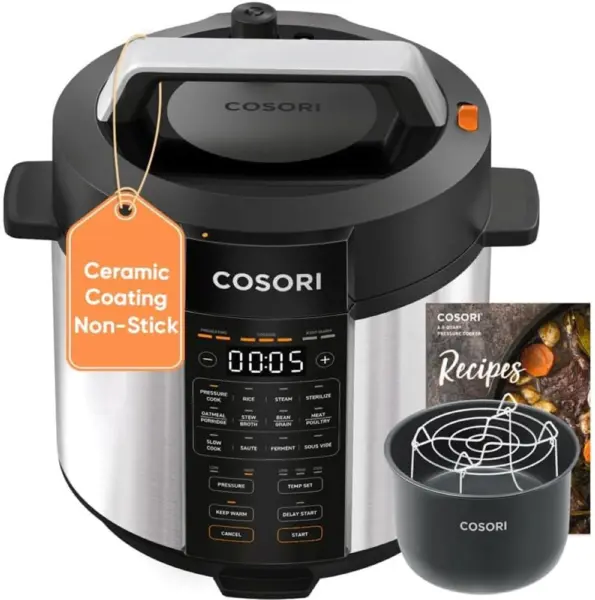
Cosori 9-in-1 6 Qt
Key Features
- Wattage: 1100 watts
- Capacity: 6 quarts
- Inner pot: Ceramic coating
- Cooking functions: 9-in-1
- Price: Budget
The reason to choose the Cosori over the Duo is the inner pot. It is ceramic-coated rather than bare stainless, so rice lifts out in one piece, oatmeal does not weld itself to the bottom, and cleanup is a rinse instead of a soak. On the starches that glue themselves to steel, that is the difference between a two-minute job and a ten-minute one.
Around that pot sits a well-sorted machine: nine functions including sous vide and a ferment setting for dough, 12 safety features, and 1,100 watts — a little more power than the Duo’s 1,000. We also like where the vent controls sit. The seal-and-vent button is set apart from the steam valve, and the release is angled 30 degrees back, so your hand stays out of the plume.
Two years of warranty is the longest coverage in this group, and at 11.9 pounds it is the lightest of the 6-quart models here, easy to move between shelf and counter. The coating is the part that needs care: metal utensils and scouring pads dull it, so keep a silicone spatula in the drawer and wash the pot by hand when you can.
On paper this beats the Duo — more power, more functions, longer coverage. The ceramic liner is what keeps it second for us. Coatings age and stainless does not, and the Duo’s pot has a much longer service record behind it. If you make rice, porridge, or yogurt several times a week and hate soaking, that trade is worth making.
Pros
- Ceramic pot releases rice and porridge in a rinse
- Two-year warranty, the longest of these picks
- Lightest 6-quart model here at 11.9 pounds
- Vent button set away from the steam valve
Cons
- Units can arrive dented; inspect on delivery
Buy this one if cleanup is what stops you from using a pressure cooker — the ceramic pot rinses clean and the warranty runs two years.
Best for Sous Vide Upgrade
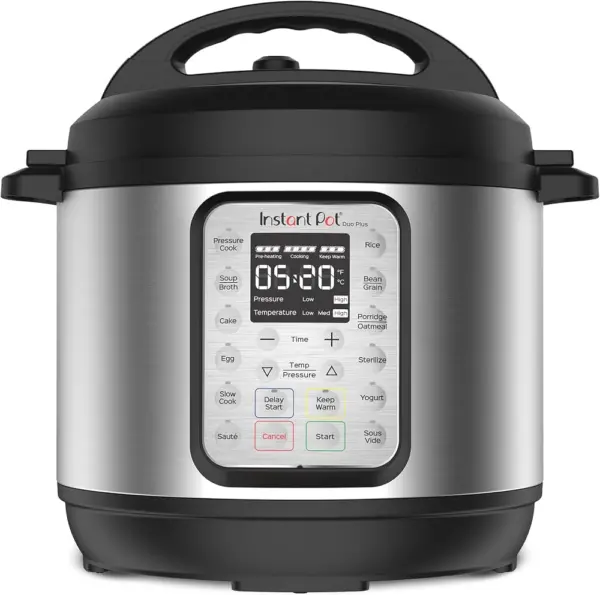
Instant Pot Duo Plus 6 Qt
Key Features
- Capacity: 6 quarts
- Inner pot: 18/8 stainless, tri-ply base
- Cooking functions: 9-in-1
- One-touch programs: 15
Two additions separate the Duo Plus from the Duo: sous vide, and a steam release on a dedicated switch that Instant Pot calls Easy-Release. The switch is the one we noticed every time we vented a pot. Release is the part of pressure cooking people flinch at, and putting it on a button you press from arm’s length is a small design decision with a real payoff.
The pot is a step up as well: 18/8 stainless with an anti-spin, tri-ply base, so it stays put while you stir onions instead of rotating under the spoon. Fifteen one-touch programs cover pressure cooking, slow cooking, sauté, sous vide, steam, sterilize, rice, yogurt, and keep warm, and the display keeps time, temperature, and pressure in view while it runs.
What you are paying for here is handling, not better food — the beans coming out of this pot and out of the Duo are the same beans. Buy it if sous vide is a function you will use, or if you vent a pot most nights and want the switch; otherwise the Duo does the same cooking for less.
Pros
- Steam release on a dedicated switch
- Tri-ply 18/8 pot that will not spin while you stir
- Sous vide built in alongside 15 programs
- Display shows time, temperature, and pressure live
Cons
- Durability is a real question; units can fail within months
Worth the step up from the Duo if you will use sous vide or vent a pot most nights; the switch and the stable pot make it the nicer one to handle.
Best for Large Households
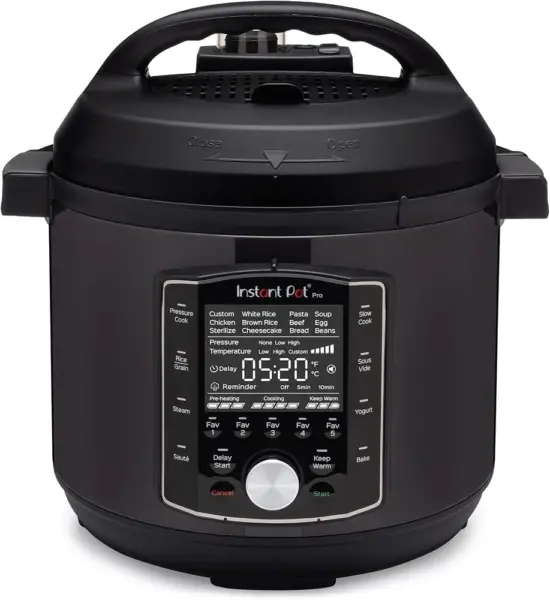
Instant Pot Pro 8 Qt
Key Features
- Wattage: 1400 watts
- Capacity: 8 quarts
- Cooking functions: 10-in-1
- One-touch programs: 28
- Price: Midrange
Eight quarts changes the kind of cooking you do. The Pro holds eight servings, a pork shoulder, or three one-quart mason jars standing upright for canning and yogurt — a batch that fills the fridge for a week. It also takes 14.4 by 13.9 inches of counter and stands 14.2 inches tall, so measure the gap under your cabinets before you buy: the lid comes off and needs somewhere to go.
The size comes with the power to match. At 1,400 watts it is the second-most powerful pick here, and that headroom matters because a full 8-quart pot has more food and liquid to bring up to pressure. Twenty-eight one-touch programs is the largest set in this guide, and the release runs through a diffusing cover that spreads the plume instead of firing it straight at the cabinet above.
The caveat is in the trim and the shell rather than the cooking: plastic parts can crack and the body can dent, and the condensation collector is a piece to keep an eye on. That is the trade for a pot this capable. For a family that pressure cooks two or three times a week, the capacity and the wattage still carry it; for a household of two, it is more pot than the job needs.
Pros
- 8 quarts holds a pork shoulder or three quart jars
- 1,400 watts, second only to the Duo Crisp here
- 28 one-touch programs, the largest set here
- Diffusing cover spreads the steam release
Cons
- 15.8 pounds is a two-handed lift when full
The 8-quart pick for households that cook in batches — 28 programs and 1,400 watts, provided you have the cabinet clearance and the counter.
Best for Air Frying Too
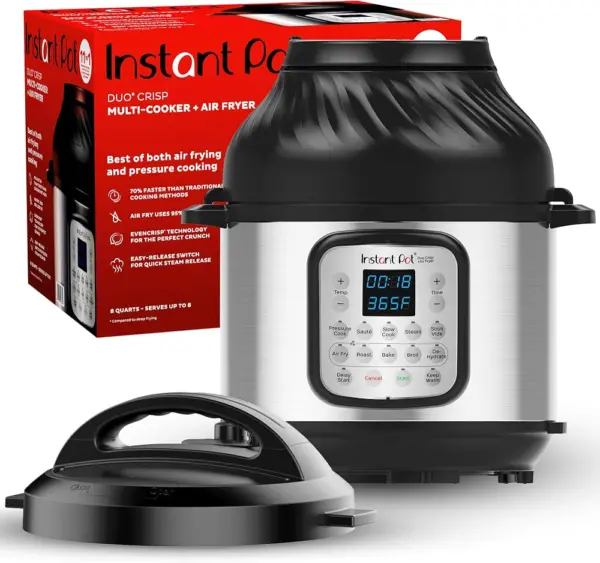
Instant Pot Duo Crisp 8 Qt
Key Features
- Wattage: 1500 watts
- Capacity: 8 quarts
- Cooking functions: 11-in-1
- One-touch programs: 11
- Price: Premium
Two lids and 22.2 pounds: the Duo Crisp is the appliance you make room for, not the one you tuck away. One lid pressure cooks, the other turns the same base into a convection oven, so a pot of beans and a tray of crisp chickpeas come out of one machine. That is the whole case for it, and it is a good one if you were going to buy an air fryer anyway.
The air frying is not an afterthought. EvenCrisp is the name Instant Pot gives the airflow, the temperature runs from 70 to 450 degrees Fahrenheit, and the basket sits over the same 8-quart base. The limit is size: the fryer basket is much smaller than the pressure pot, and it looks it when you are cooking for four.
The arithmetic decides it. If a countertop air fryer was on your list this year, this replaces it and a pressure cooker at once, and the pressure side is as capable as the Pro 8’s — 11 one-touch programs, 1,500 watts, the same 8 quarts. If air frying is not a weekly habit, the bulk is the price of a function you will not use, and the Pro 8 does the pressure half with less to lift.
Pros
- Air fryer and pressure cooker in one base
- 1,500 watts, the most powerful pick here
- Air fry range runs 70 to 450 degrees
- Full 8-quart pressure capacity
Cons
- Fryer basket coating can chip
- 15.3-inch height crowds upper cabinets
One machine instead of two if air frying is on your list; clear the counter first and be ready for 22 pounds.
Best for App-Guided Cooking
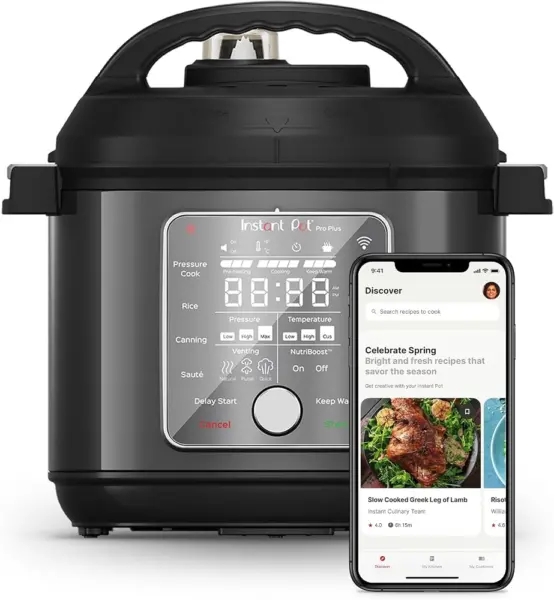
Instant Pot Pro Plus 6 Qt
Key Features
- Wattage: 1200 watts
- Capacity: 6 quarts
- Connectivity: Wi-Fi with app
- Cooking functions: 10-in-1
- Price: Premium
The Pro Plus is the most expensive pot here and the only one that connects to your phone. Paired with the Instant Connect app it offers step-by-step guided recipes — 2,000 of them, the largest library in this group — and lets you watch progress, change settings, and release steam without standing over the pot. It also cans, which none of the other picks do, and NutriBoost pulses the pot as it cooks to stir rice and risotto for you.
The money shows up in the hardware too: 1,200 watts, a WhisperQuiet release that is quieter than a bare valve, and the same 10 functions as the Pro in a 6-quart body. At 15.5 pounds it is the heaviest 6-quart model here, and it takes about 13 inches square of counter.
Our hesitation is the price against the record. This costs more than the Duo Crisp, an 8-quart machine with an air fryer built in, and it cooks the same food as the Pro in a smaller body. The guided cooking is more useful than it sounds and the canning program is genuinely rare in this group, but as a first pressure cooker it is hard to justify. It is the pick for someone who cooks from an app, cans, or works in a kitchen where a quiet release matters.
Pros
- 2,000 guided recipes in the app
- Canning program no other pick here offers
- WhisperQuiet steam release runs quieter
- NutriBoost pulses to stir rice and risotto
Cons
- Electronics can fail inside the first year
The specialist’s pick: app-guided cooking, canning, and a quiet release, at a price that only makes sense if you will use them.
How We Tested Instant Pots, From Beans to Yogurt
We started with every model we could find from the brands that dominate this category, then narrowed by capacity, wattage, price, and whether replacement parts were easy to get. Twelve made the cut, all bought at retail rather than sent as samples, and each one spent eight months on a real counter where dinner happens between 6 and 7 on weeknights and big batches get cooked on Sunday.
Every pot ran the same four jobs: unsoaked black beans, chicken stock, long-grain rice, and a braise that begins with diced onions on the sauté setting. Starting from cold, we clocked the climb to pressure, the cook time, and the natural release, then tasted for doneness instead of trusting the preset. The sauté step was the most revealing — whether onions browned evenly or only in one hot spot, and whether anything caught at the bottom before the lid went on.
Around those tests we did the smaller things: measuring counter footprint with the lid locked and checking clearance under the cabinets, then filling each to its max line to see how much usable capacity six or eight quarts really gives a family of four. Sealing rings got smeared with tomato sauce and curry, left overnight, then washed and smelled the next morning, since that is the complaint people arrive with two months in. Inner pots and lids went through the dishwasher repeatedly while we watched for coating wear and warping; yogurt ran overnight and got checked at breakfast; app controls got worked in a dim kitchen with wet hands to see whether a phone added anything to pressing a button.
At the end of eight months we reran the bean test on each pot to see whether come-up times had drifted and whether the valves still sealed cleanly.
How to Choose an Instant Pot
The right pot comes down to three things: how many people you feed, what you want it to replace, and how much counter and cabinet space you can give it.
Size It to Your Table
Six quarts is the sweet spot for three to six servings, a whole chicken, or a pot of beans with leftovers, and it is the size most people actually cook in. Eight quarts buys eight servings, a pork shoulder, or three one-quart jars standing upright for canning and yogurt — the batch-cooking size — but it is also a 14-inch-tall appliance that weighs several pounds more before you fill it.
Our rule is simple: if you already cook for five or fill the freezer on Sundays, the capacity pays for itself. If you cook for two, a 6-quart pot is the one that will look full.
Match the Inner Pot to the Food You Cook Most
Stainless is the durable choice: no coating to chip, safe with metal utensils, happy on a hot sauté. What it does not do is release sticky food on its own, so rice, oatmeal, and yogurt can mean a soak. Ceramic nonstick, like the liner in the Cosori, turns those into a rinse — with the trade that the coating dulls under metal utensils and abrasive pads.
Sear meat most nights and you want stainless. Make rice or porridge most weeks and the ceramic pot earns its keep.
Count Only the Functions You’ll Use Twice a Week
Every multi-cooker here pressure cooks, slow cooks, steams, sauté, and warms — that is the baseline, and the function count in a model name is mostly arithmetic. The extras that change what you can put on the table are sous vide, air frying, canning, and yogurt.
Air frying is the one that costs the most in weight and space: the Duo Crisp runs roughly ten pounds heavier than the 6-quart models. Buy that version only if a separate air fryer was already on your list.
Plan the Vent, the Lid, and the Space Above
A pressure cooker needs more room than its footprint suggests. The lid comes off and needs somewhere to sit, and the release sends a column of hot vapor upward — straight into an upper cabinet if you have slid the pot under one.
Look for a release you can work without leaning into the plume: the Cosori angles its vent backward, the Pro 8 spreads it through a diffusing cover, and the Pro Plus runs quieter than either. Whatever you buy, leave the vent side clear.
Expect the Clock to Run Longer Than the Recipe
Pressure time is not total time. The pot has to come up to pressure before the countdown starts and release it afterward, and a full 8-quart pot takes longer to get there than a 6-quart one with the same food.
That is the honest trade against a slow cooker: a fraction of the hours, not a fraction of the minutes the recipe suggests. Build the difference into weeknights, and use a natural release for shredded meats so they stay moist.
Frequently Asked Questions
Can an Instant Pot replace my slow cooker?
For most braises and beans, yes. Every pick here has a slow-cook program, and the results are close enough that a second appliance is hard to justify on that function alone.
What you give up is shape: a slow cooker’s wide crock lets you lift a whole roast out in one piece, while a pressure pot is taller and narrower. If you use a slow cooker weekly, keep it; if it lives in a cabinet, this replaces it.
Do I need to buy a cookbook or extra accessories?
Not a cookbook. The Duo and Duo Plus pair with an app carrying more than 800 recipes, the Pro Plus app carries 2,000 with step-by-step guidance, and the Cosori ships with a printed recipe book and a steam rack.
The one accessory worth adding is a steamer rack if your model does not include one, since it is what lets you cook eggs, potatoes, and vegetables above the liquid.
How long should one last, and what does the warranty cover?
The Duo and Pro Plus specify one year of coverage; Cosori backs its pot for two, the longest here. Those terms matter because the failures that show up are electronic — a heat sensor, a control panel, a valve — rather than the stainless pot.
Register the unit and keep the receipt. Coverage runs from the purchase date, not the day you finally unbox it.
Can you cook from frozen in one?
Yes, and it is the strongest weeknight argument for the appliance. Frozen chicken thighs, a roast, or a block of ground meat goes in with the liquid, and the pressure does the thawing as it cooks.
Add time to the recipe rather than turning up the heat, keep liquid at or above the recipe’s level so the pot can build pressure, and cut large pieces into chunks so the center is not still cold when the outside is done.
Final Verdict
For most kitchens the Duo is the one to buy: six quarts, 13 programs, a stainless pot that shrugs off metal utensils, and the shortest body here, so it genuinely clears the upper cabinets. It will not air fry or talk to your phone, and that is the point — everything it does, it does without a learning curve.
Move up to the Pro 8 if you cook for more than six or batch-cook every week; the two extra quarts and 1,400 watts carry a bigger household. And if a countertop air fryer was already on your list, put that money into the Duo Crisp instead of buying two machines — just measure the counter and the cabinet gap first.