This post contains affiliate links. We may earn a small commission when you buy through our links — at no extra cost to you.
The pitch for a stand mixer is usually cake, but the real test is a stiff dough, a lean sourdough that fights back for ten minutes straight. That’s where weaker motors bog down, bowls creep across the counter, and dough climbs the hook instead of getting kneaded. My team and I spent nine months with eight mixers built for exactly that grind, and the gap between good and merely fine was wider than I expected. What you’re buying is a machine that kneads without complaint and still feels good to live with.
Feel matters more than the spec sheet admits: how easily the head tilts, whether the bowl locks with one hand, whether the beater really reaches the last of the flour. And because these live on the counter rather than in a cupboard, finish and color count too. Here’s what first-time buyers rarely hear: wattage is the least useful number on the box, and the shape of the dough hook says more about bread than any motor spec. Below are the ones worth your counter space, sorted by what each does best.


Best for Serious Bread Baking
ZACME 8.4QT Commercial
Key Features
- Motor: 800 watts
- Warranty: 2 years
- Max dough: 3 kg/6.6 lbs/105.8 oz
- Bowl capacity: 8.4 quarts
- Price: Midrange
The figure that decided this for us is 3 kg, or 6.6 pounds, of dough in a single batch — roughly four good-sized sourdough loaves before you split anything. Only the NutriMill and the seven-quart KitchenAid claim more. ZACME backs it with an 800-watt motor, 11 speeds, an 8.4-quart bowl, and construction that meets NSF/ANSI 8-2023, the standard commercial kitchens buy against. Our pick, without much hesitation.
Bread spends most of its life in a mixer on the slow speeds, so the noise figure that matters is the low one. ZACME lists ≤48 dBA in first gear and ≤68 dBA at the top, and on a long knead that difference is the reason you can keep working in the same room. The countdown timer stops the motor when it hits zero, which we came to lean on more than expected: you can weigh out the next batch while the first one finishes. A light inside the bowl sounds like a gimmick until you’re checking a dough at six in the morning.
The hardware is commercial rather than dainty. The bowl has handles, the feet are suction cups, and 33 pounds is what keeps the whole thing planted when the hook is working through a stiff mix. That weight is also the catch, because this is a two-hand lift if it lives in a cupboard. The two-year warranty is decent rather than generous for the price.
Buy it if bread is the reason you’re shopping. If you want one machine that also runs a pasta roller, a meat grinder, and an ice cream bowl, the KitchenAid attachment system is the more travelled road, and we say so below. ZACME’s case is narrower and stronger: it kneads like a machine built for the job, and it does it quietly.
Pros
- 6.6-pound dough capacity handles four loaves at once
- Quiet drive at bread-making speeds
- Timer stops the mixer so you can walk away
- Commercial-standard build and 2-year warranty
Cons
- Needs deep counter space to clear the bowl
- Two years of cover at a midrange-to-premium price
If you bake bread most weeks, this is the machine we point you to: a 6.6-pound dough ceiling, an 800-watt motor, and quiet running you can stand next to.
Best for All-Round Home Baking
KitchenAid Artisan 5-Qt
Key Features
- Motor: 325 watts
- Speeds: 10
- Weight: 24.3 lb
- Bowl capacity: 5 quarts
- Price: Premium
Set the Artisan next to our top pick and it gives up dough capacity and quiet to gain everything else: a tilt head that opens the whole bowl to a spatula, ten speeds, and a socket on the front that takes more than ten optional attachments, from a pasta roller to a meat grinder. For a lot of kitchens that trade is the right one, and it is the machine most people are picturing when they decide to buy a stand mixer at all.
Five quarts and 325 watts is the middle of the KitchenAid range, and it’s honest about what it is. A standard two-loaf batch of lean dough kneads without complaint, the head locks for mixing, and the stainless bowl has a handle and goes in the dishwasher. The low speeds are smooth enough for folding nuts into a batter and the top end is brisk for cream. At 11 kg it doesn’t wander across the counter.
Where it gives ground is the far end of bread baking: 325 watts and a five-quart bowl won’t take an eight-pound batch, and a stiff, low-hydration dough asks more of the motor than a weekend white loaf does. Split those into two mixes and it copes fine, which is what most of us do anyway. Beyond that, the appeal is partly aesthetic — this is the finish you leave on the counter rather than hide in a cupboard, and the colour range is why people buy it as a gift.
Pros
- Tilt head gives full access for scraping and adding
- Ten-plus optional attachments off one power hub
- Even, controlled kneading on standard batches
Cons
- One-year warranty at a premium price
- Coated beater and hook can chip
Buy it if you want one mixer that kneads a two-loaf batch and then runs every attachment you can buy for it; we trust the ecosystem more than the warranty.
Best for Very Large Batches
KitchenAid 7-Quart Bowl-Lift
Key Features
- Motor: 500 watts
- Weight: 28 lb
- Bowl capacity: 7 quarts
- Bread capacity: Over 8.5 lbs
- Price: Premium
Here’s the awkward part about a mixer rated to knead over 8.5 pounds of bread: alongside plenty that run for years, some of these arrive dead or stop inside the first few bakes. That’s a condition rather than a prediction, but it’s why we tell anyone buying one to run a full, heavy bake in week one, while the returns window is still open and the machine has somewhere to go.
What you’re buying is volume and control. Seven quarts, 500 watts, eleven speeds with a genuine half speed for folding, and a bowl-lift that keeps the head clear while you scrape down. The double flex-edge beater is the accessory we rate highest here: it scrapes both walls of a wide bowl, which matters once a batch is big enough that the dough stops finding the middle by itself. For a household where four loaves at a time is normal, it does a job the smaller KitchenAids can’t.
The case for it is narrow, and the price is the reason. It costs more than anything else in this group, and if you bake two loaves a week the Artisan does the same work with less bench space and less to lift. This one earns its place in a kitchen where bread is a production rather than a hobby.
Pros
- Over 8.5 pounds of bread capacity per batch
- Half speed for folding without overbeating
- Flex-edge beater scrapes a wide bowl
Cons
- One-year warranty on a premium machine
- Twenty-eight pounds with a two-handed bowl lift
For eight-pound dough batches and a bowl-lift that stays out of your way, we still rate it — just put it through a full bake in the first week.
Best for Long Warranty, Quiet
Cuisinart SM-50R 5.5-Quart
Key Features
- Speeds: 12
- Weight: 17 lb
- Warranty: 3 years
- Bowl capacity: 5.5 quarts
- Price: Midrange
Three years of warranty is the longest cover in this group by a wide margin — triple what either KitchenAid offers — and it’s the reason this one stays on the list. The body is die-cast metal rather than plastic, the bowl is polished stainless steel at 5.5 quarts, and the head tilts with the same one-hand motion you’d expect from a far more expensive machine.
Twelve speeds is more than bread needs, but the spread is well judged: the low end is slow enough to incorporate flour without throwing up a cloud, and the top end is for cream. At 17 pounds it sits still without becoming a fixture you can’t move, and it is noticeably quieter than the budget machines here — the sort of machine you can run while someone is on the phone in the next room.
The 5.5-quart bowl takes a two-loaf batch with room to spare, and the splash guard with a pour spout earns its keep on bread specifically, letting you dribble in water while the hook is turning instead of stopping and restarting. For a machine that mixes this evenly, that’s the workflow improvement we noticed most.
We recommend it to the baker who wants a quiet, metal machine, a standard two-loaf batch, and a warranty that outlasts the learning curve — three years is a long time to find out whether a drive holds up. If your batches routinely run past two loaves, the bigger machines above are the safer buy.
Pros
- Three-year warranty, the longest here
- Quiet running and a metal body
- Splash guard with pour spout for adding water
Cons
- Dough hook stops short of the bowl’s edge
Our pick when backup matters: three years of cover, a quiet 5.5-quart bowl, and enough machine for a two-loaf batch at a midrange price.
Best for Budget Bread Baking
VIVOHOME 6-Quart
Key Features
- Motor: 660 watts
- Speeds: 10
- Weight: 11 lb
- Bowl capacity: 6 quarts
- Price: Budget
This is the least expensive mixer in the group that still claims bread duty, and it makes the claim properly: six quarts, 660 watts, ten speeds plus a pulse, a splash guard with a pour chute, and a flex-edge beater that scrapes as it turns. Six quarts is a real step up from the three- and four-quart machines, and the bowl holds enough for three loaves.
On the counter it behaves like a budget machine with a good motor. The suction cups grip well once you press the base down properly, the pulse is genuinely useful for bringing a shaggy dough together, and the bowl locks with a twist. It’s loud — 80 dB is the listed figure, the highest we have here — and at 11 pounds it will creep if you only set it down rather than seat it. Neither matters much if the machine lives in a corner and you bake with the kitchen door shut.
Our reservation is the small parts rather than the motor. The whisk and the bowl handle are the two things that break, replacement parts are hard to source, and a broken whisk turns a working mixer into a heavy ornament. We still recommend it for what it is: the cheapest way into real bread capacity, bought knowing that this is a machine you replace rather than repair.
Pros
- Six quarts and 660 watts at a budget price
- Flex-edge beater and splash guard with pour chute
- Strong suction feet once properly seated
Cons
- Whisk and bowl handle can break, with no replacement parts
We like it for exactly what it is: the least expensive mixer here that will genuinely knead a batch of bread, with small parts you’ll keep an eye on.
Best for Big Dough Batches
NutriMill Artiste 6.5-Quart

Key Features
- Motor: 500 watts
- Max dough: 8 lb
- Drive type: Bottom drive
- Bowl capacity: 6.5 quarts
- Price: Midrange
The Artiste drives from the bottom, and that changes how you use it. There’s no head to tilt: the bowl sits on the base, the dough hook comes up through the middle, and a lid with a refill window lets you add flour while it runs. That arrangement is why it can take eight pounds of dough — the drive isn’t fighting a hinge, and the extended hook reaches the whole batch instead of one side of it.
For a household doing four loaves at once, the shape of the thing makes sense. The 6.5-quart bowl is easy to scoop into, the lid keeps the flour where it belongs, and the suction feet hold through a long knead. Six speeds and 500 watts look modest next to the commercial machines, but the direct drive puts the power where the dough actually is, and kneading is what this one does best.
The bowl is plastic, which is the trade at this price, and it’s the part to look after — no dropping it on a tile floor. At 18.4 pounds it sits in the middle of the group, heavy enough to stay put and light enough to move.
We recommend it to the baker who wants big batches without commercial weight and doesn’t mind a plastic bowl. Run a full eight-pound load in the first fortnight and listen to the base: a rhythmic knock is the one thing that turns this from a bargain into a return.
Pros
- Eight-pound dough batches from a bottom drive
- Lid window lets you add flour mid-mix
- Suction feet hold through a long knead
Cons
- Plastic bowl on a machine built for heavy dough
- Drive knock can develop under load
We recommend it to the baker doing four loaves at a time who wants to load dough from above; the plastic bowl is the price of that design.
Best for Budget Large Batches
Kitchen in the box 8.5-QT
Key Features
- Motor: 900 watts
- Speeds: 10
- Dimensions: 10.4"D x 16.6"W x 14.2"H
- Bowl capacity: 8.5 quarts
- Price: Budget
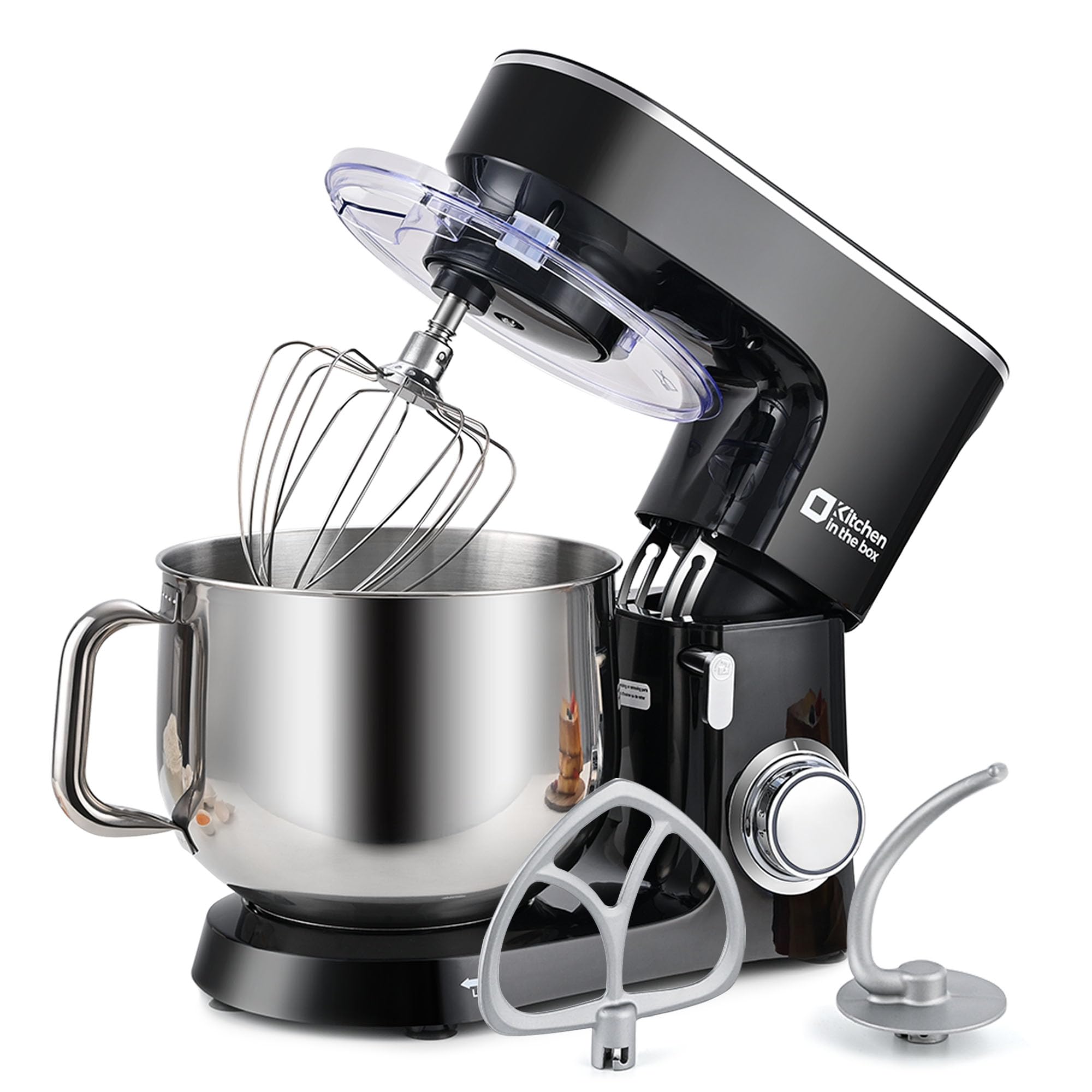
Nine hundred watts and 8.5 quarts at the bottom of the price range is a combination worth stopping on. On paper it lines up with machines costing far more: a copper motor, ten speeds with a pulse, a tilt head, a splash guard, and a stainless bowl with a handle. We think it’s the most interesting unknown here — the specification is right, the price is right, and the open question is what the motor feels like in year three.
That question is genuinely open, because this is a new model without the history behind it that the KitchenAids and the Cuisinart have built. It’s also wide at 16.6 inches, so measure the counter before you commit a corner to it. Buy it planning to bake hard in the first month: if it takes a stiff dough and a double batch without complaint or a hot smell, you’ve got a great deal of mixer for very little money.
Pros
- 8.5 quarts and 900 watts at a budget price
- Tilt head and splash guard included
Cons
- New model with no track record yet
- Sixteen and a half inches wide on the counter
We think it’s worth a look if you need volume cheaply and will bake it hard inside the return window while the return is still easy.
Best for Lightweight Everyday Baking
Martha Stewart 5.3QT

Key Features
- Motor: 660 watts
- Speeds: 12
- Weight: 9 lb
- Bowl capacity: 5.3 quarts
- Price: Budget
At nine pounds this is the easiest mixer here to lift off a shelf, and that’s clearly the brief: a 5.3-quart stainless bowl, 660 watts, twelve speeds, and a flat beater with a silicone edge that wipes the bowl as it turns. The splash shield has a chute you can pour through, and the head tilts clear for scraping. If your mixer lives in a cupboard and comes out twice a week, this is the one that won’t make your back complain.
Light cuts both ways with bread. The build quality is where the money went, and it shows in a chassis that feels less substantial than the metal machines — fine for creaming butter and bringing together a soft dough, less convincing when you’re pushing a low-hydration mix around. Buy it for cakes and cookies with the occasional loaf thrown in, and for a kitchen where the mixer gets put away after every use.
Pros
- Nine pounds is easy to move and store
- Twelve speeds and a silicone-edge beater
- Removable splash shield with a pour chute
Cons
- Shakes under a stiff dough at nine pounds
Ours is a narrow recommendation: batter, frosting, and the odd light dough, not a weekly sourdough habit — and easy to lift either way.
How We Tested Stand Mixers for Bread
We started with about 30 machines and narrowed by bowl capacity, motor type, dough-hook shape, and whether the maker actually designs the mixer for bread rather than selling a cake machine with a hook in the box. That left eight, all bought at retail. We also noted what shipped in the box, since an extra bowl or a decent dough hook changes the value math fast.
Each mixer spent nine months in a working kitchen. Saturdays meant two back-to-back loaves of 68 percent hydration sourdough, kneaded the full recommended time; weeknights brought sandwich loaves, pizza dough, and the occasional brioche, the real torture test, since enriched doughs are heavy and sticky. We taped a mark under each base and checked it after every session to see if the machine had walked. We listened for the motor’s pitch shifting under load and watched whether the head bounced or the dough simply climbed the hook.
Stability and durability got their own passes: ten minutes of kneading followed immediately by a second batch, one hand on the bowl to feel for shudder; gear noise recorded at the start and again nine months in; paint, bowl locks, and attachments checked for wear. Ease of use came down to timed one-handed head tilts and bowl changes. Versatility got tested at the small end, a single loaf’s worth of dough, where oversized bowls leave flour packed at the bottom. The disappointments were consistent: dough creeping up the hook, motors that labored on the second loaf, bowls that never locked positively. Two friends who had never owned a stand mixer baked alongside us, which is how the enjoyment question sorted itself out.
How to Choose a Stand Mixer for Bread
Bread is the hardest thing most stand mixers ever do, so buy for the stiffest dough you’ll make rather than the lightest.
Start with the dough rating, not the wattage
Wattage is the number printed largest and the one that tells you least, because makers measure it differently and a well-geared 500-watt drive can out-knead a cheap 900-watt one. The figure that maps to your baking is the stated maximum dough load. ZACME rates 3 kg, the NutriMill 8 pounds, and the seven-quart KitchenAid over 8.5 pounds. A 4.5-quart machine with no dough figure is a cake mixer that will take a loaf if you’re gentle with it.
Be honest about your biggest batch rather than your average one, and buy for that. A machine that only just copes at Christmas is a machine you’ll be replacing by spring.
Weight and feet keep it on the counter
A stiff dough pushes back, and a light machine answers by walking. The mixers that hold still here are the heavy ones: 33 pounds for the ZACME, 28 for the seven-quart KitchenAid, with suction feet doing the rest. Our lightest pick weighs nine pounds, which is lovely when you’re lifting it off a shelf and the reason it rocks once a dough tightens.
Decide which matters more. If the mixer lives in a cupboard, plan to hold the base with one hand on stiff mixes. If bread is the point, give the machine a permanent corner and buy the weight.
Tilt-head, bowl-lift, or bottom drive
Tilt-head mixers are easier to live with: the head swings back, you scrape with one hand, and the bowl lifts straight off. They need clearance above the machine, and the arrangement gets awkward as bowls grow. Bowl-lift machines cradle the bowl and drop the head onto it, which suits wide, heavy bowls and a bigger motor, but it takes two hands. Bottom drive, as on the NutriMill, lets you load from above through a lid and puts the motor directly under the dough.
Measure the gap between your counter and the underside of the cabinets before you commit. A tilt head needs room to swing back with a bowl full of dough.
Noise, cleanup, and the parts you’ll actually touch
Bread means ten or fifteen minutes of continuous running, long enough for noise to matter. Listed figures run from 48 dBA in first gear on the ZACME to 80 dB on the VIVOHOME, and that gap is the difference between a conversation and a raised voice. Look hard at the dough hook as well: one that stops short of the bowl’s edge means pushing flour in by hand for the first minute of every batch.
A splash guard with a pour chute saves stopping to add water, dishwasher-safe hooks and bowls make a weekly habit sustainable, and warranty length is worth weighing — three years is a long time to find out whether a drive holds up.
Frequently Asked Questions
Can a cheap stand mixer handle bread dough?
Yes, within limits. Lean dough made from flour, water, salt, and yeast is well within reach of a six-quart, 600-watt budget machine. The failures come from overloading: keep each batch under the maker’s stated dough maximum, use the hook rather than the paddle, and stop if the head starts lifting or the motor smells hot. Enriched doughs loaded with butter and eggs are what strain a cheap motor.
How do I know when the dough is kneaded enough?
Use the windowpane test rather than the clock. Pull off a golf-ball-sized piece, flatten it, and stretch it between your fingers. If it goes thin enough to let light through without tearing, the gluten is developed; if it tears into a ragged hole, give it a few more minutes. Timing varies too much with flour, hydration, and batch size for a recipe’s number to be reliable.
Do I use the dough hook or the flat beater for bread?
The hook, always. The flat beater is for creaming butter and folding batters — it can’t develop gluten, and it lets a stiff dough climb the bowl instead of being worked. The whisk is for eggs and cream only. If a recipe starts bread on the paddle, use it for half a minute to bring the flour together, then switch to the hook.
Why does my dough climb the hook and stop mixing?
Usually the batch is too large or too stiff for the bowl. Stop the machine, push the dough back down, and add water a tablespoon at a time until it clears the hook. If it climbs again within a minute, split the batch in two — a hook that’s completely buried in dough is rotating, not kneading.
Final Verdict
The ZACME 8.4QT is where we put our money if bread is the reason you’re buying: a 6.6-pound dough ceiling, a quiet drive, and commercial-standard construction, in a machine that will knead several loaves a week without complaint.
If you also want to run a pasta roller, a grinder, and an ice cream bowl off the same hub, the KitchenAid Artisan is the better long-term purchase and handles a two-loaf batch comfortably. Baking occasionally on a tight budget? The VIVOHOME gets you six quarts and a working dough hook for the least money here.