This post contains affiliate links. We may earn a small commission when you buy through our links — at no extra cost to you.
I’ve pulled a pork loin out of the oven because the dial stuck in the lid said it was done, sliced it in front of hungry people, and found pink in the middle. A meat thermometer is supposed to remove that guesswork — it’s the difference between a roast that comes out the way you planned and one you apologize for. The good ones find the center of the meat in a couple of seconds, hold their accuracy after being splattered with hot fat, and still have a battery when you dig them out for Thanksgiving. The bad ones run four degrees cold, and four degrees is the difference between juicy and sawdust.
My team and I have cooked with 14 of them over the past six months — instant-reads, leave-in probes, a few Bluetooth models, one dial — and the pattern held. Price mostly buys speed and a thinner tip; accuracy is the thing to check before anything else, and a thirty-second ice bath will tell you more than any spec sheet will. These are the ones that stayed within a degree, survived my countertops, and didn’t need a fresh battery mid-brisket.


Best for Everyday Cooking
TempPro TempSwift TP19H
Key Features
- Display: 2-inch auto-rotating backlit
- Response Time: 1 second
- Stated Accuracy: ±0.9°F
- Water Resistance: IP65
- Price: Budget
One second is the number that decides this one for us. Stand over a hot grill with the lid off and the gap between a thermometer that settles immediately and one that takes three or four seconds is the difference between a quick check and losing the heat you built. The TempPro TP19H reads in a second to a stated ±0.9°F, and it does it at the cheap end of what is here, which is why it is the one we point most people to.
The other half of the case is what happens after the reading. The 2-inch display rotates 180 degrees so the number faces you in either hand, the backlight is bright enough for a dark grill, and the lock button holds a reading once you have pulled the probe clear of the oven. A calibration function lets you true it up after a knock, and the folding probe and rear magnet mean it ends up on the side of the stove instead of lost in a drawer.
The part to watch is the hinge. That joint is what eventually gives out on folding thermometers, and it is the part that goes on this one; keep it folded and stuck to the fridge rather than rattling around a utensil drawer and you will get far more out of it. IP65 covers a rinse under the tap, not a soak.
Pros
- One-second reads to a stated ±0.9°F
- Screen auto-rotates for either hand
- Lock and calibration functions built in
- Magnet and folding probe keep it handy
Cons
The one we recommend to most cooks: a one-second read, a screen that works in either hand, and calibration at a budget price.
Best for First Thermometer
Alpha Grillers Meat Thermometer
Key Features
- Battery: CR2032, spare included
- Storage: Built-in magnet
- Response Time: 1 to 2 seconds
- Water Resistance: IP67
- Price: Budget
If you have been judging doneness with a knife and a prayer, this is the least expensive way out. The Alpha Grillers reads in a second or two, folds shut to protect the tip, and carries an IP67 rating — you can run the whole thing under the tap after it has been in raw chicken, which is the hygiene habit that makes a thermometer worth owning at all.
What tips it for us is how little it asks of you. There is a backlight bright enough to read over a dark grill, a magnet on the back, a spare battery in the box and a doneness guide, so the temperatures you would otherwise look up with wet hands are already in front of you. It is not the fastest here and not the most precise, but nothing about using it requires a decision.
The trade is adjustment. The TempPro adds a lock button and a calibration function for about the same money, and if you would rather true up your own readings than replace a thermometer, that is the better buy. The rest of us just want the number before our hand gets hot, and this one delivers it for less than anything else we recommend.
Pros
- Reads in a second or two
- IP67, so it rinses under the tap
- Backlight, magnet and a spare battery
- Doneness guide for common meats
Cons
A fast, fully washable thermometer that costs less than anything else on this list, and handles well enough that you forget what you paid.
Best for Steaks and Roasts
ThermoMonster HT09
Key Features
- Upper Range: 572 °F
- Probe Length: 4 inches
- Response Time: 0.5 seconds
- Stated Accuracy: ±0.5°F, NIST certified
- Price: Midrange
Half a second is a different class of instrument from the one-to-four-second thermometers that fill out this list. The ThermoMonster HT09 uses a thermocouple sensor and states ±0.5°F with an NIST calibration certificate in the box, and it is the one we pick up when we are checking a thick steak and do not want to stand there with the grill open.
The design follows from that sensor. The probe is 4 inches, so you reach the middle of a roast without your knuckles at the grate, and it is rated to 572°F, which covers frying oil and candy as well as meat. The display flips itself for left- or right-handed use, the motion sensor wakes it when you pick it up, and it runs on a single AAA rather than a button cell.
Size is the cost. At 10.5 inches it is the longest thermometer here and it wants a drawer with room or a magnetic strip, not a crowded utensil pot. That is the whole trade: a little more money and a little more counter real estate for the fastest, tightest reading of the group, which matters if you cook thick cuts often and matters much less if you are mostly checking chicken thighs.
Pros
- Half-second thermocouple read
- ±0.5°F with a calibration certificate
- 4-inch probe reaches deep roasts
- Auto-flip display and 572°F ceiling
Cons
- Longest body here, at 10.5 inches
The pick for anyone who wants the fastest, tightest read here and does not mind paying a little more for it.
Best for Frequent Cooks
Lavatools Javelin PRO
Key Features
- Warranty: 3-year limited
- Battery Life: 4,000 hours
- Response Time: 2 to 3 seconds
- Stated Accuracy: ±0.5°F
- Price: Premium
It is the most expensive thermometer here, and we kept it in the list anyway, because it is built like an instrument rather than an accessory. The display is the first clue: a 2-inch screen that rotates to stay upright in either hand and lights up bright enough to read at arm’s length.
The specifications back it up. Accuracy is stated at ±0.5°F, achievable through laboratory calibration and held with a calibration function, the battery is rated for 4,000 hours, and the warranty runs three years. Only its cheaper sibling matches that combination of a half-degree tolerance and a long warranty.
Spend the extra if you cook most nights and you are tired of replacing a thermometer every year. That is the buyer for this one: someone who wants to stop thinking about the tool, not someone chasing the fastest read. At two to three seconds it is a step behind the ThermoMonster, which costs less — but you are paying for accuracy that has been certified and a warranty that outlasts the habit, not for speed.
Pros
- Certified ±0.5°F accuracy with calibration
- Three-year limited warranty
- 4,000-hour battery life
- 2-inch auto-rotating backlit display
Cons
- Heavier than the other handhelds at 4.64 ounces
Buy it if you cook most nights and want to stop thinking about thermometers: certified accuracy, a three-year warranty, a 4,000-hour battery.
Best for Small Kitchens
Lavatools Javelin
Key Features
- Warranty: 3-year limited
- Folded Length: 4.5 inches
- Response Time: 3 to 4 seconds
- Stated Accuracy: ±0.5°F
- Price: Midrange
Closed, it is 4.5 inches long and about 50 grams — the smallest and lightest thermometer here, small enough to live in a cutlery drawer without fouling anything and light enough to forget it is in a jacket pocket on the way to a cookout.
Where it earns its spot is the combination of that size with real backing: ±0.5°F stated accuracy, a 4,000-hour battery and a three-year warranty in something the size of a marker pen. Nothing else here is this small and this well supported at the same time, and being the one you actually have with you is a different job from being the best thermometer on the counter.
The compromise is speed. Three to four seconds puts it at the slow end of the instant-reads we recommend, and at a hot grill you will notice the extra count against the ThermoMonster. For a thermometer that lives in a drawer and comes out for a Sunday roast, that is a fair price for something you can bury in a bag and still find.
Pros
- Folds to 4.5 inches and about 50 grams
- Three-year limited warranty
- 4,000-hour battery life
- ±0.5°F stated accuracy
Cons
- Smallest display of the picks at 1.4 inches
Folds to palm size, weighs almost nothing and still carries a three-year warranty — the thermometer for a drawer that is already full.
Best for Second Thermometer
AMMZO Digital Thermometer

Key Features
- Probe Length: 4.5 inches
- Response Time: 2 to 4 seconds
- Stated Accuracy: ±2°F
- Water Resistance: IP67
- Price: Budget
At the very bottom of the price range, the AMMZO still covers the essentials: an IP67 body you can rinse, a 4.5-inch probe that reaches into a chicken without burning your knuckles, a strong magnet and a folding probe that keeps the tip out of the way. It ships with two button cells and an opener for the battery door, which is more thought than the price suggests.
The tolerance is where the money went missing. ±2°F is the loosest accuracy of anything here. For chicken thighs, a burger or a loaf of bread that is plenty. For a steak you want at 130°F, two degrees either way is most of the gap between rare and medium, and this is not the thermometer to call that with.
Buy it as a second thermometer and it is honest value: the one that lives in the camper, the one you do not mind a teenager using, the gift that ends up used more than expected. As the only thermometer in a kitchen where somebody cares about steak, it will frustrate you the first time you try to hit a number.
Pros
- IP67 body rinses clean
- 4.5-inch probe keeps hands clear of heat
- Two spare batteries and an opener included
Cons
- Two-to-four-second reads
A spare thermometer for the camper or a second kitchen, as long as you are not chasing medium-rare.
Best for Long Smokes
TempPro TempTrack TP-17
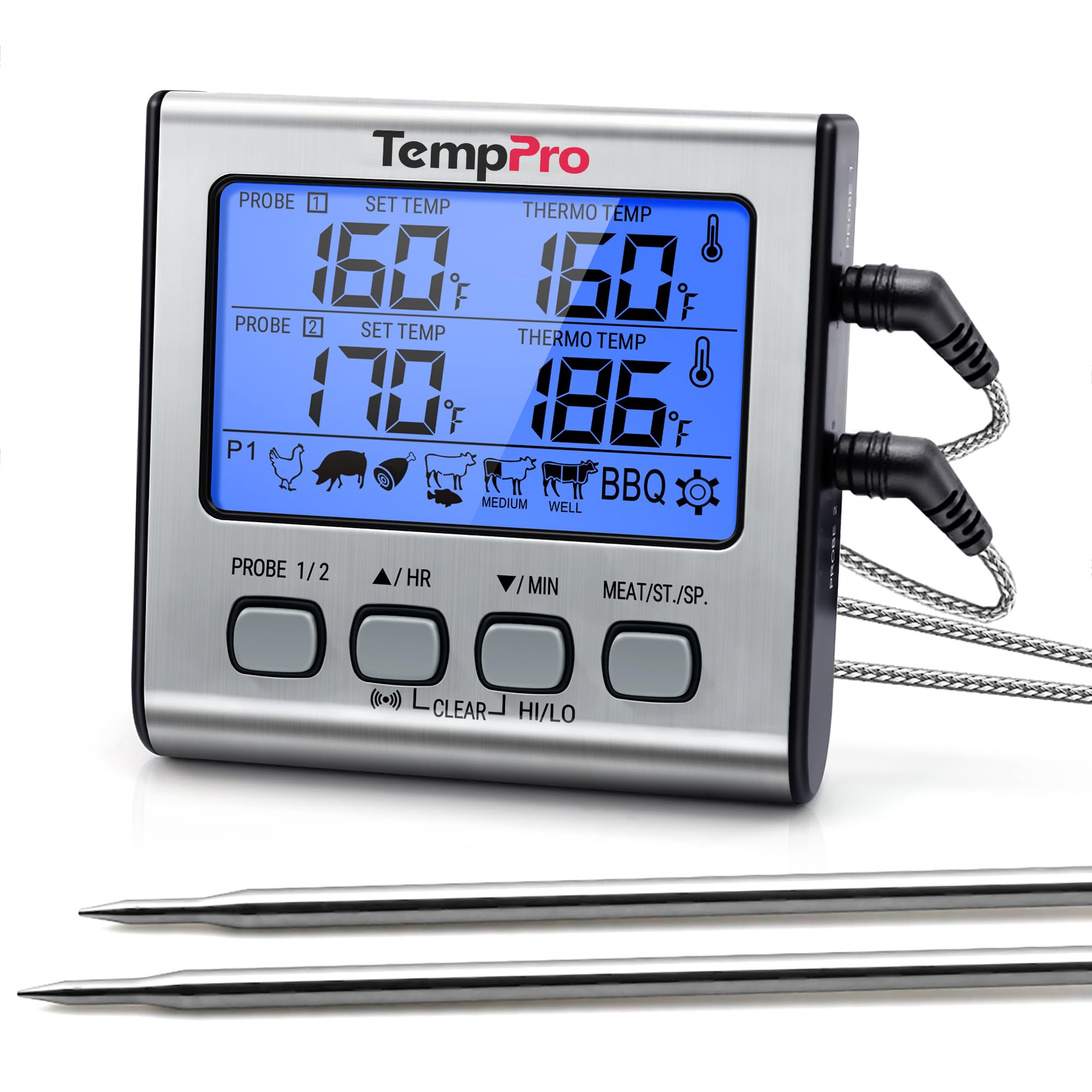
Key Features
- Alarms: Food and grill HI/LOW
- Probes: Two stainless probes
- Probe Length: 8 inches
- Stated Accuracy: ±1.8°F
- Price: Midrange
This does a different job from everything else here. The TP-17 is not for stabbing and reading — it is a leave-in unit, with two stainless probes on wires running to a base that sits on the counter or sticks to the smoker by its magnet, and an alarm that sounds when the meat hits target.
Two probes are the point. Run one into the point of a brisket and one into the flat, or put one in the meat and leave the other to watch the temperature inside the smoker, with HI/LOW alarms for both. The probes are 8 inches, long enough to stay put in a big roast, and the base carries USDA presets for the cuts people cook most.
Accuracy is the part to verify. It is stated at ±1.8°F, and a check in ice water before a twelve-hour cook costs a minute and tells you whether to trust it. The readings are the thing that varies on this unit; the alarms and presets do what they say.
Our advice is to treat it as a second thermometer. It will not check a steak on the grill and it will not replace the one on the fridge. Past the two-hour mark, though, two probes and a loud alarm are worth more than any amount of read speed, and that is the ground this one owns.
Pros
- Two leave-in probes at once
- HI/LOW alarms and USDA presets
- 8-inch probes reach deep cuts
- Backlit LCD and magnetic base
Cons
- Probes wipe clean only, not washable
If dinner takes six hours, this is the tool: two probes stay in the meat and an alarm tells you when to come back.
What Six Months of Cooking With 14 Thermometers Taught Us
The shortlist started with spec sheets. We looked for a stated accuracy of one or two degrees, a probe that could be replaced or the unit recalibrated, and a long enough track record to suggest it wouldn’t die inside a year, then cut anything with a proprietary battery, a display we couldn’t read at a glance, or a price that didn’t match what the thing actually did. Fourteen made it through — instant-reads, leave-in probes, a few Bluetooth units, and one dial — and they spent six months in my kitchen, on my charcoal grill, and alongside a neighbor’s smoker.
Accuracy got checked twice. First in an ice bath, where a working thermometer should read 32 degrees, and again in boiling water adjusted for altitude; anything that drifted more than a degree got pushed to the back of the drawer. Then we used them for real: searing steak in cast iron, roasting a spatchcocked chicken, pulling a pork shoulder off the grill. We timed how long the number took to settle and watched whether it kept climbing after the beep, since a slow read on a thin cut will overshoot while you’re standing there waiting.
Durability and battery life took the abuse. Each one was knocked off the counter onto tile, wiped with a wet rag while still hot, and folded shut with greasy fingers to see whether the hinge or the probe tip complained. We left them switched on to see how fast auto-off kicked in, noted what battery each takes and whether swapping it needs a screwdriver, and logged who needed a new cell before the six months were out. Readability got judged at arm’s length in a dim kitchen and in direct July sun, and ease of use meant working the buttons one-handed while the other hand held a hot pan.
Value came last, and it wasn’t just sticker price: we counted the cost of a replacement probe and whether the maker would recalibrate a unit, since a thermometer you can’t fix is one you’ll buy again. We also tracked which extras we actually reached for — a backlight, a target-temperature alarm, a min/max hold — and which ones just cluttered the screen.
How to Choose a Meat Thermometer
Every thermometer on this list will tell you when a chicken is done; what separates them is how fast they read with the grill open, how tight the accuracy is, and whether the thing is still working in a year.
Instant-read or leave-in probe
These are two tools, not two versions of one. An instant-read is the folding handheld you stab into a steak and read a second or four later; it is the right first purchase for almost anyone. A leave-in probe stays in the meat with a wire to a base unit that alarms at target temperature, which is the only sane way to cook a pork shoulder for eight hours without lifting the lid. The TempPro TP-17 is the leave-in option here.
We start people on an instant-read and add a probe unit when they notice they are cooking things that take all afternoon. Doing it the other way round is the common mistake: a leave-in unit is poor at quick checks, and quick checks are most of what a thermometer gets used for.
What speed and accuracy actually buy
One second and three seconds both get called instant on a listing; at the grill they are not the same thing. Speed matters most with the lid up and the fire climbing, which is why a half-second thermocouple is worth having if you cook thick steaks often. Accuracy is the figure that changes what you can actually cook.
Medium-rare is roughly 130 to 135°F. A thermometer rated ±2°F eats most of that window, so it can tell you chicken is safe but it cannot tell you a steak is perfect. A ±0.5°F instrument can. Match the tolerance to the job: ±2°F is fine for safety checks and bread, while ±0.5°F to ±1°F is what you want if you cook to a number.
Reach, display and washing
Probe length decides how close your knuckles get to the grate. Four inches reaches the middle of a roast, the compact Lavatools’ 2.75-inch probe suits thinner cuts, and the 8-inch probes on the TP-17 are meant to stay in. A folding probe protects the tip in a drawer, but the hinge is also the part that fails, so store it closed rather than loose among the utensils.
On cleaning, the rating is the fine print. IP65 and IP67 cover splashes and rinsing, not soaking, and water behind the display is one of the ways these die. Rinse the probe, wipe the body, and keep it out of the dishwasher. A backlight and a screen that stays upright in either hand sound like luxuries until you are reading a number at dusk with the lid up.
How long they last, and what backs them up
None of these is a lifetime purchase. When they fail it is the mechanical parts that go — the folding joint, the probe sheath, water behind the display — rather than the sensor. Two habits stretch the life: never rest an instant-read on a hot grill lid or leave it in the oven, and never let it sit in a sinkful of water.
Warranty is the honest hedge, and it varies more than the prices do: three years on both Lavatools, one on the TempPro probe unit. If you cook often, paying more for a long warranty is usually the cheaper way to own a thermometer, because the alternative is buying another one. Auto-off matters too, and a folding probe that switches the unit off as it closes is the simplest version of it.
Frequently Asked Questions
Can I use a meat thermometer for candy, frying oil or bread?
Yes — a digital probe reads oil and sugar syrup as happily as it reads meat, as long as the probe is rated for the temperature. Frying oil sits around 350 to 375°F and caramel goes past 340°F, so look for a stated ceiling above 400°F before you buy and check that figure rather than the word multi-use on the box.
Bread, yogurt and chocolate are the easy end of the range, all well below 220°F, where even a ±2°F thermometer is perfectly usable. Don’t leave any of them clipped to the pan, and wipe the probe before it goes back in the drawer.
How do I know if my thermometer is reading correctly?
Do the ice test. Fill a glass with crushed ice and a splash of water, stir, and put the probe into the middle without touching the sides — it should settle at 32°F. If it is off by a degree or two and the unit has a calibration function, adjust it to 32; if it is off by more than that, treat its readings as a rough guide from then on.
Boiling water works too, but its temperature falls with altitude, so ice water is the more reliable check. Run the test when the thermometer is new and again after it takes a knock.
Where should I put the probe in a steak?
In from the side, into the thickest part, stopping short of the bone and away from any seam of fat. Both read hotter than the meat around them and will tell you a steak is done when it isn’t.
Take the steak off the heat about 5°F below your target and let carryover cooking finish the job while it rests. On a thick cut, take two readings in different spots — if they disagree, keep probing before you decide.
Final Verdict
Our pick for most kitchens is the TempPro TP19H. It reads in a second, its screen works in either hand, it holds a reading while you step back from the heat, and it is priced with the budget models — nothing else here balances those as well.
Spend more only for a specific reason: the ThermoMonster if you want the fastest, tightest read on the list, or the Lavatools Javelin PRO if you want certified accuracy and a three-year warranty behind it.