This post contains affiliate links. We may earn a small commission when you buy through our links — at no extra cost to you.
Instant hot water is an upgrade you notice every day—until the dispenser dribbles lukewarm water into your mug or starts humming loud enough to hear from the next room. I’ve stood at enough sinks, waiting for a kettle to boil while a pot of pasta water sat stubborn, to understand why people want hot water on demand. The right unit fixes the wait, the counter clutter, and the small daily friction of filling a teapot, rinsing a greasy pan, or mixing a mug of something at midnight.
What makes these appliances tricky is that the spec sheet rarely matches the first cup. A unit can claim a scalding setting and still deliver a lukewarm stream for the first few seconds; an under-sink model can look simple until you’re crouched under the cabinet with a wrench. We installed 12 dispensers over eight months—countertop and under-sink models—and lived with them through morning tea, pasta-night stockpots, and after-dinner cleanup. The ones that held temperature, stayed quiet, and didn’t leak earned their place; the rest went back to the box.


Best for All-Day Hot Water
Zojirushi Micom CD-WCC40
Key Features
- Wattage: 700 W
- Capacity: 4 L (135 oz)
- Energy timer: 6–10 hours
- Heat settings: Four
- Price: Midrange
Most hot water appliances are judged on how fast they boil. This one earns its place on what happens after that: four liters of water held at one of four heat settings, ready at any hour, with no plumbing and no hole in the counter. That held temperature is why it’s our top pick — a kettle gets you boiling water once, and this gets you the right water all day, at whatever setting you chose before you went to bed.
The numbers are modest in places, and that’s fine. A 700-watt element looks weak beside the Tiger’s 1,500, but it’s topping up a reservoir that is already hot rather than starting from cold, and the six-to-ten-hour energy-saving timer means you can have it ready for six in the morning without it cycling all night. The nonstick-coated interior wipes clean, the café drip mode slows the flow for pour-over, and the fold-down handle plus a six-pound body mean you carry it to the sink to fill instead of walking a pitcher back and forth.
Where it asks something of you is on the counter. At roughly a foot in each direction it wants a permanent corner rather than a cupboard shelf, and it rewards a descaling routine — the manufacturer’s citric-acid tablets are worth keeping in a drawer, because a boiler fed hard water will scale no matter how good the liner is. Fill it at night, set the timer, and mornings take care of themselves.
Pros
- Four temperatures held all day
- 4 L covers a household’s tea and coffee
- No plumbing, no counter hole
- 6–10 hour energy-saving timer
Cons
- Hand-wash only, no dishwasher parts
- Plastic coating and lid age first
The one we recommend to anyone who wants hot water at the right temperature all day without calling a plumber — it’s the simplest good answer here.
Best for Tea and Formula
Tiger PDU-A40U
Key Features
- Wattage: 1,500 W
- Capacity: 4 L (135.26 oz)
- Dispense lock: Automatic, 10 seconds
- Preset temperatures: 158, 176, 194, 208 °F
- Price: Midrange
The Tiger’s 1,500-watt element is more than twice the Zojirushi’s 700, and that’s the first number we check when someone says their boiler takes too long in the morning. It’s the quicker of the two on paper, and a full tank is hot in the time it takes to unload a dishwasher. Speed alone wouldn’t put it on this list, though.
The presets do. Rather than a dial you have to remember, this one gives you four labeled temperatures tied to actual drinks: 208°F for coffee and black tea, 194°F for oolong and hot chocolate, 176°F for green tea, and 158°F for baby formula. That last one is the detail that sells the pot to new parents, and 176°F is the one that matters if your cupboard is full of sencha. The dispense lever also locks itself ten seconds after you stop using it, which is the safety feature we care about most in a house with small children.
The rest is sensible rather than exciting: a large LCD, two sleep timers, a removable lid and cord that make filling and emptying easy, and a four-liter tank that matches the Zojirushi liter for liter. It’s wider by most of an inch, which matters only if your counter is already crowded.
Pros
- Four labeled presets, 158°F to 208°F
- Most powerful element here at 1,500 W
- Lever locks itself after 10 seconds
Cons
- Liner can discolor and corrode inside
Buy it if your day runs on specific temperatures — green tea, oolong, formula — and you want the fastest boil of the countertop models here.
Best for Small Households
Panasonic NC-EG3000
Key Features
- Wattage: 700 W
- Capacity: 3 L (3.2 qt)
- Energy timer: 6 hours
- Preset temperatures: 160, 180, 190, 208 °F
- Price: Budget
Three liters is the number that decides this one. That’s a quarter less than the Zojirushi and the Tiger hold, and for a household of two or three it’s the right size: you refill once a day instead of letting a fourth liter sit and go flat. It’s also the least expensive way into a countertop boiler here, and nothing about using it feels like a downgrade.
The slow-drip mode is the feature we didn’t expect to use: park a filter cone under the spout and it dispenses at a pour-over pace, which makes the pot a coffee brewer as well as a tea station. The four presets — 208, 190, 180 and 160°F — cover the same ground as the Tiger’s, trading that unit’s 176 for 180 on green tea. The base rotates a full turn and the cord detaches, so filling it doesn’t mean wrestling it out from under the cabinets. The interior is the part to stay on top of: corrosion and a lingering plastic smell are the two things that can go wrong with this model, so rinse and dry the tank before first use, descale monthly with citric acid the way the manual specifies, and check the liner now and then.
Pros
- Four presets from 160°F to 208°F
- Slow-drip mode brews pour-over coffee
- The lowest-priced boiler here
Cons
- 3 L reservoir means more refills
Our pick for couples and small kitchens: three liters, four presets and the lowest price here, provided you’ll keep up with the monthly descale.
Best for Under-Sink Convenience
InSinkErator Invite Contour
Key Features
- Capacity: 0.67 gal
- Warranty: 3 years in-home
- Installation: Under sink, single hole
- Temperature range: 160–200 °F
- Price: Premium
The control on this one is a twist collar rather than a lever, and it’s the detail that makes the Invite Contour feel different from every other sink tap here. Turn it, fill the cup, let go — the flow stops on its own, so you’re not holding a spring-loaded handle down while you’re also steadying a measuring jug.
Under the counter sits a two-thirds-gallon stainless tank at 750 watts, with a dial that runs from 160 to 200°F. That range is wider than it sounds: back it off for green tea, run it wide open for pasta water, and it recovers as you draw rather than making you wait for a reservoir to refill. Installation needs one standard 1 3/8-inch hole in the counter and a grounded outlet inside the cabinet; if you have both, the plumbing side is straightforward, and if you don’t, no amount of enthusiasm fixes it.
What earns it the top under-sink spot rather than the newer HOT250 is the pairing of a three-year in-home warranty with the longest track record of any sink unit here. It’s a mature design rather than a clever one, and we’re fine with that. The trade-off is audible: the tank cycles to hold temperature, so a quiet kitchen will hear it from inside the cabinet. That’s the price of 200°F water on tap.
Pros
- Twist collar stops flow when released
- Adjustable 160–200°F tank
- Three-year in-home warranty
Cons
- Twist knob needs a firmer grip than a lever
The under-sink unit we recommend if you’re ready to drill: near-boiling water on a twist, a wide temperature dial and a three-year in-home warranty.
Best for Hot and Cold
InSinkErator HOT250 Hot/Cold
Key Features
- Handles: Hot and cold
- Capacity: 0.67 gal
- Warranty: 3 years in-home
- Hot temperature: 200 °F
- Price: Premium
Two handles on a sink-side tap looks like overkill until you live with it: one gives you roughly 200°F water for the teapot, the other gives you cold drinking water, and neither means swinging the main faucet out of the way. We came around to the second handle fastest — if you’ve been filling a pitcher from the fridge door, it’s the one you’ll use most.
The hardware underneath is the same 750-watt, two-thirds-gallon stainless tank as the other InSinkErators here, set to about 200°F. Above the counter you get an 8.21-inch faucet in matte black with a spout that swivels a full turn and a pull-forward handle, so it doesn’t collide with the main faucet when you swing it over the basin. The cold side is filter-ready rather than filtered — you add an InSinkErator filter if taste is why you’re here — and that’s worth pricing before you choose between this and the hot-only models. Three years of in-home service covers the tank, which is the part that eventually fails.
Pros
- Hot and cold water from one tap
- 360-degree swivel clears the main faucet
- Three-year in-home warranty
Cons
- Matte black coating can wear with cleaning
Worth the step up if you want cold drinking water at the same tap — it’s the only two-handle unit here, and the matte black version is the sharpest-looking of the sink taps.
Best for Filtered Hot Water
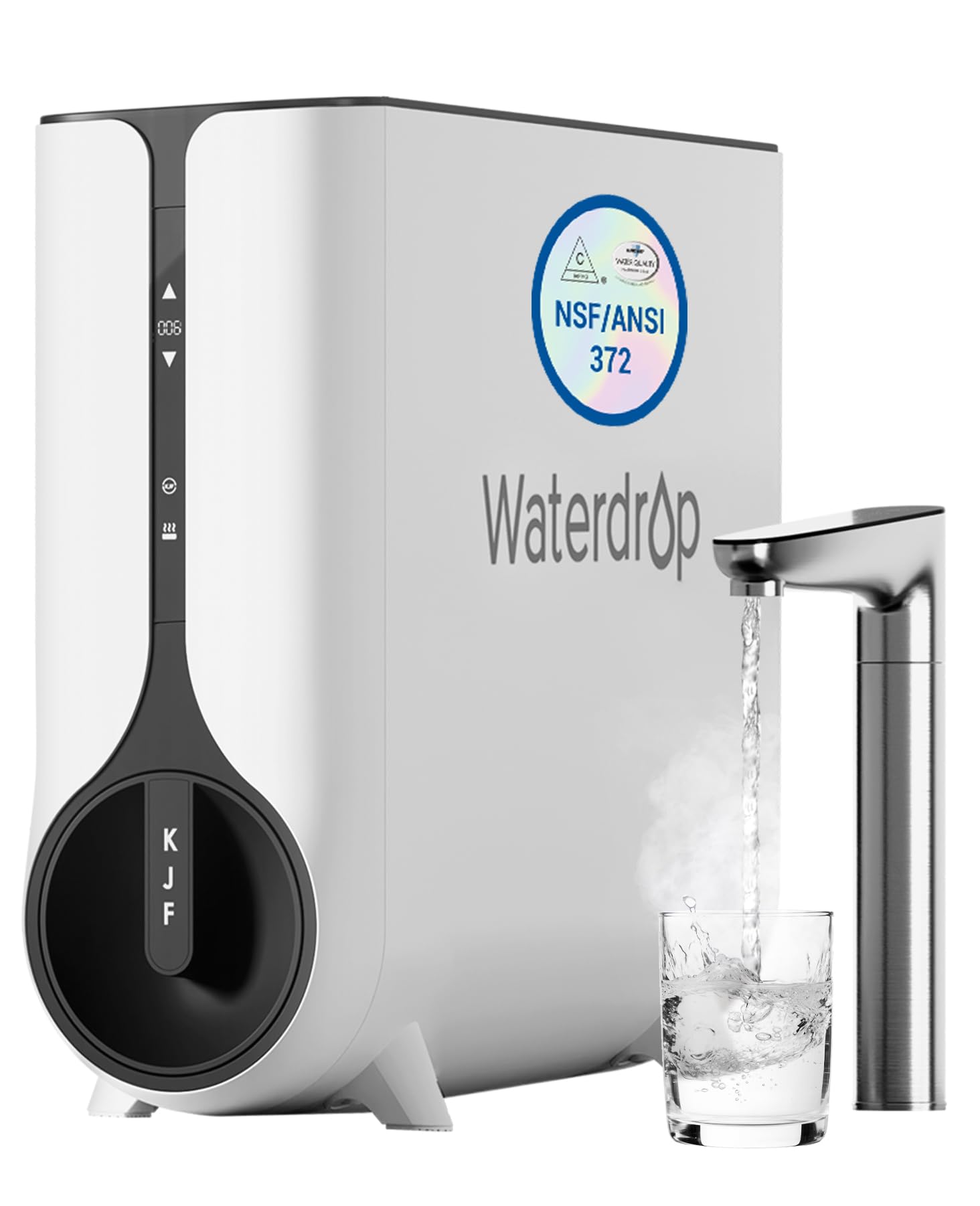
Waterdrop KJ600
Key Features
- Flow rate: 600 GPD
- Filtration: 5-stage RO
- Heat-up time: About 15 min to 203 °F
- Temperature range: 104–203 °F
- Price: Premium
Fifteen minutes is the number that reorganizes how you use this one. The KJ600 doesn’t flash-heat on demand the way a sink tap does; it holds a tank of hot water at your set temperature, and coming up from cold to 203°F takes about a quarter of an hour. Once it’s there you have anything from 104 to 203°F at the push of a button, plus cold filtered water from the same faucet — it just isn’t the machine for an impatient first cup of the morning.
Under the counter it’s a 600-gallon-per-day reverse-osmosis system with five stages of filtration and a 2:1 pure-to-drain ratio, and the smart faucet shows TDS and filter life while you draw. If your tap water tastes of chlorine, or your kettle furs up inside two weeks, one box solves the water and the hot water together.
We think of it as a filter system that happens to heat water, and that framing decides whether it’s right for you. The catch is that you’re buying filtration at filtration money and the hot side is the more delicate half: water landing below the set temperature and functions that stop working are the two ways this one disappoints. It also needs 16.6 inches of clear cabinet height under the sink, so measure before you order — tankless doesn’t mean small.
Pros
- Hot and cold filtered water from one faucet
- 5-stage RO with 600 GPD output
- Adjustable 104–203°F hot water
Cons
- Hot water can land below the set temperature
- Costs more than anything else here
Buy it if you want filtered water and hot water from one faucet and have the cabinet height; for hot water alone, the countertop boilers cost far less.
How We Tested Hot Water Dispensers
We started by narrowing the field to 12 models that represented the main formats—compact countertop units and under-sink tanks—and filtered out anything with vague temperature claims, no replaceable parts, or a footprint that wouldn’t fit beside a normal kitchen sink. We also kept an eye on price, since a dispenser shouldn’t cost more than the problem it solves.
Each unit was installed at a kitchen sink and used daily for eight months. I timed solo installation for every model, then checked the supply connections and tank fittings after the first week and again at the end of testing for drips, weeping joints, and rust. We drew hot water for morning tea, filled stockpots for pasta, rinsed greasy sheet pans, and made late-night mugs, logging how long a 12-ounce cup took to fill and whether the first cup was as hot as the fifth. We measured temperature with an instant-read thermometer at the tap, noted how quickly each unit recovered after a draw, and listened for hums, clicks, or gurgles during reheat cycles.
Ease of use got a simple test: I asked everyone in the house to draw hot water without instructions, then watched whether they needed to fiddle with a dial, wait for a lock, or guess at a temperature setting. We also checked adjustable temperature ranges, tank capacity, child-safety features, and whether the spout could clear a tall pot without splashing. Durability and quality came down to the unglamorous stuff—scale buildup, tank fittings, the weight of the faucet, and whether the unit still held temperature after months of daily cycles. At the end, I compared each model’s price against how often it needed adjustment, produced a weak stream, or made me reach for a kettle anyway.
How to Choose a Hot Water Dispenser
The first decision isn’t brand, capacity or temperature range — it’s whether you’re willing to put a hole in your counter, because that separates the two families of product here.
Countertop Boiler or Under-Sink Tap?
A countertop boiler plugs into any outlet, holds three or four liters, and moves house with you. An under-sink system needs one standard 1 3/8-inch hole in the counter, a tee off the cold supply and a grounded outlet inside the cabinet; in exchange you get near-boiling water at the sink without lifting a pot or waiting for a reservoir to refill.
The trap is the outlet. Plenty of cabinets already have one for the disposal; plenty don’t, and adding a circuit is an electrician’s job. Check for the outlet and measure the cabinet interior before you order anything that lives under the sink.
Presets or a Dial
Temperature is where the two families diverge. Countertop boilers sell labeled presets — 208°F for coffee and black tea, 194 to 190 for oolong, 176 to 180 for green tea, 160 to 158 for formula — and the useful question is whether those set points match what you actually drink. If your day is coffee and instant noodles, one 200°F setting is enough and you shouldn’t pay for four.
Under-sink units use an adjustable dial, usually 160 to 200°F: run it high for cooking and cleaning, back it off for delicate tea. Treat the labels as a starting point rather than a rule — a fragile gyokuro wants cooler water than the green-tea button suggests, and a dark oolong will take the coffee setting without complaint.
Capacity and Recovery
Three liters is roughly twelve cups; four liters is roughly seventeen. A countertop boiler is a fixed reservoir, so that number is a real ceiling — when it’s empty you’re waiting for a refill to heat. An under-sink tank holds only about two-thirds of a gallon, around ten cups, but it reheats as you draw, so ten cups isn’t the limit it looks like.
Match the size to the household. A couple will refill a three-liter pot once a day; a family of five making tea, formula and cooking water will empty a four-liter one before lunch.
What It Costs to Run
All of these hold water hot around the clock, and that standby is what you’re paying for. Elements run from 700 to 1,500 watts while heating, and the tank cycles on and off to stay at temperature.
Use the timer. The countertop boilers here offer six- to ten-hour energy-saving modes, which is the right setting if your hot-water needs are a morning and an evening rather than all day. If you want instant water at three in the morning, accept the standby cost as the price of the convenience.
Scale, Liners and Upkeep
Hard water is what ends these machines. Scale builds on the element and the liner, the water starts tasting flat, and the interior corrosion that shortens a boiler’s life begins there. Descale with citric acid on the schedule in the manual — monthly in a hard-water area, quarterly if your water is soft — and dry the tank when it’s going to sit empty.
Under-sink systems are easier only because you can feed them filtered water; the tank itself still minerals up over the years. If a kettle in your kitchen furs within a month, plan on filtering the feed water rather than simply descaling more often.
Frequently Asked Questions
How long should a hot water dispenser last?
The countertop boilers are the longer-lived half — years of service is normal, and the better ones are built around a stainless tank and a coated liner you can keep descaled. Under-sink systems are the shorter-lived: the tank and faucet are the parts that fail, and the warranty tells you what the maker expects.
Three years of in-home service is the standard worth holding out for. Treat a one-year warranty on a sink unit as a signal about how long the manufacturer plans to stand behind it.
Is instant hot water safe with kids in the house?
It’s around 200°F at the spout, so the safeguards matter more than the temperature. Countertop boilers here use a dispense lock — the Tiger’s re-engages ten seconds after you stop pouring — and under-sink taps use a twist collar or a lever that stops when you release it.
Put the tap at the back of the sink rather than the front corner, and get the mug under the spout before you open it, not after.
Do I still need a kettle?
For pasta, sterilizing jars or anything that needs a true rolling boil, yes: 200°F is hot but it isn’t 212°F, and none of the under-sink units will fill a stockpot quickly.
For tea, coffee, instant noodles, oatmeal and cleaning, no. Keep a kettle in the cupboard for the handful of jobs that need a real boil.
Final Verdict
For most kitchens the Zojirushi CD-WCC40 is the answer: four heat settings, four liters, no plumber, no hole in the counter and no cabinet space surrendered. It turns hot water from a task into a tap, and the timer means it isn’t working while you sleep.
Change one requirement and the pick changes with it. If you want the water at the sink and you’re willing to drill, the InSinkErator Invite Contour has the temperature dial and the three-year in-home warranty we look for; if cold drinking water from the same tap matters, step up to the two-handle HOT250. And if the water itself is the problem, the Waterdrop KJ600 handles filtration and heating in one box — measure that cabinet first.