This post contains affiliate links. We may earn a small commission when you buy through our links — at no extra cost to you.
There’s a particular disappointment in opening the fridge for a handful of berries and finding a pint of fuzzy, collapsed fruit. A good berry container isn’t glamorous, but it buys you days by managing airflow and keeping condensation off the fruit. I’ve tried the paper-towel-in-the-clamshell trick; a dedicated container earns its shelf space by being easier to stack, see through, and clean.
Over the past six months, my team and I tested 14 berry containers—washing, filling, stacking, and repeatedly opening and closing them. We tracked how long strawberries stayed firm, whether blueberries sweated, and if lids sealed tight enough to survive a jostled fridge shelf. The best ones share a few practical virtues: a lid that clicks without a fight, a size that fits a standard pint without crushing it, a base that doesn’t crack after a few washes, and a price that doesn’t feel silly. I’m picky about lid fit—nothing worse than a container that pops open when you grab it one-handed. The picks below earned a permanent spot next to the butter.
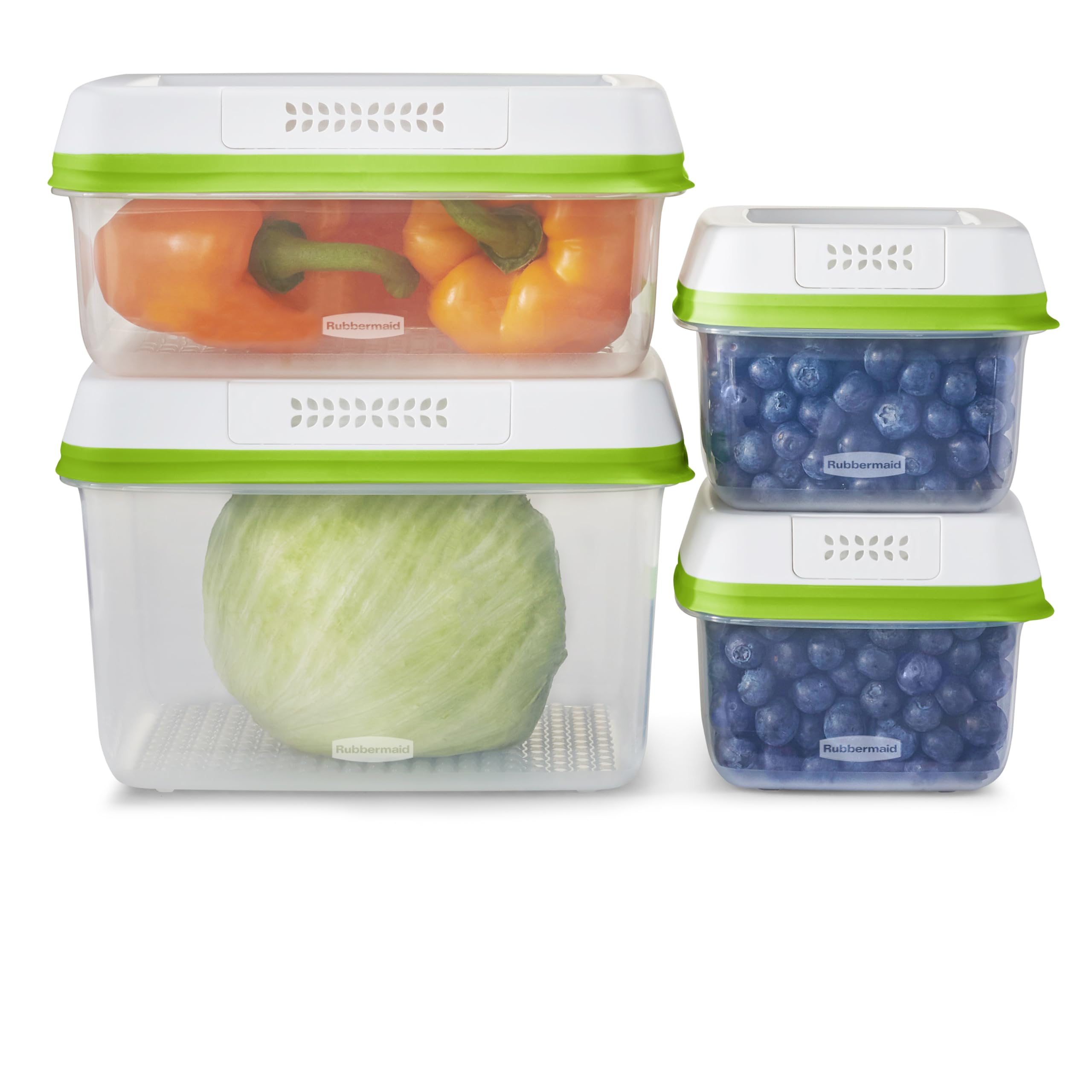


Best for Berry Flats
Rubbermaid FreshWorks 8-Piece Set
Key Features
- Care: Dishwasher safe
- Airflow: FreshVent filter with elevated base
- Capacity: 41.2 cups
- Set contents: 4 containers, medium and large
- Price: Premium
Two things separate the FreshWorks from a plain lidded box: a FreshVent filter set into the lid that regulates the flow of oxygen and carbon dioxide, and a raised floor that keeps fruit above whatever moisture collects underneath. That is the whole trick, and it is enough to make this the set we recommend first to anyone who buys berries by the flat. You load it, close it, and stop thinking about it.
Rubbermaid’s own instruction is to store the fruit unwashed and uncut, one type of produce per container, and that suits berries better than it suits almost anything else. There is no rinsing, no drying on a towel, no wet fruit sitting in a basket while you get around to it. All four containers are clear, BPA-free, and dishwasher safe, so the end-of-week cleanup is a top-rack job.
The set pairs medium containers with large ones, and both earn their shelf space: a medium takes a clamshell of strawberries, while a large one handles a week of grapes, a head of lettuce, or the overflow from a market run. The containers are rectangular and stack squarely, which matters more than it sounds when you are fitting four of them around everything else in the fridge.
There is no colander and no drain basket — the raised floor does that work instead, which means the FreshWorks is for fruit you do not rinse before storing. If you wash berries the moment they come through the door, one of the colander sets here will suit you better. For everyone else, the filter and the raised floor answer the two things that actually spoil berries: ethylene gas and standing water.
Pros
- Filter regulates airflow with no dial to set
- Raised floor keeps fruit out of moisture
- Dishwasher safe and BPA-free
Cons
- Large containers take more shelf than berries need
The set we recommend to anyone who buys berries by the flat: load them unwashed, close the lid, and let the filter and the raised floor handle the gas and the moisture.
Best for Big Households
Anysig 8-Pack with Colanders
Key Features
- Care: Top-rack dishwasher safe
- Seal: Silicone gasket, 4 locking clips
- Sizes: 13 to 112 oz
- Set contents: 8 containers, 8 colanders, 2 dividers
- Price: Midrange
Eight containers, eight colanders, and two divider plates. The Anysig set is the most complete thing here, and the only one that gives you two of every size — 13, 27, 57, and 112 ounces — so a big shop does not leave you hunting for the one box that fits.
That redundancy is why we reach for it after a market run. Two of each size means the grapes and the strawberries each get their own box without a negotiation, and the divider plates split the 112-ounce containers so a single large box can hold two kinds of berry without mixing them. The colanders lift out, so you rinse in the basket, shake it, and drop it back in the box.
Closing the lids takes a firm, even press: work around the four clips in opposite pairs rather than chasing them in a circle, and they seat cleanly. Wash on the top rack with the lids off. The grey lids also make matching boxes to lids after a wash far less of a puzzle than the all-clear sets.
Pros
- Eight containers, two of every size
- Colanders rinse and drain in place
- Divider plates split the biggest boxes
Cons
- Two smallest containers hold only a handful
Eight boxes, eight colanders, and two divider plates: for a household that goes through a flat a week, this is the most useful set here.
Best for Herbs and Melon
OXO Good Grips GreenSaver
Key Features
- Care: Dishwasher safe
- Filter: Natural carbon filter
- Airflow: Sliding vent, elevated basket
- Capacity: 4.7 liters
- Price: Midrange
Most containers here manage moisture and airflow. The GreenSaver also goes after ethylene, the gas that ripens fruit and, in a closed box, turns a firm strawberry soft overnight. A natural carbon filter in the lid absorbs it, an elevated basket keeps produce off the floor of the container, and a sliding vent sets how much humidity escapes.
In practice it behaves like a herb keeper that happens to be good with berries. The basket lifts out and doubles as a colander, the vent slides shut for fruit that wants still, humid air, and the 4.7-liter body holds a decent pile of strawberries — though not a whole flat.
The lid sits on top rather than locking down, which is fine on a shelf and hopeless if you carry the container by its rim; lift it from the base and nothing spills. We keep ours for bunches of parsley and cilantro, cut melon, and the expensive berries we plan to eat first.
Pros
- Carbon filter absorbs ripening gas
- Basket lifts out and doubles as a colander
- Sliding vent adjusts humidity
Cons
- One container only, so a second fruit needs a second buy
Buy it for herbs, cut melon, and the berries you plan to eat first — the carbon filter is the one thing here that nothing else does.
Best for Humidity Control
BOICHU 5-Pack with Vented Lids
Key Features
- Care: Dishwasher safe
- Sizes: 13 to 140 oz
- Venting: Sliding vents in lid
- Set contents: 5 containers, 5 colanders
- Price: Midrange
Sliding vents are the reason to look at this set. Each lid has a small vent you close for fridge storage and open when you want air moving, plus a handle molded into the top so a container comes off the stack without levering at the corners.
We used the vents more than we expected. Berries want still, humid air, so those boxes stayed closed; mushrooms and herbs went in with the vent open and kept better for it. The handles are a small thing that turns out to matter daily — the boxes unstack one-handed, and the 140-ounce container is easy to carry to the counter when you are picking out a bowl’s worth.
Five sizes run from 13 to 140 ounces with a removable colander in every one, and the clear walls let you see what is left without opening anything. The smallest is a garnish box more than a berry box; the largest takes a melon or a serious grape haul.
Pros
- Sliding vents you open or close
- Handle lids make unstacking easy
- A colander in every container
- Five sizes up to 140 ounces
Cons
- Lids need lining up before the clips catch
The vent is what earns this set its place: close it for berries, open it for anything you want to dry out, and stack the boxes one-handed.
Best for Tight Budgets
HOMETALL 5-Pack
Key Features
- Care: Dishwasher safe
- Sizes: Up to 140 oz
- Set contents: 5 containers with baskets
- Total capacity: 10.2 liters
- Price: Budget
Five lidded containers, each with its own basket, from a snack-size box up to 140 ounces: this is the cheapest way here to put five lidded containers in the fridge, and that is the whole case for it. The big one takes a serious load of grapes, the middle sizes cover a couple of clamshells of berries, and the small ones handle the fruit you cut up for lunch.
The baskets lift out for rinsing, the boxes nest when they are empty, and the clear walls mean you can see at a glance which one is nearly finished. A set at this end of the range usually gives you thin walls and lids that fight back; these feel closer to the midrange sets, and the whole thing is dishwasher safe on the top rack.
Pros
- Five containers up to 140 ounces
- A removable basket in every box
- Nests flat when empty
- Dishwasher safe on the top rack
Cons
- Lid tabs are the first part to break
Five lidded, basketed containers for the least money in this guide, including a 140-ounce box that swallows a grape haul.
Best for Small Kitchens
Freshmage 4-Pack

Key Features
- Seal: Sealing ring, 4 buckles
- Sizes: 0.32 to 2.7 liters
- Material: BPA-free PP plastic
- Set contents: 4 containers, 4 colanders
- Price: Budget
Four buckles per lid, and each one needs a deliberate press. That is the first thing you notice about this set, and it is why it does not sit higher in this guide: closing a container takes two hands and a moment’s attention, which is fine at the counter and awkward when the other hand is full.
What you get for the trouble is a genuinely sealed box. The silicone ring and the four buckles hold water in and air out, so fruit sits in its own humid pocket instead of drying out next to the fridge fan. The colanders lift out to rinse in, and the four sizes — 0.32 to 2.7 liters — cover a small household: blueberries in the middle box, cut melon in the big one, a handful of raspberries in the little one.
It is compact, and it nests down to almost nothing when the fridge is half empty, which we appreciated in a kitchen with more appliances than cupboards. The smallest two are for a handful rather than a haul, so this is a set for one or two people rather than a family.
Pros
- Sealing ring and four buckles seal properly
- A colander in every container
- Nests down small when empty
Cons
- Latches can crack before the box does
A tidy four-piece set for one or two people, with a real seal and a colander in every box.
Best for One Giant Container
RockBerry 5-Pack

Key Features
- Care: Dishwasher safe
- Seal: Silicone seals, 4 clips
- Sizes: 300 ml to 4,300 ml
- Set contents: 5 containers, 5 colanders
- Price: Midrange
Five containers from 300 ml to 4,300 ml sounds like a size for everything. In practice the ladder runs smaller than the numbers suggest — the two little ones hold a handful of berries each — so buy it for the range and for the big box, not for five equal workhorses.
That big box is the reason we kept this set in the rotation. At 4,300 ml it is larger than the 140-ounce containers in the BOICHU and HOMETALL sets, big enough for a whole melon cubed or a family’s strawberries, with the colander underneath keeping it all out of the juice.
The colanders lift out and double as rinse baskets, the lids carry silicone seals and four clips, and the set stacks when full and nests when empty. Clear walls, dishwasher-safe plastic, and a rectangle that sits on a standard shelf without hanging over the front edge.
So this is the set for a household that buys one big load at a time and wants a single container to hold all of it, with four smaller ones for the overflow. If you need all five boxes to be equal workhorses, the Anysig set spreads capacity more evenly.
Pros
- Biggest container among the colander sets here
- Colanders double as rinse baskets
- Silicone seals and four clips per lid
Cons
- Lids need a hard press to seat
- Latches are the first thing to fail
The big box is the reason to buy: 4,300 ml takes a whole cubed melon, and four smaller containers come with it.
Best for Drawer Organization
SMRCAD 6-Pack with Drain Trays

Key Features
- Care: Hand wash only
- Drainage: Removable drain trays
- Set contents: 2 large, 4 medium bins
- Large bin size: 10.7 x 7.6 x 3.5 in
- Price: Midrange
These are bins, not boxes. The two large ones measure 10.7 by 7.6 by 3.5 inches and the four medium ones 10.1 by 3.6 by 3.1, low enough to slide under a shelf or sit in a drawer, and wide enough that a single layer of berries is not piled on top of itself.
There is a drain tray instead of a colander: the produce sits on a perforated platform with the liquid below it, and a paper towel under the tray pulls out extra moisture. That is the right answer for berries you have already rinsed and dried, and for anything that leaks as it sits, like cut melon or defrosting fruit.
They stack when full and nest when empty, the walls are clear, and the lids snap down over the tray. The clear design means you can see what is running low without lifting a lid, and the molded handles make a bin easy to pull forward.
For a fridge that needs to look sorted — a berry drawer, a salad bar, a row of matching bins — this is the set we reach for. It holds less than the big clip-lid boxes and it does not rinse like a colander set, so treat it as storage and organization rather than a wash-and-keep solution.
Pros
- Low, wide bins fit shallow drawers
- Drain tray keeps fruit out of liquid
- Stacks full, nests empty
- Clear walls keep the fridge legible
Cons
- Hand wash only, no dishwasher
For a fridge that needs to look sorted, these low clear bins do more than raw capacity: berries stay visible, drained, and in a single layer.
How We Tested Berry Containers
We started by scanning reviews and spec sheets for containers that promised airflow, stackability, and a secure lid, then narrowed the field by size, price, and whether the design actually fit a standard pint. That left us with 14 containers, which we used for six months in our own kitchens. We treated them like any other fridge staple: washing a mix of strawberries, blueberries, and raspberries on Sunday, packing them into lunch bags, and digging through the fridge for a snack.
Freshness was the first thing we checked. We filled each container the same way—unwashed berries on the bottom, a paper towel if the design called for one—then checked daily for mold, shriveling, and pooled moisture. We noted which ones kept strawberries firm past day four and which let blueberries sweat. To test lid fit and closure, we opened and closed each lid twenty times, turned the container upside down, and gave it a shake. We also stacked them two high on a crowded fridge shelf and slid the bottom one in and out to see if the lid stayed put.
Durability and value came next. We hand-washed every container and ran a few through the dishwasher, then looked for cracks, warped lids, or hinges that loosened. We measured how many pints each one held without crushing the fruit, and whether the base was wide enough to sit stable but narrow enough for a cramped shelf. At the end, we compared performance against price—not to find the cheapest, but to see which ones earned their spot. The containers that survived six months of steady use, without a popped lid or a cracked base, made the list.
How to Choose a Berry Container
Every container here is trying to do the same two things — keep moisture away from the fruit and let gas escape — and the differences come down to how they do it and how much fiddling it takes.
Match the moisture strategy to your routine
There are three ways these containers deal with water. A vented box with a raised floor keeps fruit above the moisture that collects and lets gas move through a filter or a sliding vent. A colander set gives you a basket inside the box, so you rinse and store in the same vessel. A drain tray, like the one in the SMRCAD bins, sits under the produce and catches what drips. Choose by whether you rinse before storing: if you do, you want a basket or a tray. If you don’t, a vented box with a raised floor is simpler and has fewer parts to wash.
The trap is assuming the basket dries the fruit. It drains it. Berries that go in still wet will spoil under a closed lid however good the colander is, so spread them on a towel for twenty minutes first.
Spend your attention on the lid
The lid decides whether a set stays in the rotation. Four-clip lids seal best, but only when all four clips are seated, and a box with one corner loose is worse than an open bowl. Lids that rest on top with a vent gap — the OXO is the clearest example — are fine on a shelf and useless in a bag. Before you commit, picture closing it one-handed while the other hand holds a colander; if that seems unlikely, look for fewer, chunkier clips.
Buy for how you shop, not for the photo
The size that matters is the one you fill on a Saturday. A 13-ounce box holds a handful of raspberries; a 57-ounce (1.7-liter) box takes a one-pound clamshell of strawberries with room to spare; a 112- to 140-ounce box handles a melon or a week of grapes. Two or three mediums plus one large will outperform six identical boxes, and it is worth measuring shelf height before buying a set of tall ones — a container seven to nine inches high will not clear a shallow crisper drawer.
Read the care line before the feature list
Most sets here are dishwasher safe, but not all, and the exceptions matter. Polypropylene sets generally go on the top rack with the lids off; the PET bins in this guide are hand wash only, and heat is what warps a lid and throws off the seal for good. If you know you will not hand-wash, pay for a set that can take the machine rather than promising yourself you will be careful.
Frequently Asked Questions
How long will berries last in one of these containers?
Longer than in the clamshell they arrived in, but not indefinitely. A week is a fair expectation for strawberries that were firm and sound when you bought them, and they often go closer to two; raspberries and blackberries go first. Sort out soft or moldy fruit before it goes in, and keep one type of berry per box.
Is it worth buying containers when berries already come in a clamshell?
If you eat them within a day or two, no. Clamshells are built for shipping, though: they hold condensation against the fruit and do not vent, which is what turns a punnet fuzzy by midweek. Transfer the berries, toss any damp paper, and line the box with a paper towel if it has no drain tray.
Are these containers leakproof enough for a lunch bag?
The clip-lid sets with silicone gaskets can be carried flat without leaking. Vented boxes should stay upright, and any container whose lid rests on rather than locks belongs on a shelf, not in a bag. If you pack berries for lunch, use a sealed colander set and keep it level.
Do these containers work for anything besides berries?
Grapes, cherries, cherry tomatoes, cut melon and salad greens all do well in the same boxes. Mushrooms do better with a vent open. Keep ethylene producers — apples, bananas, ripe pears — in a separate container, because they speed up the ripening that turns berries soft.
Final Verdict
Start with the Rubbermaid FreshWorks if you want the simplest routine going: unwashed berries in, lid on, done. It is the set we recommend first because the filter and the raised floor cover the two things that actually spoil fruit, and nothing needs drying or draining beforehand.
The Anysig eight-pack is the better buy for a family or anyone who rinses before storing, since the colanders and the two-of-every-size layout earn their shelf space. If herbs and fast-ripening fruit are the problem rather than volume, the OXO GreenSaver’s carbon filter is the one feature here that nothing else offers.