This post contains affiliate links. We may earn a small commission when you buy through our links — at no extra cost to you.
Stainless steel is the pan that can do almost anything — a hard sear, a deglazed pan sauce, a finish in the oven — and it’s also the one most likely to weld your scrambled eggs to the bottom. That’s the bargain: no coating to scratch or flake off, but a surface that punishes impatience. What a good skillet buys you is repeatability, the same browning at the same heat, night after night, for a decade.
I’ve spent the last eight months cooking in 12 stainless steel skillets, and my team and I put each one through the same punishing week: eggs in the morning, a steak and a pan sauce at night, then a trip through the dishwasher. The differences came down to things no product photo shows — how thick the base actually is, whether the handle stays cool, whether the sides are tall enough to keep a stir-fry in the pan. A heavier pan holds heat steadier, but it’s a chore to lift one-handed with a pound of potatoes in it. The pans that balanced both are the ones worth reading about.




Best for Searing and Roasting
All-Clad D3 12-Inch Fry Pan
Key Features
- Lid: Included
- Diameter: 12 inches
- Construction: Tri-ply, bonded to rim
- Oven safe to: 600 °F
- Price: Premium
A lid on a skillet looks like an afterthought until you use one. Sear chicken thighs skin-side down, pour off the fat, clamp the lid on, and the same pan finishes dinner, on the burner or in an oven rated to 600°F. All-Clad’s D3 puts a lid and that oven rating on top of a fully bonded 12-inch body, and the combination is most of why it leads this group.
The body is what matters day to day. The aluminum core is bonded between stainless from the center of the base out to the rim, so the walls heat along with the floor. We noticed it when we pushed sliced onions up the sides to clear room for a steak: they kept browning instead of going limp. The long riveted handle is shaped for an underhand grip, and the balance point sits where your wrist wants it when you tilt a full pan to spoon off fat.
Our read is that the D3 is worth the top spot because it’s the most complete pan here: bonded heat, a high oven rating, and a lid together mean fewer times you reach for a second pot. The costs are real. It’s hand wash only, and hard heat leaves a rainbow tint and rings of polymerized oil that need a vinegar soak or a stainless cleanser to lift. Neither bothers us as much as giving up the lid would.
Twelve inches holds four chicken thighs without crowding, and the sides are high enough to keep a stir-fry in but low enough to slide a spatula under an egg. It works on gas and induction, travels from burner to oven to table, and takes metal utensils without complaint. This is the pan we point to when someone wants one skillet and no excuses.
Pros
- Bonded tri-ply heats the walls, not just the base
- Lid and 600°F rating turn it into a roaster
- Long riveted handle balances a full pan
- Made in the USA with a limited lifetime warranty
Cons
- Most expensive single pan here
We recommend the D3 to anyone who wants one pan to sear, roast, and steam. The bonded tri-ply body heats evenly, and the lid plus a 600°F oven rating make it more than a skillet.
Best for Everyday Family Cooking
Tramontina Signature 12-Inch Fry Pan
Key Features
- Cleaning: Dishwasher safe
- Diameter: 12 inches
- Construction: Tri-ply clad
- Oven safe to: 500 °F
- Price: Midrange
Bonded tri-ply usually costs a good deal more than this. Tramontina’s Signature 12-inch is fully clad, with an aluminum core bonded to stainless from base to rim, and it’s the pan we point people toward when they want clad performance without premium pricing. Set it beside pans costing several times as much and it holds its own on the burner.
Twelve inches is the useful size: four chicken thighs, a cut-up chicken, a pile of peppers and onions for a family dinner. At 2.9 pounds it’s light for a clad pan this wide, which we appreciated most when flipping, because a full pan of potatoes stays controllable one-handed. The riveted stainless handle is shaped for a secure grip and sits comfortably against the palm.
The practical wins show up on a weeknight: dishwasher safe, oven safe to 500°F, NSF-certified, and happy on induction. It’s the pan alone, with no lid, which is the one thing the All-Clad above adds. We think that’s the right trade for most kitchens: the performance is there, and the money you don’t spend on a lid buys a second skillet later.
Pros
- Full tri-ply cladding at a midrange price
- Light for a 12-inch clad pan
- Dishwasher safe and oven safe to 500°F
- NSF-certified, induction-ready construction
Cons
- No lid included
We recommend the Signature to anyone who wants bonded clad heat in a big skillet without premium pricing: it’s dishwasher safe, oven safe to 500°F, and light enough to flip one-handed.
Best for First Stainless Set
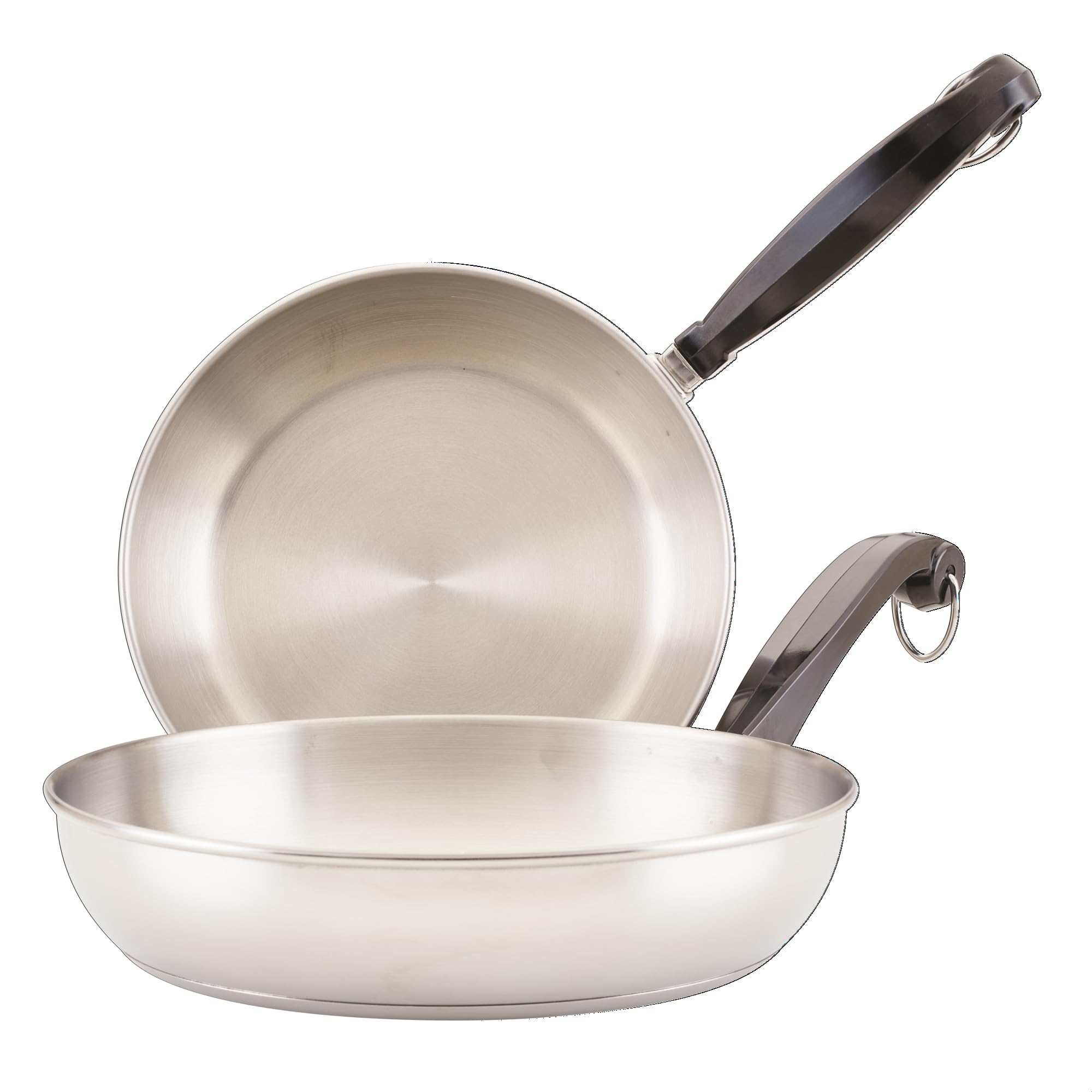
Farberware Classic Frying Pan Set
Key Features
- Base: Aluminum core
- Cleaning: Dishwasher safe
- Oven safe to: 350 °F
- Pans included: 8.25 and 10 inches
- Price: Budget
Two pans in the box, 8.25 and 10 inches, plus a lifetime warranty. The Farberware Classic set is the least expensive route here to a matched pair of stainless skillets, and it’s the one we suggest for a first apartment or a kitchen being rebuilt from nothing.
The appeal is how little it asks of you. The aluminum core sits in the base rather than running up the walls, and that’s the honest trade: the bottom heats evenly, the sides run cooler, and food browns best toward the middle. For eggs, quesadillas, a couple of chops, and a pan of sautéed vegetables, that’s plenty, and the dishwasher handles the cleanup.
The limits are specific. The oven ceiling is 350°F and the handles are plastic, so there’s no broiler finish and no hot-oven roast. If oven work is on your list, the Cuisinart MultiClad Pro goes to 550°F and takes the broiler. For stovetop cooking, which is what most people do most nights, the Farberware pair is honest cookware at a price that leaves room to upgrade later.
Pros
- Two sizes in one purchase
- Dishwasher safe with a lifetime warranty
- Even heating across the base
- Works on induction as well as gas and electric
Cons
- Oven safe to only 350°F
We recommend this set for first kitchens and rentals: two dishwasher-safe stainless pans, a lifetime warranty, and enough left over to add a better skillet once you know what you want.
Best for Serious Home Cooks
Made In 3-Piece Frying Pan Set
Key Features
- Cleaning: Hand wash only
- Construction: 5-ply clad
- Oven safe to: 800 °F
- Pans included: 8, 10, and 12 inches
- Price: Premium
Eight, ten, and twelve inches, all built the same way: five layers of stainless and aluminum clad to the rim, riveted stay-cool handles, and an oven rating of 800°F. If the plan is to clear out a mismatched drawer and start over, Made In’s set is the most complete answer in this group.
Five plies is more metal than most cooking needs, and we’ll say so. What the extra layers buy is stability: the pan holds its temperature when a cold steak goes in, so the sear doesn’t stall while the pan catches up. The 8-inch surprised us. It’s the pan that gets used for a fried egg on a Tuesday, and having it behave like the 12-inch means nothing to relearn.
The 12-inch does the heavy lifting: two ribeyes side by side, a whole cut-up chicken, a frittata that finishes under the broiler. Handles across all three are riveted stainless, shaped to stay comfortable when the pan is full, and every size is induction compatible and oven safe to 800°F, which is more headroom than most cooks will ever use.
Our hesitation is durability under hard use. A warped base is the failure to plan around: preheat gradually, don’t blast a cold pan with high heat, and let it cool before it hits water. Treated that way, the set is a genuine upgrade over a drawer of mismatched pans, and three sizes that behave identically are worth real money when you’re working two burners.
Pros
- Three sizes, all clad to the rim in 5-ply
- Oven safe to 800°F
- Stay-cool riveted handles
- Induction compatible in every size
Cons
- Hand wash only
We recommend the Made In set to anyone replacing a whole drawer at once: three 5-ply pans that behave identically, with an 800°F oven rating and hand-wash care.
Best for Single Servings
Cuisinart MultiClad Pro 8-Inch Skillet
Key Features
- Rim: Tapered
- Diameter: 8 inches
- Construction: Triple-ply clad
- Oven safe to: 550 °F
- Price: Midrange
An 8-inch skillet earns its drawer space by doing what a 12-inch pan can’t: one omelet, two eggs, a single grilled sandwich, a pan sauce for two. The MultiClad Pro is the one we reach for at breakfast. It’s fully clad tri-ply, weighs just over two pounds, and the tapered rim pours without dribbling down the outside, a small thing you notice every time you make an omelet.
Heat is the reason it works. The triple-ply body runs up the sides, so the edges of an omelet set as quickly as the middle, and the cast stainless handle stays cool long enough to move the pan by hand. It’s oven safe to 550°F and broiler safe, which means a frittata for two finishes under the broiler instead of on the burner.
Eggs will stick if you rush it: preheat until a drop of water beads and skates, then add fat, and the pan releases cleanly. That’s stainless steel rather than a fault in this pan, and at this size it’s a small surface to manage. Eight inches does limit you to small batches, so think of it as the companion to a 12-inch skillet rather than a replacement for one.
Pros
- Fully clad tri-ply in a small footprint
- Tapered rim pours cleanly
- Oven and broiler safe to 550°F
- Dishwasher safe
Cons
- Eight inches limits you to small batches
For eggs, a single chop, or a small kitchen, we recommend this clad 8-inch skillet: quick to heat, cool to handle, dishwasher safe, and oven safe to 550°F.
Best for Quick Weeknight Meals
Carote 10-Inch Tri-Ply Pan

Key Features
- Cleaning: Dishwasher safe
- Diameter: 10 inches
- Construction: 3-ply bonded
- Oven safe to: 600 °F
- Price: Budget
Ten inches, three bonded layers, an oven rating of 600°F, and a dishwasher-safe body: the Carote does the clad-pan job for a fraction of what the premium singles here cost.
The handle is the detail we appreciate most. It’s a hollow Y-shaped design with an open end, and the effect is a grip that stays cooler than a solid stainless bar when you’re working over a hot burner, which is exactly what you want when you’re tossing vegetables one-handed. Ten inches is the size we use for a pound of shrimp or a pan of peppers for two.
What you give up is longevity. The finish and the handle are the parts to watch, since this is the pan in the group where wear shows up first, and the low price is the trade for that. We think it makes a strong second skillet or a starter pan: the heat and the handle are right, and if it looks tired in a couple of years you haven’t lost much. For a pan you plan to keep for decades, spend elsewhere.
Pros
- Three-ply bonded from base to rim
- Hollow Y-shaped handle stays cooler
- Oven and broiler safe to 600°F
- Dishwasher safe
Cons
- Finish and handle wear first
We recommend the Carote as a low-cost 10-inch clad pan for eggs and quick dinners, with the caveat that the finish shows its age before the pan gives out.
Best for Covered One-Pan Dinners
VocVoi 12-Inch Pan with Lid

Key Features
- Lid: Glass, included
- Capacity: 5 quarts
- Diameter: 12 inches
- Oven safe to: 500 °F
- Price: Budget
Twelve inches, tri-ply construction, a glass lid, and an oven rating of 500°F: this is the least expensive way in this group to get a big skillet you can cover.
The lid is the reason to pick it over the other budget pans here. We used it more than we expected, to hold heat while a sauce reduced, to keep splatter off the backsplash when browning pork chops, and to check on dinner without lifting the glass. The pan is also deeper than most skillets here, at five quarts, so it handles a braise as well as a sear.
Two things to know. At five pounds it’s the heaviest 12-inch pan in this group, and a full one wants two hands. And while it’s described as working on gas, electric, glass, and halogen, induction isn’t clearly confirmed, so check before ordering if you cook on induction. Neither changes how it cooks: the heat is steady across the base and up the sides, and the pan feels more solid than the price suggests.
Pros
- Glass lid included at a budget price
- Five-quart depth doubles as a braiser
- Even heat across base and sides
- Sturdy, well-finished feel
Cons
- Heaviest 12-inch pan here
We recommend this pan to anyone who wants a big, lidded skillet without premium pricing: even heat, five quarts of depth, and a glass lid that earns its keep.
Best for Tight Kitchens
LolyKitch 3-Piece Pan Set

Key Features
- Handles: Detachable
- Construction: 3-ply bonded
- Oven safe to: 500 °F
- Pans included: 8.5, 10, and 12 inches
- Price: Midrange
Three pans, at 8.5, 10, and 12 inches, three glass lids, and handles that come off. The detachable handle is the whole idea: with the handles removed, the pans nest inside each other, so a full set takes up roughly the cabinet space of one 12-inch skillet.
The design pays off every time you put the pans away, and we found that trade worth making. If you have room for fixed handles, a conventional set is simpler to live with; if your cabinets are already full, this is the set that fits.
The pans themselves are three-ply with a starburst finish, oven safe to 500°F, dishwasher safe, and induction compatible, and the vented lids hold steam without fogging your view of dinner. The 12-inch is the one that gets used most: it handles a family-sized sauté without crowding, and the lid wilts a mountain of greens in one go.
Our reservation is the handle. A clip-on design is only as good as the click you feel when it seats, and you’ll want to check it every time before lifting a full pan. In a small kitchen, a camper, or a rental, that’s a fair exchange for the space you save; in a big kitchen with deep drawers, it’s extra fiddling for no gain.
Pros
- Handles detach so the pans nest flat
- Three sizes with vented glass lids
- Oven safe to 500°F and dishwasher safe
- Induction compatible
Cons
- Three lids still need drawer space
For small kitchens and anyone short on cabinet space, we recommend this set: three clad pans and vented lids that store flat once the handles come off.
How We Tested 12 Stainless Steel Skillets
We started by pulling every stainless skillet we could find from the major cookware lines and cross-checking the specs that actually matter: how the base is built, how thick the aluminum or copper core is, the cooking surface diameter versus the overall width, the listed weight, oven-safe temperature, and price per inch of cooking surface. Anything with a thin stamped disc base or a handle that couldn’t take a 500-degree oven came off the list before we turned on a burner. That left 12 skillets, from 8 to 12 inches.
For eight months those 12 pans lived in my kitchen and rotated through the same routine. Mornings were eggs, fried and scrambled, and I noted whether they released on their own or had to be pried up and soaked. To see how heat moved, I dusted a thin layer of flour across each dry pan over medium heat and watched where it browned first — center-out or in a ring at the edges — then timed how long butter took to foam from edge to edge. Evenings meant a thick steak, a splash of wine to see whether the fond lifted in one pass, and a stir-fry to check if the sides were tall enough to keep food in the pan. I weighed each one empty and again holding a pound of potatoes.
Cleanup told us as much as cooking did: every pan went through the dishwasher at least a dozen times, plus the occasional powdered-cleanser scrub, and I checked the polished exterior for scratches and cloudiness. I spun each one on the counter to catch a wobble from warping and tugged at handles and rivets after a season of 450-degree oven trips. Then we set price against performance, since a modest pan that sears as evenly as an expensive one is worth knowing about.
How to Choose a Stainless Steel Skillet
The choice that shapes everything else is whether the pan’s heat comes from a bonded whole body or from a disc in the base; after that it’s size, oven rating, and how much fiddling you’ll tolerate.
Clad or disc: where the heat comes from
A clad pan bonds aluminum between layers of stainless from the base up to the rim, so the walls heat along with the floor and food keeps browning when you push it to the side. A disc-bottom pan puts that aluminum only in the base: it costs less and heats the middle evenly, but the sides stay cooler and food that climbs the wall steams instead of searing.
If you sear, deglaze, and use the whole surface, pay for clad. If you mostly do eggs and pancakes in the center, a disc pan does the job for less. Watch the wording, because ‘tri-ply’ on an inexpensive pan sometimes describes only the base.
Size: measure the surface, not the rim
A skillet’s nominal size is its rim diameter, and the flat cooking surface is always smaller, so a 12-inch pan is not 12 inches of browning space. Twelve inches is the right default for a household: it fits four chicken thighs or two steaks without crowding, which is what makes a sear rather than a steam. Ten inches suits two people, and eight is for eggs, a single sandwich, and small kitchens.
Check the widest burner on your range before you go bigger, and remember that a loaded 12-inch pan is heavy in a way an 8-inch pan never is. If you flip food in the pan rather than turning it with tongs, weight matters more than an extra inch.
Oven rating, handles, and lids
The oven-safe number on the box is usually set by the handle, not the pan. A skillet rated to 350°F is a stovetop pan with a plastic grip; one rated to 500°F or 600°F can finish a roast or a frittata, and that headroom changes more dinners than an extra layer of metal does. Stainless handles tolerate the heat but get hot, so keep a dry towel within reach.
A lid is the cheapest way to make one pan do two jobs: steam, braise, hold heat, and keep splatter off the backsplash. Few stainless skillets include one, which is part of what you pay for on our top pick.
One pan or a set
Start with one 12-inch skillet if you’re new to stainless. Technique is what makes these pans work, and one pan teaches you faster than three. A set makes sense when you’re replacing everything at once or cooking for a family, and matched sizes mean the same preheat and the same spatula move work in all of them.
The trap is buying five pans when you’ll use two. Most households get by with a 12-inch and an 8-inch, and a 10-inch you never reach for is money sitting in a cabinet.
Sticking is technique, not a defect
Stainless has no coating, so release comes from heat and fat. Preheat the dry pan over medium for a minute or two, flick a few drops of water in, and wait for them to bead and skate across the surface; that’s the signal the metal is ready. Add oil or butter, let it shimmer, then add the food and leave it alone until it releases on its own.
Eggs and fish still cling if you rush the preheat or crowd the pan. Buy stainless for browning, fond, and pan sauces, and keep one small coated pan if eggs are a daily habit.
Frequently Asked Questions
Can I use metal utensils in a stainless steel skillet?
Yes. There’s no coating to scratch, so tongs, a fish spatula, and a whisk are all fine, and that’s one of the real advantages over a coated pan. The habit to avoid is cutting in the pan with a knife, which can gouge the surface. Metal on metal leaves light scratch marks over time; they’re cosmetic and don’t affect how the pan cooks.
Why has my stainless pan turned rainbow-colored or white?
Heat tint and mineral deposits, both harmless. High heat leaves a blue or rainbow hue, and hard water or salty food can leave white spots. Make a paste with a little water and a stainless cleanser, rub it on following the grain of the polish, and rinse. A vinegar soak lifts the lighter marks. Neither is a sign the pan is failing, and both will come back eventually.
Do stainless steel skillets work on induction?
Most clad stainless pans do, because the outer layer is magnetic, but not every one, and the label doesn’t always settle it. Test any pan with a magnet before you buy: if a fridge magnet clings firmly to the base and stays put, the pan will work on induction. If it slides off or barely grabs, it won’t.
Can I season a stainless steel skillet like cast iron?
No, and you don’t need to. Stainless doesn’t absorb oil the way cast iron does; baked-on oil just becomes a brown stain you’ll scrub off later. Release comes from preheating and fat, not from a built-up layer. If oil does bake on, a stainless cleanser takes it off without damaging anything.
Final Verdict
Buy the All-Clad D3 12-inch if you want one pan that sears, roasts, and steams, and you don’t mind washing it by hand. The bonded body and the lid are what put it ahead of everything else here, and the 600°F rating means it goes from burner to hot oven without a second dish.
If that’s more pan than you want to pay for, the Tramontina Signature gives you the same bonded clad construction in the same 12-inch size for far less, and gives up only the lid. Cooking mostly for one? Start with the 8-inch Cuisinart and add the big pan when the household grows.