This post contains affiliate links. We may earn a small commission when you buy through our links — at no extra cost to you.
The market for induction-compatible sauté pans is split between two camps: stainless steel enthusiasts who accept a learning curve for lifetime durability, and nonstick seekers who want immediate easy release but often find coatings fading faster than promised. Both sides make valid claims, but marketing frequently stretches the truth on how long nonstick surfaces hold up.
This guide cuts through that noise. It highlights pans that actually deliver on their promises based on real-world use patterns — whether you need a weekly workhorse for family meals or a lightweight nonstick for quick weeknight dinners. The right choice depends on how you cook, not on how a pan looks on a shelf.
If you’re wrestling with the stainless-vs-nonstick decision, the key is matching the pan to your tolerance for maintenance. Stainless rewards proper technique with decades of service; nonstick rewards convenience but asks for replacement every one to three years.


Best for Everyday Family Cooking
Cuisinart 5.5Qt Stainless
Key Features
- Material: Stainless steel, aluminum base
- Capacity: 5.5 Qt
- Oven Safe: Yes
- Induction: Yes
- Price: $$
The Cuisinart 5.5Qt sauté pan spreads heat uniformly across its cooking surface, supporting searing, sautéing, and braising without persistent hot spots. The tri‑ply construction—stainless steel with an aluminum core—makes it compatible with induction cooktops and oven‑safe for finishing dishes. Its 5.5‑quart capacity handles full family portions or batch‑cooked stews with room to spare.
The pan’s weight is the most immediate physical tradeoff: when filled, lifting and pouring safely requires two hands. The helper handle improves control, but one‑handed maneuvers are awkward. The stainless surface rewards a brief preheat before adding oil, a standard technique that prevents sticking and produces good browning. Cooks who follow that step get consistent results across varied recipes.
This pan fits home cooks who want a durable, induction‑compatible workhorse for everyday family cooking and don’t mind its substantial heft. Those with wrist or grip concerns may prefer a lighter alternative. When fully loaded, the pan demands two hands for safe pouring—a detail to weigh if you frequently drain large batches of liquid.
Pros
- Even heat distribution prevents hot spots during searing and simmering.
- 5.5‑quart capacity accommodates family‑sized meals and batch cooking.
- Easy to clean with Bar Keepers Friend or similar stainless cleaner.
- Mid‑range price offers strong build quality for the cost.
Cons
- The pan’s weight can make one‑handed pouring difficult, especially when loaded with food or liquid.
For cooks who prioritize even heat and durability over lightness, the Cuisinart 5.5Qt delivers consistent performance at a reasonable cost.
Best for Durable Nonstick Daily
Circulon A1 5Qt Nonstick
Key Features
- Material: Aluminum, ScratchDefense coating
- Capacity: 5 Qt
- Oven Safe: 400°F (lid 350°F)
- Induction: Yes
- Price: $$
The Circulon A1’s ScratchDefense coating handles metal utensils and dishwasher cleaning without showing the wear that sidelines other nonstick pans. Food releases easily, and the aluminum body delivers even heating on induction cooktops without warping.
This pan suits home cooks who want a long-lasting nonstick surface for daily sautéing and don’t need oven temperatures above 400°F. The lid is limited to 350°F, so high-heat roasting or searing finishes are off the table — a tradeoff for the pan’s scratch resistance and dishwasher safety.
Pros
- Scratch-resistant nonstick coating holds up to metal utensils and dishwasher cleaning
- Nonstick performance makes food release and cleanup quick
- Heats evenly on induction and resists warping
Cons
- The scratch-resistant coating can show wear over time under heavy use
- Oven safe only to 400°F (lid 350°F), limiting high-heat roasting or finishing
Best for cooks who value a nonstick pan that survives metal spoons and dishwasher loads over high-heat oven versatility.
Best for Enthusiast Heat Control
All-Clad D3 3Qt Stainless
Key Features
- Material: Tri-ply stainless steel
- Capacity: 3 Qt
- Oven Safe: 600°F
- Induction: Yes
- Price: $$$
The All-Clad D3 3Qt saute pan uses tri-ply stainless cladding that responds nearly instantly to heat adjustments. This construction gives the pan an edge in searing and deglazing over broader alternatives that prioritize volume over precision.
This pan suits enthusiast cooks who value heat control and plan to keep cookware for decades. The 3-quart size works well for individuals or couples; those feeding larger families should look at the Cuisinart 5.5Qt. The stainless surface requires a brief adjustment — preheating and oil are needed to prevent sticking.
Pros
- Tri-ply bonded construction provides even heat distribution and rapid temperature response.
- Lifetime build quality with pans regularly lasting decades.
- Excellent for searing, deglazing, and making pan sauces.
Cons
- Stainless steel requires preheating and oil to prevent sticking — a learning curve for those new to stainless.
For cooks who prioritize heat responsiveness and longevity over sheer capacity, this 3-quart pan delivers precision that holds up for decades.
Best for Large Batch Cooking
Tramontina 6Qt Tri-Ply
Key Features
- Material: Tri-ply stainless steel
- Capacity: 6 Qt
- Oven Safe: 500°F
- Induction: Yes
- Price: $$
Tri-ply stainless steel construction with an aluminum core delivers even heat distribution across the full 6-quart surface, making it suitable for searing and braising. This pan matches the build quality of brands costing significantly more, though heat responsiveness is slightly less immediate than All-Clad’s copper-core models. The 6-quart capacity sets it apart from the 5.5-quart Cuisinart, offering extra room for larger batches.
Best for home cooks who need a large induction-compatible pan and are willing to trade off some heft and a steeper learning curve for the cost savings. The weight becomes demanding when the pan is full — expect to use two hands to lift and pour. The lid has no steam vent, so boil-overs can occur with liquid-heavy dishes. Stainless steel requires proper preheating and oil technique to avoid sticking, a typical adjustment for anyone moving from nonstick.
Pros
- Large 6-quart capacity handles family-sized portions without crowding.
- Even heat distribution across tri-ply construction for consistent cooking.
- Solid build quality with NSF certification and lifetime warranty.
Cons
- Heavy when full, and the lid lacks a steam vent, increasing risk of boil-overs.
- Stainless steel surface requires careful preheating and oil management to prevent sticking.
For its price and capacity, this pan delivers value that few competitors match — but only if you’re comfortable handling a heavy pan and adjusting to stainless steel cooking.
Best for Budget Family Nonstick
SENSARTE 12" Nonstick 5Qt
Key Features
- Material: Aluminum, ILAG nonstick
- Capacity: 5 Qt
- Oven Safe: 302°F
- Induction: Yes
- Price: $
This 12-inch pan offers the largest nonstick surface we tested on induction at this price, with a helper handle that makes lifting manageable. The nonstick coating releases food cleanly at first, though reports of scratching within months are noted—best for cooks who value easy cleanup over long-term durability. The low 302°F oven tolerance limits stovetop-to-oven recipes, so this pan stays on the cooktop.
Ideal for families cooking large batches on induction who want a lightweight, easy-to-clean pan and are comfortable replacing nonstick every year or two. The coating wear and low oven temperature are acceptable tradeoffs for the low initial cost.
Pros
- 12-inch diameter and 5-quart capacity handle family-sized meals on induction.
- Nonstick surface releases food easily and wipes clean with minimal effort.
- Priced well below most induction-compatible nonstick pans of this size.
Cons
- Nonstick coating can scratch or lose its release within months under regular use—best for lighter cooking.
- At 5 quarts full, the pan is heavy enough to require two hands for safe pouring, especially for smaller cooks.
For large families on a budget who prioritize immediate nonstick ease over longevity, this pan delivers dependable performance at a low entry price.
Best for Singles or Couples
Breville 3.5Qt Clad
Key Features
- Material: Tri-ply clad stainless
- Capacity: 3.5 Qt
- Oven Safe: 500°F
- Induction: Yes
- Price: $$
This Breville pan delivers even heat distribution on induction without hot spots, matching the performance of more expensive tri-ply pans. Its three-layer clad construction provides responsive temperature control, and the stainless steel surface won’t react with acidic foods. Compared to the larger Cuisinart pan, the Breville offers similar heat performance in a more compact form that’s easier to store.
The 3.5-quart size is best for singles or couples cooking sides, sauces, or two servings of protein — not for family-sized meals. At over 3 pounds, the pan feels substantial; those with wrist issues may find it tiring to handle daily. Breville’s build quality is evident in the tight-fitting lid and sturdy handle, making this a dependable choice for everyday cooking within its size limits. The 500°F oven safety adds flexibility for finishing dishes in the oven.
Pros
- Even heat distribution prevents hot spots for consistent browning and searing.
- Heavy-duty construction feels solid and durable for long-term use.
- Good value for a tri-ply pan with this build quality at a mid-range price.
Cons
- 3.5-quart capacity suits 1-2 person meals, not family cooking.
- Weight is noticeable; may be uncomfortable for daily use for those with wrist concerns.
For smaller households wanting even heating and solid construction without the premium price of All-Clad, this Breville pan delivers consistent results.
Best for Budget Stainless Entry
CAROTE 10" Tri-Ply Stainless

Key Features
- Material: Tri-ply stainless steel
- Capacity: 4 Qt
- Oven Safe: 600°F
- Induction: Yes
- Price: $
For cooks seeking an induction-ready stainless steel pan without spending $100+, the CAROTE 10" delivers even heat distribution and solid construction at a budget-friendly price. Its tri-ply build handles sauces and searing well once you master the preheating technique – expect food to stick initially if you rush the process. The real tradeoff is handle durability: under daily heavy lifting the rivets may loosen, making this better suited as a starter pan or occasional-use piece rather than a lifelong workhorse. At 4 quarts, it’s smaller than the 5.5-quart Cuisinart top pick, but the price advantage is hard to ignore for cooks willing to accept that minor QC gamble.
Pros
- Even heat distribution across the tri-ply surface for consistent cooking results.
- Strong build quality and solid feel relative to the low price point.
- Good value for a tri-ply stainless pan with induction and 600°F oven safety.
Cons
- Under frequent heavy use, the handle may loosen over time – less of an issue for moderate home cooking.
- Stainless surface demands proper preheating and oil; food may stick initially if technique isn’t followed.
Best suited as a budget-friendly entry into stainless steel or a spare pan for cooks comfortable with the learning curve and willing to accept handle longevity as a variable.
Best for Budget Hybrid Test
Inqibee 5Qt Hybrid

Key Features
- Material: Tri-ply stainless, hybrid nonstick
- Capacity: 5 Qt
- Oven Safe: 500°F (lid 350°F)
- Induction: Yes
- Price: $
The Inqibee 5QT Hybrid Nonstick Saute Pan combines tri-ply construction, induction compatibility, and a 5-quart capacity at a price that undercuts most competitors. Its nonstick surface handles everyday cooking tasks like eggs and stir-fries without sticking. However, long-term durability under heavy daily use remains uncertain, and the nonstick coating may not hold up as well as higher-priced alternatives. This makes the pan a sensible choice for light to moderate users or those testing the hybrid nonstick category without a major investment.
Pros
- Tri-ply hybrid nonstick construction with induction compatibility at an entry-level price.
- Nonstick surface performs well for eggs, pancakes, and other delicate items from the start.
Cons
- Coating durability may fall short of premium pans under regular heavy use.
For budget-conscious shoppers who want to explore a hybrid nonstick pan without a large upfront cost, the Inqibee offers a low-risk entry point—provided you accept that its longevity is unproven.
Best for Premium 5-Ply Style
KitchenAid 5Qt 5-Ply

Key Features
- Material: 5-ply clad stainless
- Capacity: 5 Qt
- Oven Safe: 500°F
- Induction: Yes
- Price: $$$
The KitchenAid 5-qt sauté pan delivers even heat from its 5-ply construction and keeps handles cool, a practical advantage for larger batches. However, its weight makes it a two-handle pan when loaded, and the polished stainless surface demands regular cleaning to stay spot-free. Priced close to All-Clad D3 but with heavier feel and less refined handle ergonomics, it’s a capable choice for home cooks who prioritize capacity and aesthetics over lightness.
Pros
- 5-ply clad construction provides even heat distribution across the large 5-quart surface
- Black stainless handles remain cool to the touch during cooking
Cons
- Stainless exterior shows water spots and fingerprints; regular polishing needed
- Heavy pan may be cumbersome to maneuver, especially when full
Best for home cooks who want a large, good-looking stainless pan and are willing to manage its weight and upkeep rather than pay the premium for a lighter alternative.
Best for Italian Craftsmanship
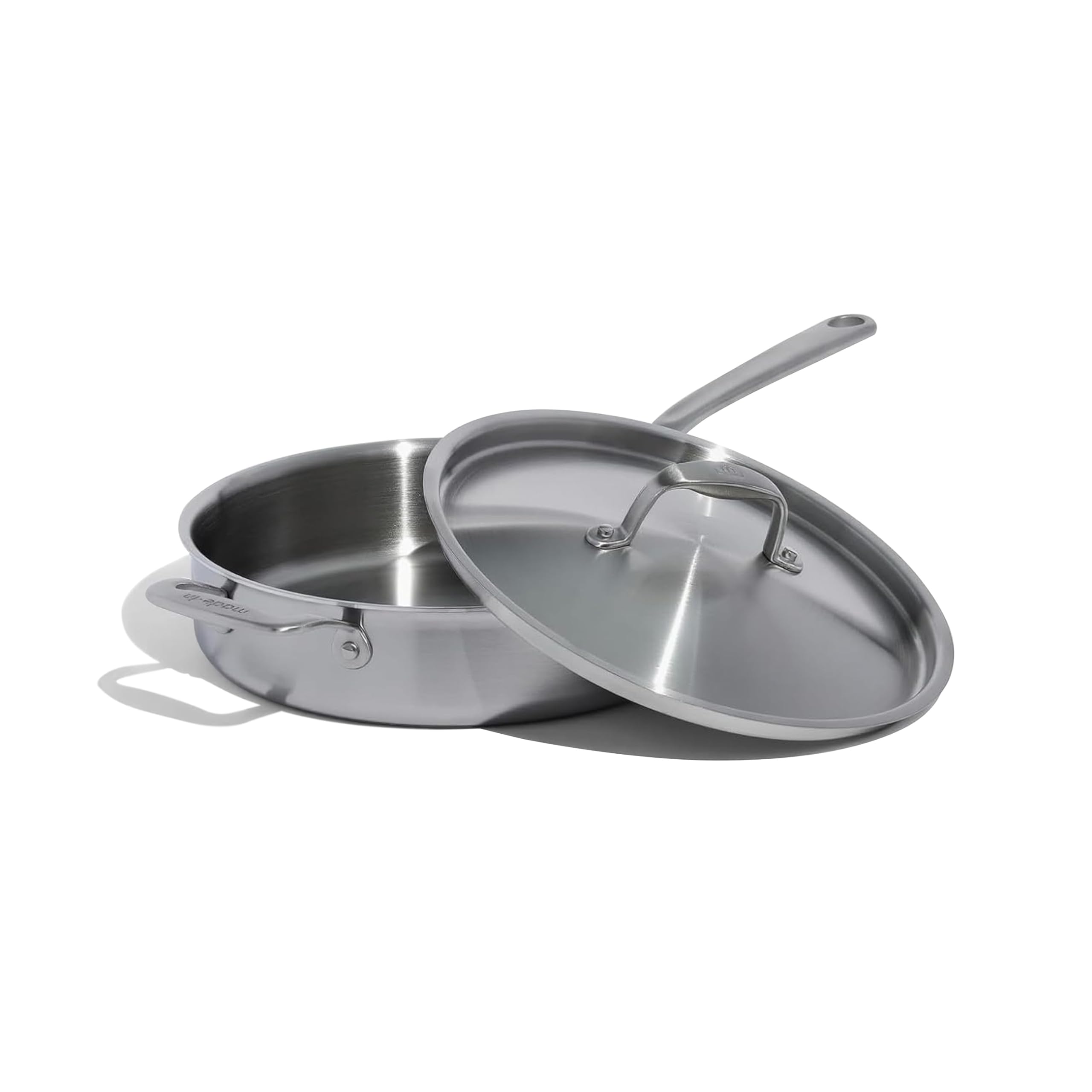
Made In 3.5Qt 5-Ply
Key Features
- Material: 5-ply stainless steel
- Capacity: 3.5 Qt
- Oven Safe: 800°F
- Induction: Yes
- Price: $$$
The Made In 3.5-quart saute pan uses 5-ply stainless steel construction that heats evenly and retains heat well, with an oven-safe limit of 800°F that handles high-heat roasting. Its handle stays cool during stovetop use. However, some units may develop a warp that causes wobbling on flat cooktops, so checking flatness on arrival is wise. The 3.5-quart capacity and premium pricing limit its appeal for family cooking when larger stainless pans cost less per quart. This pan suits the cook who prioritizes Italian craftsmanship and extreme oven temperature tolerance over capacity and a worry-free flat cooktop experience.
Pros
- 5-ply stainless construction delivers even heat distribution and heat retention.
- Handle stays cool and remains comfortable during extended stovetop use.
- Oven safe up to 800°F for high-heat roasting and searing.
Cons
- Premium price for a 3.5-quart pan; larger stainless options cost less per quart.
- Some units may develop a warp that causes wobbling on flat cooktops — worth inspecting before first use.
Best for the cook who values Italian craftsmanship and 800°F oven safety over capacity and a worry-free flat cooktop experience.
Best for Precision Heat Control
All-Clad Copper Core 3Qt

Key Features
- Material: 5-ply with copper core
- Capacity: 3 Qt
- Oven Safe: 600°F
- Induction: Yes
- Price: $$$$
The copper core delivers exceptional responsiveness for precision searing and sauce work—ideal for induction cooktops. However, the 3-quart capacity limits batch cooking, the stainless interior shows discoloration quickly, and the handle shape may feel awkward during extended use. The premium price and regular polishing requirements make this a specialist tool for dedicated cooks rather than a daily driver.
Pros
- Copper core delivers instant heat response across the entire pan surface.
- Build quality and materials support decades of heavy use.
Cons
- Stainless interior shows discoloration and charring; regular polishing needed.
- Handle may feel uncomfortable for some users due to shape and weight.
Best for the serious home cook who prioritizes heat precision over cost and maintenance, and works with small batches.
Best for Aesthetic Non-Toxic
Caraway 4.5Qt Ceramic

Key Features
- Material: Ceramic nonstick over stainless
- Capacity: 4.5 Qt
- Oven Safe: 550°F
- Induction: Yes
- Price: $$$
The Caraway sauté pan’s ceramic coating offers nonstick performance free of PTFE/PFOA, with 550°F oven safety and induction compatibility. The color options and sleek design make it a natural fit for display. However, the coating can lose its release properties within months of regular use, and the weight requires two hands when full. This pan suits light, occasional cooks who value aesthetics and non-toxic materials over long-term durability.
Pros
- Attractive color options complement kitchen decor and suit health-conscious priorities
- Nonstick surface releases food easily and requires minimal scrubbing
Cons
- Heavy construction requires two hands to lift when full
- Ceramic coating may lose nonstick performance within months of regular use
Best suited for those who cook infrequently, prioritize kitchen aesthetics and non-toxic materials, and accept that the pan’s nonstick lifespan is limited.
How to Choose
The single most important buying insight: nonstick coatings are consumables, while stainless steel pans become heirlooms — so match your choice to how often you’re willing to replace cookware, not just upfront price.
Material: Stainless Steel vs Nonstick
Stainless steel offers unmatched durability and oven versatility. It requires preheating (the water droplet test) and sufficient oil to create a semi-nonstick effect. Once learned, you can sear, deglaze, and build sauces without worrying about coating wear.
Nonstick surfaces — whether PTFE or ceramic — make cooking and cleanup effortless out of the box. But they degrade with heat above 500°F, metal utensils, and time. Expect to replace a daily-use nonstick pan every 1–3 years, regardless of brand claims.
Capacity: Quart Size for Your Household
A 3-quart pan works well for singles or couples, enough for a chicken breast and vegetables. Families of 3–4 need at least 5 quarts to avoid overcrowding. An 8-inch diameter pan with 4 quarts is often too small for a full meal; look for 10–12 inch diameter with 5+ quarts.
Oversized pans (6 quarts or more) are heavy even empty. When full, they become two-hand affairs. Make sure your storage space and wrist strength match the size you choose.
Oven-Safe Temperature
Higher oven temperatures (500°F+) let you start on the stovetop and finish in the oven — ideal for searing steaks then roasting, or starting a braise in the pan. Nonstick pans typically cap at 400–500°F, and lids even lower. Stainless pans can go to 600°F or higher without risk.
If you frequently use the stovetop-to-oven method, avoid pans with low oven limits (e.g., 302°F on some budget nonstick). That restriction eliminates the ability to broil or sear finishes.
Induction Base Flatness
Induction cooktops require a completely flat base to make full contact with the electromagnetic coil. A warped pan spins or rocks, causing uneven heating and noisy operation. Stainless steel pans with thick, multi-ply bases resist warping better than thin aluminum ones.
Some pans, especially 5-ply or copper-core models, are more prone to slight warping over time. Check the base for flatness after purchase by placing it on a flat surface. If it rocks, return it immediately.
FAQ
Why does my new stainless steel sauté pan stick so badly even with oil?
Stainless steel requires proper preheating before adding oil. Heat the pan dry until a water droplet beads and skates across the surface (the Leidenfrost effect). Then add oil and let it shimmer before adding food. Without this step, food bonds to the microscopic pores in the metal. It’s a learned technique, not a product flaw.
How long does the nonstick coating last on a Circulon or Ninja sauté pan?
With daily use, most nonstick coatings — including Circulon’s ScratchDefense and Ninja’s NeverStick — begin to show wear within 12–18 months, even with careful handling. The ‘metal-utensil safe’ claim means they survive occasional metal use, but regular metal utensils still accelerate degradation. Plan on replacement every 2–3 years for moderate use.
Can a 12-inch sauté pan with a helper handle fit on a standard induction burner?
Most induction burners have a heating zone of 6–8 inches in diameter. A 12-inch pan will extend beyond the zone, causing the outer edges to heat less efficiently. It still works for larger quantities, but for even searing, match the pan diameter to the burner’s ring size. Check your cooktop manual for maximum pan diameter.
Should I get a stainless steel or nonstick sauté pan for my induction cooktop?
If you’re willing to spend a few minutes learning proper preheating and deglazing, a stainless steel pan will outlast any nonstick by decades and can go into the oven at high heat. If you want immediate ease and rarely use high temperatures, a quality nonstick like the Circulon A1 is a better fit — just plan to replace it every 2–3 years.