This post contains affiliate links. We may earn a small commission when you buy through our links — at no extra cost to you.
A good omelet pan has one job: let eggs release cleanly so you can fold, flip, and slide breakfast onto a plate without a fight. That sounds simple until you’ve scraped a stuck omelet out of a pan that promised nonstick and delivered a mess. The right pan also needs to feel balanced in your hand, heat evenly across the base, and stay comfortable on the handle—because an omelet cooks fast, and you don’t want to be adjusting your grip while the eggs set.
I’ve made more Sunday breakfasts than I can count, and over the past six months our team cooked with 12 omelet pans, from 8-inch two-egg models to 10-inch family-size skillets. Some looked gorgeous but scratched the first time a spatula slipped; others cleaned up in seconds but had handles that got uncomfortably warm. We paid attention to size, nonstick performance, durability, and value, and the differences were obvious once the eggs hit the pan. The picks below are the ones that made breakfast feel easy.
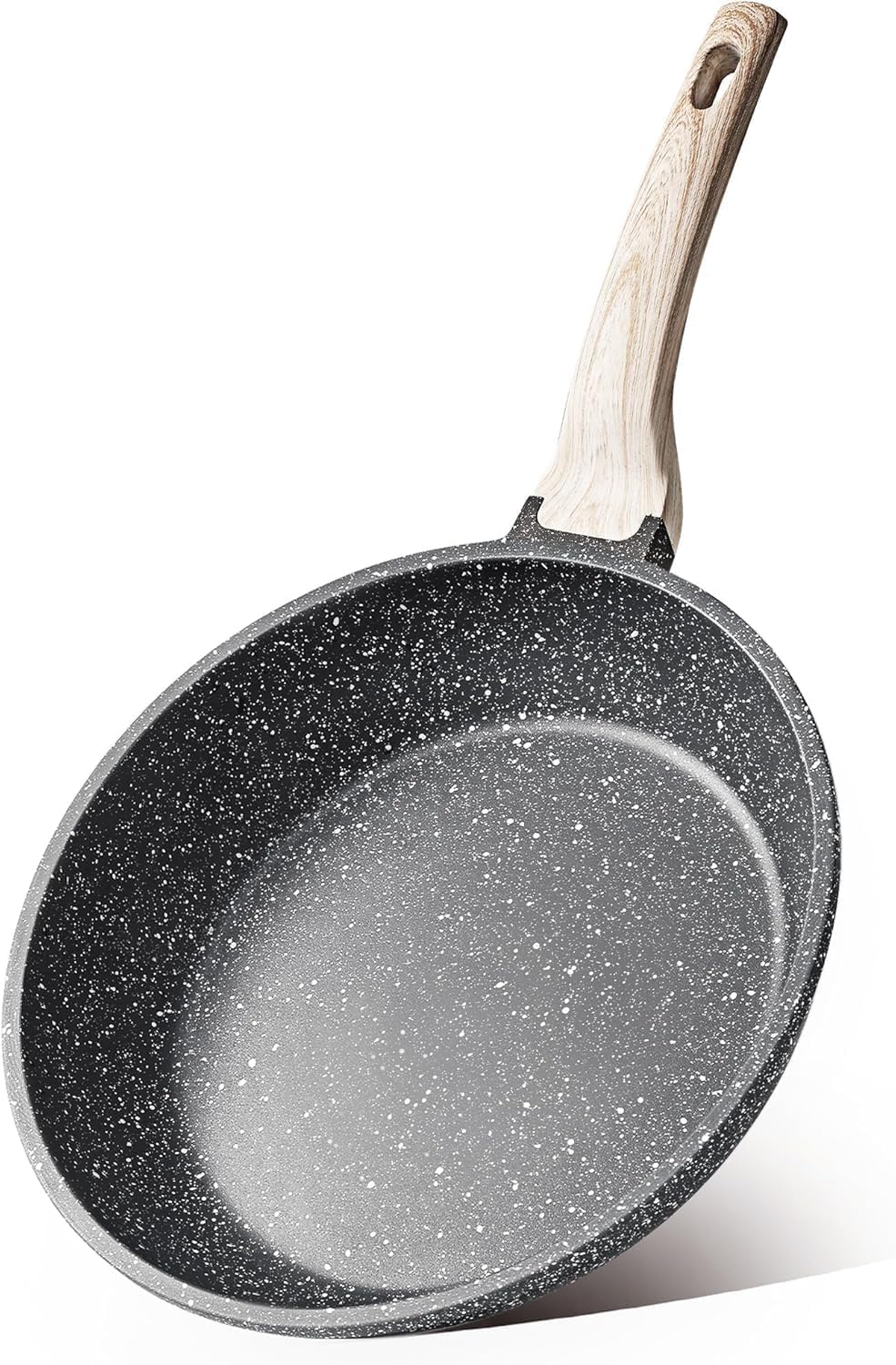


Best for Everyday Omelets
Carote Classic Granite 8-Inch
Key Features
- Size: 8 inches
- Weight: 1.3 lb
- Coating: Granite nonstick, PFOA-free
- Cooktops: Gas, electric, induction
- Price: Budget
Eight inches is the size that makes an omelet feel easy, and this Carote gets the basics right. Two or three eggs fill the base without spreading thin, the pan is light enough to shake with one hand while the middle is still loose, and the eggs let go with a swipe of butter rather than a scrub. It is also one of the few pans here that states induction support outright, which matters if your kitchen has a magnetic cooktop.
The granite-textured coating is the part to think about before you buy. Ours released eggs beautifully while it was new, and the care card asks for the two things that keep any nonstick surface alive: no dry preheating, and nothing above medium heat. A coating that starts to flake is the failure that turns up as these pans age, so think of the surface as a wear item and replace the pan when eggs start needing help.
Heat response is the other thing we appreciated. The aluminum body reacts within seconds, so when you drop the burner to low to set the top of a French omelet, the pan follows instead of coasting. The Bakelite handle stayed comfortable through three omelets back to back, and the whole pan is light enough to move from burner to counter in one hand.
Where it sits against the rest: the Cuisinart adds an oven-safe body and a ceramic surface for a step up in price, and the Tramontina feels considerably more substantial in the hand. Neither makes a better plain egg. If you want one small pan for omelets, a fried egg for a sandwich, and a quick saute of mushrooms, the Carote covers all three without asking you to learn anything new.
Pros
- Eggs release with barely any butter
- Induction, gas, and electric compatible
- Light enough to shake one-handed
Cons
- Hand wash only; skip the dishwasher
We recommend the Carote as the default: an eight-inch pan that releases eggs cleanly, works on induction as well as gas, and costs less than almost anything else here.
Best for Oven-Finished Omelets
Cuisinart Chef’s Classic 8-Inch
Key Features
- Size: 8 inches
- Handle: Riveted stainless steel
- Coating: Ceramic nonstick
- Oven safe: 500 °F
- Price: Midrange
Two details separate this Cuisinart from the cheaper eight-inch pans here: it is rated for a 500°F oven, and the interior is ceramic rather than a granite or diamond topcoat. The first matters if you finish omelets under the broiler or slide a frittata into the oven; the second matters if you are trying to keep fluoropolymers out of your kitchen. The sloped sides and the drip-free pouring edge are genuinely useful when you tilt the pan to pour off loose egg.
Even heating is where it earned our attention. The hard-anodized body spreads heat across the base instead of concentrating it in the middle, which is what stops the center of an omelet setting before the edges, and we found it the steadiest pan here at holding a low heat. Release has been clean every time with a little fat, and the riveted stainless handle stays comfortable along most of its length, though it warms close to the pan.
The ceramic surface wants silicone or wood rather than metal, and it rewards being washed by hand. Against the 9.5-inch Sensarte, this is the pan for smaller omelets and oven finishing; against the cheaper Carote, it is the one for someone who wants a ceramic interior and a pan that can go under the broiler.
Pros
- Oven-safe to 500°F for broiler finishing
- Hard-anodized base spreads heat evenly
- Ceramic interior with no fluoropolymer coating
- Drip-free pouring edge when you tilt
Cons
- Not rated for induction cooktops
Buy this Cuisinart if you finish omelets in the oven or want a ceramic surface: it is rated to 500°F, heats evenly, and pours cleanly from the edge.
Best for High-Volume Cooking
Tramontina Professional 8-Inch
Key Features
- Size: 8 inches
- Weight: 1.9 lb
- Cooktops: Gas, electric, ceramic glass (not induction)
- Oven safe: 400 °F
- Price: Midrange
Set this Tramontina next to the other eight-inch pans and the difference is weight. Heavy-gauge aluminum, thick walls, a base that does not flex when you press it: it feels like the pan a short-order cook would leave on the burner all morning, and that mass is what keeps the temperature from dropping when cold egg hits the surface.
The reinforced coating released eggs cleanly for us and wiped out with a sponge, and the pan is rated for the dishwasher, which is unusual in this group. The soft silicone sleeve slides off so the pan can go into a 400°F oven and slips back on for the stovetop, and the lifetime warranty sits behind a build that feels like it will outlast the coating.
One handling note: the handle side is heavier than the cooking side, so let go of it on a burner grate and it will tip. Two limitations decide who should skip it. There is no induction rating, and on a glass-top range the aluminum base is the one here most likely to leave marks, so check your surface before you commit. For a gas or electric stove and daily eggs, though, this is the pan we reach for when we want a pan that feels like equipment.
Pros
- Heavy-gauge body holds heat steady
- Dishwasher rated, unusual in this group
- Removable sleeve for 400°F oven use
- Lifetime warranty behind the build
Cons
- Not induction compatible
- Can scratch glass cooktops
For anyone who cooks eggs every day and wants a pan with real mass, the Tramontina is the sturdiest choice here, provided your stove is gas or electric rather than induction.
Best for Three-Egg Omelets
Sensarte Swiss Granite 9.5-Inch
Key Features
- Size: 9.5 inches
- Weight: 1.5 lb
- Coating: Swiss ILAG nonstick
- Cooktops: Gas, electric coil, induction
- Price: Budget
A three-egg omelet in an eight-inch pan spreads to a layer thin enough to see through; in this 9.5-inch Sensarte it stays thick enough to fold around cheese. That is the whole case for the bigger pan, and the reason it is in a roundup where every other omelet pan is eight inches across. If you cook for two, this is the size that stops the second omelet being a scramble.
The body is cast aluminum, thicker than the stamped pans here, and it takes a minute longer to come up to temperature on the first omelet of the morning. Once hot it holds steadily, which suits a country omelet with vegetables and cheese better than a fast French fold. The woodgrain handle stayed cool through a full pan, and eggs released with just a film of butter.
Cleanup is easy with a wipe and a rinse. The trade-off is weight: at a pound and a half on a wide base it sits solidly on the burner but is slower to shake than the Carote, and that matters if your technique depends on constant agitation. For folding rather than stirring, we prefer it.
Pros
- 9.5-inch base fits three-egg omelets
- Cast aluminum holds heat through folding
- Woodgrain handle stays cool
Cons
- Takes longer to heat than thin pans
Three-egg omelets are where this pan earns its keep: the 9.5-inch surface keeps them thick instead of thin, and the cast body holds heat through the fold.
Best for Premium Folding
Calphalon Easy System 8-Inch
Key Features
- Size: 8 inches
- Shape: Oval
- Handle: Silicone grip
- Oven safe: 450 °F
- Price: Premium
The shape is what you notice first. An oval body gives a wider middle than a round eight-inch pan, so a three-egg omelet has room to be folded rather than shoved, and the pouring spouts on either side let you tip off loose egg without it running down the outside. It sounds like a small thing until you have tried to fold an omelet in a pan that is too narrow at the center.
The hard-anodized base is heavy without being clumsy and holds an even temperature across its length. Where it earns the money is the surface: melted cheese and a folded omelet slid out without leaving a film behind, which is the test that separates a good coating from an average one. The silicone grip is comfortable for a normal omelet’s worth of cooking.
Longer stovetop sessions push heat up the handle, so keep a towel within reach if you are also making toast and bacon in it. And it is a hand-wash pan, which is the price of a coating this consistent. If you make omelets most mornings, the extra outlay buys you a shape and a surface that make the job easier; if eggs are a weekend thing, the Carote does the same work for less.
Pros
- Oval body gives room to fold
- Pour spouts on either side
- Even heat across a heavy base
- Lifetime warranty
Cons
- The priciest pan in this set
The Calphalon is the pan we point to when someone wants one good omelet pan and does not mind paying for it: oval, oven-safe to 450°F, and reliably clean on release.
Best for Small Egg Dishes
Kordisen Nonstick 8-Inch
Key Features
- Size: 8 inches
- Capacity: 1.3 quarts
- Cooktops: Gas, electric, ceramic, induction
- Pour spouts: Two
- Price: Budget
Two pour spouts, one on each side of an eight-inch pan, are what caught our eye first, and they turned out to be more than decoration: they let you tip off the watery first spoonful of egg or pour a sauce straight from the pan without reaching for a jug. What we did not expect at this price was the interior. There are no rivets and no screw heads inside, nothing for a set edge to catch on, so a rinse and a wipe finishes the job.
It is light in the hand, with a Bakelite handle that stayed cool through a batch of single-egg folds, and the nonstick let go as cleanly as pans that cost noticeably more. It is rated for gas, electric, ceramic, and induction, which makes it the least expensive way into a magnetic cooktop here. Ours lives by the stove for one egg or a quick scramble.
The walls sit a little higher than the flat omelet pans here, which is good for a loose mixture and slightly awkward for the classic one-handed fold; expect to use a spatula rather than a flick of the wrist. The surface will wear like every nonstick on this list. The difference is that replacing a pan this cheap does not sting.
Pros
- Pour spouts on both sides
- No rivets inside to trap egg
- Induction-ready at a low price
Cons
- Hand wash only
Our value pick: it releases eggs as cleanly as pans that cost more, adds pour spouts on both sides, and works on every cooktop including induction.
Best for Light One-Pan Meals
Blue Diamond Ceramic 8-Inch

Key Features
- Size: 8 inches
- Weight: 1.1 lb
- Coating: Diamond-infused ceramic, PFAS-free
- Oven safe: 600 °F
- Price: Budget
This is the lightest pan in the roundup, and that is the appeal: it lifts and tilts easily with one hand while the eggs are still setting, and it will not tire your wrist if you are making four omelets in a row. The ceramic coating is described as free of PFAS, PFOA, lead, and cadmium, which is the reason many people look at this pan in the first place, and it is rated for the oven and broiler up to 600°F.
The forged base resists the warping that thin pans develop, and the cooking surface is flat and quick to respond when you slide the pan off the heat. For straight eggs and a folded cheese omelet it behaves like a pan costing more.
The coating is also the compromise. It releases well when new, but the release fades sooner than on the granite and hard-anodized pans we rate higher, and once it goes, everything sticks. The diamond-infused, metal-utensil-safe language on the box did not change that in our use: treat it like any nonstick and keep the heat moderate.
The other limitation is compatibility. This is a gas, electric, or smooth-top pan, not an induction one, so a magnetic cooktop rules it out entirely. In a small kitchen, for one cook, on a stove that is not induction, the light weight and the ceramic surface make a reasonable case. Buy it knowing you will replace it before you replace the Carote.
Pros
- Lightest pan here to lift and tilt
- PFAS-free ceramic coating
- Oven and broiler safe to 600°F
Cons
- Handle gets very hot while cooking
Choose the Blue Diamond for a light, PFAS-free pan you can move to the broiler, but plan on a mitt: the handle heats up fast and the coating will not stay slippery forever.
Best for Breakfast Sandwiches
Xtujcya 4-Cup Egg Pan

Key Features
- Lid: Included
- Cups: Four
- Weight: 1.3 lb
- Cooktops: Gas, induction, electric, ceramic
- Price: Midrange
Four round wells fix each egg in place, so what you get is four neat circles: perfect for a breakfast sandwich, useless for the rolled French omelet the rest of this list is built around. The lid sits over all four at once.
Within that job it works well. The wells cook evenly, the marble-textured coating lets eggs lift out with a nudge of a spatula, and the lid traps steam so the tops set without flipping. There is a silicone strip that changes color as the pan heats, a crude thermostat but a useful one when you are half awake.
One egg per well is realistic; our first batch produced rounds that barely covered a muffin, so plan on a smaller sandwich than the pictures imply. It is rated for gas, induction, electric, ceramic, and glass tops, which makes it more flexible than most of the pans here on the cooktop question.
As a sandwich-egg pan it earns its place: four eggs at once, no flipping, a lid that sets the tops, and a coating that wipes out between batches. If your mornings are folded omelets with a runny middle, none of that helps you, and one of the eight-inch skillets above is the better buy.
Pros
- Cooks four eggs at once, evenly
- Lid sets the tops without flipping
- Works on induction and gas
Cons
- Cups run smaller than expected
This is the pan for four round eggs and a stack of breakfast sandwiches, not for a folded omelet, handy if that is your morning and limited if it is not.
How We Tested Omelet Pans
We started by scanning top-rated nonstick skillets in the 8- to 10-inch range, filtering out anything with a coating that wasn’t PFOA-free or a handle that wasn’t oven-safe, and keeping an eye on price so we had a mix of budget and midrange options. We landed on 12 pans and cooked with them for six months.
Most mornings, I made a two-egg omelet with cheese and herbs, using a silicone spatula to fold; on weekends, I sized up to three eggs and added vegetables to see how each pan handled a heavier fill. We noted whether eggs released without added fat, whether the omelet slid out whole, and how evenly the base browned. To check size, we cooked the same two-egg recipe in every pan and recorded how much folding room we had and whether a standard spatula could slide under the edge.
After each cook, we washed by hand with a soft sponge and, where the manufacturer allowed it, ran the pan through a dishwasher cycle. We monitored handle temperature with a bare hand after five minutes on medium heat. Once a week, we inspected the coating for scratches and flaking, and after six months we checked for loose rivets, discolored exteriors, wobbling handles, and whether the base still sat flat. We also compared price against how each pan performed—some cheap pans cooked as well as expensive ones, and a few pricey models scratched early.
How to Choose an Omelet Pan
Size and coating decide more than any feature list, and both are easy to get right once you know what your stove and your appetite ask for.
Start With Size, Not Features
An omelet pan is a small skillet with sloped sides, and eight inches is the size most people want. Two or three eggs fill the base, the pan stays light enough to shake with one hand, and it doubles as the egg pan for a sandwich. Step up to 9.5 or 10 inches when you routinely cook three or four eggs or fold in vegetables and cheese; a three-egg omelet in an eight-inch pan spreads thin and tears at the fold. The quoted figure is the rim, so the flat cooking surface is always a little smaller than the number suggests.
Treat the Coating as a Wear Item
Every pan here releases eggs when it is new. What separates them is how long that lasts. Granite, ceramic, diamond, and Swiss-branded topcoats all sit over an aluminum body, and all of them degrade with high heat, metal utensils, and dishwasher detergent. The routine that keeps them working is medium heat, never a dry preheat, silicone or wood tools, and hand washing.
That is also the honest way to budget: buy a pan you can afford to replace in a couple of years rather than one you expect to keep for a decade. The surface decides the pan’s life, not the handle or the base.
Check Your Cooktop Before the Pan
Induction is the specification that catches people out. A pan needs a magnetic base to work on it, and not every pan here has one: the Tramontina is a gas, electric, and ceramic-glass pan, and the Blue Diamond is not rated for induction either. Read the compatibility line rather than the title. If you cook on a glass-top range, note that a bare aluminum base is the one most likely to leave marks, which is worth weighing against the stability a heavier pan gives you.
Weight, Balance, and the Handle
Weight decides technique. A light eight-inch pan responds within seconds when you drop the burner, which is exactly what a French omelet with constant stirring wants; a heavy pan holds heat but takes longer to calm down. Balance matters as much: a pan that is heavier on the handle side will rock on the grate if you let go of it. Handles matter too. Stainless and aluminum conduct heat, Bakelite and silicone stay cooler, and any pan you finish in the oven needs a mitt regardless of what the grip is made of.
Sides, Spouts, and the Fold
Sloped sides are non-negotiable; a spatula has to slide under the edge and lift without tearing the surface. Past that, look at the small conveniences. A pouring lip or a spout on one or both sides lets you tip off the watery first spoonful of egg or pour a sauce cleanly. An oval pan gives a wider middle to fold into. None of it changes how an egg cooks, but it changes how calm you feel at the stove on a weekday morning.
Frequently Asked Questions
Do I need a separate omelet pan if I already own a skillet?
Probably not. An omelet pan is a small nonstick skillet with sloped sides, so an eight-inch skillet in decent condition already does the job. What a dedicated pan buys you is a surface reserved for eggs, with no browned bits from searing meat, plus lighter weight and the right size. If your current pan needs butter to stop eggs sticking, replace it rather than add a second one.
How do you fold an omelet without tearing it?
Keep the heat medium-low and use a flexible silicone spatula rather than a stiff turner. Tilt the pan away from you so the loose egg runs to the far edge, slide the spatula under one side, and fold it a third of the way in; repeat from the other side for a tri-fold. If the surface is grabbing, add a sliver of butter and give it thirty seconds before you try again.
What is the difference between PFOA-free and PFAS-free on these pans?
PFAS is the family of chemicals; PFOA is one member of it. A pan labeled PFOA-free may still use other fluoropolymers, while the ceramic-coated pans here are described as PTFE-free and PFAS-free. If avoiding fluoropolymers is your reason for shopping, read for PFAS-free and choose ceramic. If it is not, the label matters less than keeping the pan under its heat limit.
Final Verdict
The Carote Classic Granite 8-inch is the pan we recommend to most people: it lets go of eggs without a fight, works on any cooktop including induction, and asks for very little money. Start there unless something specific in your kitchen says otherwise.
If you finish omelets under the broiler or want a ceramic interior, the Cuisinart Chef’s Classic is the better buy. If three or four eggs is your normal batch, step up to the 9.5-inch Sensarte, which keeps a bigger omelet thick enough to fold.