This post contains affiliate links. We may earn a small commission when you buy through our links — at no extra cost to you.
The knife block I bought in my twenties is gone now — not because it fell apart, but because a single well-made chef’s knife made the other five feel pointless. That’s the quiet shift nobody warns you about: once a blade is genuinely sharp and balanced in your hand, prep stops being a chore. Onions get diced instead of mangled, tomatoes slice clean instead of squashing, and the squash you used to avoid buying is suddenly a ten-second job. What a good knife actually fixes is the small daily friction of cooking, and the fact that a dull edge is the one most of us are working with.
Shopping for one is oddly hard. Prices swing wildly, the steel names read like a chemistry exam, and every brand claims a hand-finished edge. Over the past six months, my team and I cooked with 14 knives from nine brands — dicing, breaking down whole chickens, and leaving a few wet on the counter to see what happened. Here’s the thing first-time buyers get wrong: an 8-inch chef’s knife is the workhorse, and one excellent knife beats a set of eight mediocre ones every time. The picks below are the ones that held up.



Best for Everyday Prep
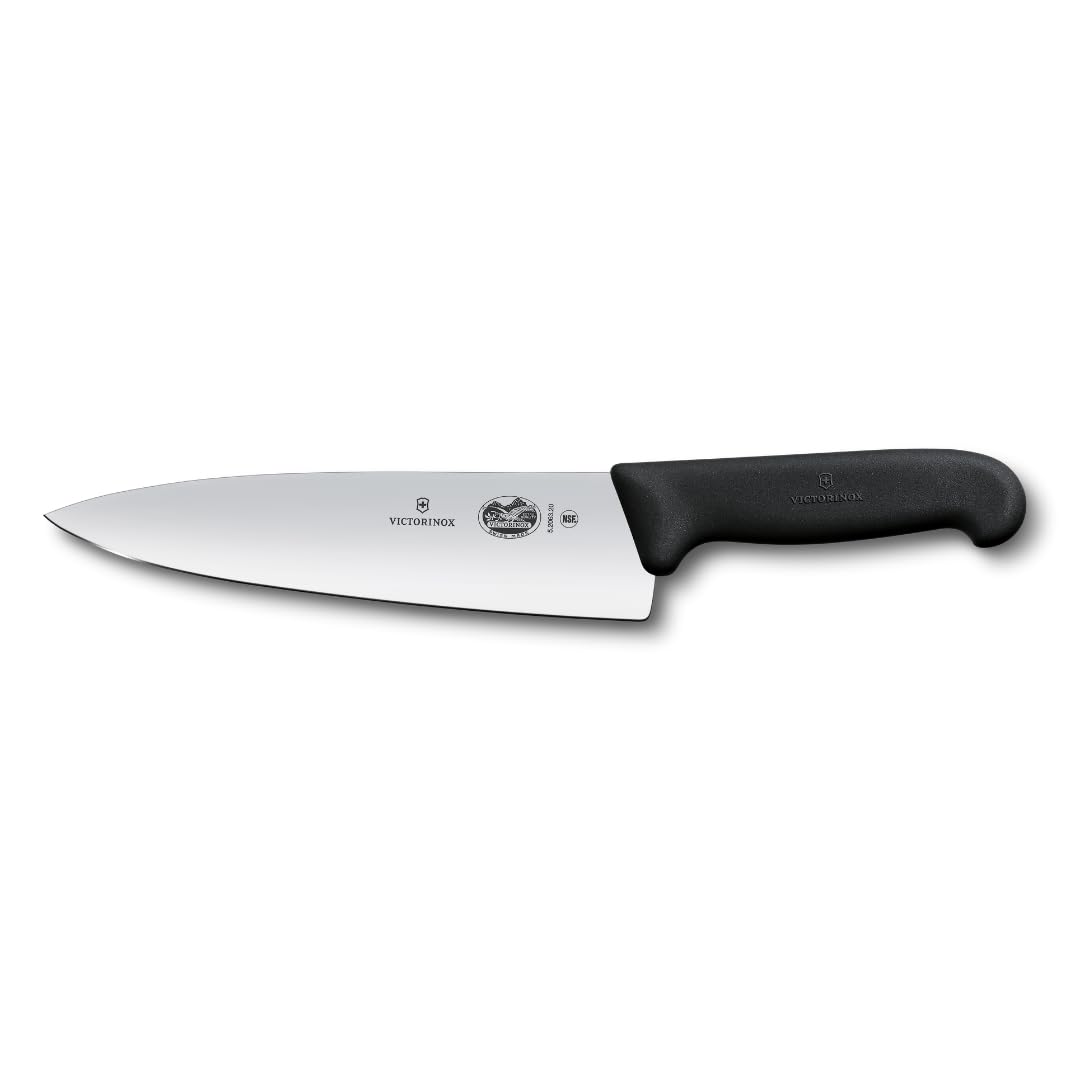
Victorinox Fibrox Pro Chef’s Knife
Key Features
- Care: Dishwasher safe
- Handle: Textured TPE, non-slip
- Blade length: 8 inches
- Construction: Stamped
- Price: Midrange
The handle is the first thing we noticed, because it’s the first thing that usually goes wrong: rinse your hands mid-prep and most plastic handles turn slick. The Fibrox Pro’s textured TPE stays grippy even wet, and that is the main reason this stamped Swiss chef’s knife is the one we recommend to anyone starting from nothing. The 8-inch blade sits on a light, thin spine, so it moves through onions and carrots without the wrist work a heavy forged knife demands.
That lightness is the trade. There’s no real bolster, and the blade won’t crush garlic or power through a squash the way a thicker knife will, so keep something heavier around if squash is a regular guest. What you get in exchange is a dishwasher-safe build, an NSF-approved handle, a lifetime warranty against manufacturing defects, and a price that sits in the middle of this group.
Against the other chef’s knives here, it comes down to feel. The Mercer is lighter and plainer, the SHAN ZU and PAUDIN are heavier and better looking, and the Victorinox lands between them with the surest wet-hand grip of the four and the longest warranty. Ours has been through the dishwasher more times than we can count without the handle loosening or the blade spotting.
Pros
- Grippy TPE handle that works with wet hands
- Light blade that keeps long prep comfortable
- Dishwasher safe, with a lifetime warranty
Cons
- Plain handle and blade look purely functional
- Too light to crush garlic or power through squash
We point anyone buying a first real chef’s knife here: the grip holds when wet, the blade takes an edge, and the warranty runs for life.
Best for Stocking a Kitchen
Astercook 15-Piece Knife Block Set
Key Features
- Steel: 1.4116 German stainless
- Set size: 15 pieces
- Sharpener: Built into block
- Construction: Forged, full tang
- Price: Premium
The sharpener lives in the block. Draw a knife through the angled slot on the way back to its place and you’ve touched up the edge one-handed, with no steel, no stone, and no hunting through a drawer. That’s the feature we kept coming back to, and it’s why a set this size stays usable instead of slowly going blunt in the block.
Fifteen pieces is the other half of the pitch. The lineup covers chef’s, slicing, santoku, bread, utility, and paring work, the blades are forged from 1.4116 German stainless with full tangs, and every knife shares one handle shape, so switching mid-recipe doesn’t mean relearning your grip. When someone is furnishing a kitchen from nothing, this is the block we point them to.
The sharpener is also the caveat. A pull-through slot removes more steel per pass than a honing rod, so treat it as a revival tool for a dull edge every few weeks rather than a nightly habit. And a set this recent hasn’t had time to prove how the edge holds up over years: the first months look strong, the fifth year is unknown.
Set against the Cuisinart block further down, this one wins on the sharpener and the full-tang build, while the Cuisinart wins on looks and on price. If you want the counter to look settled and the knife drawer to stay empty, fifteen pieces in one block is the tidy answer.
Pros
- Built-in sharpener keeps every blade usable
- Fifteen pieces cover the whole kitchen
- Forged, full-tang 1.4116 German steel
- Everything stores in one block
Cons
- Pull-through sharpener removes more steel than honing
- Long-term edge holding isn’t yet established
For a kitchen starting from zero, we hand people this block: fifteen forged pieces, one handle shape, and a sharpener that keeps them all cutting.
Best for Looks and Edge
SHAN ZU 8-Inch Damascus Chef Knife
Key Features
- Handle: G10 glass fiber
- Cladding: 67-layer Damascus
- Core steel: 10Cr15Mov, 62 HRC
- Blade length: 8 inches
- Price: Midrange
Layers you can actually see: the 67-fold cladding on this blade shifts as light moves across it, and it’s layered steel rather than a printed or etched pattern. Put it beside the PAUDIN below and the difference is plain — one is decorated, the other is forged with a pattern running through it.
The core is 10Cr15Mov at 62 HRC, harder than the 5Cr steels most mid-priced chef’s knives use, ground to 15 degrees on a 2.2 mm spine and hung with a frosted G10 handle. In practice that means a very fine edge that keeps its bite, and enough stiffness to feel precise on a tomato. What it won’t tolerate is being used like a cleaver.
This is the best-looking knife in the group, and the one we reach for when the board is full of delicate work: thin slices of fish, herbs, anything where a coarse edge would show. The G10 handle is the other half of that — grippy when wet, and untroubled by the sink in a way wood is not.
A hard, thin edge like this can chip if you twist it in the board or take it to a chicken carcass, so keep a heavier knife for bones and anything frozen. Hand wash it, dry it before it goes back in the block, and the finish stays as sharp as the edge.
Pros
- Genuine 67-layer Damascus cladding
- 62 HRC core holds a fine edge
- G10 handle stays grippy and shrugs off water
- The best-looking blade in this group
Cons
- Twelve-month warranty is the shortest here
We recommend this to anyone who wants a knife that looks like an heirloom and holds a fine edge, as long as they’ll treat it gently.
Best for Gift-Worthy Looks
PAUDIN 8-Inch Chef Knife
Key Features
- Steel: 5Cr15Mov
- Handle: Wood
- Blade length: 8 inches
- Construction: Stamped
- Price: Midrange
The handle is wood, and that’s the reason to pick this over the plastic-handled knives here: warm in the hand, slightly softer than steel under your palm, and handsome enough that guests ask about it. It’s also the reason to be disciplined, because wood and dishwashers don’t get along. This is a wash-by-hand, dry-immediately knife.
Balance is what surprised us. The 8-inch blade and the wood handle meet at a point that keeps the knife steady in a pinch grip, and for slicing onions or breaking down a chicken it feels like the most settled of the chef’s knives here. It also arrives with a bright, flowing pattern down the blade that reads as far more expensive than the knife does.
That pattern is the honesty note: it’s etched, not Damascus, and PAUDIN is upfront about it. The steel is 5Cr15Mov, the softer end of what’s here, which cuts both ways — it takes a keen edge quickly off a steel and gives it up sooner than the SHAN ZU’s 62 HRC core. If you prefer twenty seconds on a steel to babying a hard edge, that trade suits you.
Buy it because it looks good, cuts well, and comes with a two-year warranty, not because you think you’re getting layered steel. That distinction is the whole difference between this and the SHAN ZU a few rows up.
Pros
- Wood handle feels warm and settles the balance
- Takes a keen edge fast and hones back easily
- Etched pattern looks far pricier than the knife is
Cons
- Wood handle needs hand washing and drying
- Softer steel loses its edge sooner than hard cores
We suggest this one when a chef’s knife has to look good on a gift table and still feel settled in the hand every day.
Best for Daily Cooking
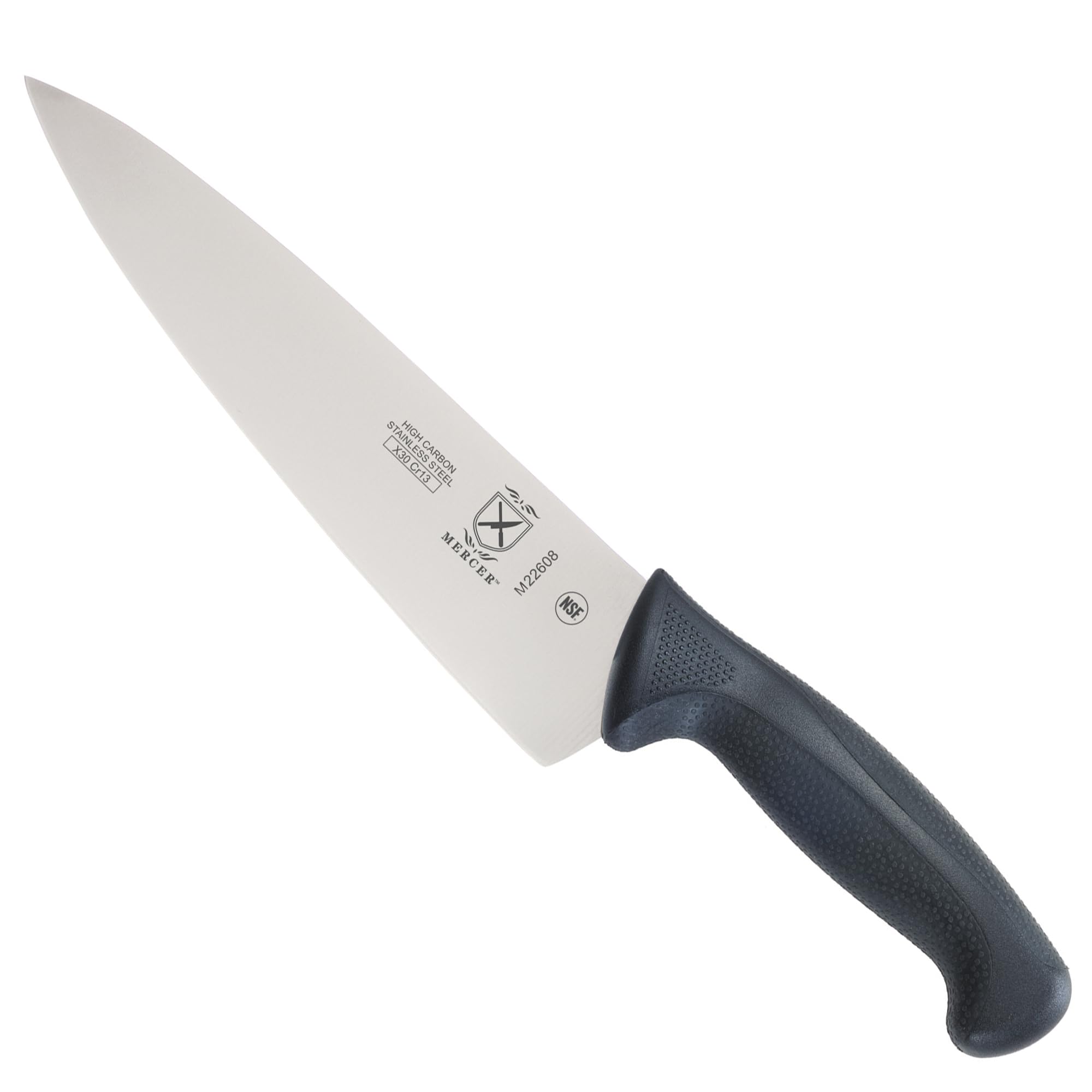
Mercer Culinary Millennia 8-Inch Chef Knife
Key Features
- Care: Hand wash
- Steel: High-carbon steel
- Handle: Santoprene
- Blade length: 8 inches
- Price: Budget
No bolster, no rivets, no wooden presentation box. The Millennia looks like what it is — a knife from a restaurant supply catalog — with a Santoprene handle, molded finger points, and one piece of high-carbon steel at 6.7 ounces. That plainness is not a flaw in a knife that lives on a board rather than in a display block.
What the low weight buys is speed. The thin blade goes where you point it, the semi-soft handle lets your fingers sink in slightly so the grip doesn’t fight you, and a pile of onions breaks down without the knife feeling like a chore. It doesn’t flatter a heavy hand: you steer this one rather than drive it.
Of everything here, this is the one we keep recommending to people who cook every night and don’t want a relationship with their knife. It’s the least expensive full-size chef’s knife in the group, it stands up to daily work, and when it eventually wears out you replace it without a second thought.
The catch is care. Mercer’s warranty excludes dishwasher damage, so this is hand-wash-and-dry, and a stamped high-carbon blade wants a couple of passes on a steel every week or two. Do that and it behaves like a much pricier knife; skip it and it goes dull like any other bargain blade.
Pros
- Light, precise 8-inch blade
- Textured Santoprene grip stays secure
- Least expensive full-size chef’s knife here
Cons
- Hand wash only; the warranty excludes dishwasher use
- Needs regular honing to hold its edge
We keep this in the rotation for anyone who cooks nightly and wants a knife that works hard and costs little to replace.
Best for Small Prep Tasks
Victorinox Swiss Classic Paring Knife
Key Features
- Edge: Straight, spear point
- Handle: Polypropylene
- Blade length: 3.25 inches
- Certification: NSF approved
- Price: Budget
Some kitchen work a chef’s knife is simply bad at: coring a tomato, peeling an apple, trimming the ends off green beans, getting the stem out of a strawberry. A 3.25-inch paring knife does all of it in one motion, and the Swiss Classic is the one we reach for — light, sharp, and small enough that you can feel exactly where the tip is going.
The numbers look almost funny next to the chef’s knives here: 18 grams, a stamped stainless blade with a straight edge and a spear point, a textured polypropylene handle, NSF approval, dishwasher tolerance, and the same lifetime warranty Victorinox puts on everything. Ours came sharp and has needed nothing more than a few passes on a steel.
It is a light, stamped knife, and it can feel insubstantial if you’re used to a forged paring knife with a full bolster — that’s the price of the control, and the slim handle is what lets you choke up for detail work. It’s also the least expensive knife here by a wide margin, which makes losing one an annoyance rather than a tragedy.
Pros
- Small blade for coring, peeling, and trimming
- Textured handle stays put in wet hands
- Dishwasher safe with a lifetime warranty
- Least expensive knife in this guide
Cons
- Light stamped build feels insubstantial in some hands
We buy this one before any other small knife: it makes the fiddly jobs quick, and it survives the dishwasher without complaint.
Best for Matched Counter Set
Cuisinart 15-Piece Hollow Handle Block Set

Key Features
- Blades: High-carbon stainless
- Handles: Hollow stainless steel
- Storage: Included block
- Set size: 15 pieces
- Price: Premium
The handles are hollow stainless steel, formed in one piece with the blade, with no rivets and no seam where food can collect. In the hand that reads as light — noticeably lighter than the forged block set above — and one-piece construction means there’s nothing to loosen after a few hundred washings.
Fifteen pieces, and the useful ones are genuinely useful: an 8-inch chef’s knife, an 8-inch slicer, a 7-inch santoku, a 5.5-inch serrated utility knife, a 3.5-inch paring knife, a bird’s beak for peeling, and the block that holds them, with a lifetime warranty on the set. High-carbon stainless blades with a tapered grind and a strong bolster for control.
Stainless here is not stain-proof. Left wet in a sink or run through a dishwasher, these blades spot and rust; washed and dried by hand the same evening, they stay bright. That’s not so much a defect as the deal with stamped stainless, and it’s a deal you can keep.
So where does it land? A matched block with a lifetime warranty and a full lineup is a real convenience, and this is the set we hand to someone who wants the counter to look finished and doesn’t want to think about cutlery again. It doesn’t outcut the Astercook block or the single chef’s knives here, and the hollow handles keep it feeling light — but it costs less than the Astercook and looks like it belongs in a better kitchen.
Pros
- Fifteen pieces in a matched block
- One-piece handles with no seams
- Tapered high-carbon blades with a lifetime warranty
Cons
- Hollow handles make the knives feel light
- Tall block needs roughly 15 inches of clearance
We suggest this set when a matched block and a lifetime warranty matter more than the last word in blade feel.
Best for First Kitchens
Cuisinart Advantage 12-Piece Set

Key Features
- Blades: Stainless, nonstick coated
- Knives: 6, with blade guards
- Set size: 12 pieces
- Chef knife: 8 inches
- Price: Budget
Each knife has its own color and a matching guard, which sounds gimmicky until you’re the one cooking: the red one handles raw chicken, the green one handles the salad, and nobody has to guess which blade touched what. That’s the whole argument for this set, and in a shared kitchen it’s a good one.
Six knives and six guards, including 8-inch chef, slicing, and serrated bread knives, in stamped stainless with a colored nonstick coating. Food releases cleanly, the blades wipe down in a second, and they arrive sharp enough for vegetables, fruit, and boneless meat. The guards mean the whole set can live in a drawer without a block or a magnetic strip.
Stamped blades of this kind are honest about what they are: sharp now, and dependent on a few passes of a steel to stay that way. The coated finish is the part that makes them quick to clean, and it’s also the part that ages, with color wearing away along the edge as you sharpen.
For a first apartment, a dorm kitchen, a camper, or a house where three people cook and none of them agree, this is the set we suggest. Six sharp knives with guards, color-coded, inexpensive enough that a wrecked blade isn’t a crisis. It isn’t the set for someone who wants a knife to keep — that’s what the Victorinox Fibrox Pro is for.
Pros
- Six color-coded knives with matching guards
- Coated blades wipe clean quickly
- Least expensive full set here
Cons
- Coating wears along the edge over time
- Stamped blades need frequent honing
We recommend this for a first kitchen or a shared one, where cheap, color-coded knives that live in a drawer beat one precious blade.
How We Tested 14 Knives From Nine Brands
We started by narrowing the field to brands that sell individual knives rather than only sets, then read through the one- and two-star reviews looking for patterns — chipped edges near the tip, handles that loosened, rust blooming at the bolster. From there we filtered by stated steel type, published hardness, construction (full tang and forged versus stamped), and price, so the final nine brands spanned budget workhorses to investment pieces. The 14 knives we bought were mostly 8-inch chef’s knives, with a paring knife and a santoku in the mix.
Testing ran for six months in home kitchens, on real dinners rather than a cutting board in a lab. We broke down onions, butternut squash, tomatoes, and bunches of parsley, and spatchcocked whole chickens. Out of the box, we noted whether each blade bit into a tomato under its own weight or needed pressure, and whether it sliced paper cleanly along the whole edge. To judge edge retention, we used the same knife for weeks, honing when the maker recommended it, and logged the first moment it started sliding on tomato skin instead of catching it.
Size got tested by handing each knife to cooks with different hand sizes: we checked whether a pinch grip felt crowded, whether knuckles cleared the board during a fine dice, and how blade length balanced against handle length. For appearance, we looked at blade faces and handle seams after a few weeks of daily use, watching for scratches and discoloration. On rust, we left each knife wet on a damp towel for an hour, then wrapped one in a soaked paper towel overnight to see which blades spotted. Value came down to what was in the box and whether the edge arrived ready to use.
How to Choose a Kitchen Knife Brand
The name on the blade tells you less than the steel it’s made from, the way the handle meets a wet hand, and what the warranty actually covers.
Start with the steel, not the badge
Most of what a knife does is decided by a few tenths of a percent of carbon and a hardness figure. The 5Cr15Mov blade on the PAUDIN here is soft enough to straighten on a steel in seconds; the SHAN ZU’s 10Cr15Mov core at 62 HRC holds a finer edge for longer but chips where the softer blade would simply roll. Neither is better in the abstract. Be honest about how you cut: if you twist, chop through bones, or leave knives sitting in the sink, softer steel will outlast harder steel in your kitchen.
Stamped, forged, and the handle in between
Stamped blades are cut from sheet steel, thinner and lighter; forged ones are thicker, heavier, and usually carry a bolster between hand and edge. For a home cook, neither word matters as much as weight and grip. A knife you can steer for twenty minutes without your forearm complaining beats a heavier one that feels impressive for the first onion. Grip is the other half: textured TPE or Santoprene stays put when wet, wood wants dry hands and hand washing, and hollow stainless handles trade heft for easy cleaning.
A block set or one knife that earns its space
A block set furnishes a kitchen in one purchase and gives every blade somewhere to live, which is worth real money if you’re starting from nothing. It also puts a block close to a foot and a half tall on your counter and fills slots with knives you may never reach for. Most cooking runs on a chef’s knife and a paring knife. If you already have a board and a drawer, spend the budget on those two; if the drawer is empty, a set with a built-in sharpener keeps every piece in it usable.
Dishwashers, rust, and what the care claim covers
Dishwasher-safe is a materials claim, not a promise that a blade stays bright. Heat, detergent, and sitting wet produce the spotting that gets blamed on cheap steel, and hollow or riveted handles can hold water where you can’t dry it. Warranties differ too: Mercer’s excludes dishwasher damage outright, while Victorinox covers defects for life. If you know you’ll use the rack, buy for it. If you want a knife that still looks new in five years, hand wash and dry it. Both are legitimate choices; only one keeps the finish.
Frequently Asked Questions
Are expensive kitchen knives worth it?
For most home cooks, no. The least expensive full-size chef’s knife here takes a keen edge, holds a non-slip grip, and carries a lifetime warranty, and it will do everything a weeknight dinner asks of it. Money beyond that buys harder steel that keeps an edge longer, nicer handles, and the block. Put the difference into a honing steel and a board you actually like.
How often should kitchen knives be sharpened?
Hone every few uses and sharpen when the edge fails the tomato test: if the skin tears instead of splitting under light pressure, it’s time. For most homes that means a real sharpening two or three times a year. A pull-through sharpener removes more steel per pass than a rod, so use it sparingly, and never on a serrated bread knife.
What’s the difference between Damascus steel and a Damascus pattern?
Damascus is layered or clad steel, so the pattern runs through the blade; here that’s the SHAN ZU’s 67 layers over a 62 HRC core. A Damascus pattern is etched or printed onto a single steel, which is exactly what PAUDIN says about its own blade. If edge holding matters, check the core steel and hardness. If you want the look, an etched blade delivers it.
Final Verdict
Buy the Victorinox Fibrox Pro 8-inch chef’s knife. It earns the top spot on the two things that decide whether you enjoy cooking: an edge that arrives sharp and a handle that stays put when your hands are wet, with a dishwasher-safe build and a lifetime warranty behind both.
If you’re outfitting a kitchen from nothing, the Astercook block puts fifteen forged pieces and a built-in sharpener on the counter in a single purchase. If you want the least expensive capable chef’s knife here, that’s the Mercer.