This post contains affiliate links. We may earn a small commission when you buy through our links — at no extra cost to you.
A forged knife starts as one piece of steel, heated and shaped so the blade, bolster, and tang are continuous — nothing riveted on, nothing stamped from a sheet. You feel that as heft and balance; you see it in how long an edge lasts before it skates over a tomato. The tradeoff is real: forged knives cost more and weigh more, and a clumsy one leaves your wrist aching before the onions are done. What you’re buying is prep that stays boring, and a blade that still looks new after years of wet sponges.
I’ve cooked with 10 forged knives over the past eight months, from budget workhorses to showpieces, and the ones I reach for aren’t the most expensive. We broke down whole chickens, halved squash, and minced more parsley than I care to admit; balance at the pinch grip mattered more than blade thickness, and a knife that arrived razor-sharp could be dull by spring. Out-of-box sharpness is a factory story — how an edge holds after a month of dinners is the steel’s story. The picks below are the ones that survived, in sizes that actually earn drawer space.



Best for First Forged Set
Mercer Genesis 6-Piece Set
Key Features
- Block: Tempered glass
- Pieces: 6
- Blade steel: High-carbon German steel
- Construction: Forged
- Price: Premium
Six knives, not fifteen. That is the first thing we noticed about the Genesis set, and it is why the set ends up at the top of this page. Mercer skips the steak knives and the herb scissors and gives you a paring knife, a five-inch utility, a stiff boning knife, an eight-inch chef’s knife, a bread knife and a block — the pieces that get picked up during an ordinary week of cooking. We prefer that to a fifteen-slot block where four knives do all the work and the rest wait for a party.
The blades are forged from high-carbon German steel and taper-ground, and the Santoprene handles stay grippy with wet hands. What we kept coming back to is how unremarkable the set feels to use, in the best way: nothing about the chef’s knife asks you to learn a new grip, and the boning knife has enough flex to follow a chicken carcass without wandering. Slicing a tomato and dicing an onion told us most of what we needed — both went cleanly with no crushing.
The tempered glass block is the other half of the appeal. It holds the knives upright where you can see what you’re reaching for, it wipes clean, and unlike wood it doesn’t soak up whatever was on the last blade. It is heavy — the loaded set runs a little over eight pounds — so pick a spot for it and leave it there. The dividers are metal, which keeps edges apart but can catch one if you slide a knife in sideways; set each blade in from above.
Where it falls short is breadth, and only breadth. There are no steak knives, no shears and no honing steel in the box, so if you want one purchase to cover a dinner party’s worth of place settings, this isn’t it. What you get instead is a smaller set with no dull filler in it, and after living with both kinds of block, that is the trade we take every time.
Pros
- Six knives cover everyday prep without filler
- Tempered glass block wipes clean
- Handles stay grippy when wet
- Consistent quality across all six knives
Cons
- No steak knives, shears or honing steel
- Heavy glass block needs a permanent spot
Six forged knives that cover every ordinary prep job, a glass block that keeps them in sight, and no rust or handle worries — this is the set we recommend first.
Best for One Good Knife
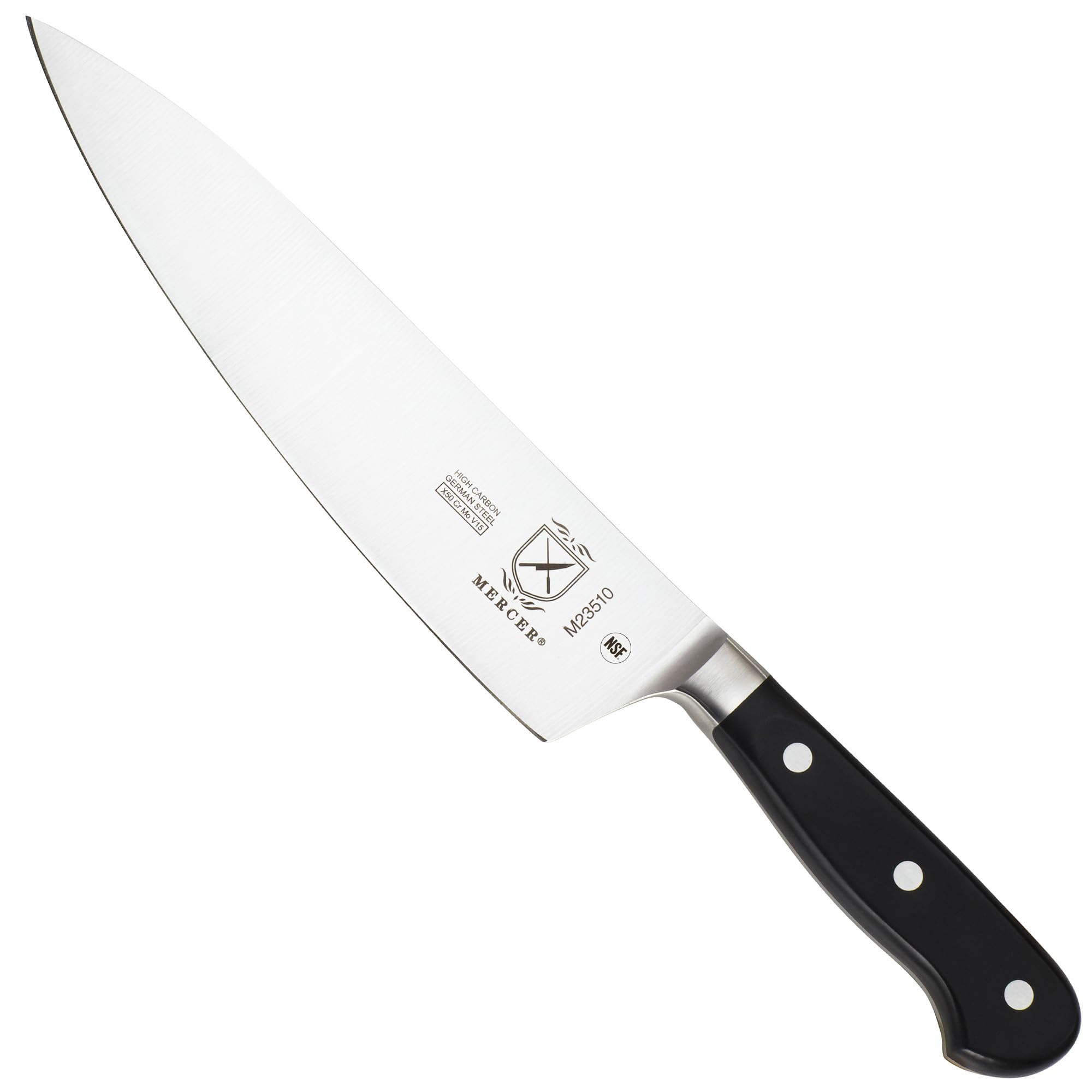
Mercer Renaissance 8-Inch
Key Features
- Handle: Triple-riveted Delrin
- Weight: 8.8 oz
- Blade length: 8 inches
- Construction: Forged
- Price: Midrange
The bolster is the detail that decides it. On most forged chef’s knives the metal collar between blade and handle runs all the way to the heel, which means a stone never touches the last inch of edge. Mercer cuts it short, so the whole blade sits flat when you sharpen. You notice that on a knife you’ve owned for a year, not on one you’ve just unwrapped.
At 8.8 ounces the Renaissance feels like a working knife rather than a showpiece, and the triple-riveted Delrin handle is flush at every seam. We used it alongside the more expensive forged knives here and kept coming back to how little it gives up: it slices tomatoes without crushing them and the rounded spine is comfortable when you choke up on it. For culinary students and line cooks who keep their own stone, this is the knife we recommend over any block set.
Two things to know before you buy. It arrives as a single knife with no guard and no block, so sort out storage before it lands — a magnetic strip or a drawer guard saves the edge. And it ships sharp rather than polished, so expect to touch the edge up within the first few weeks if you want it to glide. Neither is a fault; both are why it earns its place at this price instead of a fancier one.
Pros
- Short bolster exposes the full edge for sharpening
- Taper-ground blade slices cleanly
- Triple-riveted handle is flush and comfortable
Cons
- No guard, sheath or block included
- Edge arrives sharp but not polished
This is the forged chef’s knife we point cooks toward when they want one good blade and plan to sharpen it themselves.
Best for Whole-Kitchen Coverage
McCook 15-Piece Set
Key Features
- Block: Cherry wood with built-in sharpener
- Pieces: 15
- Edge angle: 15°
- Construction: Forged
- Price: Premium
The sharpener built into the block is why this set stays out on the counter instead of living in a cupboard. Two or three pulls through the slot and a tired paring knife is usable again — no steel, no stone, no soaking. We were skeptical of a pull-through sharpener, and it does take more metal off than a stone does, but for a household that never got around to sharpening anything, it is the difference between dull knives and working ones.
The rest of the set is built for coverage. Fifteen pieces, forged high-carbon stainless at HRC 57±2 with a 15-degree edge, and a cherry-wood block that swallows the lot. The lineup runs from an eight-inch chef’s knife and an eight-inch slicer through a five-inch santoku, serrated and fine-edge utility knives and a paring knife. The blades cut cleanly out of the box and the handles have enough swell to fill your palm rather than sit in it.
The catch is water. This is high-carbon steel living in a wood block that traps moisture, and the knives that go back damp are the ones that come out spotted, so we treat drying as part of washing rather than an optional extra. The block itself is the other variable: joints can work loose over time. Neither problem changes how well the knives cut, and neither is unusual for a set that fills this many slots for the money. Keep a towel by the block and it will outwork sets that cost more.
Pros
- Built-in sharpener revives dull blades fast
- Fifteen forged pieces plus a block
- Blades arrive sharp at 15 degrees
Cons
- Block joints can work loose
Built-in sharpener, fifteen pieces, and a block that holds them all: this is the set we hand people who want a whole kitchen’s worth of knives at once.
Best for Butchering and Bbq
XYJ Serbian Cleaver
Key Features
- Sheath: Leather with belt loop
- Weight: 1.3 lb
- Blade length: 6.7 inches
- Construction: Forged
- Price: Budget
Weight is the point of this knife. At 1.3 pounds it is comfortably the heaviest blade in this group, and the shape — a broad, curved Serbian cleaver with a stonewashed, hammered finish — lets you rock through a pile of onions or a skirt steak without pushing. You raise it and let it fall. After a session with it, our lighter chef’s knives felt like they were asking for more effort than they needed to.
It’s forged from high carbon steel with a full tang under the wood handle, and it arrives in a thick leather sheath with a belt loop, which is unusual at this level and genuinely useful if the knife travels to a grill or a campsite. Sharp out of the box is the other thing we noticed: it went through chicken thighs and a beef skirt in single passes, and the weight carried the cut.
High carbon steel is a commitment, though. It spots if it goes away wet, so dry it and wipe it with a little oil before it goes back in the sheath, which itself holds moisture against the blade. The edge is also thin enough behind the bevel that a twist in a hard cut can crack it, so use it as a cleaver and not as a wedge. Treated that way it is an absurd amount of knife for the money.
Pros
- Heavy blade does the chopping work
- Razor sharp out of the box
- Leather sheath with belt loop included
Cons
- Blade can crack under twisting cuts
A heavy, short-bladed forged cleaver that makes short work of roasts and racks, and costs less than most single chef’s knives here.
Best for Budget Precision
HOSHANHO 8-Inch Chef Knife
Key Features
- Weight: 12.3 oz
- Edge angle: 13° per side
- Blade steel: 10Cr15CoMoV
- Construction: Forged
- Price: Budget
Thirteen degrees per side. That figure separates this knife from everything else here — the McCook and Cuisinart sets run 15 degrees, and the difference is not academic. A thinner edge has less material to push through a tomato skin, so it bites and glides where a thicker grind skids. We noticed it most on soft things: ripe tomatoes, peppers, fish.
The steel is 10Cr15CoMoV, a Japanese high-carbon, hand-sharpened and finished with a matte blade and a pakkawood handle. The sloped bolster puts your thumb and forefinger closer to the blade for a proper pinch grip, and at 350 g the knife has enough mass to feel planted without tiring your wrist over a long prep. For a first Japanese-style knife, the money is startling.
The trade is durability at the thin end of the scale. A 13-degree edge chips when it meets anything harder than an onion — a chicken bone, a frozen block, the corner of a cutting board. Given how little the knife asks for, we’re happy to keep it for vegetables and boneless proteins and reach for something heavier when there’s bone on the board.
Pros
- 13-degree edge cuts with almost no pressure
- Sloped bolster makes a pinch grip natural
- Japanese high-carbon steel at a budget price
Cons
- Thin edge chips on bone or frozen food
The sharpest edge here for the least money — a thin Japanese-steel chef’s knife for cooks who want precision and will treat it gently.
Best for White Kitchens
Cuisinart C77WTR-15P

Key Features
- Block: Wood
- Pieces: 15
- Handles: White, triple rivet
- Construction: Forged, full tang
- Price: Midrange
White handles are the whole reason to consider this set, and we aren’t dismissive of that — a matching block in a white kitchen looks deliberate in a way black never does. What we can’t get past is that the handles, the very thing you’re buying it for, are also the part that gives trouble first. That is the trade this set asks you to make, and it is worth knowing before the box arrives.
The blades themselves are genuinely good. Forged high-carbon stainless with a full tang and an extra-wide safety bolster, sharp out of the box, and the lineup covers everything: eight-inch chef and slicing knives, a seven-inch santoku, utility, paring and bird’s-beak knives, six steak knives, shears, an eight-inch honing steel and a wood block. It is one of the most complete sets here, and the wide bolster gives your hand a clear stop at the blade.
Where it goes wrong is water. Leave a blade wet and it spots; leave it soaking and the spots turn into something you can’t wipe off. Wash one at a time, dry immediately and keep the knives out of the sink, and the finish stays as bright as the day it came out of the box.
It is the cheapest route to a full forged block here, and that is the honest case for it: coverage and a finish nobody else in this group offers, in exchange for handles you have to protect. A lot of kitchens will take that trade, especially a white one.
Pros
- White finish looks sharp and stays bright
- Full lineup from parer to steak knives
- Forged blades with a wide safety bolster
Cons
- Handles can crack with repeated washing
- Ships with a honing steel, not a sharpener
Buy this set for how it looks on the counter — the blades are sharp and properly forged, but the handles are the part that gives trouble.
Best for Vegetable Prep
HOSHANHO 7-Inch Santoku

Key Features
- Weight: 12.3 oz
- Edge angle: 15° per side
- Blade length: 7 inches
- Construction: Forged
- Price: Midrange
The shape is the argument. A santoku has a flatter edge than a chef’s knife with a gentle curve toward the tip, so it rocks through herbs and slides down a cabbage without the long belly that makes a chef’s knife feel like a lot of blade. At seven inches it also steers more easily in a small kitchen, which is why it comes out when the board is already crowded with a pan and a bowl.
The blade is triple-layer laminated 10Cr15CoMoV, hand-sharpened to 15 degrees a side, with a frosted finish that hides scratches better than a mirror polish and a pakkawood handle that stays comfortable through a long prep. It arrives genuinely sharp, the kind of edge that goes through a tomato under its own weight.
The weight is the surprise. At 350 g it matches the brand’s eight-inch chef’s knife here, yet the shorter blade puts that mass closer to your hand, so it feels quicker rather than heavier. We liked the curved spine where your fingers sit; it doesn’t dig in during a long dice, and the handle swell fills a medium hand.
What it isn’t is a substitute for a chef’s knife when you break down a chicken or split a squash — the thin edge and the short blade both work against you there. It is the knife for the ninety percent of prep that is onions, herbs and vegetables, which makes it a sensible second blade rather than a replacement for one.
Pros
- Flatter edge rocks through vegetables
- 15-degree edge arrives genuinely sharp
- Balanced, comfortable pakkawood handle
Cons
- Short blade is limiting on squash and poultry
A santoku for cooks who prep more vegetables than roasts: a thin 15-degree edge, a shape that rocks, and a shorter blade to steer.
Best for Grill and Camp
ROCOCO Viking Cleaver

Key Features
- Handle: Walnut
- Weight: 15.2 oz
- Blade length: 6.2 inches
- Construction: Forged
- Price: Budget
It looks like a prop from a Viking film, and the shape isn’t only cosmetic. The broad, curved blade rocks forward through meat and vegetables, and the short 6.2-inch length keeps it controllable for someone who has never picked up a cleaver. We found it does its best work on chicken, fish and a pile of vegetables, where the rocking motion does the effort for you.
The blade is hand-forged high carbon steel with a hammered finish, walnut under the handle, and it ships with a light coat of oil and a leather sheath. That sheath is a big part of the appeal: this is a knife you can hang on a belt or drop in a grill bag without worrying about the edge, which is more than most of the knives here can claim.
The oil is not a formality. High carbon steel spots the moment it goes away wet, so wipe it down after washing and put a thin film back on before it returns to the sheath. That is a two-minute habit, and it is what keeps the hammered finish looking like the photographs.
As kitchen kit it is a niche pick. A heavy chef’s knife or the XYJ reaches further and handles more of the same work. As a gift for someone who grills, smokes or camps, though, it is the most characterful knife in this group, and the price makes it an easy one to hand over with a straight face.
Pros
- Rocking blade makes short work of chicken and veg
- Leather sheath included for travel
- Hammered finish looks the part
Cons
- Smaller than the photos suggest
A compact axe-shaped cleaver with a leather sheath — more character than most knives here, and genuinely useful on chicken, fish and vegetables.
How We Tested 10 Forged Knives Over Eight Months
We started by rounding up forged knives that met three filters: a full tang running the length of the handle, a bolster that’s clearly part of the blade rather than a welded-on collar, and a lineup that covered an 8-inch chef’s knife, a paring knife, and at least one santoku or utility blade. Steel type, handle material, and stated hardness got cross-checked against owner reviews, and anything suspiciously light for its size was cut before it reached the kitchen. Ten knives made the final list.
Those 10 stayed in a home kitchen for eight months, not on a shelf. They broke down whole chickens, halved squash, minced garlic, and sliced tomatoes still warm from the garden. We cut hot chicken off the bone, smeared tomato and lemon juice on the blades and left them for ten minutes, then washed by hand and dried — no dishwasher, since that’s how most people treat a knife they paid for. Each one got the same paper-slice test out of the box and again at the four- and eight-month marks, and we noted whether it skated on tomato skin before we reached for the honing rod.
Weight was judged in the hand and in the wrist: we noted where each knife balanced in a pinch grip and watched for fatigue through an hour of chopping. Appearance got the same pickiness — handle seams, the bolster-to-blade transition, whether the finish spotted after a damp sponge sat against it for an hour. Rust resistance and blade durability were tracked on a calendar; a knife that needed honing every week lost points no matter how good it looked. Value came down to edge retention per dollar, and size decided which ones earned daily reach.
How to Choose Forged Knives
Forged construction tells you how a blade was made; the decision that actually changes your cooking is whether you want one knife you sharpen and love, or a block that covers every job at once.
Set or single knife
Fifteen-piece sets sell the idea of a complete kitchen, but most cooks reach for three knives: a chef’s knife, a paring knife and something serrated. The rest are useful in the week you need them and decoration the other fifty. A six-piece set like the Mercer Genesis is closer to how a kitchen actually works. A fifteen-slot block is the better buy when you’re furnishing a first apartment and want every slot filled in one payment. Count the knives you’d be annoyed to buy separately, then see whether the set still looks like value.
German steel or Japanese steel
Steel and edge angle decide how a knife feels on the board. German-style high-carbon stainless, usually sharpened at 15 degrees or a little more, is tougher and forgives a lazy stroke. Japanese high-carbon at 13 degrees has less material behind the edge, so it bites into tomato skin and glides through fish with less pressure. The cost is fragility at the edge: thin, hard blades chip on bone, frozen food and board corners. Buy the thin edge for vegetables and boneless proteins, and accept that you’ll handle it carefully.
Tang, bolster and rivets
A forged knife is made from a single billet, and the signs are visible: a tang running under the handle, rivets sitting flush, and a bolster — the collar between blade and grip — that gives your hand a stop. Check the bolster with sharpening in mind. A full bolster runs to the heel and blocks a stone from the last inch of edge; a short one, like the Renaissance here, lets the whole blade sit flat. Run a thumb along the spine for a rounded edge. That is the difference between comfortable and not after twenty minutes of prep.
Weight, balance and your hand
Where the weight sits matters more than the number on the listing. A 350 g chef’s knife with mass forward of the bolster falls through food; the same weight in a short blade, like the santoku here, feels quick instead. A 1.3-pound cleaver is a tool you lift and drop, not one you steer. Try a pinch grip before you commit: thumb and forefinger on the blade, the rest on the handle. A sloped bolster makes that grip natural, and smaller hands do better with a shorter blade than with a thinner handle.
Blocks, sheaths and storage
A block is furniture, so measure the counter before you choose one. A six-slot glass block takes roughly 10 by 4 inches of footprint and shows you what’s missing; a fifteen-slot wood block runs closer to 14 by 9 and holds everything, including the moisture that spots carbon steel. Metal slot dividers keep blades apart but can catch an edge if you slide a knife in sideways, so set it in from above. Sheaths suit knives that travel to a grill. Magnetic strips suit small kitchens, as long as children can’t reach them.
Frequently Asked Questions
Can forged knives go in the dishwasher?
No. Heat, detergent and the knock of a cycle are hard on an edge and on the finish, and the drying stage leaves water sitting against steel, which is how rust spots start. Wash by hand in warm water, dry immediately with a towel and put the knife away. A minute at the sink is the cheapest maintenance there is.
What size chef’s knife should I start with?
Eight inches is the all-purpose default and covers the most ground: long enough for cabbage, short enough to control. Cooks with smaller hands or a cramped counter often prefer six to seven inches, and a seven-inch santoku is another way to shorten the blade without losing a rocking cut. Buy the eight-inch knife first and add a short blade when you notice yourself reaching for one.
Can I cut through bones or frozen food with a forged knife?
Not with a chef’s knife. A 13- to 15-degree edge is thin, and thin edges chip on bone and on anything frozen solid, which takes real work to grind out. Let frozen meat temper first, cut around bones rather than through them, and keep a cleaver like the XYJ for jobs that need weight instead of precision.
How often should a forged knife be sharpened?
Hone lightly before each use to realign the edge, and sharpen when a tomato skin resists or the blade slides across an onion instead of biting. For home cooking that usually means two to four sessions a year, worked at the blade’s own angle: 15 degrees for German steel, 13 for a thin Japanese edge. Twice a year is plenty for most kitchens.
Final Verdict
For most kitchens the Mercer Genesis six-piece set is the answer: forged German steel, six knives that cover real prep, a glass block that wipes clean, and no rust or handle worries to plan around. If you’d rather buy one knife and sharpen it yourself, the Renaissance is the better spend — same maker, same steel, shorter bolster.
And if you’re outfitting a first kitchen from nothing, the McCook’s fifteen pieces and built-in sharpener cover more ground for about the same money, as long as you dry every blade before it goes back in the block.