This post contains affiliate links. We may earn a small commission when you buy through our links — at no extra cost to you.
Pressure canning has a reputation problem. Say you’re thinking about putting up a batch of green beans, and someone will bring up a cousin’s aunt whose canner blew its lid — which is exactly why your first canner matters more than any other piece of kitchen equipment. A good one locks with a certainty you can feel, holds pressure without you hovering over the burner, and comes with instructions a first-timer can actually follow. Get those three right and the afternoon goes from nerve-wracking to routine.
Weight is the thing nobody warns beginners about — a loaded canner is heavy before you add jars, and you lift it more than you’d expect. Over seven months, my team and I ran 10 pressure canners through batches of beans, tomatoes, and stock, judging how each felt to carry, how surely the lid locked, and whether the manual answered a first-timer’s questions. The picks below are the ones that earned their price and made the job feel ordinary.

Best for All-Around Beginner Canner
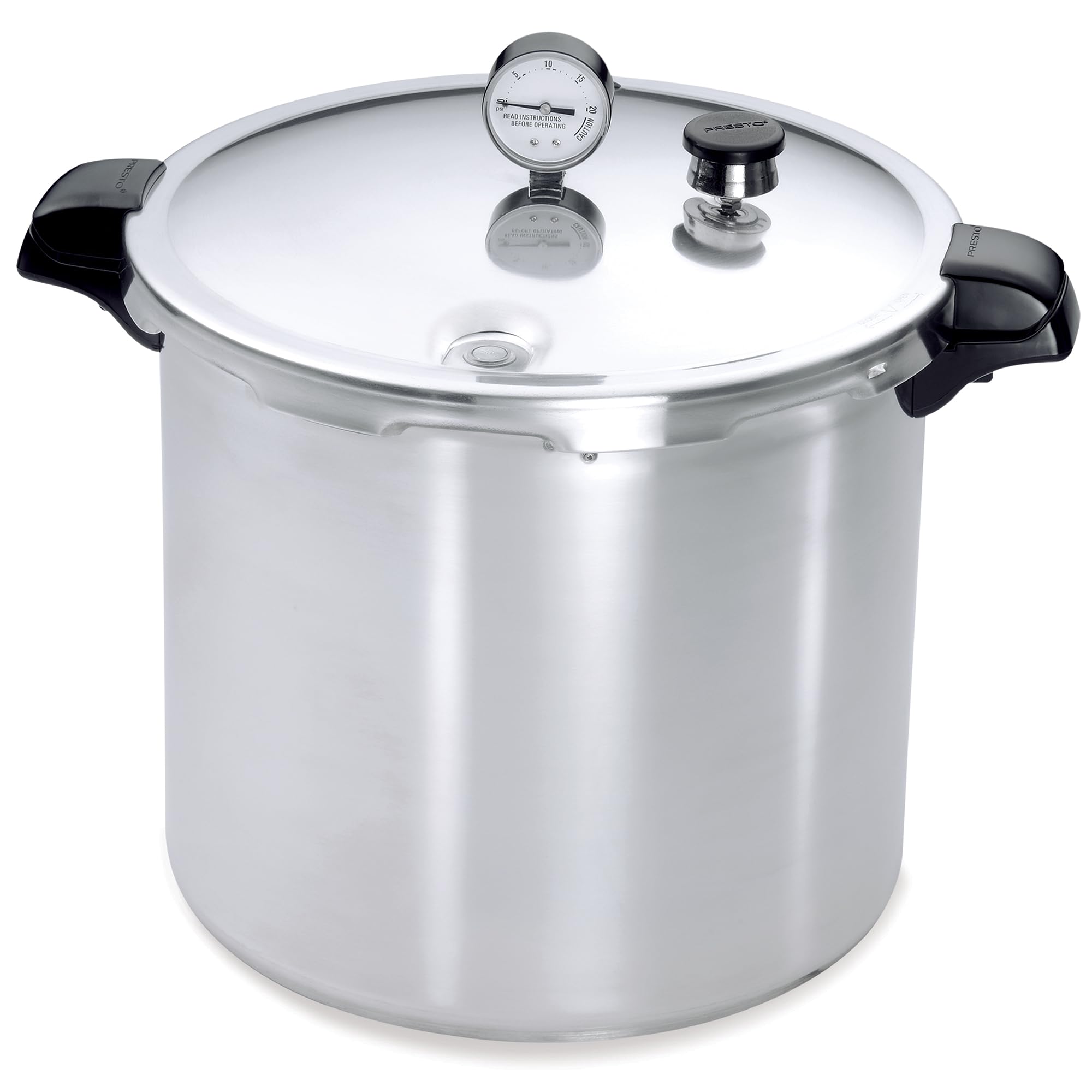
Presto 01784 23-Quart Canner
Key Features
- Weight: 12.5 lb
- Capacity: 23 quarts
- Stovetop: Induction, gas, electric, smooth-top
- Pressure control: Dial gauge and weighted regulator
- Price: Midrange
The first thing we check on a pressure canner is whether it will sit flat on the stove the buyer actually owns. The Presto 01784 is the one here that answers that question for almost everyone: induction, gas, electric coil, and smooth-top. That broad fit is why it leads our list for beginners. A 23-quart body gives you a full-size batch, and the canning rack is included, so the first setup is not a scavenger hunt.
We like having two pressure references in one lid: a dial gauge to watch and a weighted regulator that rocks when the canner is at pressure. For a beginner, that combination is more reassuring than a gauge alone, because the weight gives you an audible cue while the gauge shows where you are. The air vent and cover lock are the other beginner-friendly detail: pressure will not build unless the lid is seated, and the lid will not open until pressure drops.
The caveat is the gauge. A dial can lose accuracy, and this model is no exception; have it checked before you rely on it, and treat the rocking weight as your second opinion. The rest of the canner is familiar Presto aluminum: wide, stable, and heavy once it is full. The first batch is mostly loading jars and listening for the rock.
Pros
- Works on induction and every common stovetop
- 23-quart capacity for full-size batches
- Dial gauge plus rocking weighted regulator
- Lid lock prevents opening under pressure
Cons
- Dial gauge can lose accuracy
We recommend the Presto 01784 as the beginner’s default: a familiar stovetop canner that fits nearly any stove, gives you a gauge and a weight to follow, and has the capacity to make a batch worth the setup.
Best for Small Electric Batches
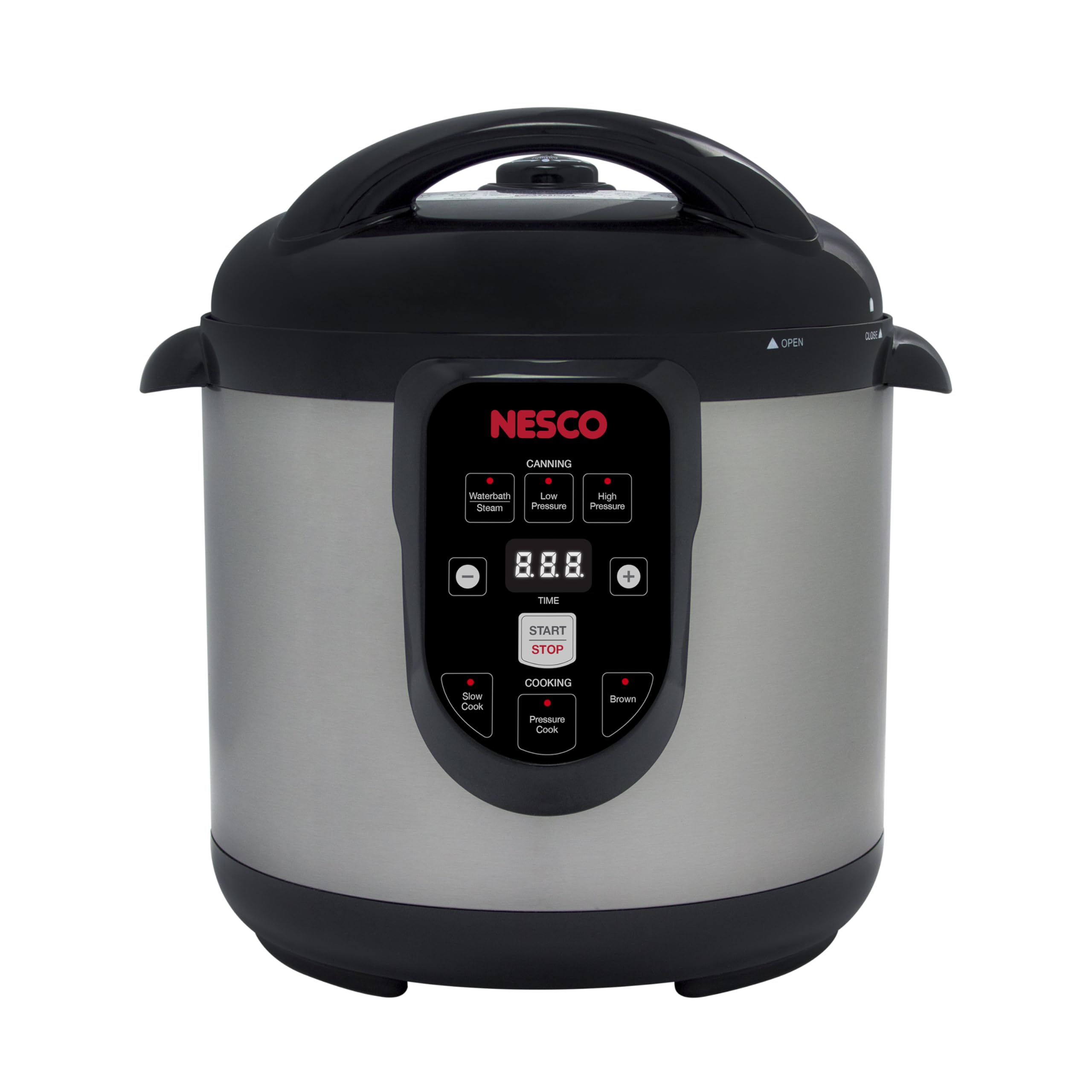
NESCO NPC-9 Electric Canner
Key Features
- Modes: Pressure, water bath, slow cook, steam
- Weight: 22 lb
- Capacity: 9 quarts
- Pressure control: Digital automatic
- Price: Midrange
A stovetop canner asks you to stay in the kitchen and watch the jiggle; the NESCO NPC-9 is for anyone who would rather set a program and walk away. It is a plug-in electric canner with digital controls, a safety lock, an automatic float valve, and a pressure-regulation system that handles the hold for you. That is why we keep it in the roundup for first-timers who are nervous about pressure: the machine takes over the part that usually makes beginners hover.
The 9-quart pot is the small-batch specialist. It handles pressure canning, water bath, slow cooking, and steaming, and the removable nonstick inner pot is easier to clean than a big aluminum stovetop canner. We like that one appliance can put up a few jars and then cook dinner, especially in a kitchen where a 23-quart pot would live in the basement.
The manual is the weak link. Read it once, then cross-check your process times and pressure with USDA or extension guidance; do not treat the booklet as the final word. The nonstick pot wipes clean, and the machine stays on the counter instead of the stove.
Pros
- Set-and-forget electric pressure control
- Safety lock and automatic float valve
- Pressure, water bath, slow cook, and steam modes
- Removable nonstick pot is easy to clean
Cons
- Small 9-quart batch size
We recommend the NESCO NPC-9 for beginners who want electric set-and-forget canning in small batches; it takes the stove-watching out of the process, as long as you don’t need quart after quart.
Best for Long-Term Premium Use
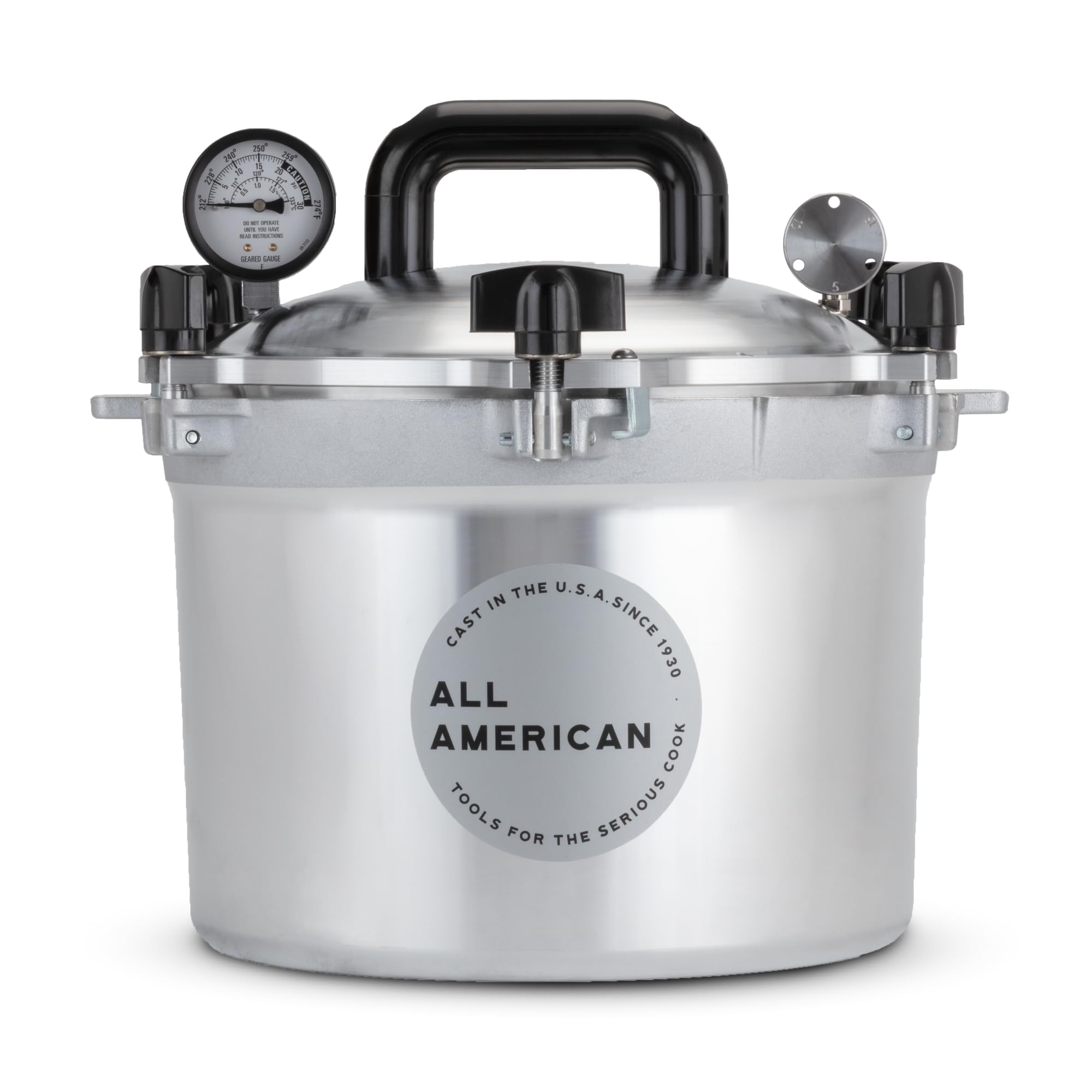
All American 910 Canner
Key Features
- Seal: Metal-to-metal, no gasket
- Weight: 14.8 lb
- Capacity: 10.5 quarts
- Stovetop: Gas, electric, flat-top
- Price: Premium
The All American 910’s lid is the detail that got our attention: there is no rubber gasket to stretch, crack, or replace. The seal is machined metal-to-metal, and the lid clamps down with a set of locking devices. That is a genuine long-term ownership advantage, because the gasket is the part that ages on most canners.
The rest of the build matches that first impression. It is cast aluminum, with double-thickness edges and a satin finish that is easy to clean. The steam gauge and overpressure plug give you a clear pressure reference, and the canner is designed for gas, electric, and flat-top stoves. We like the old-fashioned solidity of it; nothing about the lid feels incidental.
The lid does take a moment to seat evenly, and that is the learning curve. Once you have the clamping pattern down, the canner feels simple. The bigger trade-offs are weight and batch size, and they are real; this is not the canner for a 20-quart afternoon. What it offers instead is the confidence of a lid that has nothing to wear out.
Pros
- No gasket to replace
- Cast-aluminum, heavy-duty construction
- Steam gauge and overpressure plug
- Easy-to-clean satin finish
Cons
- Heavy at 14.8 pounds
- Small 10.5-quart capacity
We recommend the All American 910 for the beginner who wants to buy one canner and keep it for decades, especially for small batches and anyone tired of replacing gaskets.
Best for Large Coil-Stove Batches
T-fal 22-Quart Canner
Key Features
- Capacity: 22 quarts
- Included: Two racks and guide
- Stovetop: Gas and electric coil
- Pressure settings: 3 pressure settings
- Price: Budget
Two racks and a 22-quart body are the reason the T-fal is here: it turns a pile of produce into a full afternoon’s jars without a second batch. The aluminum pot heats evenly on gas and electric-coil stoves, and the three pressure settings give you a simple choice for the food and your altitude. The included step-by-step guide is a helpful starting point for a beginner.
We like it as a workhorse, not as a showpiece. The lid locks securely, the steam release is easy to find, and the two racks keep jars off the bottom and let you stack a second layer. If you have a coil stove and a garden that comes in all at once, this is the canner that keeps the afternoon moving. If you have induction, it is not your canner.
The value question is the one to settle before buying. This is a big, basic aluminum canner, not a digital machine, and the price sits below the top pick but not so far below that price alone should decide. The 22-quart capacity and two racks are what you are paying for, and they are the reason to choose it over a smaller electric.
Pros
- 22-quart capacity with two racks
- Three pressure settings
- Works on gas and electric coil
- Includes canning guide
Cons
- Heavy at 14.8 pounds empty
We recommend the T-fal for large-batch canning on a gas or electric-coil stove; the two racks and three pressure settings make it a straightforward workhorse, as long as induction isn’t on your counter.
Best for Push-Button Larger Batches
Presto 02144 Digital Canner

Key Features
- Safety: Ten built-in features
- Weight: 20.5 lb
- Capacity: 12 quarts
- Pressure control: Digital automatic
- Price: Premium
The Presto 02144 is the electric canner for someone who wants the automation of the NPC-9 but a little more room for jars. It is a 12-quart digital canner that handles both pressure canning and water-bath canning, with a control knob and a display that steps you through the mode. The ten built-in safety features, including a cover lock and a sensor that holds the set temperature, are the real beginner appeal: fewer gauges to watch, fewer ways to get the lid open too soon.
We like the idea of one appliance covering both low-acid and high-acid canning, and the 12-quart body is a useful step up from the smallest electric models. The push-button controls also make repeat batches feel less like a science experiment. What we cannot do is give it the same long-term endorsement as the stovetop picks, because the design is doing the persuading here rather than a long record of use.
The trade-offs are price and batch size. This is a premium electric canner, and 12 quarts is still small next to a 22- or 23-quart stovetop. If you want set-and-forget canning for small-to-medium batches, it makes sense; if you are putting up a bushel of tomatoes, a big stovetop canner is the better tool. The control knob is the part that makes it feel less like a laboratory and more like an appliance.
Pros
- Automates pressure and water-bath canning
- Ten built-in safety features
- 12-quart capacity is larger than the NPC-9
- Digital controls simplify repeat batches
Cons
- Premium price for a 12-quart electric
We recommend the Presto 02144 for the cook who wants push-button pressure canning and water-bath mode in one appliance, and can accept a premium price for smaller batches.
Best for Weighted-Regulator Large Batches
Mirro 22-Quart Canner

Key Features
- Weight: 13.7 lb
- Capacity: 22 quarts
- Material: Aluminum
- Pressure settings: 5, 10, 15 psi
- Price: Budget
Three separate regulator weights—5, 10, and 15 psi—are the small design choice that makes the Mirro easy to understand: you pick the one for your altitude and listen for the jiggle. That is a simpler mental model than a dial gauge, and it is why we keep this canner in the budget conversation. The 22-quart body and two racks put it in big-batch territory, and the aluminum pot heats quickly.
We like the low-tech approach. There is no digital menu to learn, no sensor to trust, and the weights are physical parts you can see. The dual cool-touch handles help when you are moving a full pot, and the included rack keeps jars off the bottom. For a beginner with a good reference guide, the three weights are easier to verify than a gauge that might be off.
The manual is the weak link. It is not where a beginner should learn, and the pressure control and lid seal can be finicky. Use USDA or extension guidance, check the seal and vent before each batch, and practice the lock with an empty canner. What you get in return is a large, simple aluminum canner at the lower end of the full-size prices here; the three weights are the part we trust.
Pros
- Three separate 5, 10, and 15 psi weights
- 22-quart capacity with two racks
- Aluminum body heats quickly
- Lower price than most full-size canners here
Cons
- Lid seal can be finicky
We recommend the Mirro for a budget-minded beginner with a mentor or a good USDA guide; the three weights are simple to learn, but the manual and seal take patience.
Best for Lighter Large Batches
Granite Ware 20-Quart Canner

Key Features
- Weight: 10.5 lb
- Capacity: 20 quarts
- Material: Hard-anodized aluminum
- Pressure settings: 5, 10, 15 psi
- Price: Midrange
At 10.5 pounds empty, the Granite Ware is the lightest full-size canner here, and that matters when you are moving it from shelf to stove. The 20-quart body holds a big batch, and the three-piece regulator gives you 5, 10, and 15 psi settings. For a beginner with a weak shelf or a bad shoulder, that combination is appealing.
The hard-anodized aluminum is meant to resist rust and stains, and the pot heats quickly. We like the simple regulator system: three pieces, no dial to calibrate, and an audible jiggle when you are at pressure. The lid takes practice to lock, and the steam valve is the part to watch; rust can appear there if you do not dry it thoroughly.
The manual is thin, so plan on a USDA or extension guide for process times and altitude adjustments. The lid locking mechanism is not as intuitive as the Presto or T-fal, and that is a real beginner hurdle. Practice with an empty canner before the first full batch.
What the Granite Ware offers is a lighter large-batch body at a midrange price, with a regulator that is easy to understand once the lid is seated. The lid is the part to practice, and the valve is the part to dry. That is a fair trade for the weight savings.
Pros
- Light 10.5-pound body
- 20-quart capacity
- Adjustable 5, 10, and 15 psi regulator
- Hard-anodized aluminum
Cons
- Steam valve can rust
- Lid can be difficult to lock
We recommend the Granite Ware for a beginner who wants a lighter large-batch canner and will check the valve and lid; it is not the most polished option here.
How We Picked and Tested Beginner-Friendly Pressure Canners
We started by pulling every pressure canner sold for home use — dial-gauge and weighted-gauge, aluminum and stainless steel — then narrowed to 10 that made sense for someone new to this: replacement parts are actually available, the gauge can be checked or swapped, and the manual is written in plain language. We skipped the oversized 30-quart models and anything whose gaskets were hard to source, since a canner you can’t service is a canner you’ll be replacing.
Each of the 10 spent seven months in home kitchens doing real work — Saturday mornings of pint jars of green beans, late-summer afternoons of crushed tomatoes, stock the weekend after Thanksgiving. We weighed every canner empty and again with a full load, because lifting a hot, heavy canner off the burner is the part beginners underestimate. We timed the run from cold water to the first rock of the weighted gauge, then watched the dial and the jiggler for the entire processing time to see whether pressure drifted when the burner cycled on and off. Lid locking got tested the blunt way: we tried to turn the lid while the canner was pressurized.
Gaskets came out after every session; we noted which ones stuck, stretched, or left a groove in the rim, and counted how many cycles each seal lasted before it needed replacing. We also handed each manual to someone who had never pressure canned and asked them to run a batch alone, marking where they stalled. Value came down to what was in the box — a spare gasket, a rack that actually fits, a gauge you can send out for testing — and construction showed up in the small things, like whether the handles stayed cool and whether the base sat flat without rocking.
How to Choose a Pressure Canner for Beginners
The safest beginner canner is the one whose pressure you can verify, whose lid you cannot open under pressure, and whose batch size matches the jars you actually put up.
Stovetop or electric: match the canner to your attention span
A stovetop canner is a pot on a burner: you bring it to pressure, adjust the heat, and listen or watch until the processing time is up. It gives you the biggest batches and the most direct control, but it asks you to stay nearby. An electric canner automates the hold and locks the lid, which is why we point nervous beginners to the NESCO NPC-9 for small batches. The trade-off is capacity and, often, price.
Choose stovetop if you want to put up quarts in quantity and do not mind tending the pot. Choose electric if you want set-and-forget convenience and mostly pint or half-pint batches. Neither is automatically safer; the safety comes from a working lock, a verifiable pressure source, and a tested process.
Pressure control: a gauge, a weight, or a sensor
A dial gauge shows the pressure, but it can drift and needs checking. A weighted regulator rocks or jiggles at a set pressure, so you can hear it from across the kitchen. Digital canners use a sensor and a program to hold pressure. For a beginner, we prefer a canner with a weighted regulator or a digital hold, or a dial gauge paired with a weight. The Presto 01784 gives you both a gauge and a rocking weight, which is a useful double-check.
If you buy a dial-gauge canner, have the gauge tested before the first season and at the start of each canning season. At altitude, you need a different pressure, so follow a tested altitude chart rather than guessing. A weight that is not rocking can mean the heat is too low; a gauge that climbs while the weight is silent is a sign to stop and check.
Capacity and jar fit: quarts are not the whole story
A 22- or 23-quart canner is the full-size standard for a reason: it holds a single layer of quart jars and enough water to process a big batch. A 9- or 12-quart electric canner is a small-batch machine, better for pints, half-pints, and a few wide-mouth jars. The number on the box is volume, not a promise that your tallest jars will fit under the lid. Check the maker’s jar chart and the rack height before you buy.
If you put up a garden’s worth of tomatoes, the bigger stovetop body pays off. If you can only manage a few jars at a time, a smaller electric canner is easier to fill and clean. The All American 910 is the premium small-batch exception here: 10.5 quarts, built to last, and not the canner for a 20-quart afternoon.
Weight, burner, and clearance
A full pressure canner is heavy, and the water makes it heavier. Check that your burner can support the pot and that the canner sits flat without overhanging the edge. Induction and glass-top ranges need a flat, magnetic base; the Presto 01784 is the one here that covers induction, gas, electric coil, and smooth-top. The T-fal is for gas and electric coil only.
Measure the space above the canner, too. You need room to lift the lid and clear the gauge or regulator. If you cannot lift a full pot safely, choose a smaller canner or a model you can leave on the counter. A canner that is too heavy to move is a canner that stays in the box.
Gaskets, manuals, and the first batch
Most aluminum canners use a rubber gasket, which is a wear part; the All American 910 uses a metal-to-metal seal instead. A gasket is not a dealbreaker, but buy a spare before you need it. The manual matters more than the marketing: some booklets are thin, and a beginner should cross-check process times and pressure with USDA or extension guidance. The Mirro and Granite Ware are the two here where the booklet alone is not enough.
Practice with an empty canner before the first real batch. Learn how the lid locks, how the vent behaves, and how long the pressure takes to drop. Then load jars according to a tested recipe. The first batch should feel boring, not dramatic.
Frequently Asked Questions
What’s the difference between a pressure cooker and a pressure canner?
A pressure cooker is built for fast cooking; a pressure canner is built to hold sealed jars and reach the pressures and times needed for low-acid foods. Some canners double as cookers, but a regular electric pressure cooker is not automatically a canner. Look for a canner with a jar rack, a lid lock, and canning instructions for low-acid foods, and follow tested process times.
Does a pressure canner need to be USDA-approved?
The USDA recommends pressure canning as the safe method for low-acid foods, but it does not certify individual appliances. What matters is whether the maker supports pressure canning low-acid foods and gives you reliable pressure control and jar capacity. Use a tested recipe and the correct pressure for your altitude rather than relying on an ‘approved’ label.
Why does a pressure canner need a rack?
The rack keeps jars off the direct heat of the bottom, lets steam and water circulate, and reduces the chance of breakage. Use the rack even when you are tempted to skip it, and use a second rack if you stack jars. Check that the jars do not touch the lid and that the canner is not overfilled.
Final Verdict
For most beginners, we recommend the Presto 01784. It is the canner that fits the widest range of stoves, gives you a gauge and a rocking weight to follow, and holds a full-size batch without turning canning into a stovetop vigil. If you want electric set-and-forget for small batches, the NESCO NPC-9 is the better fit. If you want a buy-once no-gasket canner and can handle the weight and smaller batches, the All American 910 earns its premium.