This post contains affiliate links. We may earn a small commission when you buy through our links — at no extra cost to you.
A sharpening stone is a simple thing: an abrasive surface that grinds away a sliver of steel until two planes meet at an edge. What separates a good one from a frustrating one is less obvious — how fast it cuts, how long it stays flat, and how much soaking and scrubbing it demands before you can even start. I’ve sharpened on everything from a hardware-store oilstone to a hand-me-down water stone worn into a shallow dish, and the wrong stone makes sharpening feel like a chore worth avoiding. The right one turns a drawer of dull knives back into tools that slice a tomato under their own weight.
Over the past eight months, my team and I have kept 12 stones in rotation, soaking, flattening, and running a steady parade of kitchen knives across them. Ease of use matters almost as much as grit: a stone that needs a long soak is one you’ll skip on a Tuesday night. The picks below earned their place on sharpening performance, durability, and value, and they cover the grit depths that actually get used rather than the ones that look good on a spec sheet.



Best for Home Kitchen Knives
Sharp Pebble 1000/6000
Key Features
- Grits: 1000 / 6000
- Abrasive: Corundum
- Included: Bamboo base, angle guide, manual
- Stone size: 7.25 x 2.25 x 1 in
- Price: Midrange
Holding a steady angle is the thing that scares people away from stones, and the little plastic angle guide in this box is the answer to it. We clipped it onto a chef’s knife for our first passes and let the guide set the angle while we concentrated on the stroke. The stone sat still in its bamboo base on a granite counter, which is more than we can say for bare stones balanced on a towel.
Once the motion felt natural we took the guide off, and the stone kept earning its place. The 1000 grit is the workhorse: it took a dull santoku to slicing tomatoes in one sitting, and it is the side you will use nine times out of ten. The 6000 side is a finishing step, a few light passes to polish the bevel and leave a cleaner cut. Two grits on one 7.25-inch stone is why this is our default: it covers maintenance and refinement without asking you to buy a progression.
The stone wants water, and the bamboo base is wood. Dry it completely before you put the kit away, or you will find it swollen and musty a season later. The surface is standard for a kit stone, but long slicers and cleavers will overhang it, and you will be repositioning more often than on a full bench stone.
What surprised us is how often the fine side comes out. We expected to live on the 1000 and treat the 6000 as a novelty, and instead a few strokes on the polish have become the habit that keeps the knives cutting cleanly for weeks.
Pros
- Two grits cover dull edges and final polish
- Angle guide and base make the first session manageable
- Complete kit in one box, instructions included
Cons
- Bamboo base must be dried fully before storage
- 7.25-inch surface is short for long blades
We recommend it to anyone who owns a block of everyday knives: two grits, a base that grips, and an angle guide that makes the first session work.
Best for Frequent, Low-Mess Sharpening
Shapton K0702 #1000
Key Features
- Grit: 1000
- Type: Splash-and-go water stone
- Included: Plastic case doubles as holder
- Price: Midrange
Where the Sharp Pebble asks for a soak, this Shapton asks for a splash. We keep a spray bottle beside it: two squirts, half a minute, and it is cutting. That one difference is why it is the stone we reach for on a weeknight when a knife is dragging and nobody wants a project.
It is a harder stone than the water stones in the kits here, and you feel it. The blade runs on a firm, fast surface with less mud and less give, it stays flat through a long session, and it leaves a clean 1000-grit edge that suits kitchen work. The plastic case it ships in flips into a stone holder, a small design decision we appreciate more every time we use it.
The trade-off is range. A 1000-grit stone maintains an edge; it does not rebuild one, so a chipped or badly neglected blade needs something coarser first, and the 320 in this guide is the natural partner. Hard stones also load up eventually, and a rub with a flattening stone brings the bite back.
Pros
- Ready with a splash, no soaking
- Case doubles as a stone holder
- Hard, fast, and slow to dish
Cons
- Single grit will not repair a damaged edge
Buy it if you want a stone that is ready in thirty seconds and stays flat; we think it is the best single stone here for cooks who sharpen often.
Best for Reviving Dull Knives
Sharp Pebble 400/1000
Key Features
- Grits: 400 / 1000
- Included: Flattening stone, rubber base, angle guide
- Stone size: 7.25 x 2.25 x 1 in
- Price: Midrange
The flattening stone is the detail that sets this kit apart. Most starter kits hand you a stone, a rubber base, and a guide, then leave you to buy a flattening stone separately once the middle has hollowed out. This one includes the coarse stone you rub across the surface to true it up, which is the difference between a stone that keeps cutting and one that starts rounding your edges.
The stone itself is 400 on one side and 1000 on the other, and the coarse side does real work. It took a decade-old chef’s knife with a rolled edge back to a straight line, and the 1000 side finished it to a usable, clean-cutting edge. The rubber base gripped better than the bamboo ones here, with nothing shifting even on a damp counter, and the angle guide is the same beginner-friendly wedge as the larger Sharp Pebble kit.
Where it stops is the finish: 1000 is as fine as it goes, so you get a working edge, not a polished bevel. For most kitchens that is the right place to stop. The rubber base is the part we did not expect to care about, and it is the piece we notice every time we set the stone down.
Pros
- Flattening stone included, unusual at this level
- 400 grit revives neglected, rolled edges
- Rubber base holds on a wet counter
Cons
- Tops out at 1000 grit, so no polished bevel
Our pick for genuinely dull knives: the 400 side revives them, and the flattening stone keeps the stone working long after cheaper kits give up.
Best for Hard Steels
SHARPAL 162N
Key Features
- Grits: 325 / 1200
- Abrasive: Monocrystalline diamond
- Included: Case, non-slip base, angle guide
- Plate thickness: 0.35 in
- Price: Premium
This is the most expensive stone in the group, and it is the only one that shrugs at hardened steel. The 8-by-3-inch plate is monocrystalline diamond bonded to 0.35-inch steel, 325 grit on one side and 1200 on the other, and it does not care whether it is facing a kitchen gyuto or a carbide router bit.
Diamond earns its keep in three ways we noticed immediately: it cuts fast, it needs no soak and no oil, and it stays dead flat, which is the whole argument for the format. Water stones dish and you chase the flatness; this plate does not move. The package is unusually complete, too, with a storage case whose lid becomes a non-slip base and an angle guide that offers four fixed angles.
The 1200-grit side is a working edge, not a polish, so do not expect the bright bevel a 6000 water stone leaves. Diamond also wears, and the fine side is the one that goes first if you lean on it. In a workshop with chisels, planer blades, and hard stainless, those are acceptable costs; in a kitchen full of soft German steel, a water stone gives a finer edge for less.
Pros
- Cuts hard steel, carbide, and ceramic
- No soaking, no oil, no slurry
- Stays flat while water stones dish
- Case lid becomes the non-slip base
Cons
- Fine side wears with heavy use
- 1200 grit stops short of a polish
Worth the premium if you sharpen hard steel, carbide, or ceramic; nothing else here stays this flat and cuts this fast without a soak.
Best for Full Grit Progression
Intelitopia Stone Set
Key Features
- Grits: 400 / 1000 and 3000 / 8000
- Weight: 5 lb
- Included: Leather strop, flattening stone, bamboo base
- Price: Midrange
Two double-sided corundum stones, a bamboo base, three rubber bases, a flattening stone, an angle guide, and a leather strop: the box is the argument here. A beginner can buy this once and have every step of a full sharpening session covered, without hunting down the accessories that other kits charge for separately.
We worked a tired chef’s knife through all four grits in one sitting. The 400 reset a bevel that had gone convex, the 1000 sharpened it, the 3000 refined it, and a few passes on the 8000 plus the strop gave us the brightest edge any kit here produced, and the longest session getting there.
The fine grits are slower and fussier than the coarse stones, and the whole kit weighs five pounds, so it is not something you tuck in a drawer. The stones are also on the soft side; expect to flatten them more often than the Shaptons. The strop is the accessory most kits skip, and it is the one that turns a sharp edge into a smooth one, which is why this set stays interesting after the novelty of four grits wears off.
Pros
- Four grits plus strop in one purchase
- Flattening stone and bases included
- A cheap way to learn a full progression
Cons
- More grits than most kitchens actually use
- Soft stones need frequent flattening
This is the kit we point to for learning a full progression, provided you will use the fine grits and do not mind flattening soft stones.
Best for Chipped, Damaged Edges
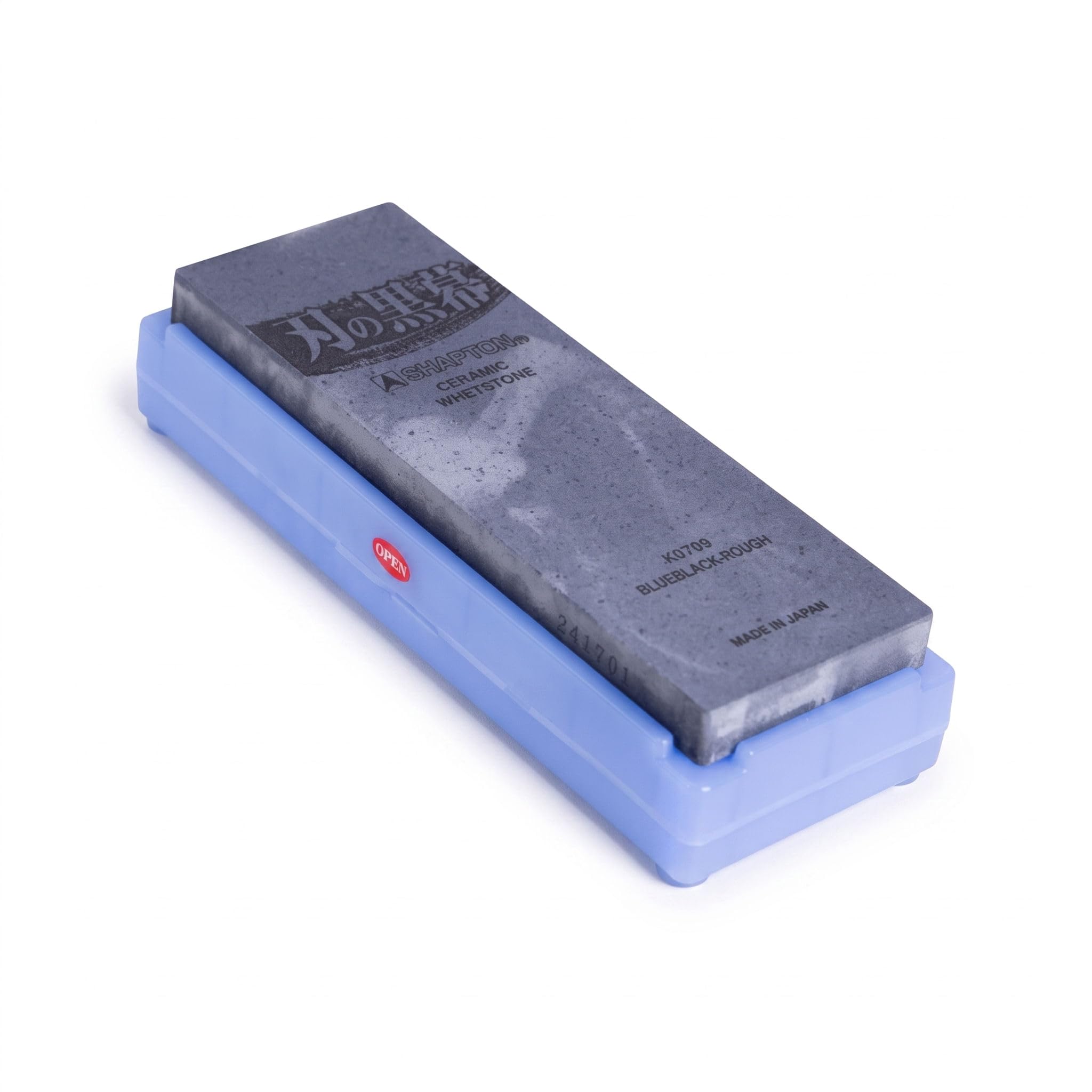
Shapton K0709 #320
Key Features
- Grit: 320
- Setup: Splash and go
- Weight: 1.1 lb
- Stone size: 8.27 x 2.76 x 0.59 in
- Price: Midrange
Buy this one for the drawer of knives you have given up on. A 320-grit stone is a repair tool: it grinds a new bevel where a chip or a decade of steeling has rounded one off, and it does it in a fraction of the time a 1000 would take. We used it on a chipped cleaver that had been living at the back of a block, and the nick was gone after a few minutes of steady work.
It is splash-and-go like its 1000-grit sibling, and for a coarse stone it holds its shape well. Coarse stones are usually the quickest to hollow out, and this one stayed usable through a long session. The scratch pattern is even, which matters because you are handing the edge to a finer stone next.
That is the catch: this stone finishes nothing. You need a 1000 after it, and if you do not already own one, the money is better spent there first. Our view is that the 320 is the second stone you buy rather than the first, unless you sharpen other people’s knives, in which case it pays for itself in a weekend.
Pros
- Fast on chips and damaged edges
- Splash-and-go with no soak
- Holds shape for a coarse stone
- Even, uniform scratch pattern
Cons
- Coarse finish needs a follow-up stone
Reach for this when an edge is chipped, not when it is merely dull; it is a repair stone that wants a 1000-grit partner.
Best for Axes and Tools
Lansky Puck
Key Features
- Grits: Coarse and medium
- Format: Handheld puck
- Weight: 9.17 oz
- Price: Budget
A puck changes the motion. Instead of running the blade across a bench stone, you grip the stone and sweep it along the edge, which is what makes it work on an axe head in the yard or a machete at a campsite. We keep one in a tool bag and another in the truck, and neither has needed anything from us but a wipe.
The two sides are coarse and medium, and that is the right pairing for the jobs it is built for: hatchets, mower blades, pruners, shovels, the sort of edge that needs to be functional rather than pretty. It takes a nick out of a hatchet quickly and leaves a working edge you can touch up in a couple of minutes each time you pick the tool up.
The same coarseness is why it is not a kitchen stone. On a chef’s knife it leaves a toothy edge that drags in onions, and you would want a 1000 to follow. It also handles pruners and shovel edges without complaint, which is more than most kitchen stones can say.
Pros
- Handheld shape works on axes and mower blades
- Coarse and medium sides cover tool edges
- Small enough to live in a tool bag
Cons
- Grits are too coarse for kitchen knives
The stone we keep with the tools rather than the dishes: it makes axes, machetes, and mower blades usable again for very little money.
Best for First-Time Buyers
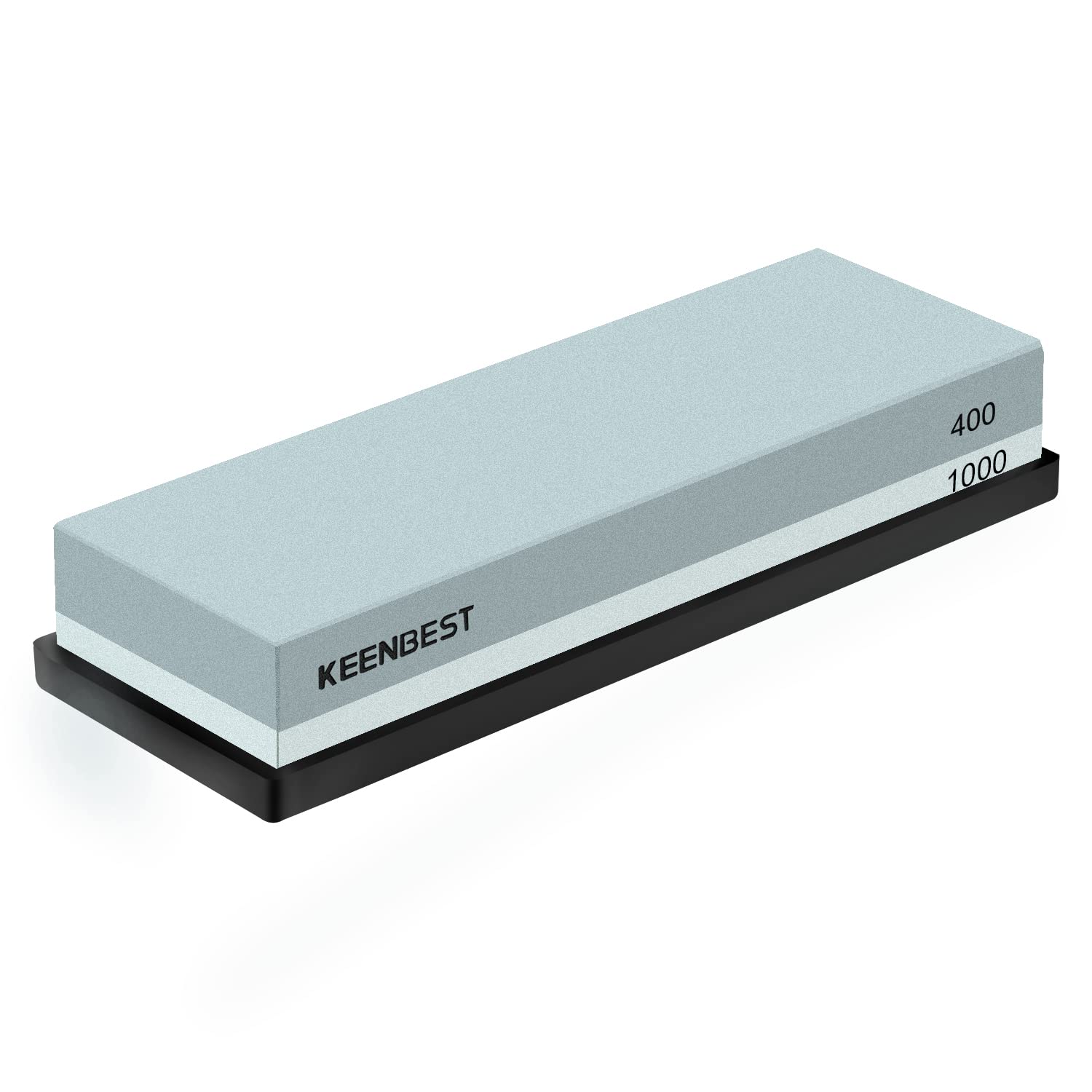
KEENBEST 400/1000
Key Features
- Grits: 400 / 1000
- Included: Rubber base, quick guide
- Stone size: 7 x 2.2 x 1.1 in
- Price: Budget
This is the least expensive stone in the group, and it does not pretend otherwise: a 7-inch, two-sided 400/1000 stone, a rubber base, and a short guide. For someone who has never sharpened anything and wants to find out whether they will stick with it, that is a sensible place to start.
It does the basic job. The 400 side brings a dull paring knife back to usable and the 1000 side cleans the edge up. The rubber frame holds it steady on a counter, and the stone is light enough to store in a drawer and forget about until you need it. If your knives are soft stainless and your expectation is a sharp working edge, this gets you there without any drama.
What you give up is wear. This is the thinnest stone here, and the material goes faster than the harder stones in this guide, so it will need flattening more often and replacing sooner. It is also the smallest surface of the group, so long blades need more repositioning. Keep it dry, store it flat, and it will teach you the motion cheaply.
Pros
- Lowest entry cost of any stone here
- 400 and 1000 cover dull to usable
- Rubber base holds it steady
Cons
- Wears faster than the harder stones here
- Smallest usable surface in the group
A fair first stone for soft kitchen knives if you are unsure about the habit; just expect to replace it sooner than the harder stones here.
Best for Pruners and Shears
Felco 903

Key Features
- Format: Narrow tapered hone
- Length: 3.94 in
- Abrasive: Diamond-coated steel
- Price: Midrange
At just under four inches long and two-thirds of an inch wide, this is barely a stone in the bench sense. It is a diamond-coated steel wand with tapered ends, shaped to follow the curve of a bypass pruner blade. If you own good pruners, that shape is the entire point, and it is the reason we keep one in the garden bucket rather than in the kitchen.
A few strokes along the bevel of each blade brings a pair of shears back to clean cuts, and the taper lets you work the curved section without rounding it over. The instructions are printed on the card it comes on, which we appreciate, because this is the sort of tool you pick up twice a year and forget the technique for. It is small enough to ride in a pocket or tie to a sheath, and narrow enough that a chef’s knife would take all evening on it. At about the price of a full-size water stone here, it asks a lot for a tool with one job. Two or three strokes per blade at the end of a pruning session keeps a good pair of shears out of the replacement market.
Pros
- Tapered shape follows curved pruner blades
- Diamond coating cuts quickly
- Small enough to carry or sheath
Cons
- Too narrow for kitchen knives
- Priced like a full-size stone here
We like it for pruners and curved blades and nothing else; gardeners with good shears get their money back in clean cuts.
How We Tested Sharpening Stones
We started by gathering the stones a home cook or woodworker would realistically buy — water stones, oil stones, diamond plates, and combination blocks — then narrowed the field by grit range, dimensions, price, and whether coarse stones and flattening tools were easy to find for the same system.
Most of the work happened on my kitchen counter, usually Sunday afternoons with a stack of neglected knives from the block plus a friend’s chipped paring knife and a dull chisel that had been sitting in a drawer. We timed how long each stone took to raise a burr on the same dull chef’s knife, counted strokes to get there, and noted whether the stone grabbed the edge or skated over it. To check ease of use, we timed how long each one bubbled in a water bath before it stopped absorbing, watched whether it stayed put on a damp towel or needed a holder, and cleaned up afterward to see how much slurry ended up on the counter.
Grit depth was judged by the scratch pattern: we looked at how deep a coarse stone’s marks ran and how many passes on the next grit it took to polish them out, which is where a lot of otherwise decent stones fall apart. For durability, we drew a pencil grid on each surface and rubbed it against wet sandpaper to see how quickly the stone dished, then weighed every stone at the start and again at eight months to see how much material had actually worn away. The stones that stayed flat longest and needed the least fuss are the ones that made the list.
How to Choose a Sharpening Stone
The right stone is the one you will actually soak, use, and dry, so choose by the edges you own and the patience you have rather than by the number of grits on the box.
Match the grit to the edge you are fixing
If your knives are tired rather than damaged, a 1000-grit stone is the only one you need. It sharpens, it maintains, and it leaves an edge that bites into a tomato. Coarse grits, 320 or 400, are for reshaping: chips, rolled edges, a blade that has been steeled into a curve. Finishing grits above 3000 refine a bevel that is already sharp.
The trap is buying the fine stone first. You cannot polish an edge that has not been shaped, and an 8000-grit side is wasted on a soft stainless blade. Start at 1000, add a 320 or 400 when something chips, and buy the polishing grit when you notice the difference it makes.
Water stones, diamond plates, and what each does well
Water stones cut through a slurry of abrasive and water, which gives a refined edge and a feel most cooks prefer. They also dish, which is why flattening becomes part of owning one. Diamond plates bond abrasive to a steel backing: they cut faster, stay flat, and handle carbide, ceramic, and high-hardness tool steels that a water stone struggles with.
Our split is simple. We reach for the SHARPAL when a chisel, a planer blade, or a hard stainless knife is involved, and for a water stone when the blade has to slice dinner.
Splash-and-go versus a ten-minute soak
The most common reason a stone stays in a drawer is the setup. A stone that needs a long soak and a day of drying is one you will use twice a year, however good it is. Splash-and-go stones like the Shapton 1000 are ready in seconds, which is why we keep one within reach of the sink.
If you sharpen on impulse, when a knife drags mid-recipe, pay for that convenience. If sharpening is a planned session with the radio on, soaking costs you nothing.
Size, base, and the flattening stone most kits skip
Seven to eight inches of length suits an 8-inch chef’s knife. Wider stones feel steadier under a big blade; narrower ones store more easily. The base matters more than it sounds, because a stone that slides on a wet counter is how people cut themselves, so insist on rubber or bamboo with a non-slip foot.
Then check for a flattening stone. Soft water stones hollow out in the middle, and a dished stone rounds the edge you are trying to sharpen. The Sharp Pebble 400/1000 and the Intelitopia set include one; many inexpensive kits quietly leave it out.
One stone or a progression?
For a household with a block of everyday knives, one 1000-grit stone plus a coarse stone for damage covers everything. A progression of 400, 1000, 3000, and 8000 with a strop makes sense if you sharpen often, sharpen tools, or simply enjoy the process.
Buy the progression second. The angle control you build on a single stone is what the fine grits depend on, and a strop on a badly shaped bevel only makes a bad edge shiny.
Frequently Asked Questions
How often should I sharpen kitchen knives on a stone?
For a home cook, a few light passes on a 1000-grit stone every month or two keeps an edge working. A knife that skins a tomato instead of biting into it is telling you it is time. Sharpening removes metal, so recover the edge with a handful of strokes rather than grinding at it weekly.
Can I use oil on a water stone?
No. Water stones are porous, and oil clogs the pores so the abrasive stops cutting. Soak or splash with water only; oil belongs to oil stones, which are a different product. Diamond plates are the flexible option here, since they run dry or with water and need no soaking at all.
Will a whetstone sharpen ceramic knives or hard powdered steel?
A water stone will struggle. Ceramic blades, carbide tooling, and high-hardness steels resist aluminum-oxide abrasives, and you will spend a long time getting a shallow result. Go diamond instead: the SHARPAL’s 325-grit side cuts those materials and stays flat while it does.
How long does a stone last, and how do I know when it is done?
A water stone used at home lasts years if you flatten it regularly. It tells you when it is tired by staying dished after flattening, or by loading so heavily that it polishes rather than cuts. Check flatness with a straightedge across the surface. Diamond plates wear differently: once the surface slides without biting, it is spent.
Final Verdict
Ours is the Sharp Pebble 1000/6000. The angle guide and non-slip base make the first session work instead of frustrate, and the 1000 side handles nearly everything a home kitchen asks of it. Buy the Shapton 1000 instead if you will never soak a stone, and the SHARPAL if your knives include ceramic or hard tool steel.
The rest can wait. Add a coarse stone when something chips, a fine grit when you can feel the difference, and a strop when your edges are already consistent.