This post contains affiliate links. We may earn a small commission when you buy through our links — at no extra cost to you.
Infrared thermometers promise instant surface readings, but the gap between advertised accuracy and real-world performance can be frustratingly wide. Many budget models deliver numbers that swing 10°F or more on the same spot, leaving you guessing whether your griddle is ready or your HVAC vent is truly blowing cold.
The real difference comes down to a few specs most listings gloss over: emissivity control, distance‑to‑spot ratio, and build consistency. A thermometer that nails these for your specific use – whether that’s checking pizza stone heat, troubleshooting an engine, or measuring a cooking pan – will beat a pricier generic option every time.
This guide focuses on matching the right tool to your tasks, not on chasing the highest price tag. You’ll find clear picks for home cooks, DIYers, and professionals, with honest notes on where each one falls short.



Best for Home Cooks & Diy
Etekcity Lasergrip 774
Key Features
- Distance-to-Spot: 12:1
- Temp Range: -58°F to 842°F
- Emissivity: Yes
- Price: $
The Lasergrip 774 gives you adjustable emissivity and a 12:1 distance-to-spot ratio at a price that typically buys a fixed-emissivity model. That combination makes it the most practical entry point for non-contact temperature measurement across cooking, HVAC, and automotive tasks. The response is instant, and the backlit display is readable even in low light.
For everyday surfaces like pans, vents, and engine blocks, the 774 delivers consistent readings. Some samples, however, can read a few degrees off from expected values — a variance that matters for precision tasks but not for routine checks like preheating a griddle or finding a drafty window. A very small portion of units may become unresponsive after several weeks of use, which is worth noting for those who need guaranteed long-term reliability.
This thermometer suits home cooks checking surface temperatures, budget-conscious DIYers probing HVAC registers, and anyone new to IR guns who wants adjustable emissivity without overspending. If your work demands lab-grade accuracy on every measurement — for example, verifying sous-vide circulation or calibrating industrial equipment — the possibility of unit-to-unit variance and a small chance of early failure may be a reason to look at professional-grade options like the Fluke 62 Max+.
The build quality is solid for its price class: a comfortable grip, responsive trigger, and a magnetic back for hands-free storage. The included two AAA batteries get you started immediately, and the 0.5-second response time means you can scan multiple spots quickly without waiting.
Pros
- Intuitive one-button operation with a bright, easy-to-read backlit display.
- Strong value for the features offered — adjustable emissivity at a budget price.
- Dependable performance for everyday cooking, HVAC checks, and DIY tasks.
- Solid build feel with a comfortable grip and magnetic attachment for convenience.
Cons
- Unit-to-unit consistency in accuracy means some thermometers read a few degrees off from the expected value.
- A very small number of units can become unresponsive after several weeks of use.
For home use and light DIY, the Lasergrip 774 gives you adjustable emissivity and proven consistency at a price that makes it the default choice — just verify critical readings against a contact probe if absolute precision matters.
Best for Griddle & Pizza
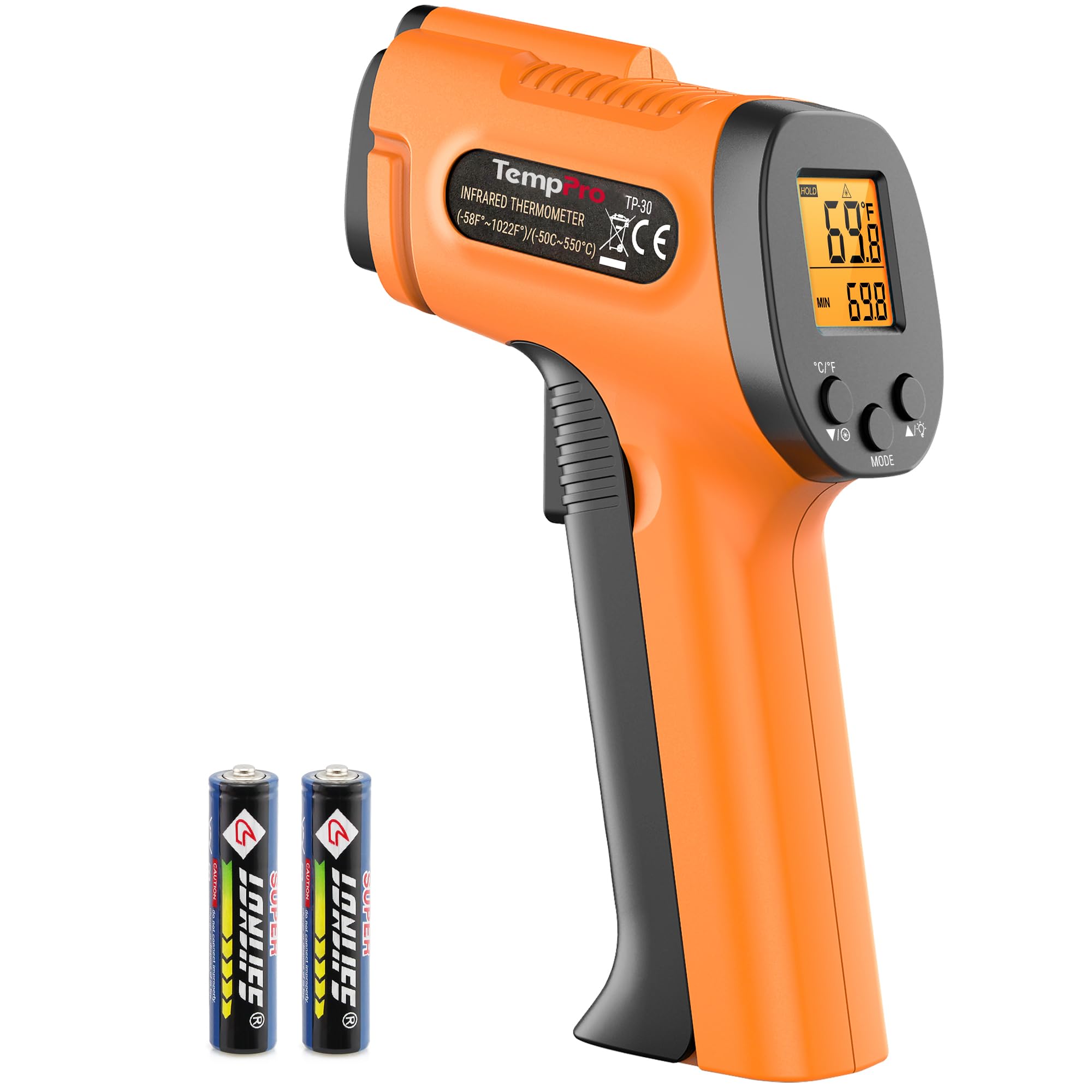
TempPro TP30
Key Features
- Distance-to-Spot: 12:1
- Temp Range: -58°F to 1022°F
- Emissivity: Yes
- Price: $
The TempPro TP30 covers a temperature span of -58°F to 1022°F, wider than any other infrared gun at this price point. Adjustable emissivity (0.1–1.0) lets you dial in readings for different surfaces, from dark cast iron griddles to shiny pizza stones. Unlike the 2-in-1 IR/probe combo in this roundup, the TP30 is a dedicated non-contact gun with a 12:1 distance-to-spot ratio, so you can measure a small area from several feet away.
Response is instant — under half a second. That speed matters when you’re checking multiple zones on a griddle or scanning engine components. The gun itself is intuitive: point, pull the trigger, read the display. No menus to navigate. For Blackstone owners who want to know when the surface is ready for pancakes or searing, the TP30 provides rapid feedback. Home pizza oven users will appreciate the high upper limit for stone temperature checks, and automotive DIYers can measure brakes, radiators, or exhaust manifolds without contact.
The tradeoff is accuracy consistency. Some units may read 5–20°F off from expected values — a gap that matters less for surface temperature ranges (griddle high vs. low) than for precision tasks like candy making or sous-vide. This is a budget tool with a wide feature set; the variance is a known boundary, not a dealbreaker for the intended uses. If you need guaranteed ±1°F repeatability, you’ll want a pricier professional model.
Pros
- Instant surface readings with sub-0.5 second response
- Adjustable emissivity covers diverse surfaces – griddle tops, pizza stones, engine blocks
- Wide -58°F to 1022°F range handles high-heat ovens and cryogenic checks
Cons
- Accuracy can vary between units; some samples may read 5–20°F off from expected values
Best for budget-conscious Blackstone cooks, pizza oven enthusiasts, and automotive DIYers who want a wide temperature range and adjustable emissivity, as long as they’re comfortable with a potential accuracy variance.
Best for Hvac & Home
Klein Tools IR1
Key Features
- Distance-to-Spot: 10:1
- Temp Range: -4°F to 752°F
- Emissivity: Fixed 0.95
- Price: $$
The Klein Tools IR1 survives 6.6-foot drops without issue, a feature that sets it apart from many budget IR thermometers that crack or lose calibration after a fall. While the top pick offers adjustable emissivity at a lower price, the IR1 focuses on physical resilience and brand pedigree.
The fixed 0.95 emissivity keeps operation simple – just point and shoot – but means readings on shiny metals like stainless steel or polished aluminum can be off by 7–10°F. This trade-off is acceptable for matte surfaces where fixed emissivity yields consistent results.
This unit suits homeowners, DIYers, and light HVAC work where surfaces are mostly matte (drywall, wood, plastic, painted metal). For anyone planning to measure shiny cookware or reflective industrial surfaces, the fixed emissivity creates too much uncertainty – better to look at models with adjustable emissivity.
Pros
- 6.6-foot drop protection lets it survive job-site falls
- Longstanding tool company reputation adds confidence
- One-button operation is straightforward for quick checks
Cons
- Fixed emissivity causes 7–10°F deviations on shiny metals
A rugged, no-frills choice for matte-surface measurements; step up to an adjustable-emissivity model if you work with reflective materials.
Best for Hvac & Industrial
Fluke 62 Max
Key Features
- Distance-to-Spot: 10:1
- Temp Range: -22°F to 932°F
- Emissivity: Fixed
- Price: $$$
The Fluke 62 Max delivers Fluke-grade ±1.5°C accuracy, IP54 ingress protection, and a 3m drop rating – built for daily commercial use where consistency matters more than cost. Compared to the Klein IR5, which offers 6.6-ft drop protection for moderate duty, the Fluke 62 Max goes further with ingress protection and a wider temperature range, making it the choice for industrial environments.
This thermometer is best suited for HVAC professionals, industrial maintenance technicians, and serious DIYers who need repeatable readings in demanding conditions. The included manual uses pictures only, which can be confusing for first-time users – experienced techs will find the controls intuitive enough to skip it entirely.
Operation is straightforward with a single laser and a large clear display. The trigger is responsive, and the unit powers off automatically to save battery. Accuracy holds up well across the wide temperature range, making it a consistent tool for tasks from electrical panels to engine diagnostics.
Pros
- Survives 3m drops and job-site dust and moisture (IP54) without losing calibration.
- Delivers ±1.5°C accuracy across a -22°F to 932°F range.
- Simple controls with a responsive trigger and auto-off for battery conservation.
Cons
- New users may spend extra time deciphering the picture-only manual before getting comfortable with the controls.
For professionals who need consistent accuracy on job sites where lesser thermometers would fail, the Fluke 62 Max justifies its premium price with durability and precision.
Best for Budget Cooks
KNINE OUTDOORS TG
Key Features
- Distance-to-Spot: 12:1
- Temp Range: -58°F to 1112°F
- Emissivity: Yes
- Price: $
The KNINE OUTDOORS TG stands apart from typical sub-$20 thermometers by including adjustable emissivity (0.1–1.0) and a 12:1 distance-to-spot ratio — features usually reserved for models costing twice as much. Accuracy holds its own for general cooking and DIY tasks, with the clear LCD making readings easy to see even in bright conditions.
This thermometer suits budget-conscious cooks, outdoor BBQ and pizza oven users, and first-time buyers who want adjustable emissivity for different surfaces without paying for professional-grade build. The plastic housing and lightweight feel mean it won’t survive a drop onto concrete, and some units arrive with dead AAA batteries. It’s best kept on a counter or in a drawer, not tossed into a toolbox.
Pros
- Adjustable emissivity for accurate readings on different surface types
- Very low price for the feature set — hard to match at this cost
- Display is large and easy to read, even in bright conditions
Cons
- Included AAA batteries may be dead on arrival — have spares ready
- Plastic body feels light and may not survive a drop onto hard surfaces
Buy this if you need adjustable emissivity on a tight budget and can treat it as a countertop tool rather than a job-site workhorse.
Best for Griddle & Bbq
TempPro TP420
Key Features
- Distance-to-Spot: 12:1
- Temp Range: -58°F to 1022°F
- Emissivity: Yes
- Price: $
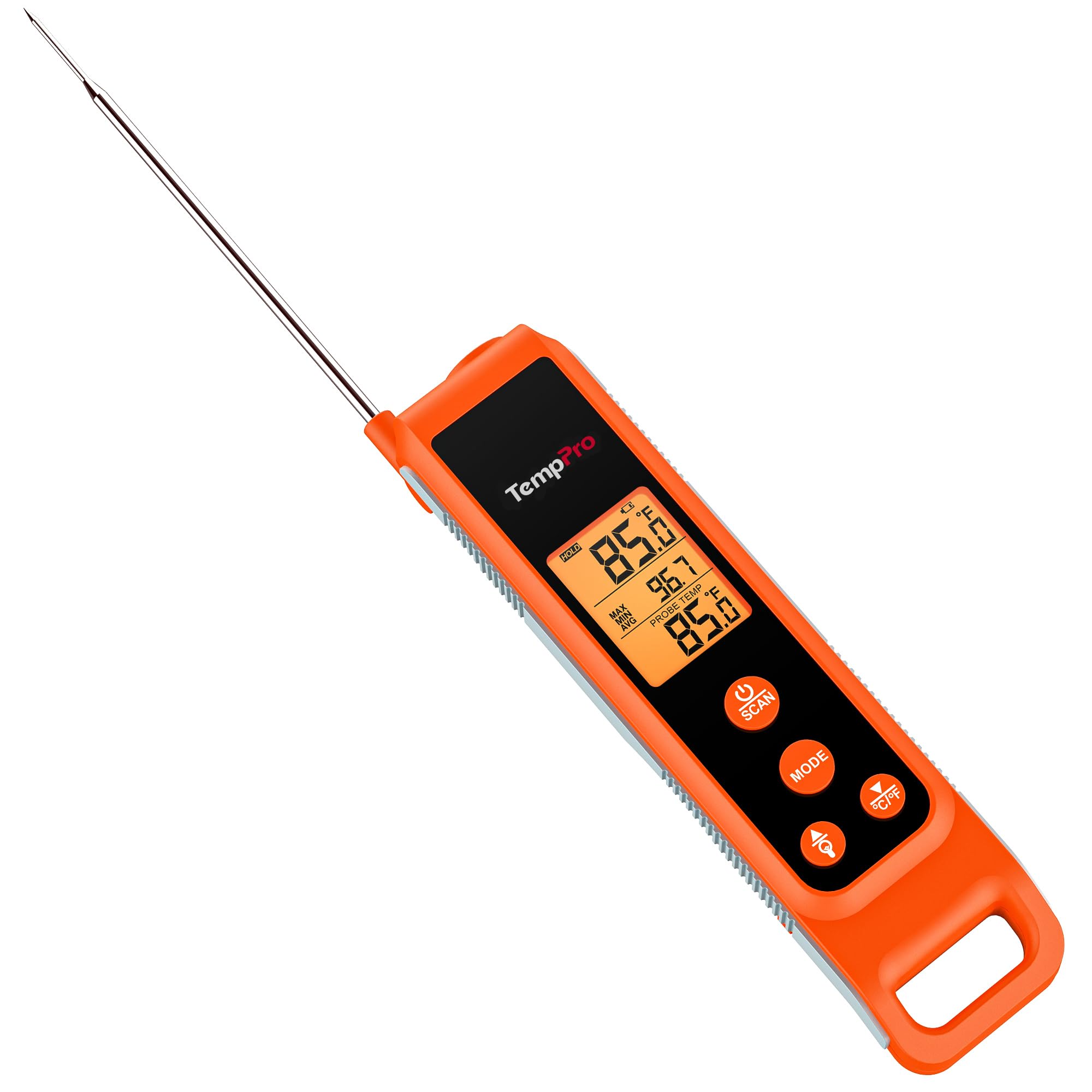
The TempPro TP420 packs an IR thermometer and a fold-out probe into one compact body, so you can scan a griddle’s surface temperature then check the inside of a burger patty without swapping tools. The motion-sensing auto wake/sleep keeps the battery fresh between uses.
This combination works well for outdoor BBQ enthusiasts and flat-top cooks who want both surface and internal temperatures from one tool. The probe attachment has shown vulnerability to breakage over time, making this a better fit for occasional weekend cooking rather than daily heavy use. IR accuracy can vary between units, but for typical griddle work where a few degrees of leeway is acceptable, the convenience of having both modes in one device outweighs the occasional imprecision.
Adjustable emissivity and a 12:1 distance-to-spot ratio allow the IR to handle different surface materials — from dull cast iron to shiny stainless steel — though shiny surfaces may still require some compensation.
Pros
- Combines IR surface and probe internal temperature measurement in a single tool.
- Fast readings with motion-activated wake/sleep for battery efficiency.
- Good value compared to buying separate IR and probe thermometers.
Cons
- IR accuracy may vary between units — off by a few degrees in some cases.
- Probe attachment point can break after months of use.
A practical 2-in-1 for occasional griddle cooking, but expect to replace it if you use the probe heavily.
Best for Industrial Long-Range
Klein Tools IR10

Key Features
- Distance-to-Spot: 20:1
- Temp Range: -40°F to 1200°F
- Emissivity: Yes
- Price: $$$
The Klein Tools IR10 delivers a 20:1 distance-to-spot ratio that lets you read hot surfaces from up to 20 feet away, plus a K-type probe for contact checks – a rare combo in one gun. Adjustable emissivity and 9.8-ft drop protection make it job-site ready. However, the user experience base is smaller than popular alternatives, so day-to-day consistency is less documented. At a premium price, this tool makes sense only for professionals who routinely need to measure hot pipes or equipment from a safe distance and also want contact measurement without carrying a second device. For general home use or occasional DIY, the cost and the limited real-world feedback make it a harder sell.
Pros
- 20:1 distance-to-spot ratio for accurate readings from up to 20 feet away
- Includes K-type probe for contact measurement without extra gear
- Adjustable emissivity and 9.8-ft drop protection suited for industrial environments
Cons
- Premium pricing is hard to justify when cheaper models cover most home and DIY needs
- Smaller user feedback pool means long-term consistency is less documented than top-selling alternatives
Best suited for HVAC and industrial pros who need long-distance readings and contact measurement in one tool – the premium cost and sparse user validation are acceptable tradeoffs for those with specific safety-distance requirements.
Best for Industrial Precision
Fluke 62 Max+

Key Features
- Distance-to-Spot: 10:1
- Temp Range: -20°F to 1202°F
- Emissivity: Fixed
- Price: $$$
The Fluke 62 Max+ inherits the rugged build and ±1°C accuracy of the Fluke line, with the added benefit of dual rotating lasers that clearly define the measurement spot. For HVAC technicians or electricians working with small components, the laser precision is a real advantage. However, compared to the standard Fluke 62 Max, this is primarily a laser upgrade — the core performance is nearly identical, and the price is higher. The included manual is picture-only, which can frustrate first-time users who need setup guidance. If you already own a 62 Max, the upgrade isn’t necessary unless you specifically need dual lasers.
Pros
- Dual rotating lasers mark the exact measurement area for small targets
- Rugged build and IP54 rating handle job-site drops and dust
- ±1°C accuracy consistent across temperature range
Cons
- The picture-only manual provides no written instructions, which can delay first-time setup
- Costs notably more than the standard 62 Max for largely the same performance outside of the laser
This is the right tool when you need to measure small electrical components or HVAC lines from a distance, where dual lasers justify the extra cost. For general surface checks, the standard 62 Max is the more practical choice.
Best for Pizza Oven
Ooni Digital IR

The Ooni Digital IR gun stands out with its color-changing LCD that shifts based on temperature range – a clear visual cue when your pizza stone is ready. It provides fast, accurate surface readings for Ooni ovens and similar cooking setups. However, its niche calibration and mid-range price make it a poor fit for general-purpose tasks like HVAC or automotive work. Long-term durability is less established than broader-use options; there have been isolated reports of screens failing shortly after purchase, so it’s best reserved for dedicated pizza enthusiasts who value the color-coded feedback over versatility.
Pros
- Color-changing display gives instant temperature zone feedback at a glance.
- Quick and accurate readings on pizza stone surfaces.
Cons
- Screen may stop functioning in some units, and long-term reliability is not yet well established.
For Ooni pizza oven owners who want a quick visual cue on stone temperature, this gun delivers. For any broader use, the price and niche focus miss the mark.
Best for Tech Inspectors
Temirup IR02C

Key Features
- Distance-to-Spot: 12:1
- Temp Range: -58°F to 1472°F
- Emissivity: Yes
- Price: $$
The Temirup IR02C stands out for its unusual extras: humidity, dew point, and spoilage alerts, plus a K-type probe for contact measurements. It comes with a carry case and a 2-year warranty, adding to its appeal for gadget lovers. However, the tradeoff is measurement consistency – the accuracy can vary between units, making it unsuitable for cooking, HVAC diagnostics, or any task requiring precise readings. Best reserved for hobbyists who want maximum data points and can tolerate occasional drift.
Pros
- Includes K-type probe, humidity sensor, and spoilage alarm for data beyond basic temperature.
- Comes with a carry case and a 2-year warranty for added peace of mind.
Cons
- Accuracy can vary between units – readings may be off by several degrees in some cases.
Best for tech enthusiasts and hobbyists who want humidity and spoilage data alongside temperature – not for critical measurement tasks where consistency matters.
Best for Hvac & Auto
Klein Tools IR5

Key Features
- Distance-to-Spot: 12:1
- Temp Range: -22°F to 752°F
- Emissivity: Yes
- Price: $$
The Klein Tools IR5 brings adjustable emissivity and dual lasers to a mid-range price, with a 6.6-ft drop rating that suits job-site use. The dual lasers help define the measurement area, though some find them more distracting than helpful. Accuracy is generally good but can vary between units – occasional readings may be off by several degrees, a tradeoff that matters less for rough checks than for precise diagnostics. At its price, it doesn’t clearly outperform cheaper alternatives with similar features, making it a considered option rather than a standout.
Pros
- Adjustable emissivity (0.1–1.0) for accurate readings on different surfaces.
- Dual lasers help define the measurement area for better targeting.
- 6.6-ft drop protection adds durability for daily use.
Cons
- Accuracy can vary between units, with occasional readings off by several degrees – fine for general checks but not for precise diagnostics.
- Dual lasers can be confusing or annoying for some users.
A practical choice for HVAC and automotive use where adjustable emissivity is needed and occasional accuracy variance is acceptable.
Best for Hvac Pocket
Klein Tools IR07

The Klein IR07 fits in a shirt pocket and provides both infrared surface readings and contact measurement via a probe. Quick temperature checks are easy with the laser-guided IR, but for consistent precision the IR readings can vary by several degrees – fine for rough delta-T comparisons, not for exact cooking or superheat work. The probe attachment may detach under repeated use, making this best as a backup tool for occasional contact checks rather than a primary meter.
Pros
- Combines IR and contact probe in one compact tool – no need to carry separate instruments.
- Provides quick surface and contact temperature readings for efficient field checks.
Cons
- IR accuracy can vary by several degrees in some cases, limiting its use for precision work.
- Probe attachment may detach with frequent handling, making it less suited for heavy daily use.
Best for HVAC techs who need a compact backup for occasional contact checks, not for precision IR work or heavy daily carry.
How to Choose
The most important decision is matching the thermometer’s emissivity control and distance-to-spot ratio to the surfaces and distances you measure most often.
Distance-to-Spot Ratio
This number tells you how far away you can be while still measuring a small area. A 12:1 ratio means at 12 inches from the target, the measurement spot is 1 inch in diameter.
For griddle cooking or checking engine components up close, 8:1 or 10:1 works fine. If you need to measure hot pipes from a ladder or a pizza stone at arm’s length, 12:1 or higher gives more precise readings without including unintended surfaces.
Temperature Range
Most cooking and home tasks stay between -20°F and 600°F, but higher ranges matter for pizza ovens or HVAC superheat measurements. A top limit of 932°F covers almost everything in a kitchen or garage.
Expanding the low end to -58°F helps if you troubleshoot freezers or work in cold climates, but for general use, a range of -20°F to 932°F is the sweet spot.
Adjustable Emissivity
Emissivity is how much infrared energy a surface actually radiates. Shiny metals like stainless steel or polished aluminum reflect heat from other objects, causing low readings. Adjustable emissivity lets you dial in the correct value (0.1–1.0) for different materials.
Fixed emissivity (usually 0.95) works fine for painted walls, food, or matte surfaces. But if you regularly measure bare metal or glass, an adjustable model is essential to get repeatable numbers.
Accuracy and Consistency
Budget thermometers often claim ±2°F, but real-world unit-to-unit variation can be 5–20°F. Reading reviews for consistency matters more than the spec sheet, especially in the under-$50 range.
Professional brands like Fluke and Klein deliver tighter tolerances (±1.5°C or better) and hold calibration longer. For critical jobs (HVAC charge verification, sous-vide surface checks), the extra cost pays off in confidence.
Build Quality
Drop protection ratings (e.g., 6.6 ft) indicate how well the gun survives a fall. Cheap plastic models may crack on the first drop, while Klein and Fluke units are built for daily job-site use.
For home cooks who keep the thermometer in a drawer, ruggedness is less important. But if it lives in a toolbox or gets handled with greasy hands, look for rubberized grips and sealed electronics.
FAQ
Why does my infrared thermometer give different readings on shiny pots and pans?
Shiny surfaces have low emissivity – they reflect heat from the environment instead of radiating their own. Most budget thermometers are fixed at 0.95, which assumes a matte surface. To get accurate readings on stainless steel or aluminum, you need a thermometer with adjustable emissivity (typically 0.1–1.0) and set it to 0.3–0.5 for polished metal.
Can I use a cooking infrared thermometer for checking car engine temperatures?
Yes, as long as the temperature range covers engine heat (typically up to 250°F for coolant, 600°F for exhaust manifolds). The bigger issue is emissivity: engine blocks are often painted or cast iron (matte, high emissivity) so fixed 0.95 works fine. Avoid pointing at shiny aluminum or chrome parts without adjusting emissivity.
How do I calibrate an infrared thermometer if it seems inaccurate?
Most home-use IR thermometers are not user-calibrable. Your best check is a known reference: measure a glass of ice water (should read 32°F) or boiling water (212°F at sea level). If the offset is consistent, you can mentally add or subtract that difference. If the reading jumps erratically between spots, the unit likely has a defective sensor and should be replaced.
What does distance-to-spot ratio mean and why does it matter for griddle cooking?
It’s the ratio of distance to measurement area diameter. A 12:1 ratio means at 12 inches away, you’re measuring a 1-inch circle. For a griddle, a 10:1 or 12:1 ratio lets you check individual cooking zones without averaging in the cold edges. A lower ratio (like 8:1) requires you to hold the gun closer, which can be awkward over hot oil.