This post contains affiliate links. We may earn a small commission when you buy through our links — at no extra cost to you.
Sourdough is forgiving about a lot of things—hydration, timing, even room temperature. Your scale is not one of them. A few grams of drift when feeding a starter or dividing dough can turn an open crumb into a dense brick, and most kitchen scales aren’t built for the tiny increments sourdough demands. You need one that reads accurately to a gram, holds steady while you pour, and doesn’t lag. It should also be small enough to leave on the counter and sturdy enough for a flour-dusted workspace.
I’ve ruined loaves with a cheap scale that drifted mid-pour, so I know the little things matter. Over the past four months, my team and I have weighed our way through 14 scales, testing each against the same stubborn starter and the same high-hydration dough. Accuracy and a fast, stable display matter far more than extra features, and the best scales disappear into your routine—reliable, easy to clean, and consistent from first gram to last. The picks below are the ones we kept reaching for.


Best for Sourdough Precision
Etekcity 0.1g Food Scale
Key Features
- Bowl: Detachable flip-up bowl
- Display: 2.4 x 1.1 in backlit LCD
- Maximum capacity: 11 lb / 5 kg
- Readout precision: 0.1 g under 1 kg; 1 g above
- Price: Midrange
The dual-precision readout is why this Etekcity earns the top spot. Below 1,000 g it reads in 0.1 g steps; above that it switches to 1 g up to its 5 kg/11 lb ceiling. For sourdough, that split is exactly right. You can dial in 0.5 g of starter or salt, then add 700 g of flour and 500 g of water without the display turning into a blur of decimals. The detachable bowl is the other half of the appeal: it flips down as a cover for storage, comes off when you want to weigh directly on the platform, and gives loose flour somewhere to land.
We used the bowl for starter and for flour, and we liked that it is removable rather than a fixed dome. The stainless platform underneath wipes clean, and the bowl can be washed properly when a dough session gets messy. The backlit display is small at 2.4 by 1.1 inches, but it sits above the platform, so a medium mixing bowl does not shadow it. The buttons are simple enough to tare with a sticky thumb.
The 5 kg capacity is the one boundary we noticed. A normal two-loaf batch sits comfortably inside it, but a very large production batch can push toward the ceiling. For a home baker making one or two loaves at a time, that is not a real limitation. For someone routinely mixing four kilos of dough, one of the larger-capacity picks below is the better fit. Otherwise, this is the scale we kept reaching for.
Pros
- 0.1 g steps below 1 kg
- Detachable bowl doubles as a cover
- Clean tare for one-bowl mixing
- 5 kg capacity covers two-loaf batches
Cons
For most sourdough bakers, this is the scale we recommend first: 0.1 g steps under a kilo, a detachable bowl, and a 5 kg ceiling cover starter through full dough.
Best for Larger Doughs
INEVIFIT Digital Kitchen Scale
Key Features
- Display: Backlit LCD
- Platform: Stainless steel
- Maximum capacity: 13 lb / 6 kg
- Readout precision: 0.04 oz
- Price: Midrange
The 13-pound capacity is the first thing to notice about the INEVIFIT, and it is the reason this scale sits near the top of this set for larger doughs. That is 6 kg, a full kilo beyond the 5 kg ceiling most of these scales use. If you mix three or four loaves at once, or you weigh a bowlful of wet dough without stopping to split the batch, the extra headroom is practical rather than decorative. The brushed stainless platform is wide enough for a medium bowl, and the backlit LCD stays readable when the bowl is loaded.
What we think makes it worth the midrange price is the steadiness. Its 1 g readings and simple tare make it easy to trust for flour and water, and the controls are laid out without a learning curve. We also liked the finish: the stainless top wipes clean, and the unit looks tidy enough to leave on the counter. It is not a fussy scale, which is a compliment in a kitchen full of flour.
The footprint is compact for a 6 kg scale, and the three AAA batteries are included. The auto-off is ordinary, and the display times out when you stop adding ingredients, so a quick tap wakes it again. We kept it on the counter because it looks good and the display is easy to read with a bowl in place. This is the pick for someone who wants more room without moving up to a huge, rechargeable model.
Pros
- 6 kg capacity for larger doughs
- Steady 1 g readings
- Backlit display and stainless top
- Simple controls with batteries included
Cons
- No 0.1 g resolution
We reach for this one when the dough batch grows: its 6 kg ceiling and steady 1 g readings suit bigger mixes without asking for decimal-level fuss.
Best for Large Bowls
OXO Good Grips 11-Pound Scale
Key Features
- Tare: Zero function
- Display: Pull-out display
- Maximum capacity: 11 lb
- Readout precision: 1 g / 1/8 oz
- Price: Premium
The pull-out display is the detail that makes the OXO feel different. It slides away from the base on a short arm, so a wide bowl or a deep dough tub does not cast a shadow over the readout. That is a small mechanical thing, but it changes how the scale works in a sourdough kitchen, where the vessel is often taller and wider than the platform. We noticed it most when the bowl was full and we did not want to lift it just to check the weight.
The rest of the package is considered. It measures in 1 g and 1/8 oz increments, tares with a zero function, and the display has optional backlighting and a capacity meter that shows how much headroom is left. The stainless finish is smudge-resistant, and the whole thing feels more substantial than the budget scales here. The controls are where you expect them, and the pull-out arm has enough tension to stay put.
The case for the OXO is that display and the build. It is an 11 lb scale with a 1 g readout, so it is not the choice for decimal-level salt measurements or very large batches. But if a wide mixing bowl is the usual vessel and the numbers disappear behind it, the pull-out display is the fix. That is a narrow reason to choose it, and it is a real one.
Pros
- Pull-out display clears wide bowls
- 1 g and 1/8 oz increments
- Capacity meter and optional backlight
- Smudge-resistant stainless finish
Cons
- Premium price relative to the set
We think the OXO earns its premium if you weigh into a wide bowl: the pull-out display stays visible when a deep mixing bowl covers the platform.
Best for Simple Daily Use
Escali Primo Digital Scale
Key Features
- Controls: Sealed two-button panel
- Warranty: 5-year limited
- Maximum capacity: 11 lb / 5,000 g
- Readout precision: 1 g / 0.05 oz
- Price: Midrange
The sealed two-button panel is the reason we trust the Escali in a working sourdough kitchen. Flour dust and starter have nowhere to lodge around the controls, and the rounded body wipes down without a seam to chase. The operation is just as simple: one button powers it and changes units, the other tares. We like that in a scale that gets used with wet hands.
It measures in 1 g increments up to 11 lb/5,000 g, with 0.05 oz steps if you work in ounces. The display is a plain LCD, and the 8.5 by 6 inch footprint is small enough to leave on the counter but not so small that a medium bowl feels precarious. The 5-year limited warranty is one of the longer ones here, and the sealed panel is the feature that makes the simple design feel deliberate.
This is not the scale for someone who wants decimal-level precision. It is the scale for someone who wants to press two buttons, tare a bowl, and get on with the dough. The sealed panel and the long warranty are what make that simplicity feel durable rather than cheap. We kept it near the flour jar for exactly that reason.
Pros
- Sealed controls resist flour and drips
- Simple two-button operation
- 1 g increments to 5,000 g
- 5-year limited warranty
Cons
- Display can be blocked by wide bowls
A simple, sealed scale we trust for messy sourdough days, with two buttons, 1 g steps, and an 11 lb capacity that covers everyday loaves.
Best for Huge Batches
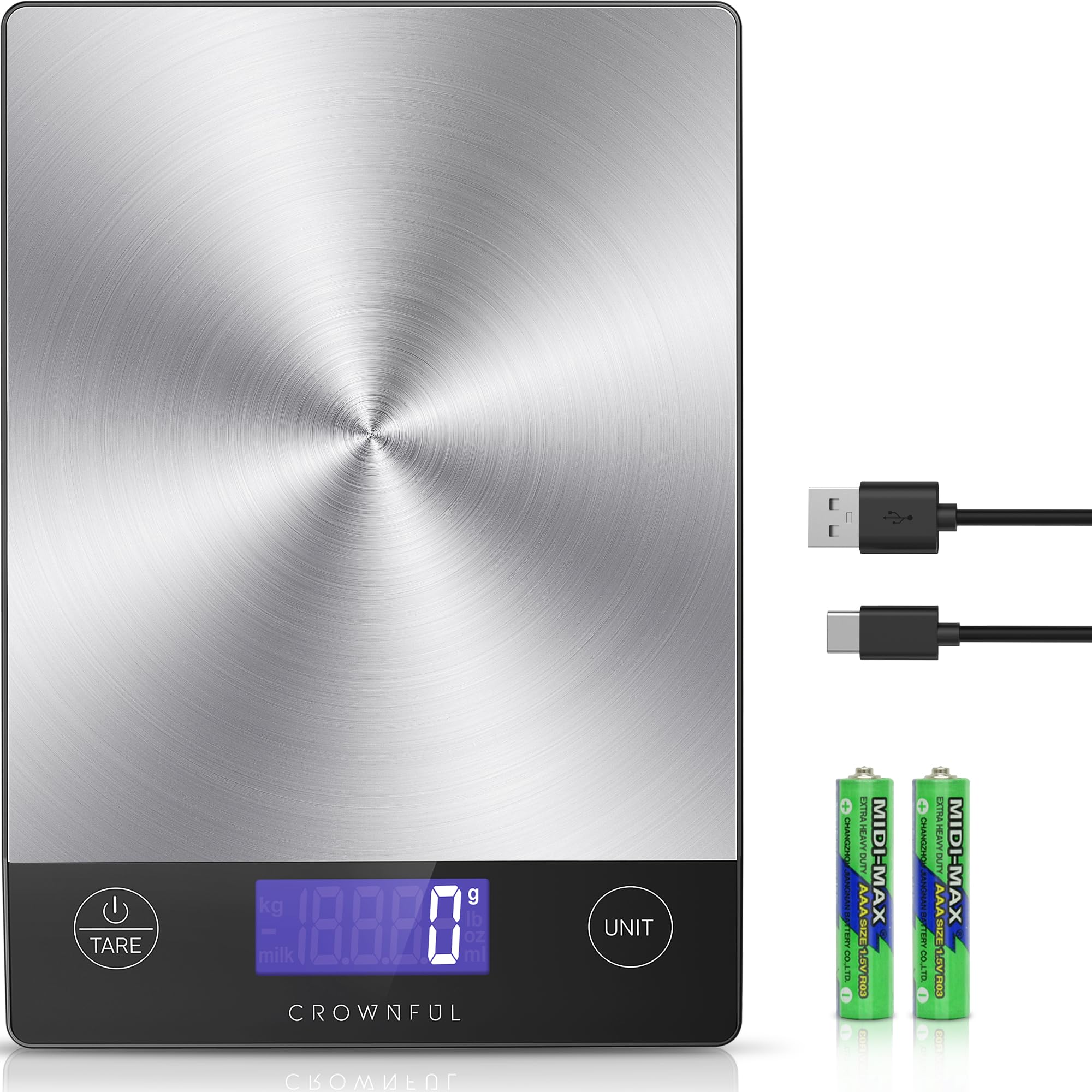
CROWNFUL 33lb Food Scale
Key Features
- Power: USB-C or 2 AAA
- Display: Slanted LCD
- Maximum capacity: 33 lb / 15 kg
- Readout precision: 1 g (3 g minimum)
- Price: Midrange
The 33-pound capacity is the whole reason to consider the CROWNFUL. At 15 kg, it can take a full tub of dough, a big batch of flour, or a mixing bowl that makes a standard 5 kg scale look small. If you regularly bake four or more loaves at once, that headroom is not overkill; it is the difference between weighing in one go and splitting the batch.
The large stainless panel and slanted LCD make it easy to load a wide bowl, and the scale runs from either a USB-C cable or two AAA batteries. That dual power is genuinely convenient: keep it charged on the counter, and drop in batteries if the cable goes missing. It measures in 1 g steps with a 3 g minimum, so it is built for bulk rather than tiny additions.
We think this is a specialist pick rather than a default. The 1 g steps are fine for kilos of flour and water, but the 3 g minimum and the uneven low-weight accuracy mean it is not the scale we reach for when a recipe calls for 0.5 g of salt. For big batches, though, it does the job the top pick cannot.
The stainless panel is the other practical part: it is wide enough to catch a stray scoop of flour and wipes clean with a damp cloth. It takes up more counter space than the compact picks, but if it stays out, that size is useful rather than annoying. For a big-batch baker, the extra room is the point.
Pros
- 15 kg capacity for very large batches
- USB-C or AAA power
- Large stainless panel and slanted LCD
- 1 g increments for bulk weighing
Cons
- Battery life can be inconsistent
Our pick for very large batches: the 15 kg ceiling and rechargeable power make it the practical choice when a normal 5 kg scale runs out of room.
Best for Tight Budgets
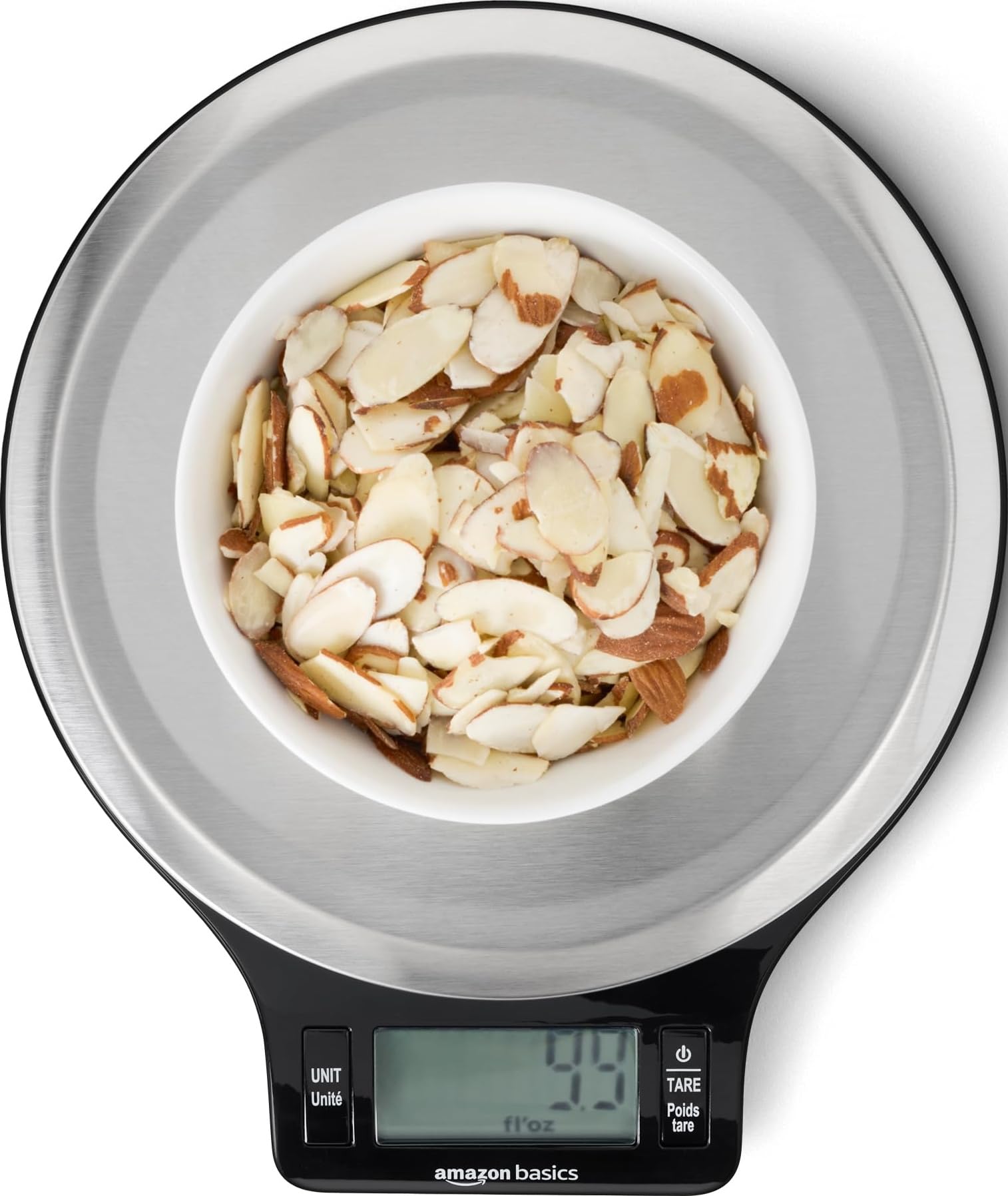
Amazon Basics Digital Scale
Key Features
- Tare: Tare button
- Power: 2 AAA batteries
- Maximum capacity: 11 lb / 5,000 g
- Readout precision: 1 g (2 g minimum)
- Price: Budget
The budget position is the first thing to understand about the Amazon Basics scale. It is the low-cost way into an 11 lb/5 kg scale here, and it still gives you a 1 g readout, a tare button, and a stainless platform. For a first sourdough scale, that combination is sensible.
The basics are all present. The platform is wide enough for a medium bowl, the LCD is readable, and the tare button zeroes a container so you can add flour and water in one bowl. It runs on two AAA batteries, which are included, and the unit switches between grams, ounces, pounds, fluid ounces, and milliliters. Nothing about the controls is fussy.
We used it as a second scale for overflow weighing—a bag of flour, a bowl of nuts, a batch of dough—and it handled those jobs without fuss. The controls are simple, the footprint is small, and it does not ask for much counter space. The stainless top wipes clean, and the body is light enough to move around one-handed.
We still think it earns a place for a beginner who wants to try weighing ingredients without spending much. It covers the main moves—tare, grams, a full bowl—and leaves room to upgrade later if sourdough becomes a weekly habit. For a beginner, that is a low-risk way to start.
Pros
- Low-cost entry to 11 lb weighing
- Tare and multiple units
- Simple stainless platform
Cons
- 2 g minimum limits tiny additions
- Durability is a gamble
The budget pick we suggest when the priority is spending little: it covers 11 lb and 1 g steps, though long-term durability is the compromise.
Best for Small Kitchens
Greater Goods Food Scale

Key Features
- Profile: 0.5 inch
- Warranty: 5 years
- Maximum capacity: 11 lb / 5 kg
- Readout precision: 1 g (2 g minimum)
- Price: Budget
The half-inch profile is what makes this Greater Goods scale easy to live with. It slips into a drawer or stands against the backsplash without becoming another appliance on the counter. The 6.5 by 6.1 inch surface is still big enough for a medium bowl, so the slim shape does not come at the cost of a usable platform.
We like it for a small kitchen where the scale comes out for a loaf and then disappears. The 1 g readout and 2 g minimum are fine for flour, water, and dough; the five-year warranty is a longer commitment than most here, and the sage green finish is a nice change from stainless. The tare control is straightforward, and the smooth BPA-free surface wipes clean.
The battery is a coin cell, and the five-year warranty gives it a longer runway than most budget models. As a compact second scale or a small-kitchen primary, it earns its place. The slim shape and the color make it easy to keep out, which is half the battle with a kitchen tool.
Pros
- Half-inch profile stores easily
- Five-year warranty
- 1 g resolution for flour and dough
- Wipe-clean BPA-free surface
Cons
- Accuracy can wander at low weights
- Battery life varies
We like this one for a tiny kitchen: it is half an inch thick, comes with a five-year warranty, and handles ordinary sourdough weighing.
How We Tested the Best Kitchen Scales for Sourdough
We started by pulling together every scale we could find that advertised gram-level precision and a capacity of at least 5 pounds—enough for a big batch of dough—then filtered out models with slow displays or confusing tare buttons based on spec sheets and customer reviews. That left us with 14 scales, which we tested over four months. Each one lived on my counter next to a jar of starter and a bowl of flour, and we used them for every feeding, mix, and divide.
To check accuracy, we weighed the same 5-gram packet of yeast and the same 500-gram bag of flour on every scale, then compared the readings. We also poured flour in a steady stream to see how quickly the display settled, and we left a bowl on the platform for a full minute to see if the reading drifted. For size, we noted which scales were small enough to leave out permanently and which ones crowded the counter. And we paid attention to the tare button—how easy it was to zero out a bowl with flour-dusted fingers.
Battery life got its own test: we ran each scale on the same set of batteries and logged when the low-battery warning first appeared, then kept using it to see if readings got flaky as power drained. We wiped each scale with a damp cloth after every use and checked whether flour worked its way into the buttons or under the platform. Reliability mattered most—we wanted a scale that gave the same reading for the same weight every time, day after day. And we considered value and appearance: does it look good enough to leave on the counter, and does the price match the accuracy and build quality?
How to Choose a Kitchen Scale for Sourdough
Sourdough is less about any single measurement than whether the same one repeats, so the scale you want is the one that stays readable and precise through starter, salt, flour, and a heavy bowl of dough.
Resolution Where It Matters
The number to look at is not just maximum capacity but the resolution at the weights you actually use. A 1 g scale is fine for flour and water; salt and starter are where 0.1 g helps, especially if you feed a small starter or bake one loaf. Our top pick switches from 0.1 g below 1 kg to 1 g above, which is a sensible split. If you never measure below 10 g, a good 1 g scale like the INEVIFIT is simpler and still repeatable.
Capacity and Bowl Fit
Most home batches sit well inside 5 kg/11 lb: 1,000 g flour, 750 g water, 200 g starter, and 20 g salt is about 2 kg before you add a bowl. Capacity matters when you mix several loaves or weigh a full dough tub. The other half is platform shape. A detachable bowl is handy; a wide platform is better if you already have a bowl you like. The OXO’s pull-out display is the clearest answer to a tall bowl blocking the numbers.
Tare, Display, and Sticky Hands
Tare is not a bonus feature on a sourdough scale; it is how you keep one bowl on the counter and add ingredients in sequence. Look for a button you can hit with a knuckle or a thumb, and a display that stays visible once the bowl is loaded. Backlighting helps in a dim kitchen, but position matters more than brightness. If you often weigh into a deep container, a display that pulls away from the base or sits above the platform is worth more than another unit conversion.
The Messy Details
Flour dust and starter drips find every seam, so cleaning is part of accuracy. A removable bowl or a flat glass or stainless platform wipes down quickly; sealed buttons keep gunk out of the controls. The Escali’s sealed two-button panel is the simplest version of this idea, while the top pick’s detachable bowl is easier to wash than a fixed one. Also check the power source: standard AAA batteries are easy to replace, USB-C charging saves the search, and a five-year warranty is meaningful on a scale that lives near water and flour.
Power, Footprint, and Longevity
A scale that lives in a drawer needs a slim profile; one that stays on the counter can be heavier and more stable. Battery type matters less than whether the auto-off is predictable and the battery door stays put. Rechargeable models like the CROWNFUL cut out disposable batteries, but a standard AAA model is easier to keep alive long-term. Whatever you choose, buy for the controls and the warranty rather than a long list of units you will never use.
Frequently Asked Questions
Is a sourdough scale worth buying if I already have measuring cups?
Yes, if you care about repeating a loaf. A cup of flour can vary a lot depending on how it is scooped and packed, while grams give you the same starting point each time. Use the scale for flour and water first; once you see how consistent the dough feels, weighing starter and salt becomes the natural next step.
How can I check whether my scale is still accurate?
Use a known weight, such as a calibration weight or a sealed package with a printed net weight, and check it at a couple of points like 100 g and 500 g. Then weigh the same item three times. If the reading drifts or changes after a fresh battery and a level surface, the scale is not trustworthy for small sourdough additions.
What should I do if the reading keeps drifting while I add flour?
Stop adding, let the display settle, and press tare again before continuing. Make sure the scale is on a hard, level counter and that nothing is touching the platform or the bowl. Drafts, a warm stovetop, and a leaning hand can all make a sensitive scale hunt; if it still drifts with a known weight, replace the battery before you blame the recipe.
Final Verdict
For a home sourdough baker, the Etekcity 0.1g Food Scale is the one we recommend first. The 0.1 g resolution under a kilo handles starter and salt, the bowl catches flour and starter, and the 5 kg ceiling covers a normal two-loaf batch.
If your batches run larger, choose the INEVIFIT for its 6 kg capacity. If a wide bowl is the usual vessel and the display disappears behind it, the OXO’s pull-out readout is the fix. Those are the two requirements that change the pick; otherwise the Etekcity stays the default.