This post contains affiliate links. We may earn a small commission when you buy through our links — at no extra cost to you.
Blender marketing fixates on wattage, but real-world performance depends on more than a number on the box. Pitchers crack, motors fail, and loud operation surprises buyers regardless of price.
Even premium models costing over $400 show durability complaints. The key isn’t chasing the highest power rating but matching the blender to how often and what you blend. For most home kitchens, 1000-1200W covers smoothies and frozen drinks without overspending.
This guide focuses on models that balance power, build quality, and real-world longevity. The sweet spot sits around $100 to $130, where you get enough performance without paying for unnecessary extremes.


Best for Multi-Tasking Families
Ninja AMZ493BRN
Key Features
- Motor Power: 1200W
- Capacity & Material: 72 oz pitcher, plastic
- Speeds/Programs: Auto-iQ presets
- Accessories: Pitcher, processor, cup
- Price: $$
The AMZ493BRN combines a 72-oz blender pitcher, a 40-oz food processor bowl, and an 18-oz single-serve cup on a single 1200W base — effectively replacing three appliances without compromise. Blending frozen fruit or ice into smooth, even textures requires no manual intervention, and the food processor handles chopping, dough mixing, and shredding with consistent results.
The motor produces a noticeable hum that carries through walls — typical for any 1200W appliance in this class, but worth considering if your kitchen is open to living spaces. The plastic pitcher and processor bowl show no signs of warping under regular use, though drops or thermal shock may lead to hairline cracks over time.
This system suits families who want one machine for morning smoothies, evening dough, and occasional food prep without dedicating separate counter space. If you only need a blender and have limited counter space, the three-piece setup will feel bulky. The noise level is comparable to other high-powered blenders; you will hear it in the next room.
Priced in the mid-range, you get a food processor and a blender that individually would cost more separately. The tradeoff is the plastic build and louder operation — acceptable for most households but not for noise-sensitive or strictly blender-only buyers.
Pros
- Blender, food processor, and personal cup on one base — saves money and counter space.
- Consistent blending results with frozen fruit and ice — no chunks or unblended pockets.
- Powerful 1200W motor handles tough ingredients without bogging down.
- Auto-iQ presets simplify operation for smoothies and frozen drinks.
Cons
- In a compact kitchen, the three-piece system requires more cabinet and counter space than a standalone blender.
- In quiet apartments or open floor plans, the motor noise carries — less of an issue in a busy household.
- Plastic construction can develop stress cracks over time if the pitcher is dropped or subjected to thermal shock.
This system delivers the bulk of what a Vitamix offers for a fraction of the cost, provided you can accept its louder operation and plastic build — ideal for families wanting one machine for blending and food prep.
Best for Smoothie Enthusiasts
Vitamix 5200
Key Features
- Motor Power: 2 HP (1380W)
- Capacity & Material: 64 oz classic, plastic
- Speeds/Programs: 10 variable + high
- Accessories: 64 oz container
- Price: $$$$
The Vitamix 5200’s classic tall container and variable speed control give you total command over blend texture – from chunky to silky. Unlike the low-profile A3500 with preset programs, the 5200 relies on manual adjustments, rewarding those who like to fine-tune each batch.
The motor is powerful and the blades are built to last, but a small number of units may develop motor problems within the first year. The blender is loud at high speeds, enough that early-morning blending might wake others. For daily use, the blend quality remains unmatched by any competitor in this price range.
This blender is for enthusiasts who blend daily and want the smoothest possible results – they’ll appreciate the 7-year warranty and brand prestige. However, they must accept that the motor reliability is not perfect and the noise is part of the high-performance package.
Pros
- Industry-leading blend quality – produces silky smooth results every time
- Extremely durable motor and blades; many last over a decade
- Self-cleaning cycle saves time
Cons
- At high speeds, the blender produces enough noise to be heard in adjacent rooms – suited for spaces where sound isn’t a concern
- Some units may experience motor failure within months of purchase, despite the premium build – a risk for those expecting decades of use
For daily smoothie enthusiasts who prioritize silky texture over cost and don’t mind the noise, the Vitamix 5200 delivers professional-grade blending that cheaper models can’t match – just be prepared for the possibility of motor issues down the line.
Best for Occasional Users
Hamilton Beach 58148A
Key Features
- Motor Power: 700W
- Capacity & Material: 40 oz glass jar
- Speeds/Programs: 12 functions via 5 buttons
- Accessories: Glass jar
- Price: $
The Hamilton Beach Power Elite Wave Action Blender delivers a glass jar at a budget-friendly price rarely seen in countertop blenders. Unlike the mid-range glass jar options that include a travel cup, this model costs significantly less but shares a similar limitation with frozen ingredients, as the 700W motor handles soft contents best.
This blender fits occasional smoothie makers who want an odor-resistant glass container without spending much. However, the motor struggles with frozen fruit and ice, leaving chunks, and the lid can be difficult to remove. The blender is also loud, making it more suitable for a busy kitchen than quiet mornings.
Cleaning is easy: both the glass jar and blade assembly are dishwasher-safe. A choice of 12 blending functions adds some flexibility for simple tasks like milkshakes or sauces, but the real draw is the durable glass that resists scratches and odors over time.
Pros
- Glass jar resists scratches and odors, staying clear through many uses.
- Dishwasher-safe jar and blades simplify cleanup.
- Sub-$40 price makes it accessible for light blending needs.
Cons
- Blending frozen fruit or ice can leave chunks – best for soft ingredients only.
- Loud operation and a lid that can be very difficult to remove.
For light blending tasks where a glass jar matters more than frozen drink capability, this is the most affordable way to get one.
Best for Daily Smoothie Makers
Ninja BN401
Key Features
- Motor Power: 1000W
- Capacity & Material: 24 oz cups, plastic
- Speeds/Programs: 2 Auto-iQ programs
- Accessories: Two 24-oz cups
- Price: $$
Where the top pick offers a full kitchen system, the BN401 focuses on what matters most for personal blending: raw power and portability. Its 1000W motor pulverizes ice and frozen fruit in seconds, and the two 24-oz cups with to-go lids let you blend and walk out the door.
The tradeoff for that speed is a sound level that can trigger a conversation with the next room – it’s loud enough that early-morning blending may wake light sleepers. Some units have also shown motor or base issues within the first few months, so checking the warranty is wise. In daily use, the Auto-iQ presets take the guesswork out of timing, and the cups clean quickly by hand or dishwasher.
This is the right blender for a single person or couple who makes one or two smoothies each day and values speed over silence. If you need larger batch sizes or a quieter operation, the top pick or a full-size model fits better. The durability report is worth noting – some owners have experienced premature failures, but the vast majority get solid performance.
Pros
- Pulverizes ice and frozen fruit in seconds for smoothies ready in under 30 seconds.
- Two 24-oz cups with leak-proof lids make it simple to blend and take on the go.
Cons
- In a quiet home or early morning, the blender’s noise level can be startling – less of an issue in a busy kitchen.
- Some units may develop motor or base issues within the first few months of daily use – worth checking warranty coverage.
For a single smoothie drinker who wants serious blending power without the full countertop footprint, the BN401 delivers where it counts – just be prepared for the noise and check the warranty.
Best for Large & Single Servings
Nutribullet NBF50500
Key Features
- Motor Power: 1200W
- Capacity & Material: 64 oz pitcher, plastic
- Speeds/Programs: 3 speeds + pulse + extract
- Accessories: Pitcher, 32 & 24 oz cups
- Price: $$
The Nutribullet NBF50500 pairs a full-size 64 oz pitcher with 32 oz and 24 oz personal cups, all driven by a 1200W motor and a dedicated extract cycle. That combination covers everything from a single morning smoothie to a pitcher of frozen margaritas for a gathering, and the cups rinse clean with little effort. The motor powers through ice and frozen fruit without stalling, producing consistently smooth results in the pitcher and the smaller containers alike.
This setup works best for Nutribullet owners wanting to add a larger pitcher without switching brands, or for households that need both batch and single-serve capacity from one base. The tradeoff is that the pitcher and blade assembly are plastic — some units have developed cracks or leaks after a few months of regular use, particularly when handling heavy frozen loads. The motor and blade attachment have also shown intermittent reliability issues in a subset of units, so this is better suited for moderate use rather than daily frozen-drink routines.
Cleanup is straightforward: the cups have wide mouths and the pitcher doesn’t trap residue under the blade, so a quick rinse or a spin with warm soapy water does the job. Three manual speeds plus pulse and the extract program give enough control for most recipes, though the pitcher’s plastic feels lighter than glass alternatives and can scratch over time.
Pros
- Powerful 1200W motor handles ice and frozen fruit with ease
- Includes both a full-size pitcher and two personal cups for flexible batch sizes
- Cups and pitcher are simple to clean with minimal effort
Cons
- Pitcher and blade assembly may develop cracks or leaks after months of use
- Motor or blade attachment can be inconsistent between units
A flexible two-in-one blender for households that want both pitcher and personal cups, as long as heavy daily frozen blending isn’t the norm.
Best for Glass Jar Lovers
Oster Pro 1200

Key Features
- Motor Power: 1200W
- Capacity & Material: 48 oz glass jar
- Speeds/Programs: 7 including 3 presets
- Accessories: Glass jar, 24 oz cup
- Price: $$
The Oster Pro 1200’s shatterproof glass jar resists odors and scratches while staying dishwasher safe – a clear advantage over plastic pitchers. The included 24 oz travel cup adds value for single-serve smoothies at a mid-range price. However, the motor is loud, especially when crushing ice, and some units may develop blade or motor issues with extended use. For occasional smoothie makers who prioritize glass, it’s a fair option, but durability and noise keep it behind pricier alternatives for heavy blending, while cheaper models like Hamilton Beach cover lighter use more affordably.
Pros
- Glass jar that resists odors and scratches, dishwasher safe, and won’t cloud like plastic.
- Includes a 24 oz travel cup for convenient single-serve blending on the go.
Cons
- Loud operation, particularly when crushing ice – noticeable in any open kitchen.
- Occasional reports of blade breakage or motor burnout over time under regular use.
Best suited for occasional smoothie makers who prefer glass and don’t mind higher noise – not a daily workhorse.
Best for Early Adopters
H-Duka 1800W
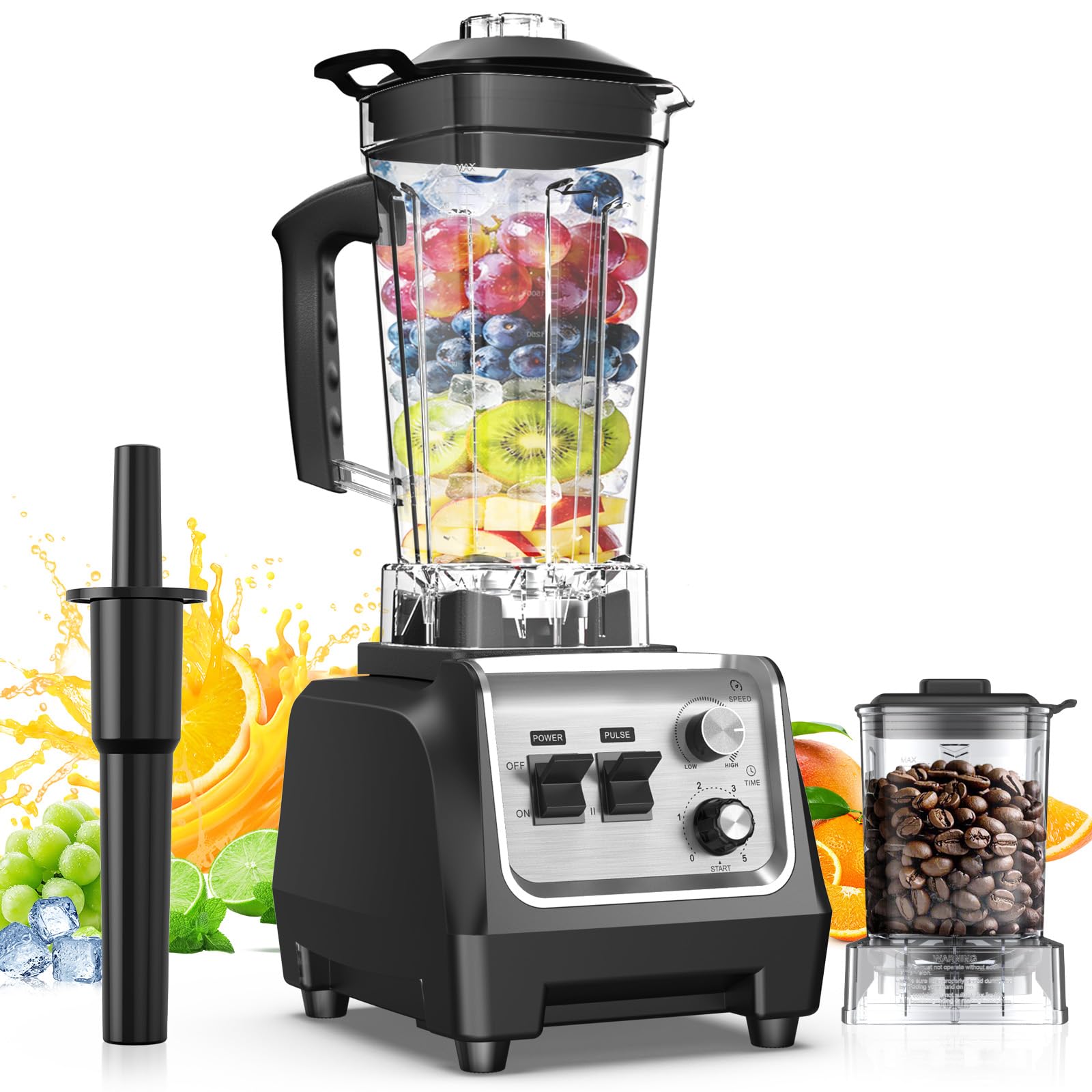
Key Features
- Motor Power: 1800W
- Capacity & Material: 70 oz polycarbonate
- Speeds/Programs: Dial control + timer
- Accessories: Pitcher, grinding cup
- Price: $$
The 1800W motor handles tough ingredients and frozen fruit with ease, while the 70 oz pitcher and included 20 oz grinding cup cover multiple blending tasks. However, this is a new entry with limited real-world feedback—long-term durability hasn’t been established, so it best suits buyers who are comfortable with some uncertainty in exchange for high specs at a low price.
Pros
- Extremely high power for the price – handles frozen fruit and ice without strain.
- Large 70 oz pitcher plus separate grinding cup offer flexibility for dry ingredients.
Cons
Best for early adopters who want maximum power and capacity on a budget and are comfortable with an unfamiliar brand and limited user history.
Best for Vitamix Loyalists
Vitamix Propel 750

Key Features
- Motor Power: 2.2 HP (1380W)
- Capacity & Material: 64 oz low-profile, plastic
- Speeds/Programs: 10 variable + 4 presets
- Accessories: 64 oz container
- Price: $$$$
The Vitamix Propel 750 delivers the brand’s signature silky blending in a low-profile 64 oz container that fits under most cabinets. Its four preset programs handle smoothies, soups, frozen desserts, and dips with consistent results. However, at a premium price, some units may experience motor or electrical issues shortly after purchase — a risk that makes the 5200 a more established choice for buyers who don’t need the low-profile shape. Noise is typical for high-power blenders, noticeable in quiet kitchens but expected at this performance level.
Pros
- Four preset programs (smoothie, soup, frozen dessert, dip) deliver consistent results without manual adjustment.
- Low-profile 64 oz container fits under standard cabinets, freeing counter space.
Cons
- Noise level matches other high-power blenders, so expect noticeable sound in open kitchens.
For Vitamix fans who prioritize a low-profile container and preset convenience over maximum long-term reliability, the Propel 750 delivers the expected blend quality. Others should consider the 5200 for a more established track record.
How to Choose
The spec that matters most is not the maximum wattage but how well the blender handles your typical load without breaking down.
Motor Power
Wattage is the most hyped spec, but more power doesn’t guarantee better blends. 1000-1200W is sufficient for frozen fruit and ice. Higher wattage often generates more heat and noise, and can stress plastic pitchers.
Consider your typical use: occasional smoothies need less power than daily crushing. A 700W motor will struggle with frozen ingredients, while an 1800W motor may be overkill and loud for most kitchens.
Capacity & Material
Plastic pitchers are lightweight and shatterproof, but they can crack after months of use, especially under high torque. Glass jars resist odors and scratches but are heavy and breakable if dropped.
For a family of four, a 64 oz pitcher (48 oz liquid max) is the sweet spot. Glass is a better long-term investment if you can handle the weight.
Speeds & Programs
Presets like Auto-iQ add convenience but often lock you into fixed timings. Many users find manual control (pulsing and variable speeds) gives better texture, especially for chunky salsas or nut butters.
If you make the same smoothie daily, presets save time. For variety, more manual speeds offer finer control.
Accessories
Extra cups, bowls, and grinding attachments increase versatility but also take up counter space and add cleaning. A food processor bowl is useful if you chop vegetables or mix dough regularly.
Single-serve cups with to-go lids are a major convenience for daily commuters. But if you rarely take smoothies on the road, a simple pitcher set may be enough.
FAQ
Why do Ninja blender pitchers crack so often?
Ninja uses BPA-free plastic for most pitchers, which is lightweight but can fatigue over time under high-speed torque. Cracks often appear near the blade base after months of heavy use. Hand-washing and avoiding extreme temperature changes may extend the life, but plastic pitchers in this price range are generally not designed for years of daily use.
Is a 600W blender enough for frozen fruit smoothies?
A 600W blender like the Nutribullet 600W will struggle with frozen fruit and ice. You’ll likely need to stop and stir or add more liquid to get a smooth consistency. For occasional soft fruit smoothies it works, but if frozen ingredients are your go-to, look for at least 900W.
What’s the real difference between a Vitamix and a Ninja blender?
Vitamix blenders excel in blend quality and durability thanks to a stronger motor, metal blade assembly, and longer warranty (7 years). Ninja models offer similar power for a lower price, but their plastic pitchers and blade bases are more prone to wear. The choice comes down to budget versus long-term investment.
How long should a blender last with daily use?
With daily use, a budget blender (under $50) may last 6-12 months before motor or pitcher issues. Mid-range models ($90-150) typically last 2-3 years with care. Premium blenders like Vitamix can last 10+ years, though some units do fail early. Warranty length is a strong indicator of expected lifespan.