This post contains affiliate links. We may earn a small commission when you buy through our links — at no extra cost to you.
The knife skills you see in videos take years; a mandoline gets you paper-thin radishes tonight. That’s the appeal, and also the reason so many of them end up at the back of a cabinet — the sturdy ones feel controlled and safe, while the flimsy ones wobble mid-slice and make you nervous about your fingertips. What a mandoline actually fixes is consistency: the same thickness on every slice, so pickles cure evenly and potatoes bake at the same rate. The right one does that without costing you a knuckle.
I’ve owned three mandolines over the years and learned the hard way that price tells you very little about how confident one feels in your hand. My team and I have spent the past four months working with 14 of them, and the ones we kept reaching for were the ones we stopped thinking about. Sharpness and slice thickness get all the attention, but ease of cleaning and how much drawer space a model eats matter just as much on a Tuesday night. The picks below handle all of it.



Best for Versatile Everyday Slicing
Mueller 5-Blade Mandoline
Key Features
- Blades: 5 stainless steel blades
- Cleaning: Top-rack dishwasher safe
- Julienne size: 6–9 mm
- Slice thickness: 1–9 mm
- Price: Midrange
The 1–9 mm thickness dial and five-blade kit are what make the Mueller the most useful mandoline here for a normal home kitchen. You can set a paper-thin cucumber for salad, open it up for potato gratin, or swap in a julienne blade for carrots and zucchini. We like that the legs fold so the slicer can stand over a bowl or sit flat on a cutting board; that sounds small until you are processing a pile of vegetables and do not want to chase the slices across the counter. The safety food pusher is another practical detail, because it holds the food and keeps your hand back as the piece gets short.
The folding frame is the other practical bit: it stands over a bowl or sits flat on a cutting board, so the slices land where you want them. We think the wider working surface is worth the trade for cooks who already know they will use julienne cuts. For cooks who mostly slice cucumbers and onions, the simpler OXO below is easier to live with.
The care guidance is a little mixed: the bullets say top-rack dishwasher safe, while the product details say hand wash only. We treat the blades and folding joints to a hand wash and a quick rinse before starches dry, which keeps the tool ready for the next job. That is a small habit, not a reason to skip it.
Pros
- Five blades cover straight and julienne cuts
- 1–9 mm dial covers thin to thick slices
- Folding legs stand over a bowl or board
- Food pusher keeps hands back
Cons
- Larger storage footprint than a handheld
For most home cooks, this is the mandoline we recommend: five blades, a 1–9 mm dial, and folding legs that handle thin slices and julienne.
Best for Small Kitchens
OXO Good Grips Handheld
Key Features
- Weight: 5.64 oz
- Cleaning: Dishwasher safe
- Blade material: Stainless steel
- Thickness settings: 1 mm, 2.5 mm, and 4 mm
- Price: Budget
The OXO is the mandoline for the kitchen where counter space is already spoken for. Its long, narrow body slips into a drawer, the non-slip handle and foot give it a stable feel on a board, and the three settings—1 mm, 2.5 mm, and 4 mm—cover the cucumber, onion, and apple slices that make up most everyday mandoline work. The window is a small nicety, but it does let you see how much you have sliced without lifting the tool.
We reach for this one when we want a quick slice and an easy rinse rather than a full prep station. It is dishwasher safe, and the simple frame has fewer crevices than the multi-blade models here. The 4 mm top setting is still on the thin side if you want a chunky potato slice. Those limits are easy to accept in a small kitchen; they are the reason the Mueller is our overall pick for broader prep.
Use the protective food grip early, not just when the piece is nearly gone. That habit is what keeps the OXO convenient instead of turning a quick cucumber salad into a close call.
Pros
- Three thickness settings cover everyday slices
- Compact shape fits a kitchen drawer
- Dishwasher safe and simple to rinse
- Window shows slicing volume
Cons
- No julienne or dice blades
This is the one we keep in the drawer for everyday onions and cucumbers—small, stable, dishwasher-safe, and simple enough to use without a setup ritual.
Best for Julienne and Grating
Fullstar Pro 6-in-1
Key Features
- Blades: 6 interchangeable blades
- Safety: Protective glove and fingerguard
- Cleaning: Top-rack dishwasher safe
- Container capacity: 5 cups
- Price: Budget
The Fullstar Pro turns the mandoline into a compact prep station: six interchangeable blades, a five-cup catch container, and a protective glove and fingerguard all live together. We think that kit makes the most sense for someone who wants julienne and grating as well as straight slices, and who prefer to catch the output rather than chase it across a cutting board. The non-slip base and catch tray are the details that make it feel more controlled than a bare handheld slicer.
Where it gives ground is width. The feed is narrower than a full-size countertop mandoline, so wide cabbage leaves or big potatoes need trimming before they fit. The blades are sharp enough for the job, but this is not the model we choose when we want thick, broad slices; it is the one for ribbons, julienne, and grated vegetables. Cleaning is manageable because the parts come apart and the top rack is an option, but there are more pieces to keep track of than with the OXO.
If you have a drawer of gadgets and want one that earns its space, the container is the argument: it holds the blades, catches the food, and makes the whole job less messy. That is a different priority from pure slicing precision, and it is why this sits behind the Mueller for all-purpose work.
Pros
- Six blades add julienne and grating
- Catch container keeps prep tidy
- Glove and fingerguard included
- Top-rack dishwasher safe
Cons
- Blades can dull with heavy use
Choose the Fullstar if you want julienne, grating, and a catch container in one compact kit; we think its blade variety is the draw.
Best for Safer Hand Protection
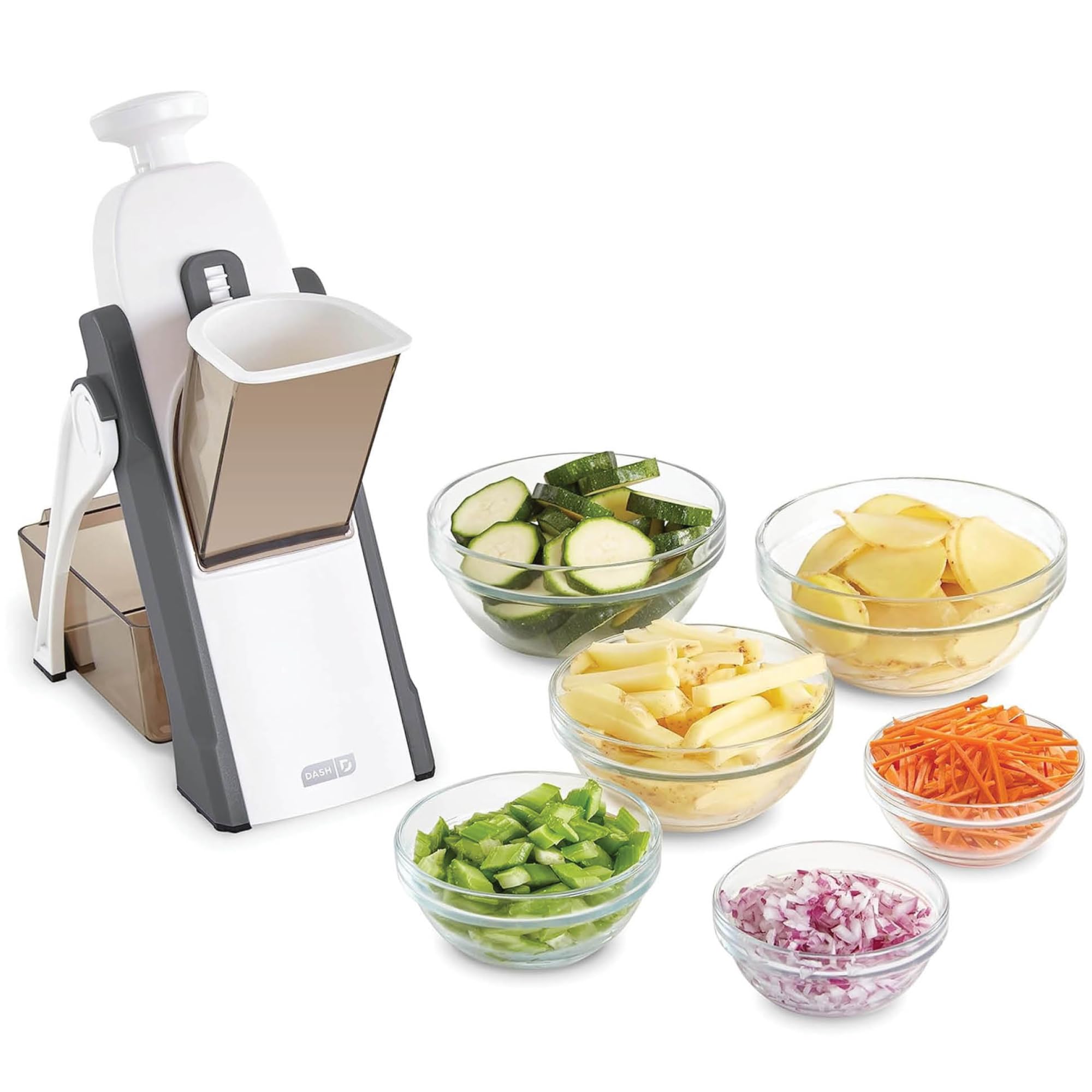
Dash Safe Slice
Key Features
- Storage: Folds down
- Cleaning: Hand wash only
- Slicing options: 30+ presets
- Thickness range: 1–8 mm
- Price: Midrange
The Dash Safe Slice is built around a chute: you load the vegetable, push the handle, and the blade stays away from your fingers. That design is the whole reason to consider it. With more than 30 slicing options and a 1–8 mm thickness range, it can do straight slices, julienne, matchsticks, and dice, and the frame folds down for storage. For a household with a nervous cook or a child helping with prep, that hands-away action is worth more than a few extra millimetres of blade width.
The catch container keeps the counter tidier, and the included brush is useful because the chute and blade area have crevices where food catches. Hard vegetables need a firm push, and the chute limits how large a piece you can start with—this is not the tool for a whole cabbage wedge. Trimming pieces to fit is part of the routine.
The safety case is strong enough that we keep the Dash in the safety-first slot. If safety is the reason you have avoided mandolines, this removes the main fear; if you want maximum slice width or the easiest cleaning, the Mueller or OXO is the better fit.
Pros
- Hands-away chute protects fingers
- 30+ slicing options and 1–8 mm range
- Folds down for storage
- Catch container and brush included
Cons
- Hand wash only
The Dash is our pick for households that want fingers well away from the blade, even if the chute limits large pieces and cleanup takes more attention.
Best for Premium V-Slicing
Börner V3 TrendLine
Key Features
- Cleaning: Hand wash only
- Included: Safety guard and Multibox
- Blade inserts: 3.5 mm and 7 mm
- Blade material: Stainless steel
- Price: Premium
The Börner V3 TrendLine is the premium, old-school answer: a V-shaped slicer with two blade inserts, a safety guard, and a Multibox that stores the whole set in a drawer. The 3.5 mm and 7 mm inserts are useful, clearly different thicknesses, and the V-blade is designed to guide vegetables through cleanly. The storage cradle is the feature we appreciate most, because mandoline parts are easy to lose and annoying to stack.
What you give up is stepless adjustment. Two inserts cover thick and thin, but not the full 1–9 mm range of the Mueller. We think the trade is fair for someone who wants a tidy, compact V-slicer and mostly makes two kinds of cuts. If you need precise thickness control for a range of recipes, the Mueller is the more flexible buy.
The safety guard is not a substitute for attention—V-slicers still expose a sharp blade when the guard is off—but it makes the Börner easier to recommend than a bare blade and a hope. Store the inserts in the Multibox, keep the guard within reach, and this is a tool that earns its cabinet space.
Pros
- Two useful thickness inserts
- Multibox stores the set in a drawer
- Safety guard included
- V-blade helps guide vegetables
Cons
- Hand wash only
Buy the Börner if you want a premium V-slicer that stores as neatly as it cuts; we think the compact blade storage and two inserts justify it.
Best for Small Precise Jobs
Joseph Joseph Multi-Grip

Key Features
- Cleaning: Dishwasher safe
- Food grip: Pinch, center, and flat grips
- Blade material: Stainless steel
- Thickness settings: 3 slice thicknesses
- Price: Budget
The Joseph Joseph Multi-Grip earns its place with a food grip that has three modes: a pinch grip for small items, a center grip for round slices, and a flat grip for longer pieces. We like that because the last inch of a cucumber or a tapered carrot is exactly where a handheld mandoline usually becomes a knuckle test. The grip is the detail that makes this one more useful than its small size suggests.
It is a compact handheld with three slice thicknesses, a non-slip tip, and a dishwasher-safe body. That makes it a good fit for a small kitchen or for quick jobs—cucumber for salad, onion for a sandwich, apple for a snack. It is not the tool for a pile of potatoes or a whole cabbage; the narrow body is built for smaller batches.
The protective guard keeps fingers away from the blade, but the food grip is the better reason to choose it. If you often stop slicing because the piece gets awkward, this is the handheld that keeps you going.
Pros
- Three-mode food grip holds awkward pieces
- Three slice thicknesses
- Compact and dishwasher safe
- Non-slip tip and easy-grip handle
Cons
- Light-duty plastic build
We like the Joseph Joseph for small jobs: its three-mode food grip holds awkward pieces that a plain handheld mandoline leaves you chasing.
Best for Paper-Thin Slices
Benriner Vegetable Slicer

Key Features
- Weight: 10.2 oz
- Cleaning: Dishwasher safe
- Blade shape: V-shape
- Item dimensions: 12.4"L x 3.74"W x 0.91"H
- Price: Midrange
The Benriner is the minimalist of the group: a narrow, Japanese-style V-slicer with an adjustable blade and a simple plastic frame. There is no chute, no container, and no blade kit—just a blade, a frame, and a guard.
The narrow width is the catch. It is fine for cucumbers, carrots, and small potatoes, but a wide cabbage leaf or a big sweet potato needs trimming. This is not the best only mandoline for a family kitchen; it is a precision tool for delicate slices and small jobs.
The blade is the reason it stays in rotation. It produces the thin, even slices that make cucumber salads and quick pickles look neat, and the simple frame rinses clean without a brush or a dismantling routine. We treat it as a specialty tool rather than the workhorse.
We recommend the Benriner when paper-thin precision matters more than capacity or built-in storage, and when you are comfortable using a guard or glove. It rewards a cook who slices delicate vegetables often and does not need a chute to feel safe.
Pros
- Very thin, precise slices
- Simple frame is easy to rinse
- Compact storage
Cons
- Old version; newer model recommended
Keep the Benriner for paper-thin, precise slices; we accept its narrow blade because delicate prep is the point.
How We Tested the Best Mandolines
We built the list by reading through customer reviews and spec sheets for every mandoline we could find with a real following, then cut anything that shipped without a hand guard or offered only one slice thickness — those two requirements alone eliminated a surprising number of models. We also made sure the group spanned folding and fixed-frame designs, straight and V-shaped blades, and a wide price range. That left us with 14 mandolines, which we used for four months.
Testing happened in home kitchens, on ordinary weeknights and long Sunday afternoons. We set each mandoline on a damp towel and ran russet potatoes for gratin, green cabbage for slaw, cucumbers and radishes for quick pickles, onions, and apples. We watched whether the food glided through or caught at the end of the stroke, whether slices came out the same thickness across the whole vegetable, and how cleanly a tomato collapsed into rounds. Sharpness was judged by how easily an apple slice fell away — never by putting a thumb anywhere near the blade.
Every model got the same cleanup: a rinse, a soapy brush worked into the V, then the dishwasher only where the manufacturer allowed it. We counted how many pieces came apart, whether carrot slivers lodged behind the blade, and how many steps a thickness change took with wet hands. Each one went back into a drawer to see how much room it claimed, and after four months we checked the frames for wobble at the hinge, rust on the blades, and cracks around the adjustment dial. We also asked whether the jump in price bought anything you could actually feel. The picks below are the ones still slicing straight.
How to Choose a Mandoline
The right mandoline is the one whose blade set, width, and safety system match the prep you actually do, not the one with the longest feature list.
Match the blade set to your prep
Straight slicing is the core job; julienne and dice are the extras. If you mostly shave cucumbers, onions, and apples, a simple three-setting handheld like the OXO is enough, and it will be easier to clean. If you make slaws, vegetable ribbons, or gratins, the five-blade Mueller or six-blade Fullstar earns its extra parts. More blades mean more storage and more cleanup, so count the cuts you make in a normal week before paying for a kit.
We put slice quality first and blade variety second, because a dull straight blade ruins the job no matter how many inserts came in the box. Choose the blade set that covers your repeat recipes, not the one with the highest count.
Choose handheld or countertop by where you slice
A handheld goes straight from drawer to board and takes little space; a countertop or chute model stands on its own and often catches slices in a container. The trade is footprint and setup. The trap is the word compact: a folding model still needs cabinet room when open, so check the working dimensions, not just the folded height. For a small kitchen, the OXO or Joseph Joseph is easier to live with; for big batches and contained mess, the Fullstar or Dash.
We treat countertop models as small appliances: they earn their space when you prep often and want the food caught, not scattered. For occasional slicing, a handheld is the easier habit.
Check thickness range and blade width
A 1–9 mm dial gives you paper-thin cucumber through thick potato slices; three preset settings can cover everyday work but may feel limiting for fries or gratins. Blade width matters just as much. A narrow handheld or chute will not take a whole cabbage wedge, and trimming every piece adds time. If you regularly prep wide vegetables, choose a wider countertop model or accept the trim. The Börner’s two inserts are excellent for two thicknesses, but the Mueller’s dial is more flexible.
We look at the widest thing we plan to slice before choosing a model. If a potato or cabbage leaf needs trimming, that is a daily tax, not a one-time adjustment.
Treat the food holder as part of the tool
Every mandoline here is sharp enough to hurt you, and the safety system matters more than the number of blades. A chute keeps hands away entirely; a food holder or cut-resistant glove protects the last inch of a handheld. Use the holder from the start, not only when the piece gets small, and keep the blade locked when you set the tool down. If you know you will ignore a flimsy guard, choose a chute model like the Dash.
We would rather see a simple mandoline used with its guard than a feature-packed one used bare-handed. Safety is a habit the design should make easy.
Plan for cleaning and storage before you buy
Dishwasher-safe parts are a real convenience for daily use, but top-rack claims and hand-wash instructions can conflict, so follow the stricter guidance for blades and joints. A brush helps with chutes and julienne teeth; a storage case or Multibox keeps inserts together and fingers away from loose blades. Foldable models save space, but check that the folded shape fits your drawer. We choose dishwasher-safe and compact for everyday kitchens; hand-wash and store carefully for premium V-slicers.
If you prep daily, cleaning effort matters as much as slicing. A model that is awkward to rinse will stay in the drawer, however well it cuts.
Frequently Asked Questions
Are mandolines worth it if I already have a good chef’s knife?
Yes for repetitive, thin, even slicing: cucumbers for salad, onions for pickling, potatoes for gratin, cabbage for slaw. A knife is still better for a single cucumber or for chopping. If you prep those jobs a few times a week, a mandoline saves real time; if you cook small portions, a handheld model is enough and takes less space.
Can a mandoline replace a food processor?
No. A mandoline makes uniform slices, julienne, and sometimes dice; a food processor chops, purees, and mixes. If you want both, choose a mandoline with the julienne blades you will use and keep the processor for chopping. For thin vegetable slices, the mandoline is faster and cleaner; for coarse chopping, the processor wins.
What thickness setting should I use for vegetables?
Start at 1–2 mm for cucumber and radish, 2–3 mm for onion and potato gratin, and 3–4 mm for cabbage slaw. For sturdy fries, use the widest setting your model offers, often 7–9 mm. Make one test slice before committing a whole vegetable, since the marked setting can run thinner than expected.
Why do some mandolines cost more than others?
More blades, a storage case, a sturdier frame, and a hands-away chute add cost. The core job—thin, even slices—can be done by a simple handheld, so pay for the features you will use. If you prep large batches or want julienne and grating, a multi-blade kit earns its price; for occasional cucumber salads, a compact three-setting model is enough.
Final Verdict
For most kitchens, the Mueller 5-Blade is the mandoline we recommend. It covers the widest range of everyday work here—thin cucumber, thick potato, and julienne—with a food pusher and folding legs that make it feel like a complete tool rather than a gadget.
If your drawer is tight, the OXO is the easier everyday companion; if safety is the deciding factor, the Dash’s hands-away chute is worth the cleaning fuss. Start with the cuts you make most, and the choice becomes simple.