This post contains affiliate links. We may earn a small commission when you buy through our links — at no extra cost to you.
An electric kettle is a simple machine: an element heats the water, a thermostat cuts the power when it’s done, and you pour. The differences hide in that last word. Some keep bubbling for a full minute after the switch trips, some cut off the instant steam hits the sensor, and a few dribble half a mug down the outside of the spout. What a good one fixes is the everyday friction — the wait, the wipe-up, the guesswork over whether it’s actually boiled.
I’ve owned four kettles in six years, and the longest-lived was the plainest, which tells you most of the price is finish and features rather than the element. Over the past eight months my team and I boiled, poured, descaled, and overfilled 12 kettles. The unglamorous lesson: if you can’t get your hand inside to scrub out scale, you’ll stop doing it, and the kettle will quietly start taking longer to boil. The picks below are the ones that made that easy.



Best for Everyday Boiling
COMFEE’ Stainless Kettle
Key Features
- Power: 1500 watts
- Safety: Auto shut-off and boil-dry protection
- Capacity: 1.7 liters
- Material: 304 stainless steel
- Price: Budget
Glass is the fun purchase and stainless is the sensible one, and after switching between the two all week we kept reaching for the sensible one. The COMFEE’ is a 1.7-liter, 1500-watt kettle with a 304 stainless inner pot, a lid that pops open on a button, a removable nylon filter at the spout and a 360-degree base that lets you park the handle wherever your counter allows. None of that is exciting. All of it is what you touch every morning.
What struck us is how little there is to think about. The handle stays cool after a full boil, the lid opens wide enough to get a hand and a bottle brush inside, and the water-level window reads clearly from standing height. Figure five to seven minutes for a full 1.7 liters on a standard circuit, and a good deal less if you only boil what you are about to drink; filling to the cup line is the habit that makes any kettle feel fast. The body is uninsulated, so the outside gets properly hot, and that is simply the trade for a metal kettle at this price: keep it back from the counter edge and lift it by the handle.
The gap is temperature control, which this one does not have. Green tea and pour-over get boiling water and a waiting period instead of a preset, and if that is your daily ritual, the Cosori gooseneck or the Cuisinart further down is money well spent. For tea bags, a French press, instant noodles and the hundred other jobs a kettle actually does, we never missed it. What we cannot promise is longevity. One year is the standard warranty in this group; if coverage matters to you, the OVENTE carries two and the Cuisinart three.
Pros
- Stainless interior with no plastic in the water path
- 1500 watts brings a full 1.7 liters to a boil quickly
- Wide pop-up lid and removable filter simplify cleaning
- Cheaper than the other stainless kettles here
Cons
- No temperature presets or keep-warm
We make this the default because it does the everyday job with nothing to baby: a stainless interior, a wide lid, a full 1.7 liters, and a price below the other stainless kettles here.
Best for Pour-Over Coffee
Cosori Gooseneck Kettle
Key Features
- Power: 1200 watts
- Presets: 5 one-touch
- Capacity: 0.8 liters
- Keep warm: Up to 60 minutes
- Price: Premium
Pour-over is the reason to own this one, and it is very good at it. The spout is narrow and gently curved, so water leaves as a thin, steerable thread instead of a glug; we could wet a coffee bed evenly without the stream punching a channel through the middle. The counter-balanced handle matters more than it sounds, too. The kettle does not lurch forward as it empties, so the last of the pour is as controlled as the first.
Around that spout sits a genuinely useful set of controls: five one-touch presets and a hold function that keeps the water at temperature for an hour. We used the hold far more than we expected. A second cup becomes a button press rather than a fresh boil, and a delicate tea never gets a shock of water that is too hot for it. The interior, lid and spout are all 304 stainless steel, and the matte black body looks better on a counter than the price suggests.
Capacity is the trade: 0.8 liters is two generous mugs or three small ones, which suits a solo coffee routine, a desk-side setup, and not a family teapot at dinner. Buy it for the pour and the presets. If you need a pot that fills four cups at once, the 1.7-liter kettles here are the ones to look at.
Pros
- Gooseneck spout gives a slow, steerable pour
- Five presets and an hour of keep-warm
- Stainless interior, lid and spout
- Matte black finish looks good on the counter
Cons
- Some units stop heating within months
- Pricier than the full-size kettles here
If you brew pour-over or drink tea that wants water below a boil, this is the kettle we point you to: a gooseneck spout, five presets and an hour of keep-warm in a small, handsome body.
Best for Brewing Tea
Cuisinart PerfecTemp Kettle
Key Features
- Power: 1500 watts
- Presets: 6, 160°F to 200°F
- Capacity: 1.7 liters
- Keep warm: 30 minutes
- Price: Premium
The premium here buys temperature control, not glamour. The CPK-17P1 is a brushed stainless 1.7-liter kettle with six presets between 160°F and 200°F, one-touch buttons, a 30-minute keep-warm and a memory feature that holds its settings if you lift the pot off the base to pour.
For anyone who drinks green, white or oolong tea, that changes the cup rather than the routine. Boiling water scorches delicate leaves and turns them bitter; 175°F does not. We set a preset once and stopped thinking about it, and the keep-warm meant the second cup tasted like the first instead of like a reheated version of it. There is a soft beep when it is ready, loud enough to hear from the next room and quiet enough not to be a nuisance.
Where it earns its price for us is the combination: full-size capacity, six genuinely different temperatures and a keep-warm long enough to cover a slow breakfast. Among the kettles here it is the only one that treats brewing temperature as the main event rather than an add-on, and in a household that drinks tea seriously, that is the whole purchase.
One thing to plan around: it vents a lot of steam at a full boil, which is why ours sits out from under the upper cabinets rather than beneath them. Give it a spot with air above it and the rest is a kettle that should be with you for years; it carries the longest warranty in this group.
Pros
- Six presets from 160°F to 200°F
- 30-minute keep-warm holds the second cup
- Memory feature survives a lift off the base
- Three-year warranty, the longest here
Cons
- Lid is the first part to wear
- Brushed body shows every fingerprint
If green, white or oolong tea is the point, we think this is the most capable kettle here: six accurate presets, a half-hour keep-warm and a three-year warranty, at a premium price.
Best for Visible Water Level
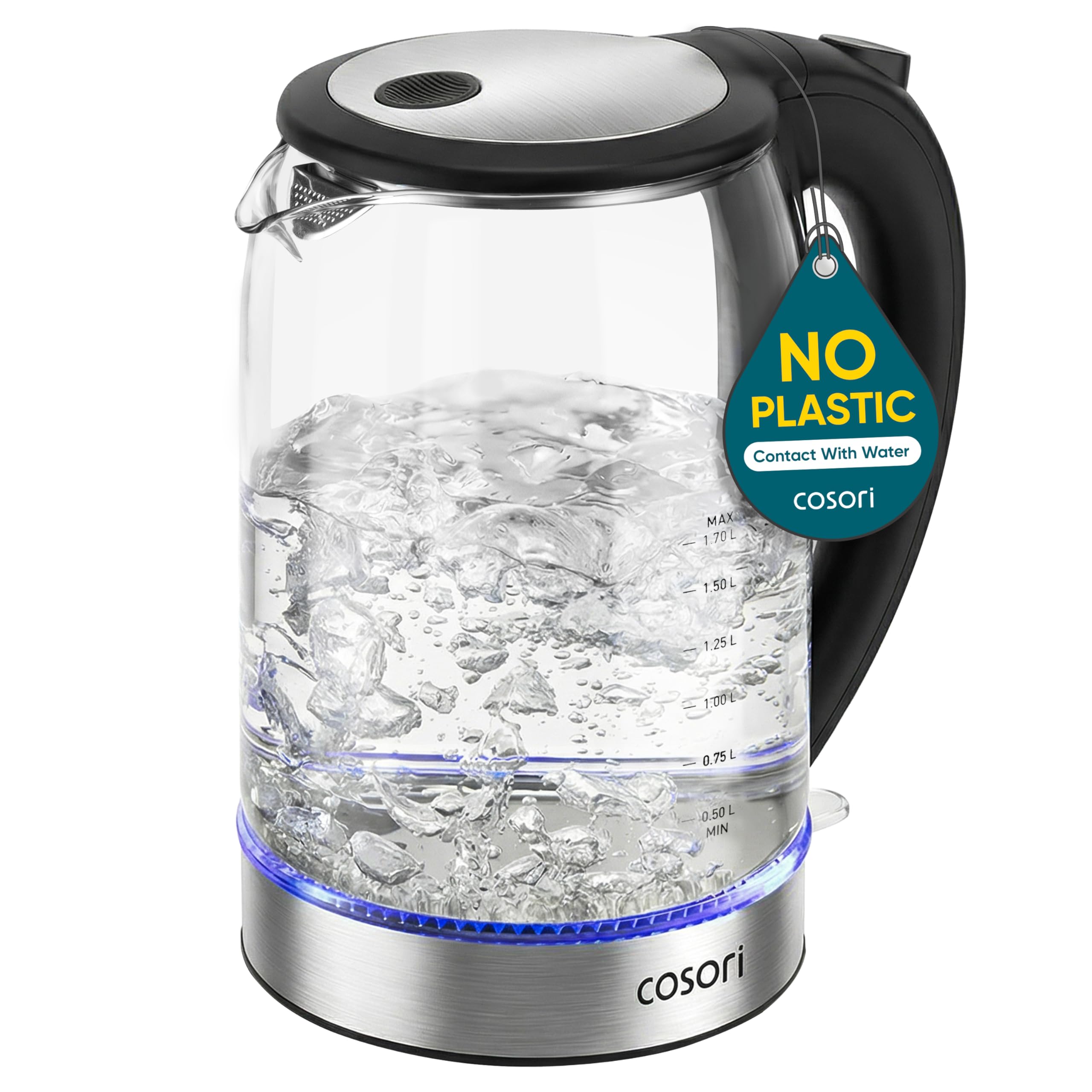
Cosori Glass Kettle
Key Features
- Power: 1500 watts
- Capacity: 1.7 liters
- Material: Borosilicate glass, stainless steel
- Water contact: No plastic
- Price: Budget
The case for glass is simple and a little vain: you can see the water level without squinting at a window, you can see the scale building up before it becomes a problem, and a full pot lit blue from below is a genuinely nice thing to watch on a dark morning. The Cosori gives you all of that in a 1.7-liter, 1500-watt kettle with a borosilicate body, a stainless steel filter and inner lid, and a lid that swings wide on a large hinge.
Among the glass kettles here, this is the one we reach for. The wide lid makes it the easiest of them to rinse out, the stainless filter catches the flakes that turn up once any kettle has been in service a while, and the water never touches plastic on its way through. Just treat the carafe like the glassware it is: no knocking it against the sink mid-rinse, no setting it down hard on the base. If that sounds like a chore, the stainless COMFEE’ is the safer buy.
Pros
- Borosilicate carafe shows the level and any scale
- No plastic in the water path
- Wide lid makes rinsing quick
Cons
- Auto shut-off has not been dependable on every unit
We recommend it to anyone who wants to watch the water: 1.7 liters of borosilicate glass, no plastic in the water path, and a price near the bottom of this group.
Best for Tight Budgets
OVENTE KP72W Kettle
Key Features
- Power: 1100 watts
- Capacity: 1.7 liters
- Material: BPA-free plastic
- Warranty: 2 years
- Price: Budget
Lifting it is the tell. The OVENTE is a 1.7-liter, 1100-watt kettle in a plastic body, and it weighs so little next to the stainless and glass models here that filling it one-handed at the sink stops being a two-hand job. That sounds like faint praise until you have done the two-hand version every morning for a year.
It is slower. At 1100 watts it takes noticeably longer to bring a full pot to the boil than the 1500-watt kettles here, so we fill it to the cup line rather than the maximum and take the extra time in exchange for the lighter body. What you get for the compromise is a two-year warranty, the longest of the budget options here, plus a removable spout filter, cord storage in the base and a footprint that fits a counter already carrying too much. The plastic will not feel as solid in five years as steel would, and that is the honest trade.
Pros
- Light enough to fill and carry one-handed
- Two-year warranty, the longest of the budget picks
- Removable filter and cord storage in the base
- Lowest price of any full-size kettle here
Cons
- On/off switch and auto shut-off can fail
We keep this one on the list for the tightest budgets: 1.7 liters, a two-year warranty and a plastic body that keeps the price and the weight down.
Best for Shared Kitchens
Hamilton Beach 40880

Key Features
- Power: 1500 watts
- Capacity: 1.7 liters
- Material: Stainless steel, BPA-free
- Water level: Side window
- Price: Midrange
The controls are a rocker switch on the back and a blue light on the front, and that is the entire interface. In a kitchen where three people make tea on different schedules, that is the feature: nobody has to learn a preset or hold a button down, and nobody can leave it stuck in a mode.
The water window runs up the side with clear markings, which sounds like a small thing until you have used a kettle where you have to open the lid to check the level. It is a 1500-watt, 1.7-liter pot with a brushed steel body, a stay-cool handle and a 360-degree base, and the jug lifts off the corded base so you can carry it to the table without unplugging anything.
Where it sits among the others: it does the same job as the COMFEE’ in a slightly nicer jacket with a better water gauge, for a little more money, and it is simpler and far cheaper than the Cuisinart. What we do not love is the lack of insulation. The outside gets hot and the water sheds heat quickly once it is off the boil, so it suits people who boil and pour rather than boil and wander off. In an office kitchen where the kettle is in and out of the sink all day, that is the right set of compromises.
Pros
- Wide water window is readable at a glance
- One switch, nothing to program
- 1500 watts for a fast full pot
- Cordless jug lifts off the base to serve
Cons
- No temperature settings or keep-warm
We like it for shared kitchens and offices: a 1.7-liter stainless kettle, a water window you can read at a glance, and one switch that does the lot.
Best for Small Kitchens
Elite Gourmet Glass Kettle

Key Features
- Base: 360° swivel
- Power: 1100 watts
- Capacity: 1 liter
- Material: Glass and stainless steel
- Price: Budget
A liter is not much water, and that is the point. This one is for the person making a single mug at a time, in a kitchen where the counter is also the prep space and a full-size kettle is a piece of furniture to be moved twice a day.
It weighs 962 grams and stands under ten inches tall, so it sits on the counter without taking it over, and the 360-degree base lets the handle face whichever way you reach from. The body is glass with stainless trim, and a blue LED lights the water from below as it heats. That is decorative, and also a genuinely useful done signal from across the room.
Nothing about it is fussy: the lid lifts off for filling and rinsing, the spout has a mesh filter, and the boil is visible through the carafe from start to finish. It is also the one to handle with care. The glass gets properly hot while it is working, so lift it by the handle and keep it back from the counter edge, where a small hand could reach it.
We reach for it when we are making one cup and do not want to haul out a full-size kettle, and that is exactly who we recommend it to. It is a small-kitchen specialist rather than a family kettle. If you routinely fill a teapot for four, the 1.7-liter models here are the better buy.
Pros
- Small footprint for tight counters
- Light at 962 grams, easy to carry full
- Blue LED works as a done signal
- Removable lid and mesh filter make rinsing easy
Cons
- Slower at 1100 watts
- Glass carafe is vulnerable to knocks
We keep this one for small spaces: a liter of glass, a light body and a footprint that fits where a 1.7-liter kettle will not.
How We Tested 12 Electric Kettles Over Eight Months
We started with about 40 models — the names you’d recognize plus a handful you wouldn’t — and cut the list by capacity, wattage, body material, lid design, and the complaints that kept repeating in customer reviews. Kettles that leaked at the base, had lids that wouldn’t latch, or needed two hands to fill got dropped early. That left 12, which we bought at retail rather than accepting samples.
Each one lived on a counter for eight months and ran at least twice a day: a fast 500-milliliter boil before work, a full pot for a French press on weekends, and a lot of tea in between. We timed every boil from the same starting water temperature, then noted whether the switch tripped at a rolling boil, a beat early, or let things churn past the mark. Once, deliberately, we let each kettle run dry to confirm the boil-dry protection actually caught it.
The rest was hands and eyes. We filled each one at the sink to see whether the lid opened wide enough to clear the tap, poured one-handed at full tilt into a mug and a narrow-spouted carafe, and checked for drips down the side. We read the water window in dim morning light, felt the body after a boil, and wiped fingerprints off every finish to see which ones showed them. In month six we descaled them all with vinegar and noted which ones we could reach inside — and which got slower afterward. Two developed rattly lids and one base flickered, so those went back; at the end we set price against what each kettle did better than a basic one, and a few couldn’t make the case.
How to Choose an Electric Kettle
The kettle you end up happy with is the one that matches how much water you actually boil, and almost every other decision follows from that.
Match the wattage to the water you actually boil
Wattage only means anything against the volume in the pot. A 1500-watt kettle takes roughly five to seven minutes to bring a full 1.7 liters to a rolling boil, and a fraction of that with two cups in it. The 1100-watt models here, the OVENTE and the Elite Gourmet, are slower on a full pot but perfectly quick for a mug or two, and they are lighter and cheaper because of it. If your household fills a teapot twice a day, pay for the 1500 watts. If you boil a cup at a time, you will not notice the difference.
Decide what touches your water
BPA-free tells you what a plastic part is not; it does not tell you whether water touches plastic at all. If that matters, read the interior description rather than the front of the box: the COMFEE’ uses a 304 stainless inner pot, the Cuisinart a stainless body, and the Cosori glass kettle pairs a glass carafe with a stainless filter and inner lid. Glass shows you the level and any scale before it becomes a problem; stainless hides both but shrugs off the knocks that end a glass kettle’s life. Neither is better in the abstract. Glass is for people who like watching the boil and will treat the pot accordingly.
Buy presets for tea and pour-over, not for tea bags
A kettle without temperature control boils water, full stop, and that is all a tea bag, a French press or a packet of instant noodles asks for. Presets start to matter when the water should not be boiling, since green tea wants something closer to 175°F and white tea a little lower, and a keep-warm means the second cup does not need a fresh boil. This is the biggest price jump in the group. If tea is a hobby, the Cuisinart’s six settings and half-hour hold are the most complete version here; if it is a habit, spend the money on capacity and a lid that opens properly instead.
Check the lid, the spout and the water window
Three small details separate a kettle you like from one you resent. A lid that opens wide enough to get a hand inside makes rinsing quick, while a narrow hinged lid turns it into a bottle-brush job. A water window or a glass body saves you opening the lid to check the level. And a removable filter at the spout catches the scale flakes that show up in any kettle after a few months. Every model here is hand wash only, so plan on rinsing and drying rather than loading it into the dishwasher.
Treat the warranty as a life expectancy
Every kettle here shuts off at a boil and guards against boiling dry, and those controls are the parts most likely to fail first, more often than the element or the pot itself. That makes the warranty a better guide than the marketing copy: one year on most of the budget models, two on the OVENTE, three on the Cuisinart. Keep the receipt and register the product if the maker asks. And do not expect a decade of service from any of them. These are appliances, not heirlooms.
Frequently Asked Questions
Why does a new kettle smell of plastic, and how do I get rid of it?
Manufacturing residue in the lid, spout or seal lifts into the steam on the first few boils. Fill to the maximum, boil, pour the water away, and repeat three times before you make a drink with it. If a chemical smell survives a week of daily use, stop using the kettle and take it up with the seller; that is not something to live with.
How often should I descale an electric kettle?
Whenever you can see a chalky film on the bottom or white flakes in the spout filter. In a hard-water area that can be every month; in soft water only a few times a year. Half fill with equal parts white vinegar and water, boil, leave it twenty minutes, then boil fresh water twice and discard it. Never scrape the element with anything metal.
Can I boil milk, soup or anything other than water?
No. Anything with protein or sugar scorches onto the element, and the residue is difficult to shift and taints the next pot of water. The kettles here are water boilers. Heat milk in a pan or a jug and use the kettle for the water that goes with it.
Should I empty the kettle after every use?
Yes, once it is cool enough to handle. Standing water speeds up scale, can leave a metallic or plastic taste in the next boil, and on a glass model leaves a ring that is harder to shift than a quick rinse. Tip it out, leave the lid open to dry, and wipe the inside once a week.
Final Verdict
For most kitchens the answer is the COMFEE’. It boils a full pot quickly, the stainless interior survives the knocks that end a glass kettle, and it costs less than the other stainless kettles here, so it is the one we recommend first.
Change it when your routine demands it: the Cosori gooseneck if you brew pour-over, the Cuisinart if brewing temperatures are the point of the kettle for you, and the OVENTE if the budget is the whole decision.