This post contains affiliate links. We may earn a small commission when you buy through our links — at no extra cost to you.
A kettle that reads 175°F on the dial and one that actually pours 175°F are two different appliances. The gap matters with green and white teas, where water a few degrees too hot turns a sweet, vegetal cup bitter in seconds. A good variable-temperature kettle closes that gap: it heats fast, holds a steady temperature, shuts off when it says it will, and pours without dribbling down the side of the pot.
We’ve spent the past six months with 12 kettles on the counter — morning cups, weekend gongfu sessions, the occasional pot of noodles — and the differences showed up fast. Here’s what first-time buyers don’t know: most kettles overshoot their set temperature because the element keeps throwing heat after the sensor says stop, so a 175°F setting can land at 185°F. The picks below are for people who taste that difference, and for anyone who just wants something pleasant to use that will hold up.



Best for Daily Tea Brewing
Cosori Gooseneck Kettle
Key Features
- Presets: 5 one-touch presets
- Wattage: 1200 watts
- Capacity: 0.8 liters
- Keep warm: Up to 1 hour
- Price: Premium
Most kettles boil everything to 212°F and leave you standing there with the lid off, waiting for the water to cool enough for green tea. The Cosori’s five presets are why it is our top pick: press the button for the leaf in front of you and it stops there, and the hold function keeps it at temperature for up to an hour while you work through a pot. In daily use we stopped thinking about the water entirely, which is the best thing a tea kettle can do for you.
The gooseneck is marketed at pour-over coffee and it earns that, but we found it just as pleasant for tea. The narrow spout gives a slow, aimed stream that fills a small cup or a gaiwan without splashing, the handle stays cool enough to grab mid-pour, and the balance is good enough to pour one-handed. Steel on the interior, lid and spout means nothing but steel meets the water, which matters if you have ever had a plastic-tasting cup out of a cheap kettle.
Capacity is the honest trade-off. At 0.8 liters it is a two-large-mug kettle rather than one you fill for four people, and the pour is deliberately slow, so filling a big thermos takes patience. Reliability is the other thing we cannot call settled: some units stop heating within a few months, so register the warranty and keep the receipt. Ours has run without complaint, and the presets alone keep it ahead of everything else here for everyday tea.
Pros
- Five presets stop at tea temperatures, not a boil
- Holds temperature for up to an hour
- Gooseneck gives a slow, aimed pour
- Steel interior, lid and spout touch the water
Cons
- 0.8 liters is a two-mug kettle
- Some units stop heating within months
We recommend it as the default for anyone who drinks green, white or oolong tea and wants the water to stop at the right temperature instead of a rolling boil.
Best for Family-Size Pots
Cuisinart PerfecTemp CPK-17P1
Key Features
- Presets: 6, from 160°F to 200°F
- Wattage: 1500 watts
- Capacity: 1.7 liters
- Keep warm: 30 minutes
- Price: Premium
Six presets between 160°F and 200°F, labeled the way a tea drinker thinks, delicate through green, white, oolong, French press and black, with 1.7 liters behind them. That combination is why the Cuisinart is the kettle we point to when a household brews more than one cup at a time. The 30-minute keep-warm holds the pot through a slow breakfast, and the memory feature keeps the cycle running if you lift the kettle off its base for a moment.
What we appreciate most is how little it asks of you: one touch selects the tea type, the blue-lit window shows the water level, and there is nothing to interpret. Two practical details are worth knowing before you buy. The fill markings sit under the handle, so the first few fills are guesswork until you learn them, and the steam from the spout is strong enough to damage the finish on a cabinet it sits beneath, so give it clearance.
Cuisinart backs it with a three-year limited warranty, the longest of any pick here. What that money buys is straightforward: 1.7 liters held at the temperature you chose, which nothing else in this group does at this size. The lid is the part to treat gently, since it takes the wear on a kettle used several times a day.
Pros
- Six presets named for tea types
- Largest temperature-controlled pot here
- 30-minute keep warm plus lift-off memory
- Three-year limited warranty
Cons
- The priciest kettle in this group
- Some units stop heating within weeks
Our pick when the pot has to serve the table: six tea presets and 1.7 liters, bought with the longest warranty here and the highest price.
Best for Loose-Leaf Tea
Chefman Preset Kettle with Infuser
Key Features
- Infuser: Removable stainless basket
- Wattage: 1100 watts
- Capacity: 1.8 liters
- Temperature range: 160°F to 212°F
- Price: Budget
Steeping a whole pot of loose leaf inside the kettle is the trick here, and it works. A stainless basket drops into the glass body, you set a temperature, and the tea colors in front of you until you lift the basket out. We used it for a pot of oolong shared between two cups and the leaves stayed in the basket, with no sediment in the second pour. For anyone buying tea by the ounce rather than the box, that is a genuinely different way to brew.
The presets run from 160°F to 212°F, and the light ring tells you what is happening without a screen: white on standby, red while heating, green in steep-and-hold mode. At 1.8 liters it is the biggest brewer here, which makes it the one to bring out when there are guests and everyone wants something different from the same pot.
Two things hold it back. At 1100 watts it is noticeably slower to the boil than the 1500-watt kettles in this group, and the shut-off is the feature to watch: some units keep going past the boil, so stay in the room for the first few weeks and confirm yours cuts out. Glass bodies at this price also chip and crack with knocks, so treat the carafe as the fragile part it is.
Pros
- Removable basket steeps a whole pot of loose leaf
- Presets span 160°F to 212°F
- Largest capacity in this group
- Color-coded lights show heating and steeping
Cons
- Auto shut-off can miss the boil
- 1100 watts heats slower than the rest here
The only kettle here that steeps the leaves for you, which makes it the one we suggest to anyone buying loose leaf by the ounce.
Best for Cool-Touch Brewing
Elite Gourmet Double-Wall Kettle
Key Features
- Presets: 4, adjustable by 5°F
- Wattage: 1100 watts
- Capacity: 1.7 liters
- Keep warm: Up to 2 hours
- Price: Midrange
Double-wall construction is the whole reason to look at this Elite Gourmet. A 304 steel interior, a borosilicate glass outer layer, and an outside that stays cool to the touch while the water inside is at a rolling boil. In a house where someone else’s hand ends up on the kettle, that is not a marketing point, it is the feature that decides the purchase.
The touch panel offers four presets with 5°F adjustments, a real-time temperature readout and a keep-warm that runs up to two hours, the longest here. At 1.7 liters and 1100 watts it is not quick, and the maker’s own figure is under ten minutes for a full fill, so allow a few minutes over a 1500-watt kettle. We found the readout the most useful part: you can watch the number climb instead of guessing.
Where it earns its place is as the household kettle for people who want temperature control without paying premium money, since it covers most of what the Cuisinart does for far less. The caveat is longevity: lids and hinges are what give out on these, and some units quit inside a year, so keep the receipt. If yours clears the first few months, there is a lot of kettle here for the outlay.
Pros
- Cool-touch body around a steel interior
- Keep-warm runs up to two hours
- Four presets with 5°F adjustment and readout
- 1.7 liters at a midrange price
Cons
- Slower than the 1500-watt kettles here
- Lid hinge is the weak point
We point households with children and counter traffic here: a cool-touch double wall, temperature presets and a two-hour hold for far less than the premium picks.
Best for Big Budget Boils
COMFEE’ Stainless Steel Kettle
Key Features
- Body: 304 stainless steel
- Filter: Removable nylon filter
- Wattage: 1500 watts
- Capacity: 1.7 liters
- Price: Budget
1.7 liters, 1500 watts, steel inside and out. The COMFEE’ is the big, plain, fast kettle of this group. It goes from cold to a full boil in five to seven minutes by its own figures, the lid opens wide enough to get a hand and a bottle brush inside, and the removable nylon filter catches the scale that would otherwise land in your cup.
This is our budget pick for a crowd, and it is the one we hand to someone who drinks black tea with milk and does not need a dial to tell them so. There is no preset here. It boils, it shuts off, it is done. If you drink green tea, you are back to cooling the water in the cup or waiting with the lid open, and at this volume that wait is longer than it is on a small kettle.
What you accept at the price is a body that gets hot everywhere except the handle, so keep it back from the edge where a child can reach, plus a plainness that shows in the lid and switch after a couple of years of daily use. The trade is fair. This is the cheapest way here to boil enough water for four mugs at once, and it does that job without complaint.
Pros
- 1.7 liters with a 1500-watt element
- 304 steel interior, no plastic in the water
- Wide opening makes cleaning easy
- Removable nylon filter catches scale
Cons
- No temperature control at all
- Exterior gets hot away from the handle
Our budget choice for boiling a lot of water at once: no presets, no fuss, and the cheapest route here to four mugs of black tea.
Best for Small Kitchens
Amazon Basics 1-Liter Kettle
Key Features
- Body: Stainless steel
- Weight: 1.9 lb
- Wattage: 1500 watts
- Capacity: 1.06 quarts
- Price: Budget
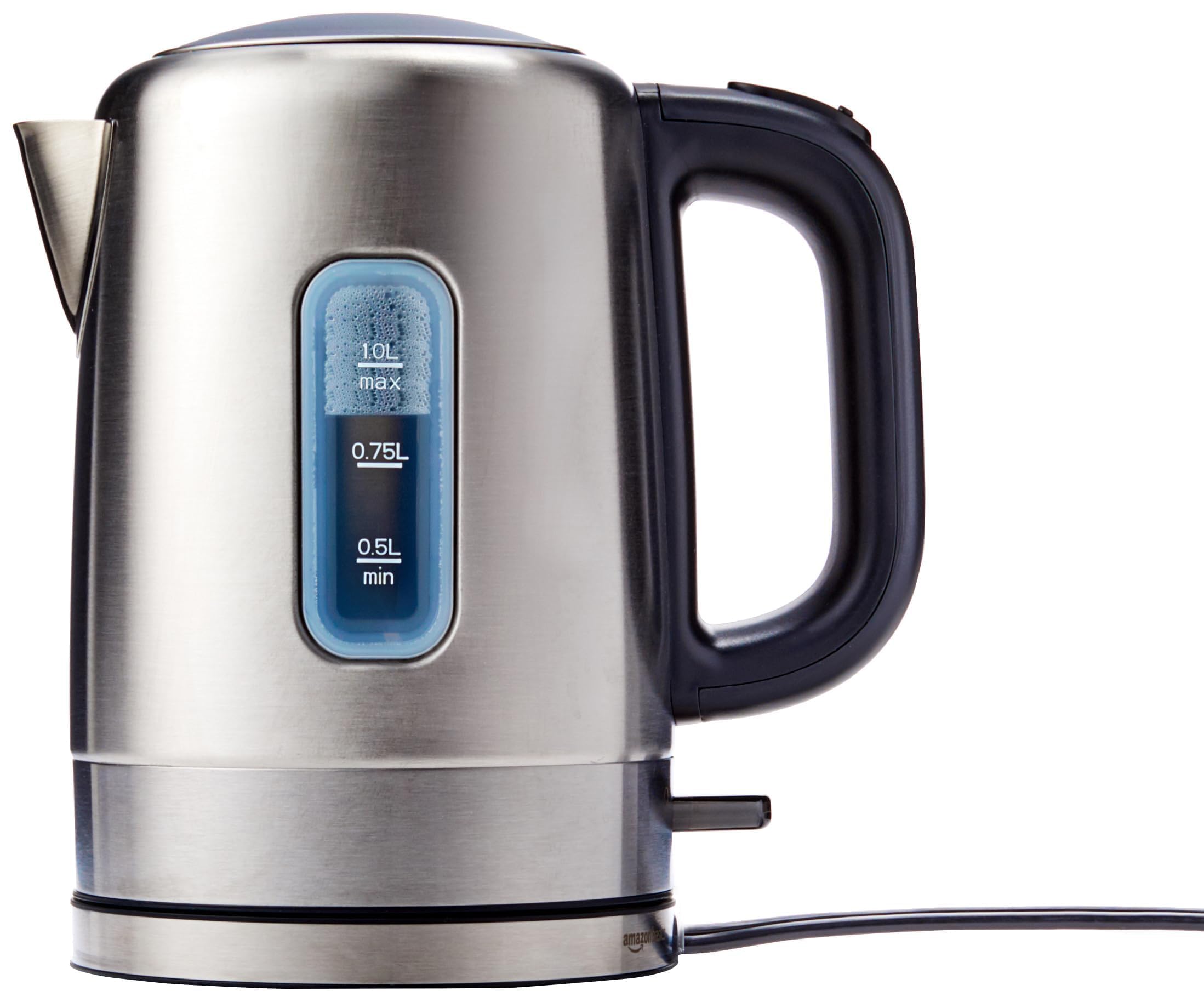
Eight inches long and under two pounds, the Amazon Basics 1-liter is the kettle that fits where others do not: a strip of counter between the sink and the toaster, a desk, the shelf in a camper. It holds 1.06 quarts, two generous mugs or three small cups, which is enough for a solo tea drinker and not enough for a pot.
The 1500-watt element and Strix thermostat are the same basic specification you find in kettles costing more, and it shows in the pace: a liter comes to the boil quickly and the switch cuts out on its own. The lid opens wide for filling from the tap and the water-level window is easy to read against the steel.
Cleaning is straightforward but hands-on. The wide opening gives you room to wipe the interior, the steel does not hold flavors from one pot to the next, and the film that hard water leaves on the base plate lifts with vinegar and a soft brush. Nothing here needs a special tool or a trip through the dishwasher.
We rate it as the no-frills pick: no presets, no keep-warm, no way to stop short of a boil, so a green-tea drinker will be boiling and waiting every time. What it does have is a small footprint, a fast boil and a price that leaves room for good leaves. If you make one or two cups at a time and want your counter back, this is the sensible buy.
Pros
- Small enough for a cramped counter
- 1500 watts brings a liter to the boil fast
- Strix thermostat and boil-dry protection
- Water-level window against bare steel
Cons
- No presets or temperature control
- Body gets hot except at the handle
We keep this one for small kitchens and single drinkers: it boils fast, takes up almost nothing, and makes no promises about temperature.
Best for Dorms and Desks
Hamilton Beach 1-Liter Kettle
Key Features
- Filter: Removable mesh filter
- Weight: 2 lb
- Wattage: 1500 watts
- Capacity: 1 liter
- Price: Budget
The removable mesh filter is a small thing that changes daily use. It sits behind the spout and catches the scale that flakes off a kettle’s element, so the end of the pour does not arrive cloudy in your cup. Pull it out, rinse it, drop it back. On a kettle this inexpensive, that is the detail we did not expect to care about and did.
One liter, 1500 watts, a concealed element and a cordless serving base: lift the kettle off and carry it to the table without unplugging anything, which is more useful than it sounds if you brew at a desk or in a bedsit. Auto shut-off and boil-dry protection are both here, and the spout pours without dribbling down the side.
There is no temperature control, so this is a kettle for people whose tea is black or who do not mind a boiled kettle sitting for a minute while it cools. At a liter it is a one- or two-person pot. Set against the Amazon Basics 1-liter, it wins on the filter and the cordless base, while that one is the all-steel option with a faster reputation for the same money.
Pros
- Removable mesh filter keeps scale out of the cup
- Cordless serving base carries to the table
- 1500 watts and concealed heating element
Cons
- No temperature control
A one-liter kettle we recommend for desks and dorm rooms, where the mesh filter and cordless base earn more than presets would.
Best for Good-Looking Budget
Taylor Swoden Glass Kettle

Key Features
- Base: 360° cordless base
- Body: Borosilicate glass
- Wattage: 1100 watts
- Capacity: 1.7 liters
- Price: Budget
Glass kettles live or die on how they look on the counter, and this one looks good. Borosilicate body, steel base and lid, and a blue glow under the water while it heats that makes the whole thing feel more considered than the outlay suggests. If the kettle stays out between brews, that counts for something.
Functionally it is plain but well thought out: a wide spout, a wide opening that is easy to fill from the tap and easy to get a brush into, and a 360° base you can set down any way round. At 1.7 liters and 1100 watts it is a slower combination than the 1500-watt kettles here, so expect a few minutes longer for a full boil.
Two cautions. There is no temperature setting, just one switch and one full boil, so a tea drinker is back to cooling the water in the cup. The handle on some units runs warm near the base, so lift it by the grip rather than the neck, and the glass is the part to look after, which means keeping it away from the edge of the sink and not knocking it against the tap.
As a looker for a small household it earns its place: two people, a few cups a day, a kettle you do not mind leaving out. The blue light is the part we came back to. It turns a plain boil into something you can watch from across the kitchen, and at this size and price that is most of the appeal.
Pros
- Glass body with a blue glow while heating
- Wide opening fills and cleans easily
- 360° cordless base for either-handed pouring
- 1.7 liters at a budget price
Cons
- No temperature setting
- Handle can run warm near the base
We recommend it to someone who wants a good-looking glass kettle for two and does not need the water held at a set temperature.
How We Tested These Electric Kettles
We started by pulling together every kettle we could find with real temperature control, not just a boil button, and sorting them by spout type, body material, capacity, and price. That list ran to about 40 models. We dropped anything that couldn’t hit 175°F, anything with plastic in the water path, and anything priced well out of line with what it actually did, which left 12 kettles from brands we’ve had good and bad luck with over the years.
Testing ran six months, on a kitchen counter, at roughly three or four boils a day. We timed each kettle bringing a liter of cool tap water to a full boil, then set them to 175°F and 195°F and checked the water with an instant-read thermometer 30 seconds after the switch clicked off, which is exactly where the overshoot shows up. Every kettle got the same pour test: filled to its max line, held one-handed at the angle you’d actually use over a gaiwan, then checked for drips down the spout and a ring of water on the counter.
Reliability and durability got the less glamorous work. Each kettle ran dry once to confirm the auto shut-off actually tripped, we unplugged several mid-boil to see whether they remembered their settings, and we descaled on our usual schedule to watch how quickly hard water left a film on the element. Functionality came down to small things: whether the lid stayed put at full tilt, whether the handle got too hot to grab bare-handed, whether the display was readable from across the kitchen. Appearance we judged the boring way, leaving all 12 out on an open shelf for six months and noting scuffs, fingerprints, and whether we still liked looking at them. The ones that scored best on value were rarely the cheapest; they were the ones that did all of the above without a single daily annoyance.
How to Choose an Electric Kettle for Tea
The kettle matters less than the water, and the water matters most at the moment it hits the leaf.
Temperature decides more than the leaf does
Green and white teas want water around 160°F to 175°F, oolong sits near 185°F to 195°F, and black tea and pu-erh take a full boil. A kettle with presets does that in one press. A boil-only kettle leaves you cooling the water in the cup or pouring between two vessels, which works but is guesswork you repeat every morning.
If black tea with milk is basically all you drink, buy a plain kettle and spend the difference on better leaves. If you keep a green or an oolong in rotation, the presets are the feature that justifies the upgrade, and they are the single biggest reason we rank the Cosori gooseneck first.
Match capacity to your pot, not your cupboard
0.8 liters fills two large mugs or three small cups. Something around 1.7 liters fills a four-cup pot with headroom. Oversizing is the common mistake: a big kettle takes longer to reach the boil and tempts you into heating water you will pour away, and every one of these has a max line that is the real capacity.
Judge it by how many cups land on the table at once, not by how many guests might turn up at Christmas.
Pour, steep, and get a brush inside
A gooseneck gives a slow, aimed stream that suits a small pot or a gaiwan; a wide spout fills a mug or a thermos faster. Neither is better, but a gooseneck is a poor choice if your usual job is filling a travel cup to the brim.
A removable infuser basket lets you steep loose leaf in the kettle itself, as the Chefman does. Cleaning access counts for more than looks: a lid that opens wide enough for a hand and a bottle brush keeps scale from building where you cannot see it.
What actually fails, and what to test first
Kettle failures cluster in the same places: the lid hinge and catch, the switch, and on glass models the body itself. The element is rarely the problem. So treat the lid as the part you handle gently and the shut-off as the thing you verify.
Before the return window closes, boil a full kettle three or four times and watch that it cuts out on its own every time. That check is worth more than an extra preset, and a long warranty is worth more than a fancy finish.
Frequently Asked Questions
Does a higher-wattage kettle cost more to run?
Not meaningfully. Wattage is speed: a 1500-watt kettle boils the same water in less time and uses roughly the same energy as an 1100-watt one taking longer over it. The savings come from boiling only what you are about to pour. Filling a 1.7-liter kettle for a single cup is where the money goes.
Can I brew loose-leaf tea directly in the kettle?
Only with an infuser basket, like the one inside the Chefman. Leaves dropped into a bare kettle clog the spout, keep steeping after you have poured, and bake onto the base plate. Never heat milk in one either, whatever the manual’s hot-chocolate suggestion implies: it scorches onto the element and the sensors cannot read through it.
Do I need filtered water in an electric kettle?
If your tap is hard, yes, or you will be descaling often. Hard water is the main reason kettles scale, cloud over and start making tea taste flat. Filtered water keeps the interior clean longer and lets the leaf do the talking. On tap water, once a month boil an inch of white vinegar and water in the kettle, then rinse twice.
Final Verdict
For most tea drinkers the Cosori gooseneck is the one to buy: five presets that stop where the leaf wants, an hour of hold, and a pour you can aim. It is a two-mug kettle, so if your household empties a pot at breakfast, the Cuisinart does the same temperature job at 1.7 liters and backs it with the longest warranty here.
And if brewing a whole pot of loose leaf in the kettle itself is the appeal, the Chefman’s infuser basket tips it. Buy for the way you actually drink tea, not for the number of features on the box.