This post contains affiliate links. We may earn a small commission when you buy through our links — at no extra cost to you.
The drip machine that came with my first apartment did one thing adequately and nothing well. Then a friend handed me a cone, a paper filter, and a kettle, and within a week the machine was in the basement. That’s the deal with non-electric brewers: no pump, no heating element, no timer — the only variable left is you, which sounds like more work and turns out to be less. What they fix isn’t speed, it’s the cup in your hand and a cleanup that’s a rinse rather than a reservoir of yesterday’s water.
Over six months our team brewed with 14 of them — pour-over cones, flat-bed drippers, French presses, moka pots, a cold brew setup, even a stovetop percolator — same beans, more caffeine after lunch than any of us planned on. One thing worth knowing before you scroll: the brewer is the cheaper half of the upgrade. A decent hand grinder will do more for your cup than a fancier brewer will, so buy the one that fits your actual morning, not the one with the prettiest photos. What follows is what earned permanent counter space.



Best for Fast Single Cups
AeroPress Original
Key Features
- Weight: 6.4 oz
- Capacity: 10 oz
- Included filters: 50 paper micro-filters
- Brew and clean time: 2 minutes
- Price: Midrange
Add coffee, add water, wait about thirty seconds, press, rinse. That’s the entire AeroPress routine, and it’s the first brewer we recommend to anyone who wants coffee without a plug. Air pressure does the extraction work quickly, which is why the cup comes out smooth rather than bitter and why cleanup is a rinse instead of a sink full of parts.
At 6.4 ounces and under five inches tall, it goes in a drawer or a duffel and needs nothing but hot water: no burner, no carafe, no glass. Fifty paper micro-filters come in the box, and there’s nothing here that asks to be handled carefully.
The limit is volume. Ten ounces is one good mug, so a second cup means a second press, and in a two-coffee-drinker household that gets tedious. A Chemex or a French press is a better shape for that kitchen. Where the AeroPress wins is the morning when nobody else is awake yet.
What keeps it at the top is forgiveness. Grind a little coarse, lose track of the timer, pour faster than you meant to, and the cup still comes out decent. That isn’t true of a pour-over that stalls or a percolator left to boil, and it’s why this suits a first-time manual brewer better than anything else in the guide.
Pros
- Brews and rinses in about two minutes
- Forgiving of grind, timing, and pour
- Packs down to 6.4 ounces
- No glass and almost nothing to wash
Cons
- Brews one 10-ounce mug at a time
- Paper micro-filters are a recurring buy
Our pick for most people: the fastest, most forgiving brewer here, and the easiest to carry. Solo drinkers get the most out of it.
Best for Clear Pour-Over
Chemex Classic 8-Cup
Key Features
- Filter: Paper, sold separately
- Capacity: 40 fluid ounces
- Cleaning: Dishwasher safe
- Material: Borosilicate glass
- Price: Premium
One piece of borosilicate glass, pinched at the waist to cradle a paper filter: the Chemex looks like something for a shelf rather than a dark kitchen at six in the morning. It’s the only brewer here we leave on the counter permanently, and the shape is half of why it sells.
The cup is the real argument. A thick paper filter holds back the oils and fine dust that a metal filter lets through, so the brew is clean and bright, with fruit and acidity reading clearly instead of sitting under a blanket of body. We noticed it most with a light roast, where the gap between this and a metal-filtered cone was obvious in the first sip. Want a chewy, heavy cup? This is the wrong tool, and the French press and percolators here do that job.
The numbers need translating: the 40-ounce capacity is counted in 5-ounce cups, so eight cups is about four mugs. Brewing is a staged pour over a few minutes, which is the best part of some mornings and the reason this ends up in a cupboard in others. It goes in the dishwasher, which is more than most glass brewers manage.
Pros
- Cleanest, brightest cup in this guide
- 40-ounce carafe serves a small table
- Dishwasher safe
- Looks good enough to leave out
Cons
- Filters sold separately
- Thin glass is the fragile part
We recommend it for the clearest, brightest cup here and a carafe worth leaving on the counter, provided you have the patience for a slow pour.
Best for Breakage-Proof Press
Utopia Stainless French Press
Key Features
- Walls: Double-walled
- Capacity: 34 oz
- Material: 304 stainless steel
- Filtration: 4-layer stainless
- Price: Budget
Glass is the weak link in almost every French press, and the carafe is what fails: a chip, a crack, and the press is finished. The Utopia removes that entire category of problem, which is why it’s the French press we point people to. Double-walled 304 steel, a four-layer filter stack, and nothing to smash against the edge of the sink.
The double wall earns its keep twice over. It holds heat far better than glass, so the second cup still tastes hot rather than tepid, and the outside stays comfortable to grab while the coffee inside does not. We also like the four-layer filter, with its spiral plate, cross plate, and two mesh screens: it leaves very little sludge at the bottom of the mug, the usual sticking point with immersion brewing.
Two practical notes. The lid has to be turned so its pour slots line up with the spout, and there’s no marker showing which way, so the first pour lands where you didn’t aim until you learn it. And 34 ounces pours three generous mugs, not the crowd the big percolator handles. For one or two people who want a full-bodied cup without breakage anxiety, neither matters much.
Pros
- Double wall keeps coffee hot
- 304 steel body won’t shatter
- Four-layer filter leaves little sludge
- Handle and body stay cool
Cons
- Opaque body hides the brew level
When breakage is the worry, this is the French press we recommend: full-immersion body, a hot second cup, and steel that shrugs off the sink.
Best for Crowd-Size Pots
Farberware 12-Cup Percolator
Key Features
- Filter: Permanent basket
- Capacity: 12 cups
- Cleaning: Dishwasher safe
- Material: Stainless steel
- Price: Midrange
Percolating is the only method here you can watch. Water climbs the central tube, sprays across the basket of grounds, and darkens the glass knob on the lid in a slow rhythm; once it’s rolling you drop the burner to low and let it finish. The result is a pot that’s genuinely hot, fuller-bodied than any pour-over, and closer to a French press in the cup.
The label needs translating: 12 cups means 12 five-ounce cups, so about 60 ounces, or six mugs. It’s heavy stainless with a permanent basket, so there’s no filter to buy, and the whole thing goes in the dishwasher, which we appreciate more than any feature on the box. Expect a little sediment in the last half cup; that’s percolation, not a fault.
For a full table this is the pot: a cabin breakfast, a houseful of guests, a morning when the power is out and the gas ring still works. It’s slower and fussier than the AeroPress, and it won’t make one perfect cup. It makes six good ones at once, which is a different job entirely.
Pros
- 60 ounces for a crowd
- Permanent basket, no paper filters
- Dishwasher safe in one piece
- Sturdy stainless with a lifetime guarantee
Cons
- Glass knob chips if the lid is dropped
We keep this one in mind for big, hot, old-fashioned pots with no filters to buy: cabins, crowds, and mornings when the power is out.
Best for Camp and Cabin
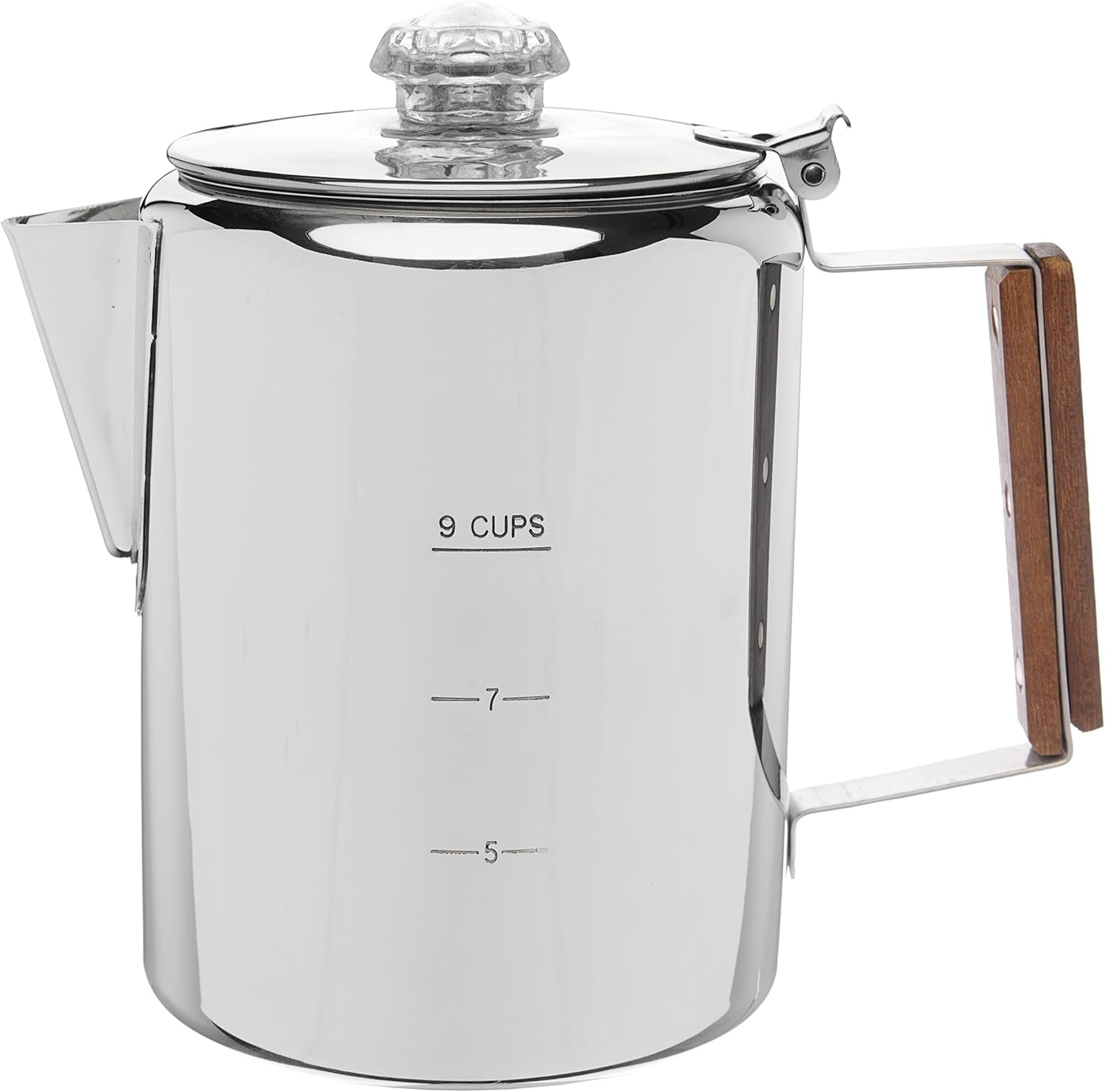
COLETTI Bozeman Percolator
Key Features
- Lid: Glass view top
- Capacity: 45 fluid ounces
- Cleaning: Dishwasher safe
- Material: Stainless steel
- Price: Midrange
Nine cups sounds generous until you convert: at 5 ounces a cup, the Bozeman brews 45 ounces, which is four mugs. That’s the right size for two people who each want a refill, and it’s why we placed it between the 12-cup Farberware and the single-serve brewers in this guide.
The build is what sells it. Stainless throughout, no aluminum or plastic in the brewing path, a glass view top so you can watch the perk, and a steel basket you can line with a paper filter if you want a cleaner cup. It needs nothing but heat, it goes in the dishwasher at home, and it’s the one here built for the morning when the kitchen is a fire ring or the power is out.
Two boundaries. Forty-five ounces is small for a family that drinks a lot, and packing it means protecting the glass view top from whatever else is in the crate. In exchange you get a two-pound brewer that needs no electricity and cleans up with a rinse.
Pros
- No aluminum or plastic in the brew path
- 45 ounces, about four mugs
- Dishwasher safe
- Reusable basket takes paper filters
Cons
- Glass view top is the fragile part
The camp-ready percolator we recommend: 45 ounces, steel in the brewing path, and nothing to plug in.
Best for Paper-Free Pour-Over
Cosori Pour Over Maker
Key Features
- Filter: Double-layer stainless
- Capacity: 34 oz
- Cleaning: Decanter and filter are dishwasher safe
- Material: Borosilicate glass
- Price: Midrange
The Cosori’s argument is the filter: two layers of 304 stainless mesh instead of paper, dropped into a 34-ounce glass decanter with a wooden sleeve around it. No cones to rebuy, no paper taste, and the coffee oils a Chemex filter traps stay in the cup.
That cuts both ways, and the trade is body for clarity. A metal filter lets more sediment through, so expect a little grit in the last mouthful and a slower drawdown if you grind fine. We found the decanter size genuinely useful for two or three people (eight 4-ounce cups, or three mugs), and the sleeve makes it comfortable to hold while it’s still hot.
Brewing is standard pour-over: medium grind, a bloom, then slow circles. The glass is heat-resistant enough for a low flame, which is a small luxury, since a lukewarm second cup goes back on the burner instead of into the microwave. The decanter and filter are dishwasher safe, and the wooden sleeve wipes clean.
Where we hesitate is longevity. The basket is what gives out here, and the mesh can come away from its frame, so it rewards careful washing and a dedicated spot in the cupboard. Treat it as glass with a metal insert rather than a rugged object and it earns its counter space.
Pros
- Reusable double-layer metal filter
- 34-ounce decanter for two or three
- Decanter safe on a low flame
- Decanter and filter are dishwasher safe
Cons
- Filter basket is the weak point
We recommend it to anyone who wants pour-over body without buying filters, and who will treat glass with a little care.
Best for Travel and Camping
Attsky Collapsible Dripper

Key Features
- Pack: 2-pack
- Filter: #2 cone paper
- Material: Food-grade silicone
- Heat resistance: Up to 464°F
- Price: Budget
It arrives as two flat silicone discs. Push one open and it becomes a cone that sits on a mug; collapse it and it slides into a jacket pocket beside a folded filter. For pack space and weight, nothing else in this guide comes close.
It’s a holder rather than a brewer with a filter of its own: a #2 paper cone goes inside, hot water goes through, and the silicone stays cool enough to lift off afterwards. Two things we noticed in use. The cone flexes a little when it’s full of hot water, so set it on a stable mug and pour gently rather than in a torrent. And because you’re looking down into silicone, you can’t see how full the mug is getting.
Both are small costs against a dripper that collapses to nothing and rinses in seconds. We keep one in the camping box and one in the kitchen drawer for the odd single cup, and it’s the cheapest way into pour-over coffee here, as long as you already carry a kettle and a mug.
Pros
- Collapses flat for packing
- Two drippers in the pack
- Dishwasher safe
- Heat resistant to 464°F
Cons
- Needs #2 paper filters
Our budget pick for coffee away from home: two cones that collapse flat and weigh next to nothing.
How We Tested 14 Non-Electric Coffee Makers
We started from a list of roughly 50 manual brewers sold by the major retailers and cut it down to 14. Filters drove a lot of the cuts — if a brewer only takes a proprietary paper that costs more than the coffee, we passed. We also filtered by capacity, from a single mug up to a 12-cup press, by material (borosilicate and stainless over soda-lime glass that clouds in the dishwasher), and by whether replacement parts exist at all, because a chipped carafe shouldn’t mean a new brewer.
Every unit got the same beans, the same grind setting, and a 1:16 ratio. We brewed at 5:45 on weekday mornings with one kitchen light on, again on weekends for four people, and once on a camp stove. We took the water temperature before the pour and again at the end of the steep, timed each brew from first pour to last drop, and looked at the spent bed of grounds to see whether the water had moved through evenly or chewed a channel down one side.
Taste was judged blind: four cups at a time, labeled with tape, my partner handing them over so I couldn’t see which was which. For cleaning, we dumped the grounds, rinsed under a hot tap, and counted the seconds — noting which ones trapped grit in a plunger plate or a cone’s ridges, and which parts came out of the dishwasher intact. Durability we judged the honest way, with six months of daily use, a few knocks against a stainless sink, and one deliberate shove off the counter to see whether the carafe was the first thing to go.
How to Choose a Non-Electric Coffee Maker
Manual brewing comes down to three things: how many cups you pour at once, how much body you want in the cup, and whether there’s a flame involved.
Start With the Cup Count, Not the Label
Every brewer here counts cups differently, and almost none of them mean a mug. The old 5-ounce measure still rules: the Chemex’s 40 ounces is eight small cups, the Farberware’s 12 cups is about 60 ounces, and the AeroPress’s 10 ounces is one generous mug. Decide how many ounces your household drinks in a sitting, then divide.
Two people who each want a refill need roughly 30 ounces, which points at the stainless French press or the 9-cup percolator. A 12-cup percolator earns its cupboard space only when you’re feeding a table or reheating a second round.
Choose the Filter and the Cup It Makes
Filter material shapes the coffee more than the brewer’s shape does. Paper, as in the Chemex, holds back oils and fine particles: the cup is clean and bright, acidity reads clearly, and you buy filters forever. Metal mesh, as in the Cosori, and the four-layer stack in a French press let those oils through, so you get more body and a little sediment. Percolators go further, recirculating water through the grounds until the brew is round and strong.
Pick the cup you like and the method follows. Don’t buy a paper-filtered brewer if what you actually want is a chewy, heavy mug.
Treat a Glass Carafe as a Wear Part
Glass makes the best-looking brewers and the most breakable ones. The carafe is what fails first on a glass press or pour-over: a chip at the sink, a crack when hot water hits a cold jug, and the brewer is done. If the thing will live beside a busy sink, in a camp box, or on a boat, buy steel: the Utopia press and both percolators here are built for that life.
If you want glass anyway, wash it by hand, warm it before the first pour, and accept that you’re buying a replaceable vessel rather than an heirloom.
Check Your Heat Source Before You Buy
Percolators and moka pots need a burner; pour-over cones, presses, and collapsible drippers need only a kettle. That distinction matters more than any specification if you brew in a hotel room, a van, or an office.
On a stove, check the base before you commit, because aluminum moka pots don’t respond to induction and an induction hob narrows your options. Then think about where the thing will sit: a 12-cup percolator is a tall pot that needs cupboard headroom, while the AeroPress and the Attsky dripper disappear into a drawer.
Count the Parts You’ll Wash
Cleaning decides whether a brewer stays on the counter. The AeroPress is a rinse and a wipe; the percolators come apart into a basket, a stem, and a lid, and all of it is dishwasher safe. The four-layer filter stack in the stainless French press is the fiddliest assembly here, though it does come apart for washing.
Knock grounds into the bin rather than down the sink, whatever you buy. Anything dishwasher safe gets used more often, and that’s worth more than a handsome shape.
Frequently Asked Questions
What grind should I use for a French press, pour-over, or percolator?
Coarse for a French press and a percolator, medium for a pour-over cone, and fine for a moka pot. Grind coarser than you think for immersion brewing: fine particles slip past the mesh and turn into grit in the last mouthful.
If the cup tastes muddy, go one notch coarser on the grinder before you change anything else.
How do I keep the second cup hot without a hot plate?
Preheat the carafe or mug with hot tap water while the coffee brews, then brew into it; that gains more heat than any lid. A double-walled steel press holds temperature longest, and a thermal carafe does the same job for pour-over.
If you’re reheating, do it gently. The Cosori decanter takes a low flame; a thin glass carafe does not.
Can I make cold brew with a non-electric coffee maker?
Yes, with a French press. Steep coarse grounds in cold water in the fridge overnight, then plunge and pour. The result is a concentrate, so dilute it with water or milk to taste, and the stainless press is the better vessel for it because there’s no glass to handle in a crowded fridge.
The AeroPress does a smaller, stronger version of the same trick. Pour-over cones and percolators are hot-water tools, so leave those for the kettle.
Final Verdict
The AeroPress Original is the non-electric coffee maker we recommend to most people, because it asks for nothing but hot water and a couple of minutes, and it forgives the mistakes that ruin a pour-over. If your mornings involve three or four cups at once, the Chemex makes the better cup and the 12-cup Farberware makes the better pot.
And if you’ve already broken a glass press, the stainless Utopia is the one that ends that cycle.