This post contains affiliate links. We may earn a small commission when you buy through our links — at no extra cost to you.
A tea kettle is simple until you’re standing in front of a shelf of them. Stovetop models can look beautiful enough to leave out, but they ask you to wait and listen for the whistle; electric kettles are faster and often safer, but some take up more counter space than they’re worth. The right one fixes the daily friction—slow boils, hot handles, a lid that dribbles, or an auto shut-off you don’t quite trust—without turning tea into a chore.
I’ve been boiling water for tea, pour-over coffee, and the occasional instant noodles at home for years, and I’ve learned that a kettle’s best features are the ones you stop noticing: a handle that stays cool, a spout that pours cleanly, a switch that clicks off when it should. Over the past seven months, we’ve tested 14 kettles, from sleek stovetop designs to fast electric models, and the differences in heating speed, build quality, and everyday ease were bigger than I expected. The picks below are the ones that earned their counter space—and the ones I’d buy again.



Best for Everyday Boiling
COMFEE’ 1.7L Stainless Kettle
Key Features
- Power: 1500 watts
- Capacity: 1.7 liters
- Auto shut-off: Yes, with boil-dry protection
- Body material: Stainless steel
- Price: Budget
There’s no glass in this kettle, and in a group where a cracked carafe is the most common way a kettle dies, that’s the specification we value most. COMFEE’ builds the body in brushed stainless around a 304 food-grade interior, with the heating element concealed under the floor of the pot and a lid that pops up on a button. Capacity is 1.7 liters, which is five or six mugs, or enough to fill a French press and still have water for a second round.
Fifteen hundred watts makes a full pot quick enough that boiling water stops being something you plan around, and the switch clicks off at the boil with a boil-dry cutout underneath as the backstop. The handle stays cool, the 360-degree base lets you set the kettle down any way round, and the lid opening is wide enough to get a hand and a sponge inside. A removable nylon filter sits at the spout for catching scale, and the whole thing has the plain, unfussy look of an appliance that expects to be used rather than admired.
Cleaning is the stainless routine: a vinegar-and-water boil when the scale shows, a soft cloth outside, never the dishwasher. The filter pulls out for rinsing, and the cord wraps under the base so it tucks back against the wall between uses. It’s the least interesting kettle here, and that’s the point — nothing on it needs explaining to a houseguest or a babysitter.
Pros
- 1500 watts boils a full 1.7 liters quickly
- Stainless body with a 304 food-grade interior
- Wide lid opening makes filling and descaling easy
- Auto shut-off plus boil-dry protection
Cons
- Outer walls get hot during a boil
- Boil only, with no presets or keep-warm
This is the kettle we point most people to: 1.7 liters, a fast 1500-watt element, stainless steel instead of glass, and a price near the bottom of this group.
Best for Watching the Boil
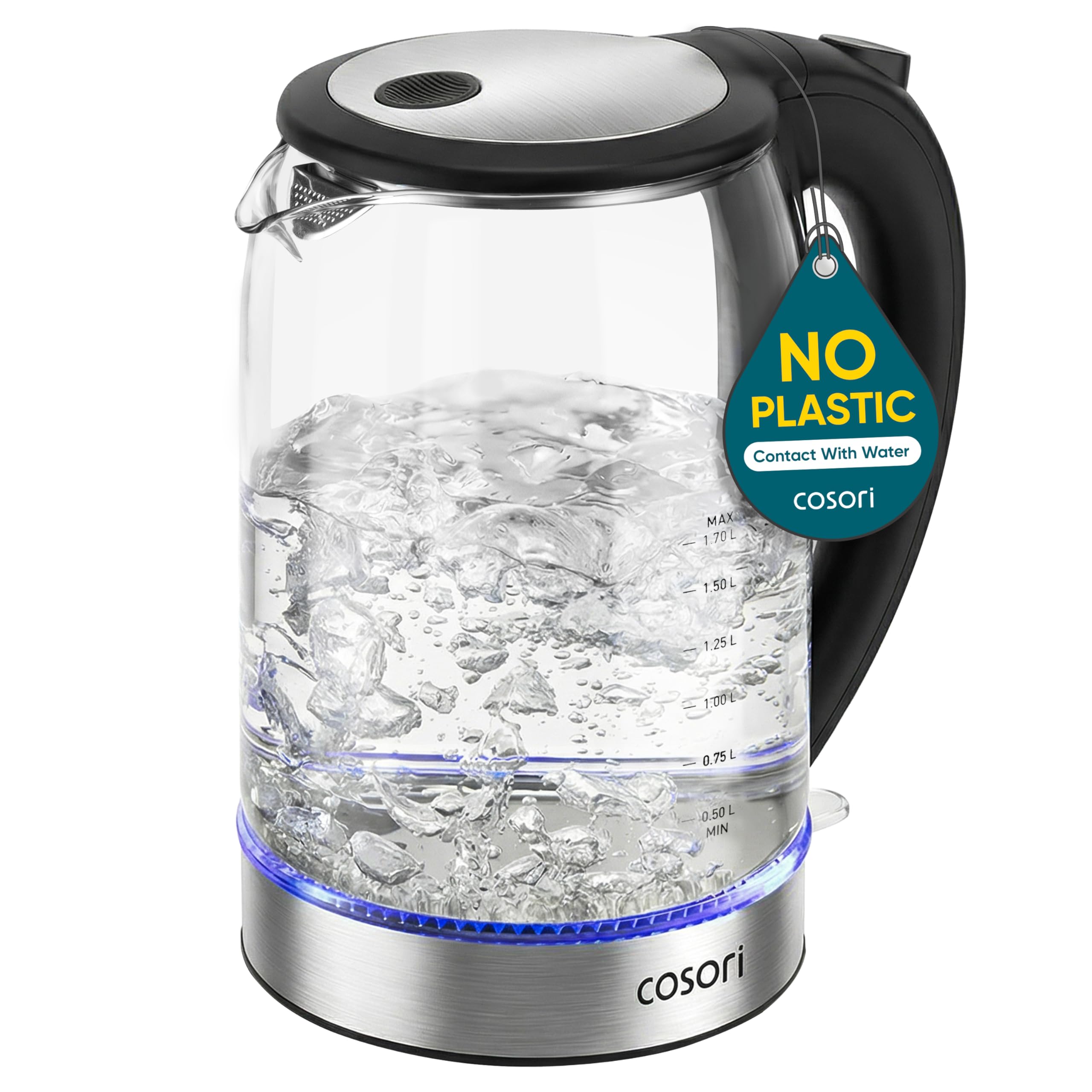
Cosori 1.7L Glass Kettle
Key Features
- Power: 1500 watts
- Capacity: 1.7 liters
- Auto shut-off: Yes, with boil-dry protection
- Water contact: Borosilicate glass and stainless steel
- Price: Budget
Cosori’s whole pitch is that the water never touches plastic, and in a glass kettle that’s the claim worth taking seriously. The body is borosilicate, the filter and inner lid are stainless steel, and the wide mouth means you can see and reach every surface the water has been in. It’s the kettle we reach for when we’re brewing something delicate, where an off note has nowhere to hide.
The 1500-watt element is rated at half a liter in under three minutes and behaves like it, so a mug is a short wait and a full pot is a few minutes more. The blue light under the water is more useful than decorative: you can see from across the kitchen whether it’s still going. Auto shut-off cuts in shortly after the boil and a boil-dry cutout sits underneath as the fallback. That shut-off is the part we watch on any kettle in this style, because it’s mechanical and it’s the part that eventually gives.
Cleaning is where the design pays off. The lid opens past vertical, the opening is wide, and a bottle brush reaches the shoulder where scale collects. Descale with vinegar every month or two if your water is hard, and set it down gently on stone counters. The wide mouth also means drying the inside is a tea-towel job rather than an afternoon of waiting.
Pros
- No plastic in the water path
- 1500 W element heats a mug fast
- Wide lid opening for filling and cleaning
- Auto shut-off with boil-dry protection
Cons
- Glass body is the part that fails first
- No temperature settings, boil only
The glass kettle to buy if you want to watch the water: nothing but glass and stainless touches it, the lid opens wide, and the element is quick.
Best for Tea Varietals
Cuisinart PerfecTemp CPK-17P1
Key Features
- Capacity: 1.7 liters
- Warranty: 3 years limited
- Keep warm: 30 minutes
- Temperature presets: 6, from 160°F to 200°F
- Price: Premium
Six buttons and a hold. The point of the CPK-17P1 is that it stops at the temperature you asked for instead of at a rolling boil, with settings down at 160°F for delicate tea and up around 200°F for a French press. If your usual method has been to boil a kettle and then wait, or splash cold water in to cool it down, this replaces the whole ritual with one press.
The body is brushed stainless with a blue backlit water window, a stay-cool handle, and a 360-degree base with cord storage. The memory feature is the small thing we ended up using constantly: lift the kettle to pour and it holds its setting for two minutes, so a second cup doesn’t send you back through the menu. It’s also the heaviest of the standard-size kettles here, which is either reassuring or tiring depending on how often you carry it to the table.
What you’re paying for is repeatability. The same preset gives the same cup on a Tuesday as on a Sunday, the hold keeps a pot at temperature for half an hour while you work through it, and the three-year limited warranty is twice what most of this group offers. It doesn’t boil faster than kettles that cost a fraction as much — nothing here is slow — so if all you make is black tea and instant coffee, the money buys you control you won’t use.
Day-to-day care is the usual: citric acid or vinegar for scale, a damp cloth for the brushed finish, nothing abrasive near the printed buttons. The cord wrap in the base is the tidiest of any kettle here, with the whole lead disappearing inside, which matters more than it sounds if yours lives at the front of the counter.
Pros
- Six presets from 160°F to 200°F
- 30-minute keep-warm holds a pot at temperature
- Three-year limited warranty, the longest here
- Memory feature keeps its setting when lifted
Cons
- Lid catch and printed buttons wear first
- Steam vent needs clearance under cabinets
If you brew more than black tea, this is the kettle that earns its price: six presets from 160°F to 200°F, a 30-minute hold, and the longest warranty here.
Best for Pour-Over Coffee
Cosori Gooseneck 0.8L
Key Features
- Power: 1200 watts
- Capacity: 0.8 liters
- Keep warm: Up to 1 hour
- Temperature presets: 5 one-touch
- Price: Premium
A gooseneck changes how a kettle feels in the hand. The narrow spout turns the pour into something you steer rather than something that happens, and the counterweighted handle keeps the flow steady as the water level drops. We noticed it most on mornings when the coffee was worth paying attention to — a slow spiral over the grounds is genuinely easier with this spout than with any standard kettle here.
The rest of the package aims at the same person. Five presets cover green tea through a full boil, the hold runs a full hour so a pot stays hot through a second cup, and the 1200-watt element gets 0.8 liters there quickly. The interior, lid, and spout are 304 stainless, so nothing plastic is in the water, and the matte black finish hides fingerprints in a way polished steel doesn’t. The beep at temperature is soft enough not to wake the house.
It’s a kettle for one coffee maker and one tea drinker who both care about temperature, not for filling a pot for four. Descale it more often than a big kettle, since a small body concentrates minerals faster, and use filtered water if yours is hard — the narrow spout is the one place scale is genuinely awkward to reach.
Pros
- Gooseneck spout gives precise pour control
- Five presets and a 60-minute keep-warm
- Stainless interior, lid, and spout
- Compact footprint for a coffee corner
Cons
- Control and power failures are the weak spot
- 0.8 liters is small for a household
For pour-over coffee and careful tea, this is the kettle: a gooseneck spout you can steer, five presets, and an hour of hold in a compact 0.8-liter body.
Best for Small Kitchens
Elite Gourmet 1L Glass Kettle
Key Features
- Power: 1100 watts
- Capacity: 1 liter
- Auto shut-off: Yes, with boil-dry protection
- Body material: Borosilicate glass
- Price: Budget
A liter is the whole argument. Filling a 1.7-liter kettle to the top for one mug means waiting on water you aren’t going to drink, and the big kettles take counter space small kitchens don’t have. This one holds a liter — two mugs, or a mug and a pot of instant noodles — in a glass body barely wider than its own base.
The 1100-watt element is modest for the size, and it turns out to suit the kettle: with a mug’s worth in it, the click-off at the boil arrives before you’ve found the tea tin. The blue LED under the water is the sort of thing that shouldn’t matter and does — we could see from across the room whether it was still heating, which is more than we can say for kettles whose only light is on the switch.
Cleaning is the other reason it suits a small setup. The lid lifts off, the mesh filter at the spout slides out for rinsing, and the glass shows you where the scale is before it becomes a problem. Ours sits on a narrow strip of counter beside the sink, which is about all the space it asks for.
Pros
- One liter suits one or two drinks
- Compact footprint for small counters
- Glass body shows water level and scale
- Lid lifts off and the filter is removable
Cons
- Slow with a full liter at 1100 W
- Glass carafe is the weak point
A liter is enough for two cups, and that’s the point of this small glass kettle: a compact footprint, a modest element, and a body that’s easy to keep clean.
Best for Gas Cooktops
Café Brew 12-Cup Glass Kettle
Key Features
- Capacity: 12 cups (48 oz)
- Body material: Borosilicate glass
- Heat diffuser: Included
- Cooktop compatibility: Gas, electric, glass
- Price: Budget
This is the only kettle here with no cord, no element, and no thermostat, and for some kitchens that’s exactly right. It holds 12 cups — 48 ounces — in Schott DURAN borosilicate glass, with a stainless handle, a glass lid, and a whistle built into the spout. On a gas range the flame shows through the water, which is either mesmerizing or a distraction depending on how easily you’re parted from your phone.
It’s rated for gas, electric, and glass cooktops and ships with a heat-diffusing trivet. Use it, and use a low-to-medium flame: glass kettles die from thermal shock, and a diffuser between the pot and the burner is the cheapest insurance in the kitchen. It’s also slower than any electric here, which suits a kitchen where someone is already standing at the stove.
The whistle is the open question. It works on ours, a thin, high sound that carries to the next room, and it doesn’t start until the water is properly rolling, so there’s no premature shrieking. Where a stovetop kettle falls down is attention: this one won’t switch itself off if you wander into the garden.
Where it can beat an electric is the long run — no element to burn out, no thermostat to stick, no base to corrode, and a body you can see through, so scale shows up early and vinegar deals with it. Where it loses is the sink. Glass near a stainless sink edge is a heartbreak waiting to happen, which is why ours stays on the stove side of the kitchen.
Pros
- 48-ounce capacity, the largest here
- No cord, element, or thermostat to fail
- Works on gas, electric, and glass cooktops
- Whistling lid signals the boil
Cons
- Lid must be lifted off to pour
- Handle gets hot on a long boil
The stovetop pick: 48 ounces of German borosilicate glass with a whistle, for gas ranges and anyone who wants no cord and nothing electronic to fail.
Best for Budget Glass
Amazon Basics 1.7L Glass Kettle

Key Features
- Power: 1500 watts
- Capacity: 1.7 liters
- Auto shut-off: Yes, with boil-dry protection
- Body material: Glass with stainless steel
- Price: Midrange
Amazon Basics does the sensible version of a glass kettle: a 1.7-liter borosilicate body, a 1500-watt concealed element, a Strix thermostat, a blue ring of light while it heats, and a handle that stays cool. Nothing about it is fussy and nothing about it needs a manual.
The glass earns its counter space. You can read the level without lifting the kettle, watch the first bubbles come up through the water, and catch scale while it’s still a film rather than a crust. The lid opens wide on a button and the opening takes a hand and a sponge, which is not true of every glass kettle here.
Speed and shut-off are ordinary in the best way: it boils about as fast as anything else in this group, clicks off when it’s done, and cuts out if it’s switched on empty. There’s a boil-dry cutout as well, and a cord that wraps under the base for storage.
What holds it back is the material itself. Glass carafes in this group crack — a knock against the sink, a hot body set down on something cold — and when the glass goes, the kettle goes. If you want the view and you’re careful with your dishes, it’s a lot of kettle for the money; if the kettle gets knocked about, buy the COMFEE’ instead.
Pros
- Clear glass shows fill level and the boil
- 1500 W element with a Strix thermostat
- Wide opening is easy to fill and clean
- Auto shut-off and boil-dry protection
Cons
- Boil only, no temperature presets
- Plastic lid and collar feel inexpensive
A good glass kettle at a modest price: 1.7 liters, 1500 watts, a Strix thermostat underneath, and a clear body that shows you the fill and the boil.
Best for Tight Budgets
OVENTE KP72W 1.7L

Key Features
- Power: 1100 watts
- Capacity: 1.7 liters
- Warranty: 2 years limited
- Body material: Plastic
- Price: Budget
This is the cheapest full-size kettle in the group, and it doesn’t skimp on the basics: 1.7 liters, an 1100-watt concealed element, a removable spout filter, cord storage in the base, and a two-year limited warranty. For the money that’s a lot of kettle.
The body is plastic and it looks it — white, with a blue indicator light and a printed gauge down the side. What it has going for it is simplicity: one switch, one light, a wide lid, and a water window you can read from above without lifting anything. This is the kettle that goes in an office kitchen, a rental, or a guest room, where nobody wants to worry about glass.
The one thing to know before you put it in a busy kitchen: the shut-off is a mechanical switch, and that’s the part that can fail, leaving a kettle that keeps boiling. The boil-dry cutout is the backstop, but this is a kettle to keep an eye on rather than one to switch on and walk away from. For a spare, a rental, or a desk, that’s a fair deal at the price.
Pros
- Cheapest full-size kettle in this group
- Two-year limited warranty
- Removable filter and cord storage
- Simple one-switch operation
Cons
- Plastic body looks and feels inexpensive
- Slow with a full pot at 1100 W
The cheapest full-size kettle here, with a two-year warranty that beats every other budget pick; a plastic body and a slower element are what you trade for it.
How We Tested 14 Tea Kettles at Home
We started by reading customer reviews and comparing specs for kettles with strong records on heating speed, durability, and auto shut-off, then filtered out models with repeated complaints about loose handles, dribbling spouts, or confusing controls. We also kept an eye on price so the group included budget-friendly picks and splurges, and we tracked availability and packaging, since a kettle that arrives dented or is never in stock is a bad purchase no matter how well it boils.
For seven months, we used all 14 kettles in a normal kitchen: morning tea, afternoon coffee, and a second round when friends stayed late. We filled each to the same line with cold tap water, timed it to a rolling boil, and noted how long it took and whether the handle stayed cool enough to grab bare-handed. We poured one-handed, refilled at the sink, and wiped down the bodies to see which finishes picked up fingerprints or water spots.
For electric models, we let them cycle through their auto shut-off repeatedly, checking whether the switch popped cleanly and the base stayed stable; stovetop kettles got the whistle test over high heat, plus a check for handles that got too hot to touch. After seven months, we looked for rattles, loose lids, mineral buildup, and peeling finishes—the durability details that show up after the honeymoon phase. We also judged appearance honestly (would we leave it out?) and value (what extra money actually bought).
How to Choose a Tea Kettle
The decision that shapes everything else is whether the kettle has a cord, because that one choice settles how fast it boils, what it costs, and which parts can fail on you.
Electric or stovetop
An electric kettle wins on speed and attention. It switches itself off, it doesn’t need you in the room, and a 1500-watt model outruns any stovetop pot for a single mug. A stovetop kettle wins on longevity and on kitchens where a burner is already lit: nothing electronic to fail, and a body you can watch.
We reach for electric on weekday mornings and for the stovetop model when the stove is already on. If you want one kettle and you boil water daily, buy electric.
What the body material decides
Glass shows you the level and the boil, and it makes scale visible before it turns into a crust. It’s also the part that cracks, which is the most common way a kettle in this group dies. Stainless hides the level but survives knocks — and an uninsulated stainless body gets properly hot, so check that your hand finds the handle, not the wall. Plastic is cheapest and lightest and the one you replace first.
Match the material to your sink habits more than to your taste. A kettle that shares counter space with a busy dish rack takes knocks a kettle on a quiet shelf never sees.
Capacity, wattage, and the size trap
Most kettles here hold 1.7 liters, which is five or six mugs. That’s right for a household and wrong for one person boiling a mug at a time: a big kettle takes longer to boil a full pot, and you’re heating water you won’t drink. One liter is plenty for two cups.
"Compact" in a listing usually describes the footprint, not the boil time. Wattage is the number that decides speed — 1500 watts is the standard here and 1100 is the budget end, and the gap shows up with a full pot rather than a mug.
Temperature presets, and when they’re worth paying for
Boil-only kettles are fine for black tea, instant coffee, and cooking. Presets matter if you drink green, white, or oolong tea, or brew pour-over coffee, because those want water well below a rolling boil and waiting for a kettle to cool is a worse habit than it sounds.
Compare two things beyond the settings: how long keep-warm runs (30 minutes on the Cuisinart, an hour on the Cosori gooseneck), and whether the kettle remembers its setting when you lift it to pour.
The parts that fail, and what covers them
Look at three parts: the switch that shuts the kettle off, the lid, and the body. The shut-off is mechanical and it’s the failure that matters, because a kettle that keeps heating after the water is gone is the one that can damage itself. A boil-dry cutout is the backstop worth having.
Warranties here run from one year to three, and the longest comes with the priciest kettle. Buy the longest you can — the failures these kettles develop aren’t always immediate.
Frequently Asked Questions
Can I use an electric kettle for ramen or instant soup?
Yes, and plenty of people do — but boil the water and pour it into the bowl rather than cooking in the kettle. Salt and food residue are miserable to rinse out of a spout and a heating element, and a kettle that smells of last night’s noodles will taste of them tomorrow.
Rinse and dry it after any savory use, and keep the lid open until the inside is dry.
How do I get rid of the white film inside my kettle?
That’s scale, and vinegar shifts it. Fill to cover the element with equal parts white vinegar and water, bring it to a boil, switch off, and let it sit for twenty minutes before rinsing and drying. Citric acid does the same job and smells less.
In hard water, repeat monthly. A glass kettle lets you see when it’s due, which is one small argument in glass’s favor.
Can I use a glass stovetop kettle on an induction cooktop?
Don’t assume it. The Café Brew is listed for gas, electric, and glass cooktops; induction works differently, heating the pot rather than the surface, so it needs cookware the manufacturer has actually rated for it.
Check the maker’s compatibility list before you buy. If your range is induction and the listing doesn’t name it, an electric kettle is the safer purchase.
Final Verdict
The COMFEE’ is the kettle we recommend to most people: it boils 1.7 liters quickly, it’s stainless rather than glass, and it costs less than almost everything else on this page. It’s the one that survives a busy sink and a rushed morning without asking anything of you.
Spend more only for a reason you can name. The Cuisinart if you brew green, white, or oolong tea and want the water to stop at the right temperature; the Cosori gooseneck if pour-over coffee is the point of the kettle; or the Café Brew if your kettle lives on a gas burner and you’d rather have no cord at all.