This post contains affiliate links. We may earn a small commission when you buy through our links — at no extra cost to you.
A pot of soup on Sunday is one of the best feelings in a kitchen—until you’re standing over the sink with a floppy freezer bag, trying to coax lentil soup into it without painting the counter. The right container should make leftovers feel like a plan, not a project: it should seal hard, stack without wobbling, and release frozen soup without a fight. That’s what I was after when I cleared a shelf and started testing.
Over the past four months, I’ve lived with 14 containers and container sets, from small single-portion cups to family-size tubs. I filled them with minestrone, stock, and split pea soup, then paid attention to the unglamorous stuff: whether the lid clicked on easily with wet hands, whether the seal survived a sideways tumble, and whether a frozen block of soup popped out cleanly. Size and value mattered as much as seal quality; a container that wastes freezer space or cracks after a few washes isn’t a bargain. The picks below are the ones that made batch cooking feel easier, not just more organized.



Best for Batch Soup Portions
Souper Cubes 1-Cup Freezer Molds
Key Features
- Material: Platinum silicone, steel rim
- Fill lines: ½ cup and 1 cup
- Portions per pack: 8 (2 trays)
- Capacity per cavity: 1 cup (8 fl oz)
- Price: Premium
Turn a filled tray over and the block drops out with a push on the base. That single move is why the Souper Cubes molds take the top spot: nothing to chip at, no thawing a whole quart to get one cup out of it. Two trays, four cavities each, eight one-cup portions from a single pot, and fill lines at half cup and a full cup so a batch splits evenly instead of by eye.
Steel in the rim is doing quieter work: a full silicone tray is a wobbly thing to carry from the stove, and the reinforcement keeps it square in two hands. What we appreciated most came after the soup set — the blocks go into a bag, the trays go back in the cupboard, and the freezer ends up holding soup rather than a wall of containers.
The hesitation is price. Per cup of capacity this is the most expensive pick here, and what you’re buying is a tool rather than storage, since the soup still needs a bag or a shelf to live on. Fill the trays on a sheet pan or a level counter rather than a crowded shelf, because a flexible tray wants two hands and a flat surface. Freeze single portions every week and the cost per use falls away; freeze quarts and it never will.
Pros
- Half-cup and full-cup fill lines
- Steel-reinforced rim stays rigid when full
- Blocks release with a push, no chipping
- Trays nest away once portions are bagged
Cons
- Rigid plastic lids are the part that can split
We recommend the Souper Cubes trays to anyone who freezes soup a cup at a time: steady one-cup blocks, a clean release, and silicone that won’t split in a hard freeze.
Best for Quart-Size Batches
GUSTO 32 oz Deli Containers
Key Features
- Care: Freezer, microwave, dishwasher safe
- Capacity: 32 fl oz (1 quart)
- Material: BPA-free plastic
- Set size: 24 containers with lids
- Price: Midrange
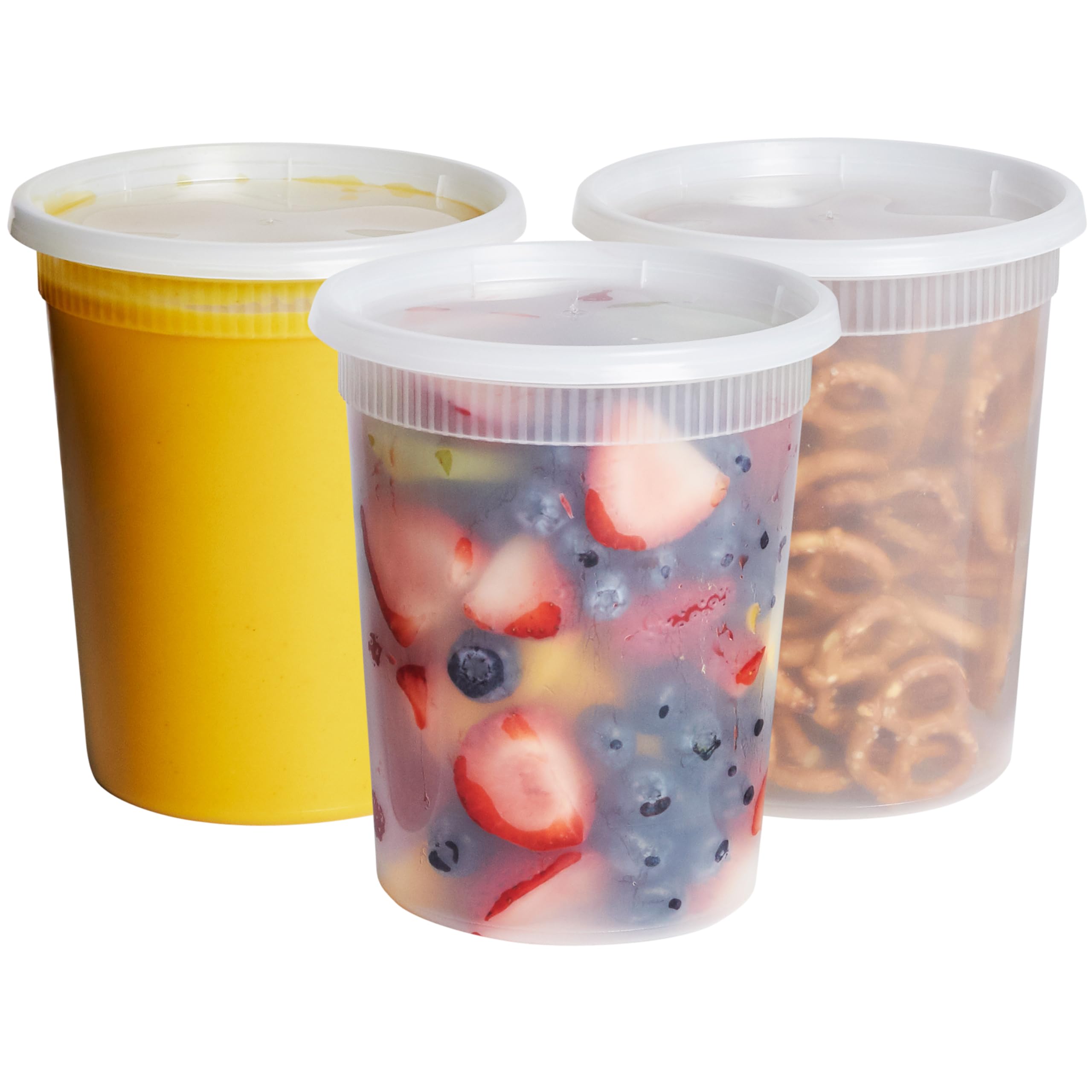
A quart holds what a pot of minestrone leaves after you’ve eaten twice — about two of the one-cup blocks our top pick turns out, in one round tub. Twenty-four arrive nested with their lids, clear enough to see the contents without lifting anything, and wide enough at the top that a ladle goes in without a funnel.
The give-away factor is what we value most. These are sturdy enough to reuse for months and plain enough that you don’t chase them down after a dinner party, which makes them the set we hand out with leftovers. Freezer, microwave and dishwasher all take them without complaint, and the lids snap down firmly enough to hold a thawing quart upright in a bag.
Portion size sets the limit rather than quality. A quart is a lot of soup to thaw for one person, so a household of one is better served by pints or by blocks. For a family that eats soup through the week, twenty-four quarts is a winter of dinners already made.
Pros
- Quart portions suit families and gifting
- Freezer, microwave and dishwasher safe
- Lids seal tightly with a firm snap
- Cheap enough to give away without chasing
Cons
- One quart size only, no smaller option
- Round tubs leave gaps in a freezer drawer
We reach for the GUSTO quarts when a batch is headed for other people’s freezers: a quart holds a dinner, the lid seals, and losing one to a friend costs nothing.
Best for Mixed-Size Freezing
JoyServe 16 & 32 oz Containers
Key Features
- Care: Microwave safe, container only
- Lids: One size fits all containers
- Sizes: 16 oz and 32 oz
- Set size: 48 sets (24 of each)
- Price: Midrange
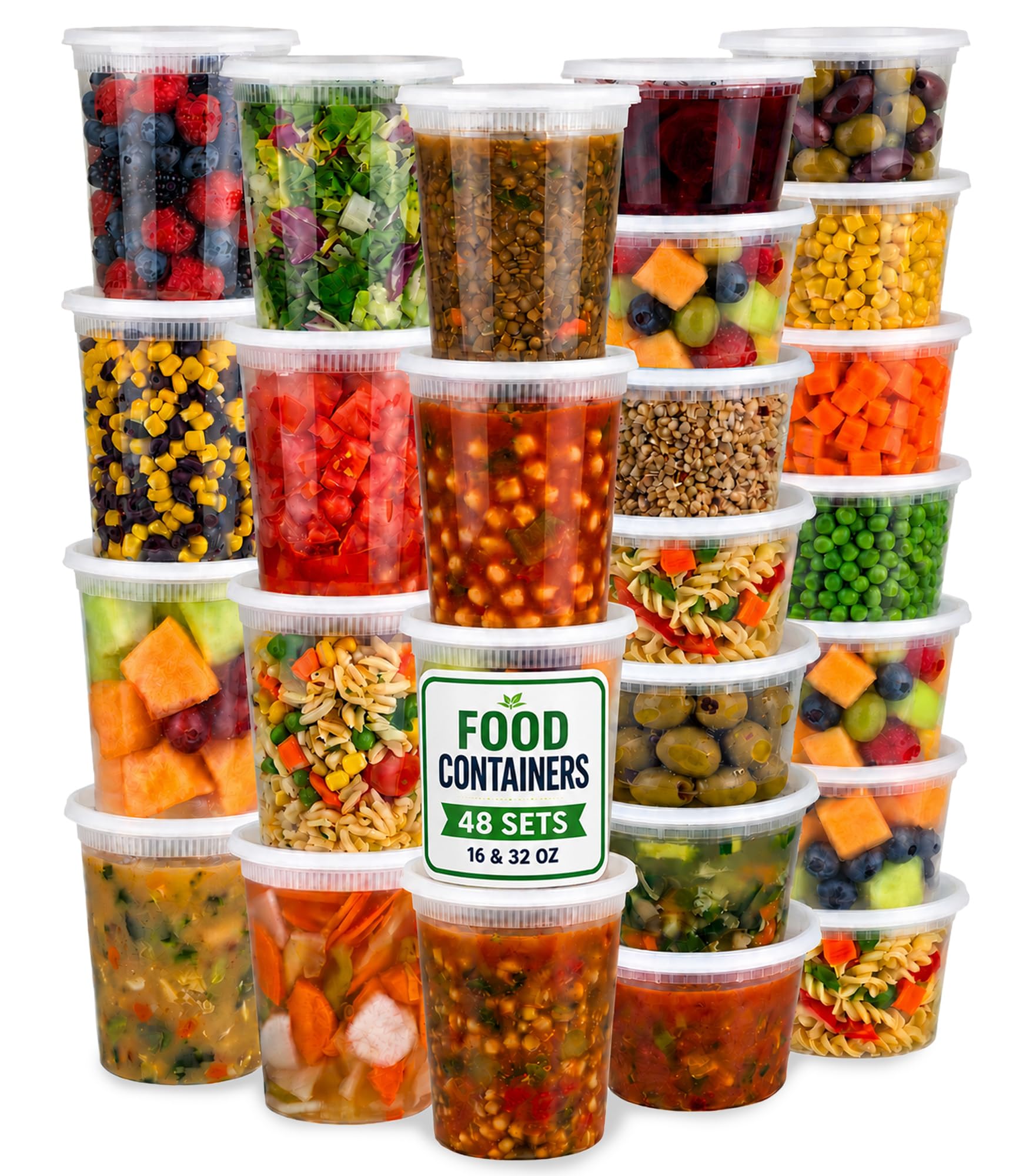
One lid fits all forty-eight containers, and that’s the detail that earns this set its place. Anyone who has stood over a drawer of orphaned lids with soup going cold will get it: take any lid off the stack and it seats on a pint or a quart. The box splits evenly, twenty-four pints for lunches and twenty-four quarts for the batch you’re putting away.
The containers are the standard thin-walled deli type — clear, stackable, fine in the freezer, the microwave and the dishwasher. The lids are the exception: they come off before reheating. We trust the seal on a soup-filled pint riding in a lunch bag, which is the test that matters when soup leaves the house.
Where it gives ground to the top pick is the reheat: the container goes in the microwave, the lid doesn’t, so you need a plate or a bowl at the other end. Forty-eight containers is also a serious amount of cupboard space when empty — nest them inside each other with the lids in a single stack and the set shrinks to something manageable.
Pros
- Any lid fits either size
- 24 pints and 24 quarts in one order
- Seal holds a soup-filled pint in a bag
- Clear, stackable and space-saving
Cons
- Lids must be removed before microwaving
For pints and quarts in one order, we point to JoyServe: one lid fits every container, so nothing gets matched and nothing gets lost.
Best for Freezer-To-Microwave Reheating
Rubbermaid Brilliance 4.7-Cup
Key Features
- Lid: Latched, with built-in vents
- Capacity: 4.7 cups (1.1 L)
- Material: Tritan plastic, BPA-free
- Set size: 2 containers with lids
- Price: Midrange
There’s a small vent under each latch, and it’s the detail that earns these a place in a soup article: latch the lid, open the vents, and a portion reheats without spattering the microwave or needing a plate balanced on top. At 4.7 cups the container is big — roughly four of the one-cup blocks our top pick produces — so it suits a batch you’re spooning into bowls rather than a single lunch.
The Tritan body is as clear as glass and light in the hand. Seal quality is where this one leads the field: the gasket and four latches hold liquid on its side, and we trust it with soup in a work bag more than any snap-lid tub here. It stacks flat, too.
What gives us pause is what a hard freeze does to rigid plastic. A tub that splits leaves soup in the bottom of the freezer, and this is the stiffest, most thoroughly latched container in the group, so it’s the one most exposed to that. If soup moves from freezer to fridge to microwave within a few weeks, the risk stays small; if you freeze the same tub over and over for a year, a flexible mold is the safer buy.
Pros
- Built-in vents let you microwave with the lid on
- Tightest seal in this set for carrying
- Clear as glass but light to carry
- Stacks flat and stays organized
Cons
- Only two containers per pack
- Latches can be stiff to open
For soup that goes from freezer to microwave in the same tub, the Brilliance is the one we trust: a vented latch lid, the tightest seal here, and a clear body.
Best for Budget Portioning
Xomoo Silicone Freezer Trays
Key Features
- Material: Silicone with steel ring
- Fill marks: 125 mL and 250 mL
- Portions per pack: 8 (2 trays)
- Capacity per cavity: 1 cup (250 mL)
- Price: Budget
Two trays, four one-cup cavities each, stainless steel set into the rim — the Xomoo molds are the same format as our top pick. Each cavity carries 125 and 250 mL marks, the lids are flexible silicone rather than rigid plastic, and everything goes in the dishwasher.
This is the version we point people to when a name-brand mold feels like a lot to spend on a freezer accessory. Blocks come out just as cleanly with a push on the base, the steel ring keeps a full tray square on the walk from stove to freezer, and a silicone lid can’t crack the way a rigid one can after a winter in the cold.
What you give up is finish. The trays come in one shade of blue, the silicone feels a touch softer in the hand, and the lids flex enough that we stack these on a shelf rather than bury them under bags of peas. None of that changes how the soup freezes.
Pros
- Same one-cup blocks for less money
- Steel ring keeps a full tray rigid
- Silicone lid has nothing to crack
- Millilitre fill marks on every cavity
Cons
- Sold only as a pair
If the price of the top pick made you hesitate, the Xomoo trays are the ones we point to: same one-cup blocks, same steel rim, and a lid with nothing rigid to crack.
Best for Small Households
AOZITA 32 oz Deli Containers

Key Features
- Care: Freezer, microwave, dishwasher safe
- Shape: Square
- Capacity: 32 fl oz
- Set size: 20 containers with lids
- Price: Budget
Most deli sets here arrive forty or fifty strong, which is more empty plastic than a small kitchen wants to store. AOZITA’s box is twenty quart containers, square rather than round, and that pairing suits a household freezing a few batches at a time and keeping the tubs in a drawer in between.
Square is the practical win: four of these stack in the footprint three round quarts take. The lids press on firmly and stay put, the containers come out of the dishwasher clear rather than wearing a shadow of last month’s tomato soup, and the whole set moves from freezer to microwave without a second dish.
Twenty containers go quickly once you’re freezing a batch a week, and that’s why this sits below the larger sets rather than beside them. As a starter set, or for someone replacing a drawer of warped takeout containers, it’s a sensible first order — add a couple of silicone trays and you have both blocks and quarts covered.
Pros
- Square tubs pack tighter in a drawer
- Twenty containers rather than fifty
- Resists staining from tomato and turmeric
- Freezer, microwave and dishwasher safe
Cons
- Lids take a firm pull to remove
- Single quart size only, no pints
For a two-person kitchen that freezes a few quarts at a time, the AOZITA set is sized right: square tubs, a firm snap lid, and no fifty-container box to store.
Best for Single Servings
Freshware 16 oz Containers

Key Features
- Capacity: 16 fl oz (1 pint)
- Material: BPA-free polypropylene
- Set size: 50 containers with lids
- Warranty: 1 year manufacturer
- Price: Budget
Fifty pints is a supply, not a set. A pint is one generous lunch or two bowls, so this box suits the cook who portions a big pot into single servings and carries one out of the door each morning.
The containers are clear, stack neatly, and handle freezer, microwave and dishwasher without complaint; there’s a one-year manufacturer warranty behind them, which is more than most tubs here carry. The lids are snap-ons that seat properly and hold in a lunch bag.
Lids are also where these give ground. Peel one off by the rim and it can crack; work around the edge a little at a time and the lid survives to be used again. A lid that arrives not quite matching its container is worth setting aside rather than forcing, because a forced lid never seats properly afterwards.
We keep this box as the everyday option and reach for silicone when we want a solid block rather than a tub. Fifty is enough that a cracked lid or a container left at a friend’s house doesn’t end the set, which is the point of buying at this quantity.
Pros
- Fifty pints for everyday single servings
- Freezer to microwave without decanting
- Backed by a one-year manufacturer warranty
- Lids snap on and hold in a bag
Cons
- Only the pint size, in a fifty-count box
If you freeze lunch-sized portions and want a box of them on hand, the Freshware pints do the job and you won’t mourn the ones that never come back.
Best for Stocking Up
DuraHome Deli Container Combo

Key Features
- Care: Top-rack dishwasher safe
- Lids: Interchangeable across all sizes
- Sizes: 8 oz, 16 oz, 32 oz
- Set size: 44 containers with lids
- Price: Midrange
The eight-ounce tubs are the sleeper of this set. A cup of stock, the end of a jar of pasta sauce, a child’s portion of chili — the things that otherwise sit in a quart with too much air around them. Sixteen of them in the box makes this combo more useful than the headline sizes suggest.
Lids are interchangeable across all three sizes, which matters more than it sounds. One stack of lids, one place to look, no matching when you’re filling a dozen tubs at once. The containers themselves are the usual clear polypropylene, fine in the freezer, the microwave and the top rack of the dishwasher.
Where this set asks for care is the plastic itself. A full tub knocked against a freezer shelf while it’s solid can crack rather than flex, so stack these flat and keep them away from the door where things slide. That’s a rigid-container problem generally, and here it’s the price of getting three sizes in one order.
We rate it below the two-size sets overall and above them on range. If you want one order to cover stock, lunch and dinner, this is the one; if you mostly freeze quarts, buy the GUSTO set and skip the sorting.
Pros
- Three sizes including a true eight-ounce tub
- One lid fits every container
- Clear bodies show what’s inside
- Freezer, microwave and top-rack dishwasher safe
Cons
- Lids on some tubs sit high and pop loose
The DuraHome combo suits anyone who wants every size on the shelf: eight-ounce tubs for stock, pints for lunch, quarts for dinner, and one lid that fits all three.
How We Tested Freezer Containers for Soup
We started by gathering containers actually sold for freezing soup, not just general storage, then filtered by capacity, lid style, and whether replacement lids were available. We ruled out anything with a narrow mouth or a lid that looked likely to pop off in a crowded freezer. That left 14 containers and sets, which we tested over four months.
The testing happened in my normal Sunday-to-Thursday rhythm. I made three big batches—minestrone, chicken stock, and split pea—and portioned them while still warm, noting how easy each container was to fill without splashing and whether the lid went on cleanly after I’d wiped the rim. I froze some flat, stacked others upright, and checked fit in the door bin and on a crowded shelf. Every container went through repeat washes, and I opened and closed each lid with dry hands and wet ones to see if the seal caught or fought back.
For the seal test, I filled each container halfway with water, closed it, shook it, and laid it on its side for 10 minutes; then I checked for drips along the rim and under the lid. I also let frozen soup thaw overnight in the fridge and reheated directly in the ones that claimed to be microwave-safe, watching for warping, cracks, or lids that no longer sat flat. Value came down to usable capacity and how the pieces held up after repeated use—extra sizes and sturdy lids counted in a set’s favor; flimsy tabs and lids that only fit one way did not.
How to Choose Containers for Freezing Soup
The container decides how the next dozen lunches go, so choose for the portion you actually eat rather than the size of the pot you cooked.
Portion size comes before everything
Freeze soup in the amount you’ll want to thaw, not the amount you made. A cup is a lunch with bread, or the base of a sauce; a pint is a generous single serving; a quart is dinner for two. That’s why the picks split into molds that turn out fixed one-cup blocks and tubs that hold pints and quarts.
Most freezers want a little of both: blocks for everyday portions, a few quarts for the nights nobody wants to cook. Decide which of those you are before you decide how many containers to buy.
Silicone molds versus rigid tubs
Silicone releases a solid block and doesn’t turn brittle in the cold; rigid tubs stack, show you what’s inside, and survive being carried. The trade runs both ways. A mold only occupies freezer space while the soup is setting — after that the blocks go into a bag — but a full silicone tray is floppy and wants a level shelf until it’s solid, which is why we fill ours on a sheet pan.
Rigid tubs are the opposite: stable and stackable, but a hard freeze plus a knock can split one, and lids crack before bodies do. If you freeze the same container week after week, silicone lasts longer.
Lids, seals and reheating
Leakproof matters most if soup leaves the house. Snap lids on deli tubs hold liquid in a bag but are usually the part that fails, and many aren’t rated for the microwave — the container is, the lid isn’t. A latched lid with a gasket is the better answer for carrying and reheating, particularly where the maker builds in a vent, as Rubbermaid does here.
Whichever set you buy, keep a marker or a roll of tape nearby. A freezer full of unlabeled containers is a freezer full of mystery.
Buy for your biggest batch, then add
Count what one pot makes before you order. A gallon of soup is sixteen cups, so a single large batch fills two silicone trays exactly, or four quarts. Buying forty containers for a household that cooks once a month leaves a lot of plastic sitting in a cupboard.
Sets with interchangeable lids, like the JoyServe and DuraHome boxes here, are easier to live with as they grow, because a lost lid doesn’t retire a container.
Frequently Asked Questions
Do I need to thaw frozen soup before reheating it?
No. Drop the block into a saucepan over low heat with a splash of water, cover it, and break it up as it loosens, or microwave it in a covered bowl and stir once halfway through. A block actually thaws faster than a full tub, because there’s no container insulating the middle.
How do I get a portion out of a silicone tray cleanly?
Wait until it’s fully solid — a half-frozen block tears. Then push up on the base of each cavity and let the block fall into your hand or onto a board. Running warm water over the underside helps if one is sticking, and don’t lever with a knife: the steel rim protects the tray’s shape, not the silicone walls.
Can hot soup go straight into the freezer?
Cool it first, uncovered, until it stops steaming, then lid it and freeze. A sealed hot container traps steam that condenses and freezes into a sheet of ice on the lid, and it warms everything around it on the shelf. If you’re in a hurry, stand the container in a bowl of cold water and stir.
Final Verdict
The Souper Cubes trays are what we tell most people to buy. Eight one-cup blocks per batch, fill lines that keep portions even, and a release that needs no knife and no thaw — they cost the most per cup here and still earn it, because these are the portions people actually eat.
Change the requirement and the answer moves. If soup goes out the door to family and friends, buy the GUSTO quarts and don’t expect the containers back. If the silicone format is right but the price isn’t, the Xomoo trays do the same job for less.