This post contains affiliate links. We may earn a small commission when you buy through our links — at no extra cost to you.
There is a specific disappointment in pulling last month’s chili out of the freezer and finding it wearing a jacket of ice, or in lifting a lid and spotting a hairline crack that wasn’t there when you packed it away. A good plastic freezer container is meant to do three jobs at once: keep air off your food, stack into something you can actually dig through, and survive the trip from freezer to microwave without warping or staining. The flimsy ones fail at least one of those, usually the seal.
I’ve kept 14 containers in near-constant rotation for the past eight months, and the gap between one that splits at the corner and one that doesn’t comes down to wall thickness and how positively the lid seats. Here’s something nobody tells a first-time freezer cook: square and rectangular containers waste far less space than round ones, and a wide, flat lid freezes food faster than a deep, narrow tub. The picks below earned their shelf space; a few others went straight to the recycling bin.
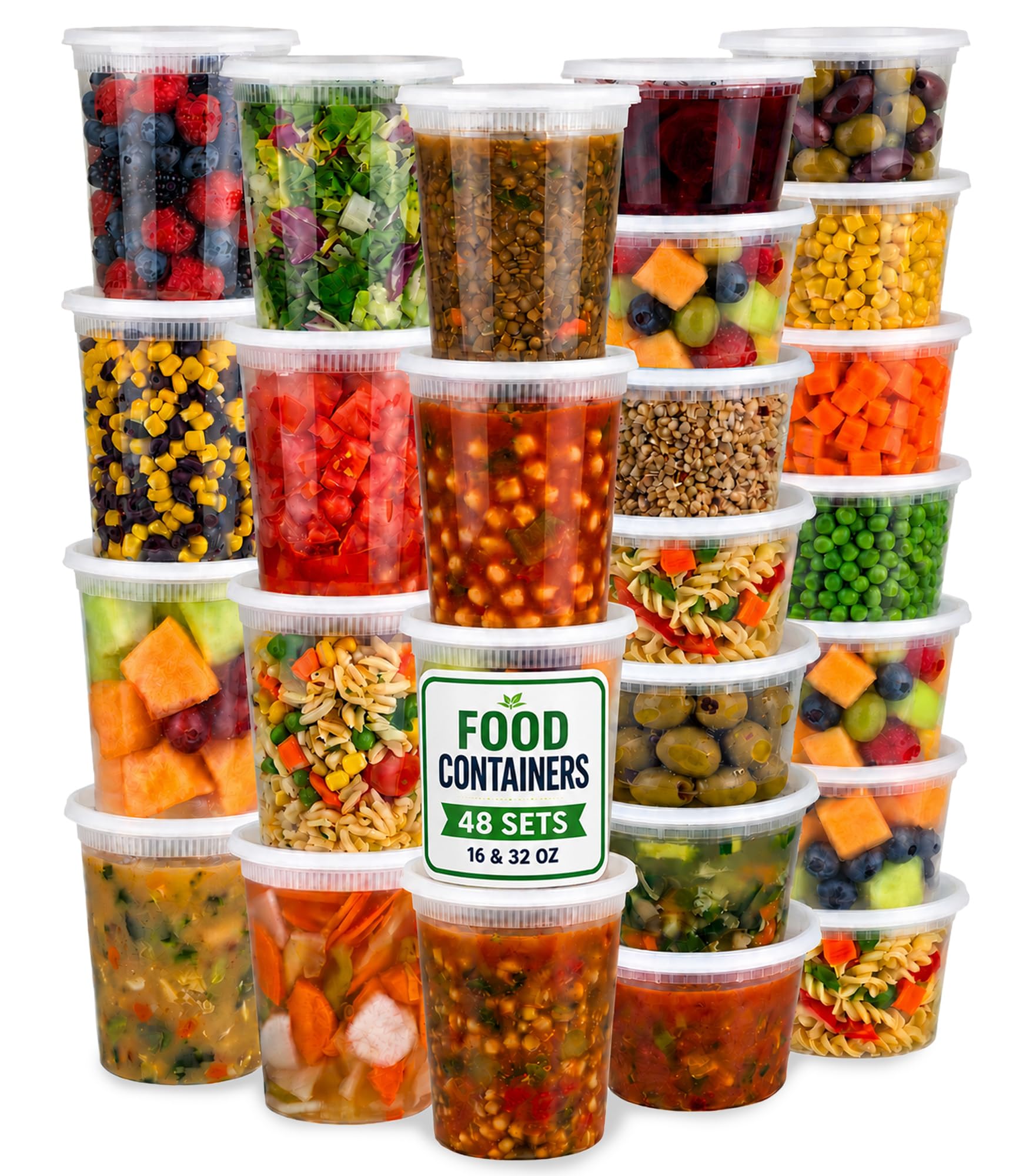


Best for Everyday Freezer Storage
JoyServe Deli Containers 48-Set
Key Features
- Sizes: 24 × 16 oz and 24 × 32 oz
- Lid Type: One-size snap lids, interchangeable
- Microwave: Container only, not the lid
- Set Count: 48 containers with lids
- Price: Midrange
One lid fits every container in this set, and that is the reason it is our top pick. The 16-ounce pints and the 32-ounce quarts take the same snap-on top, so a missing lid never sidelines a container and you never end up with a drawer of almost-fits. After a few weeks of grabbing whichever one was clean, the lids stopped registering at all, which is the best thing we can say about a lid.
The split is the other half of it: twenty-four pints and twenty-four quarts in one box is enough to put up a stockpot of chili in quarts and single servings in pints without buying two products. Both sizes are built for the freezer and the dishwasher, and the containers are microwave safe while the lids are not, so pull the top and cover the food with a paper towel to vent it.
Sealing has held up to everything we have put in them. Soup, sauce, and a batch of dal went into the freezer and came out without frost creeping under the lid or a puddle in a work bag. The tubs stack into a column that stays put, though the round shape leaves visible gaps between containers, so a packed drawer holds less than it would with rectangles.
If freezer space is genuinely tight, that round profile is the argument against this set, and the Kitch’nMore boxes nest closer together. For everyone else this is the pack to buy first: the sizes cover real cooking, and the shared lid is the detail you will appreciate every time you open the drawer.
Pros
- One lid size fits both pints and quarts
- 24 pints and 24 quarts in a single box
- Freezer, microwave and dishwasher safe
- Snap lids have held soup without leaks
Cons
- Round tubs leave gaps in a packed freezer
We recommend the JoyServe set to anyone stocking a freezer: two useful sizes, one lid that fits both, and a seal we trust with soup.
Best for Soup and Stock
Reditainer Extreme Freeze 24-Pack
Key Features
- Count: 24-pack
- Capacity: 32 fl oz (quart)
- Dimensions: 5.55 in tall, 4.55 in top
- Freezer Rating: -40°F for extended periods
- Price: Midrange
Reditainer puts a number on the box that most of this category avoids: rated to -40°F for extended periods, in heavy-gauge polypropylene. For a freezer container that is the right thing to lead with, because the failure we care about is a tub that goes brittle in the cold and splits when a bag of peas shifts against it.
These are the quarts we reach for when a pot of stock needs somewhere to go. Four cups is about two generous bowls of soup, the lids press down flat and stay seated, and the round tubs stack into a column that fits a shelf edge or a door bin. Nothing has leaked on us yet, and the plastic still feels stiff rather than chalky after repeated trips through the freezer.
What you give up is choice. There is one size here and it is the quart, so a single portion of sauce or one serving of chili ends up in a big tub or in something else entirely. Buy this pack when your freezer is mostly soup, stock, and batch cooking; the JoyServe set covers both sizes for about the same money when your portions vary.
Pros
- Explicit -40°F rating for extended freezing
- Heavy-gauge walls that stay stiff in the cold
- Tight snap lids that hold through stacking
- Microwaveable and dishwasher safe
Cons
- One size only, the 32-ounce quart
If your freezer is mostly soup and stock, these heavy-gauge quarts with a stated -40°F rating are the ones we trust to come out intact.
Best for Reusable Daily Set
Rubbermaid EasyStore 18-Piece
Key Features
- Set: 18 pieces (9 containers, 9 lids)
- Lids: Vented flip-top, interlocking
- Material: BPA-free plastic, microwave safe
- Capacity Range: 0.77 to 14.9 cups
- Price: Midrange
Some freezer containers are meant to leave the house and never come back. The EasyStore set is the other kind: nine lidded pieces you wash, stack, and reach for every week, from a 0.77-cup dip cup up to a 14.9-cup tub that swallows a whole batch of stew.
The details are what earn it a place. Each lid has a small flip vent for the microwave, the ridged tops interlock so a stack stays a stack instead of sliding apart, and the extended lip gives you something to hold when the container comes out of the freezer slick with condensation. All of it is dishwasher safe and BPA free.
As the reusable core of a freezer setup, this is the set we point people to. The pieces go from freezer to microwave to dishwasher without being babied, and the vent means leftovers reheat without splattering the inside of the microwave, which is a small thing that happens four times a week. It sits alongside a cheap bulk pack rather than replacing one.
Pros
- Nine sizes from 0.77 to 14.9 cups
- Vented lids make microwave reheating easy
- Ridged lids interlock for stable stacking
- Dishwasher safe and BPA free
Cons
- Four of the nine containers are 0.77-cup cups
This is the set to buy for the containers you keep: nine stackable pieces from snack size to 14.9 cups, with vented lids for reheating.
Best for Liquids and Lunches
Ziploc Twist N Loc, 6-Count
Key Features
- Count: 6 containers with lids
- Closure: Twist-and-lock screw lid
- Freezer Use: Freezer, microwave and dishwasher safe
- Listed Capacity: 4 cups each
- Price: Budget
Six containers is not a freezer system, and Ziploc does not pretend otherwise. What these are is the best answer here for anything that sloshes: the lid screws on rather than snapping, and a screw thread is far harder to knock loose when a bag tips over on the passenger seat.
Broth, overnight oats, and a batch of tomato sauce all went in and came back out where we left them. The half-turn to open and close is quick enough that the screw lid never becomes a chore, the wide mouth makes filling from a ladle easy, and there is no gasket to lose or scrub around.
The listed capacity is 4 cups apiece, which is right for soup for two and generous for a single serving of sauce, and six jars will not get you through a serious batch-cooking weekend. Buy this pack for the liquids and the lunches you carry; buy a bulk deli set for the volume you stack.
Pros
- Screw lid resists popping open in a bag
- Wide mouth is easy to fill and clean
- Freezer, microwave and dishwasher safe
- Stacks neatly in a small footprint
Cons
- Only six containers per pack
- Leak resistant rather than guaranteed leakproof
Six containers won’t stock a freezer, but for broth and soup that travel, the screw lid makes this the pick we reach for.
Best for Large Single Portions
Kitch’nMore 38 oz, 30-Pack
Key Features
- Count: 30-pack
- Capacity: 38 fl oz
- Dimensions: 8.9 × 6.1 × 2 in
- Compartments: 1
- Price: Premium
At 38 ounces and roughly nine by six inches, one of these boxes holds a full dinner — a chicken breast, a scoop of rice, a pile of vegetables — without stacking food in layers. That is the size we reach for on a Sunday when a week of lunches goes into the freezer in one go.
The plastic is thicker than the price suggests, and the rim, which is the part that fails first on boxes like this, has held. The lid snaps down with a firm press rather than a fight. The black body also hides the tomato and curry stains that leave clear containers looking tired after a month.
Thirty boxes is enough for a month of weekday lunches with spares left over, and they are microwave, dishwasher, and freezer safe. They also stack flat, which matters when thirty of anything moves into your kitchen at once. For portioned dinners rather than soup, this is the whole job done.
Pros
- 38-ounce single compartment holds a full meal
- Thick walls that resist cracking
- Black body hides stains
- Thirty boxes at a sensible per-container cost
Cons
- No vent in the lid
- Single compartment only
When a portion means a whole dinner, these thick 38-ounce boxes hold up, hide stains, and stack flat.
Best for Small Airtight Portions
Snapware Total Solution 5-Pack
Key Features
- Set: 5 containers and 5 lids
- Lids: Four locking tabs, write-on panel
- Capacity: 3 cups each
- Dimensions: 6.75 × 4.75 × 2.25 in
- Price: Budget
Snapware molds a write-and-erase panel into each lid, so a stack in the freezer is labeled on top where you can actually read it. It sounds like a novelty until you are standing in front of five identical containers trying to work out which one is the chili.
The lid is the other half of the design: four locking tabs, one per side, that pull the top down flat and keep it there. Turned upside down full of soup, nothing came out, and the 3-cup rectangular footprint stacks with almost no wasted height in a crowded drawer.
Five containers is a small set, and it is the one we recommend when the job is portions rather than volume: a serving of pasta, a chopped salad, a piece of fish set aside to thaw for dinner. The tabs snap with a positive click and release without a fight, which matters more than it sounds when you are opening four of them at once.
Pros
- Write-and-erase panel built into each lid
- Four locking tabs hold a firm, leakproof seal
- Slim 3-cup rectangles stack flat
- Freezer and microwave safe, easy for weaker hands
Cons
- Only five containers, all 3 cups
- Top-rack dishwasher only
Five airtight, labelable containers make this the set we grab for portions, and the write-on lids earn their keep every week.
Best for Clear Leakproof Carry
Rubbermaid Brilliance 5-Set

Key Features
- Set: 10 pieces (5 containers, 5 lids)
- Lids: Airtight clip latches, built-in vent
- Capacity: 3.2 cups each
- Material: Tritan plastic, stain and odor resistant
- Price: Premium
This is the most expensive set on the page, and what the money buys is visibility: crystal-clear Tritan, a lid that clips down on all four sides, and a built-in vent you can crack open for the microwave without taking the top off.
In use, that combination is genuinely pleasant. You can see whether the sauce has separated without opening anything, the latches press down with a satisfying snap, and Tritan resists the staining and odors that cheaper polypropylene picks up, so a red sauce container still looks clear weeks later.
Treat it as a fridge and lunchbox container first. It is the set that carries soup to work and comes back clean, not the one that holds a year of stock in the bottom of the freezer, and buying it in quantity to do that job would be spending in the wrong place.
For carrying lunch, seeing exactly what is in the box, and keeping a fridge shelf that looks the way you want it to, the premium is worth paying and this is the set we reach for. For stocking a freezer, the money goes further elsewhere.
Pros
- Crystal-clear Tritan shows contents at a glance
- Airtight clip latches with a built-in vent
- Stackable and dishwasher safe
Cons
- Can crack after repeated use
- Lid can be stiff for weaker hands
Spend the premium if you want to see what you’re storing: the clearest, most airtight container here, best kept for fridge and lunch duty.
Best for Bulk Single Portions
Freshware 16 oz, 50-Set

Key Features
- Lids: Snap-on, leakproof
- Count: 50 sets
- Capacity: 16 fl oz (pint)
- Material: BPA-free polypropylene
- Price: Budget
Fifty pint containers for about what a five-piece reusable set costs is the whole proposition, and it is a good one when your freezer holds single portions and your leftovers regularly leave the house in someone else’s hands.
A pint is the right size for one serving of soup or chili, the snap lid presses on flat, and the smooth top gives you somewhere to write a date. Stacked, they make a tidy column you can see through, which is more than you can say for the foil and freezer bags they replace.
Thin plastic gets brittle in a deep freeze, so a frozen pint that gets knocked against a shelf edge can split. Ours have survived a normal amount of shuffling because we stack them and leave them alone; treat them as containers that live in the freezer rather than ones that travel to a cookout.
Buy the pack as a stash rather than an heirloom: use them, wash them a few times, and let them go when they cloud over or a lid stops seating. For the freezer work you actually care about, the JoyServe or Reditainer containers will outlast them by a wide margin.
Pros
- Fifty pints at a give-away price
- Right size for a single serving
- Snap lids seal tightly for the first few uses
Cons
- Lids can arrive mismatched or fit poorly
Buy this pack as a stash for single portions and give-aways, not as the containers you plan to keep.
How We Tested the Best Plastic Freezer Containers
We built the shortlist by gathering every plastic freezer container sold on its own or in sets of four or more, then filtering on the specs that matter before anything was filled: capacity in cups, the temperature range the manufacturer claims, whether the lid vents, and whether both pieces are marked microwave and dishwasher safe. Containers with thin, flexible walls or lids that only clip at two points were set aside. That left 14 containers, ranging from grocery-store standbys to smaller brands, and we spent eight months living with them.
Most of the testing happened on Sunday afternoons during batch cooking. We filled each container with two cups of broth, sealed it, turned it upside down, and shook it over the sink for a full minute before freezing, then stacked them four high for a week and checked for drips, bowed lids, and freezer burn along the food line. One container in each set spent three weeks holding tomato sauce to see whether it came out stained or holding onto last night’s curry.
For durability, we dropped frozen blocks from counter height onto a cutting board and ran the lids through the dishwasher on repeat, noting which ones came out warped or stopped snapping shut. Ease of use got tested the way it actually happens: we opened every lid with wet hands and again with oiled hands, since greasy fingers on a cold lid are where lid accessibility really falls apart. We also weighed size against the space each one ate up, and divided price by usable capacity to see which sets were genuine value and which were just cheap.
How to Choose Plastic Freezer Containers
Freezer containers rarely fail in the middle; they fail at the lid or the rim, which is why the seal and the way the plastic behaves in deep cold matter more than the shape on the shelf.
Start with the sizes you actually freeze
Most kitchens end up with a drawer of small containers and nothing big enough for a pot of stock. Think about what actually leaves your stove: single servings of soup and chili want pints, a stockpot or a tray of sauce wants quarts, and a household that batch-cooks wants both. A pack that covers two sizes is worth more than fifty of one, which is why the JoyServe set with its 24 pints and 24 quarts is the one we hand most people first.
Shape is the second decision. Round tubs stack into stable columns and are easy to fill from a ladle; square and rectangular containers fill a shelf with less dead air. If your freezer is a pull-out drawer rather than a shelf, check the depth before you buy anything tall.
Cold makes plastic brittle, so check the freezer rating
Freezer safe is a low bar, because nearly everything in this category claims it. The listings that say something more useful name a temperature: the Reditainer quarts are rated to -40°F for extended periods, and the Freshware pints list a working range down to -40°F. Where no figure appears, judge by wall thickness and by how the rim is molded, since thin rims with a sharp angle are where splits begin.
No plastic tub enjoys a fall in a freezer, and even a heavy-gauge one can crack if it lands on a corner. Treat a frozen container the way you treat a bag of frozen peas and most of this stops mattering.
Snap lids, screw lids, and locking tabs
Snap lids are the freezer default: fast to seat, flat to stack, and easy to work with cold hands. They hold solid food through a tipped-over tub better than they hold thin liquid. Screw lids, like the ones on the Ziploc Twist N Loc, trade a little speed for security, because a thread will not pop off in a bag — which makes them the right container for broth, overnight oats, and anything that rides in a backpack.
Locking-tab lids, like the four-tab design on the Snapware set, pull the top down on every side and hold a firmer seal at the cost of a little more effort each time you open one. Match the closure to whether the container stays home or leaves with you.
Stacking, labeling, and the orphaned lid problem
Every kitchen accumulates a bag of lids with no containers. A set where one lid fits several sizes solves it: the JoyServe lids seat on both its pint and its quart, so losing one costs you a lid rather than a container. Flat lids with a recessed center also stack more stably than domed ones, which matters once the freezer gets full.
Labeling is more important in a freezer than in a fridge, because frost hides everything. A write-on panel, as on the Snapware lids, or a marker across a smooth top is enough. Keep the marker in the freezer rather than the utensil drawer, or you will stop using it by the second week.
Frequently Asked Questions
Can you microwave food in a plastic freezer container?
Yes, if the container is rated microwave safe, which every pick here is. Check the lid separately: the JoyServe containers are microwave safe but their lids are not, so pull the top or crack a vent if the lid has one. Thawing overnight first gives you faster, more even reheating than going straight from frozen.
How much headspace should you leave when freezing soup or stock?
Leave about an inch in a quart container and half an inch in a pint. Liquid expands as it freezes, and a brim-full tub will either push its lid or split at the seam. Cool soup to room temperature before you lid it, and freeze it uncovered for an hour if you want a flat surface to stack on.
Are these containers reusable, or should you treat them as disposable?
Most are reusable for many cycles. Heavy-gauge sets like the Reditainer quarts and the Rubbermaid containers are built for repeat trips; the bulk deli packs can be washed and refilled too, but the walls cloud and thin with each run through the dishwasher. Retire any container with a crack, a cloudy patch, or a lid that no longer seats flat.
Can you freeze food in takeout deli containers?
Often, once or twice. Turn the tub over and look for a 5 or PP recycling mark, since polypropylene handles freezing far better than the thin clear plastic that cold takeout sometimes arrives in. Takeout containers have thinner walls than purpose-made freezer tubs, so they are fine for a week or two of storage but tend to split at the rim after a few cycles.
Final Verdict
The JoyServe 48-set is what we tell most people to buy: two sizes that match how people actually cook, one lid that fits both, and a seal that has held everything we have frozen in it. If your freezer is mostly stock, soup, and chili, the heavier Reditainer quarts are the safer bet in deep cold. And if the container travels in a bag, the Ziploc Twist N Loc is the one that stays shut.