This post contains affiliate links. We may earn a small commission when you buy through our links — at no extra cost to you.
A good meal prep container has one job: make the lunch you packed at 7 a.m. still look appetizing at noon. I have opened too many bags to find a lid popped open and dressing pooling in the bottom, and I have tossed containers that stained, warped, or refused to close after a few washes. The right set fixes that: it holds a sensible portion, seals tightly enough to travel, and survives the freezer, microwave, and dishwasher. Over four months, we tested 16 container sets to find the ones worth keeping.
Portion control is as much about container size as willpower. A too-large container invites extra scoops; a too-small one sends you back for a second lunch. We looked for readable capacity markings, compartments that keep wet and dry foods apart, and lids you can open without a pry bar. Value mattered, too: a cheap set that leaks or cracks is no bargain. The picks below are the ones we kept reaching for after the novelty wore off.



Best for Entrée and Side
Rubbermaid Brilliance 2-Compartment
Key Features
- Capacity: 2.85 cups
- Leakproof: Airtight latch lid
- Pack size: 5 containers
- Compartments: 2
- Price: Premium
The Brilliance tray is a 2.85-cup rectangle split into two compartments, which maps neatly onto an entrée and a side. Clear bases show the split before you fill it, and the lid uses latches plus a silicone gasket rather than a press-on rim. At 4.5 by 6.5 by 2.5 inches, it stacks without hogging a shelf, and the same-size lids interchange across the Brilliance line.
That layout is why it earns our top recommendation. The compartments do the portioning for you: fill the larger side with protein or vegetables, the smaller with rice, and you can see whether lunch is getting carb-heavy before it goes into the bag. The lid also has built-in vents, so you can microwave with it on and the latches open instead of hunting for a splatter cover.
Leakproof performance is the other reason it leads this set. The latches clamp down firmly, and Rubbermaid rates the seal airtight and leakproof; in a lunch bag, that is the difference between dressing staying on salad and dressing meeting your notebook. The firm seal takes a deliberate pull to open, which is worth knowing if hand strength is limited. Five containers cover one person’s workweek; two-person households will want a second set or a larger pack.
Pros
- Two compartments simplify entrée and side portions
- Airtight latch lid handles commute leaks
- Vented lid reheats without splatter
- Stacks neatly and lids interchange
Cons
- Plastic can crack with rough handling
For most people, the Brilliance two-compartment set is the one we recommend: it makes an entrée-plus-side portion obvious and seals securely enough for a commute.
Best for Measured Lunches
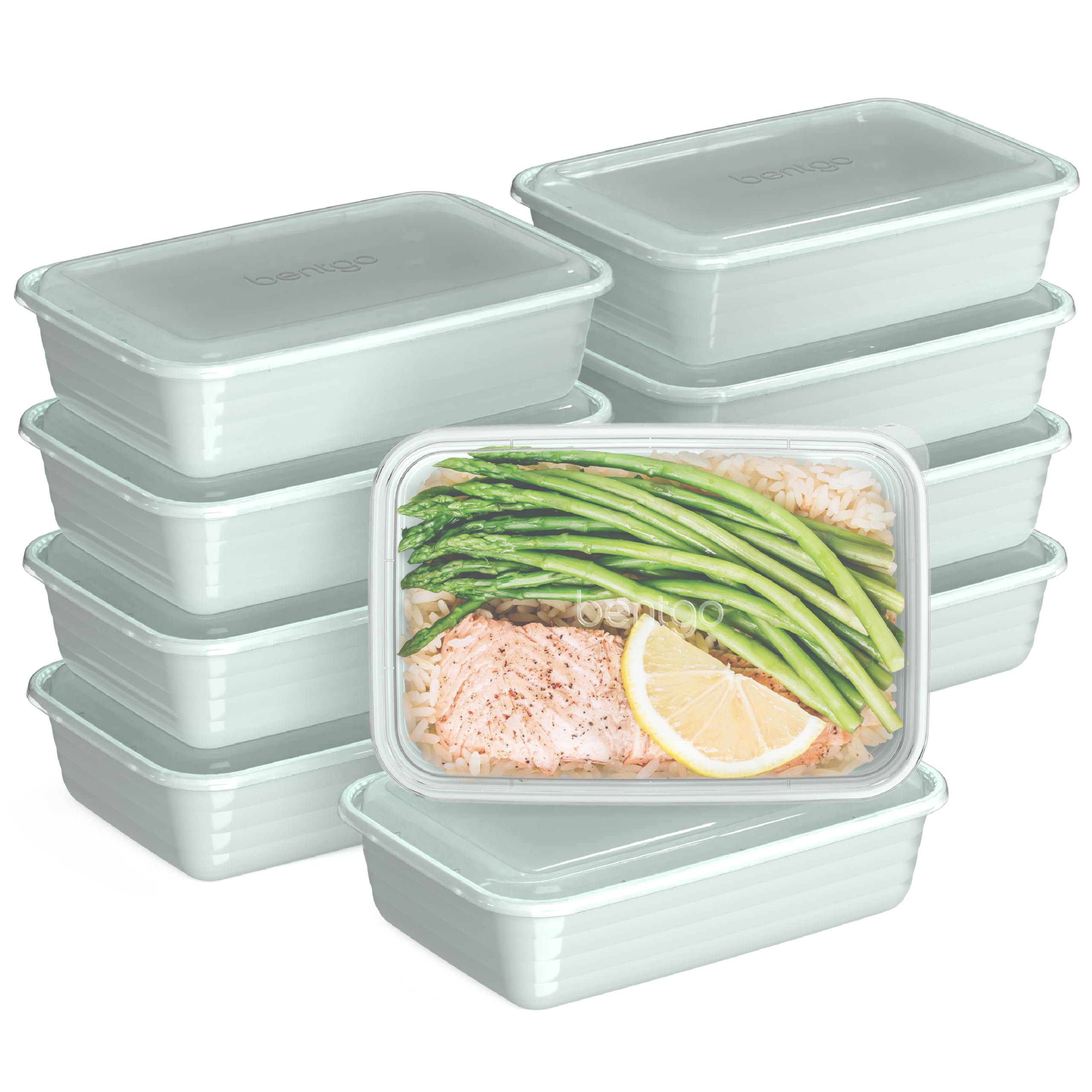
Bentgo Prep 20-Piece
Key Features
- Capacity: 4 cups
- Material: PFAS- and BPA-free
- Pack size: 10 trays + 10 lids
- Portion marks: Embossed measurements
- Price: Budget
Four cups is a generous lunch, and Bentgo molds measurement marks into the side of each tray. That combination makes it our budget pick: you can see a two-cup grain base and a two-cup stir-fry without guessing, and the 20-piece set gives you ten trays and ten lids. The trays stack when full or empty.
The material is PFAS- and BPA-free, the lids snap on securely enough for upright transport, and the rectangular shape fits a work bag without much wasted air. We also appreciate the mint finish; a fridge full of matching containers is easier to face on a Wednesday. The snap lids are simple to press on and pull off, which matters when you are packing five lunches in a row.
The trays are not the ones we reach for when lunch is saucy. The lid keeps food in when the container stays upright, but it is not a leakproof seal for soup or a loose dressing; pack those in a glass set or a dedicated leakproof container. For portioned grain bowls, salads, and leftovers that stay flat in a bag, the value is hard to beat.
Pros
- Embossed measurements make portions visible
- Ten trays cover a week of lunches
- PFAS- and BPA-free material
- Stacks neatly in fridge or bag
Cons
- Lids can crack if pried from one corner
Our budget pick is Bentgo Prep, because the embossed 4-cup trays make a generous lunch easy to measure without spending much.
Best for Mixed Portions
C CREST Glass 10-Pack
Key Features
- Material: Borosilicate glass
- Oven safe: Up to 700°F
- Pack size: 10 containers
- Capacities: 12 oz and 34 oz
- Price: Midrange
C CREST’s box mixes five 12-ounce containers with five 34-ounce ones. That is a more useful assortment than ten identical trays: the small ones suit yogurt, cut fruit, or a measured snack, while the large ones hold a full lunch or leftovers. The bodies are borosilicate glass, oven-safe up to 700°F, and the lids are plastic snap-locks with silicone gaskets.
Glass also shrugs off tomato sauce and curry in a way plastic does not, which matters if you reheat the same chili every week. The clear sides let you see the amount before the lid goes on, and the containers nest when empty. This is a set for someone who wants one box to handle both a side and a main meal.
That mix is why we recommend it for anyone who wants one glass set to cover snacks and full meals. The gasket is the part to watch. It can work loose from its channel, especially if the lid is washed roughly, and a gasket that sits twisted will not seal; we hand-wash the lids and press the silicone flat before snapping them on. If you only pack lunch, ten large containers would be more efficient; the small five are what make this set useful beyond the midday meal.
Pros
- Two useful glass sizes in one set
- Oven-safe up to 700°F
- Doesn’t stain or hold curry odors
- Nests and stacks for storage
Cons
- Heavy for a long commute
Choose the C CREST glass set if you want two useful portion sizes and oven-safe glass; we think the mixed-size pack earns its shelf space.
Best for Simple Single Portions
M MCIRCO Glass 10-Pack
Key Features
- Capacity: 22 oz
- Material: Borosilicate glass
- Pack size: 10 containers
- Compartments: 1
- Price: Midrange
A 22-ounce single compartment is the no-decision version of meal prep: one lid, one space, one portion. MCIRCO’s set gives you ten of them, each about 6.7 by 4.9 by 2.1 inches, with borosilicate glass and snap-lock lids.
This is the glass set we reach for when the meal is already mixed—chili, grain bowl, leftovers—and compartments would only get in the way. The shallow rectangular shape reheats evenly and stacks three high in the fridge. Ten containers cover a workweek plus a couple of freezer backups, and the glass does not pick up tomato stains the way plastic can.
The lid is the fussy part. The snap locks need to be pressed down in order, and the silicone seal can work loose if it is not seated properly; a lid that looks closed can still leak at one corner. We run a thumb around the gasket before packing anything with liquid, which is a five-second habit.
We recommend the set for anyone who wants plain 22-ounce glass portions and does not want to negotiate compartments. The capacity is the real limit: it suits a lunch or a moderate dinner, not a piled-high plate.
Pros
- Ten 22-ounce single portions
- Borosilicate glass resists stains
- Shallow shape stacks and reheats evenly
- Simple one-compartment packing
Cons
- Glass is heavy to carry all day
The MCIRCO 10-pack is our pick for plain 22-ounce glass portions—one lid, one compartment, and no guesswork.
Best for Bulk Weekly Prep
Ezalia 15-Pack
Key Features
- Reuse: Up to 20 times
- Capacity: 32 oz
- Pack size: 15 containers
- Compartments: 1
- Price: Budget
The Ezalia set does not pretend to be a forever container: 15 black 32-ounce trays with snap lids, sold as reusable for up to 20 cycles. The straight-sided shape stacks neatly in the fridge, and the 32-ounce capacity is big enough for a full plate of protein, rice, and vegetables.
The lids press on with a firm snap once you seat the first corner and work around the rim, and the seal holds for upright transport. The black plastic hides stains better than clear trays, and the whole set is light enough to carry without feeling precious. Fifteen containers also means you can prep for two people or build a small freezer stash without washing every night.
We recommend the set for bulk weekly prep on a tight budget. The trade-off is lifespan: this is a season-of-lunches set, not a permanent kitchen upgrade, and the plastic is thin enough that rough handling matters. That is fine if you want a big rotation or pack for kids who lose containers; it is less appealing if you want five boxes you will still be using in five years. For a two-person prep, fifteen containers split neatly between fridge and freezer.
Pros
- Fifteen 32-ounce trays for bulk prep
- Light and easy to stack
- BPA-free and microwave-safe construction
- Low cost per container
Cons
- Lids crack before the trays do
We point budget-minded weekly preppers to Ezalia’s 15-pack: big 32-ounce trays, light plastic, and a lifespan best measured in seasons.
Best for Separate Solid Sides
FIT Strong & Healthy Glass 4-Pack
Key Features
- Capacity: 32 oz
- Oven safe: Up to 450°F
- Pack size: 4 containers
- Compartments: 2 and 3
- Price: Premium
A glass container with two or three compartments sounds like the ideal portion-control tool until you tilt it. This FIT Strong & Healthy set includes two 2-compartment and two 3-compartment 32-ounce trays, with borosilicate glass oven-safe to 450°F with the lid off. The sections are molded into the tray rather than removable inserts.
The sections are generous, not token dips, and the glass does not stain or retain curry smell. A 3-compartment tray gives you a protein, a starch, and a vegetable in defined spaces; the clear lid shows the layout before lunch. The snap-lock lid contains the whole tray, but the dividers stop below the lid.
That gap is why we keep this set for solid plates. A saucy curry in one section can migrate into the rice if the container rides on its side, so keep it flat or use a single-compartment container for the wet component. For roasted vegetables, sliced meat, and grains, the built-in sections do the portioning without extra inserts.
We recommend it when portioning by food group matters and the meal goes into the oven. It is the best compartmented glass option in this set for generous sides, as long as you do not expect the dividers to act as a leakproof wall. Once the sauce comes out, the single-compartment glass picks are easier to live with.
Pros
- Two- and three-compartment glass trays
- Oven-safe borosilicate up to 450°F
- Generous sections for full sides
- Glass resists stains and odors
Cons
- Lid clasps can chip if forced
For a glass container that portions by food group, we choose the FIT Strong & Healthy four-pack; its 2- and 3-compartment trays keep solid sides apart and go into the oven.
Best for Flexible Family Lunches
FIT Strong & Healthy Bento 3-Pack

Key Features
- Capacity: 39 oz
- Material: BPA-free polypropylene
- Pack size: 3 containers
- Compartments: 3, removable
- Price: Midrange
The useful trick in these bento boxes is that the dividers come out. Each 39-ounce box arrives with a two-piece insert—one single section and one split into two—so you can turn a three-compartment lunch into a single open tray, or mix the layout to suit the meal.
We recommend them for households packing different lunches for different people. A 39-ounce box is big for a kindergartner but useful for an adult who wants a sandwich, fruit, and a side in one container; the inserts keep wet fruit away from crackers, and the snap lid is easy enough for a child to open with guidance. The BPA-free plastic is also light and dishwasher-safe.
The size is also the catch: a 39-ounce box is oversized for a modest portion, and a fully packed one is heavy for a small lunch bag. For portion control, this is less about exact measurement than about giving each food a place; that suits families and bento-style eaters better than someone counting every half-cup. It is the set we hand to someone who wants lunch to feel assembled, not scooped.
Pros
- Removable inserts change the layout
- Three 39-ounce boxes for family lunches
- BPA-free plastic is dishwasher-safe
- Easy for kids to open with guidance
Cons
- Inserts do not seal between sections
Families who want one container to adapt to different lunches get our nod with the FIT bento boxes, whose removable inserts make 39 ounces flexible.
Best for Large Single Portions
KOMUEE Glass 10-Pack

Key Features
- Capacity: 30 oz
- Material: Borosilicate glass
- Pack size: 10 containers
- Compartments: 1
- Price: Premium
Thirty ounces is closer to a dinner plate than a snack box. KOMUEE puts that capacity into a single rectangular glass container, ten to a set, with snap-lock lids and a borosilicate body that goes from freezer to oven. We recommend it for people whose portions are built on volume—big salads, roasted vegetables, a full burrito bowl—rather than a protein-and-side split.
The extra width lets you spread food in a shallow layer, which reheats more evenly than a deep, crowded box, and the glass wipes clean without holding onto sauce color. It is also the simplest large-portion glass option here: no compartments to negotiate, no second lid.
The lids are less certain. The silicone seal can shift, and the snap locks need to be seated evenly or one side will pop; we check the rim before putting the container in a bag. If you want a large, single-portion glass lunch and mostly eat at a desk, it earns its place; for smaller portions, the MCIRCO set is easier to live with.
Pros
- Large 30-ounce single portion
- Oven, microwave, freezer, dishwasher safe
- Shallow layer reheats evenly
- Simple one-compartment packing routine
Cons
- Heavy and bulky to carry
KOMUEE’s 30-ounce glass set is our choice for people who eat meal-sized salads or big bowls and want a single large compartment.
How We Tested the Best Meal Prep Containers for Portion Control
We started by pulling together container sets designed for single-portion lunches rather than bulk storage, then filtered out anything with vague capacity claims, lids that were not listed as microwave- and dishwasher-safe, or sets that cost far more per container than the rest. That left 16 sets, which we put into daily use for four months.
Each set went through the same routine: Sunday batch cooking, weekday lunches packed into a tote and carried to the office or gym, leftovers frozen and reheated, and a few unfortunate tipping tests in the sink. We filled containers with soup, chili, grain bowls, and dressed salads, sealed them, shook them, and set them on their sides for ten minutes to see whether anything crept past the lid. We also ran a finger around every gasket and noted how much effort it took to snap each lid closed and peel it back open, since a seal that is hard to clean or impossible to open is not much of a seal.
For size and portion control, we measured how many cups each container held when packed to a sensible lunch portion and checked whether the markings were still readable after washing. Durability got the dishwasher, the freezer, and a few drops from counter height; we noted cracks, cloudiness, stained lids, and warping. We also tracked which containers we reached for most often, because the best value is the set that actually gets used, not the one that looks neat in the cabinet.
How to Choose Meal Prep Containers for Portion Control
Portion control starts with a container that makes the right amount obvious before you fill it, not after.
Start With the Portion, Not the Pack
The most useful number is capacity per container, followed by how that space is divided. A 22-ounce single compartment suits a mixed lunch; a 2.85-cup two-compartment tray gives an entrée and side their own space; a 39-ounce box is a full family-style lunch. Measurement marks help if you are counting, but they cannot fix a container that is too large for your usual meal. Pick the size you will fill properly, then buy enough for one prep cycle.
Choose Glass for Heat, Plastic for Lightness
Glass is the material to choose if you reheat in the oven, pack staining foods, or want a container that does not hold onto last night’s curry. It is heavier and less forgiving if dropped. Plastic is lighter, cheaper, and easier to carry, but it can stain, warp, or crack, and most plastic trays are microwave-only, not oven-safe. If you reheat at a desk, plastic is often enough; if you reheat a portion in the oven, pick borosilicate glass and use the lid off.
The Lid Is the Part That Decides Travel
A container can be the right size and still fail on the way to work. Look for a lid with a silicone gasket and secure latches if it will ride sideways in a bag; press-on lids are fine for upright fridge storage but not for soup. Also check whether the lid is vented for microwaving and whether the gasket is removable for cleaning. A tight seal can be stiff to open, so balance leak protection against daily ease.
Buy Enough for One Prep Cycle
Count the meals you actually prep before choosing a pack. Five containers covers one person’s workweek; ten gives a buffer for freezer meals or a second person; fifteen or more is for bulk prep, giving food away, or households that run the dishwasher less often. Mixed-size packs are more useful than ten identical large trays if you also pack snacks or sides. Check stack height, too: a tall stack that does not fit your fridge is not saving space.
Plan for Cleaning and Replacement
Most glass bodies and many plastic trays are dishwasher-safe, but lids often need the top rack or hand washing. Remove and rinse gaskets if they come out, then seat them flat before the lid goes back into use. Cracked plastic or chipped glass is not worth keeping for food storage; the break can worsen and a damaged seal will leak. Treat reusable containers as a rotation with a lifespan, not permanent equipment.
Frequently Asked Questions
How long will prepped meals keep in the fridge?
Cooked meals are best eaten within three to four days; keep the fridge at or below 40°F and cool food before lidding. If you prep five weekday lunches on Sunday, freeze the last two and move them to the fridge the night before. Label the container with the date so the oldest meal gets eaten first.
Can I freeze these containers filled to the top?
Leave about half an inch of headspace for expansion, and let food cool before the lid goes on. A brim-full plastic container can crack as the contents freeze, and a glass one can too if it is dropped or moved from freezer to a hot oven. Thaw glass in the fridge before reheating unless the maker says otherwise.
Why use reusable containers instead of disposable takeout boxes?
Reusable sets buy you a better lid, a sturdier base, and a container you can wash and pack again; disposables are for sending food home or handling a one-off crowd. If you pack lunch most days, a five- or ten-container set is the practical choice. If you mostly give leftovers away, a bulk takeout pack makes more sense than risking your good glass.
Final Verdict
For most people, the Rubbermaid Brilliance two-compartment set is the one to buy. It turns an entrée and a side into an obvious portion and seals firmly enough for a commute, and the vented lid makes reheating simpler. If the budget is tighter and you want measured 4-cup lunches, Bentgo Prep is the better fit; if you want oven-safe glass, start with C CREST’s mixed sizes or the FIT compartmented set. The common thread is buying the portion size you will actually fill, not the biggest pack on the page.