This post contains affiliate links. We may earn a small commission when you buy through our links — at no extra cost to you.
Many coffee makers promise convenience but end up leaking, breaking, or producing lukewarm coffee within months. That’s a common frustration for anyone who just wants a reliable morning cup.
The key is matching the machine to your actual routine—whether that means sacrificing extra features for build quality or embracing a manual method that outlasts plastic parts. This guide cuts through the noise to highlight the brewers that consistently deliver on taste and longevity.
The right choice depends on how much effort you’re willing to invest and how long you expect it to last. No single machine fits every counter, but the options here all earn their place.


Best for Flexible Households
Keurig K-Elite
Key Features
- Brew Type: Single-serve (K-Cup)
- Capacity: 75 oz reservoir
- Special Features: Strong brew, iced, hot water
- Price: $$
The K-Elite delivers consistent coffee flavor across its five brew sizes, from a 4 oz cup to a full 12 oz mug. The strong brew setting boosts intensity without bitterness, making it suitable for those who prefer a bolder cup. The iced coffee mode brews a concentrated cup designed to hold up against melting ice, avoiding the watery taste that often comes from brewing hot coffee over ice. The hot water dispense adds practical value for tea or instant soup, and the 75 oz removable reservoir holds enough water for multiple brews before needing a refill. Controls are intuitive, with clearly labeled buttons for each function.
Brew speed is quick — the machine heats water in under a minute and begins brewing promptly. The quiet brew technology keeps noise low, which is appreciated in early morning settings. A built-in maintenance reminder alerts when descaling is needed, helping extend the machine’s lifespan. Users typically find setup simple: insert the reservoir, add a pod, and select size. The automatic shut-off after two hours of inactivity adds a layer of safety.
This machine suits households that prioritize flexibility — multiple cup sizes, iced coffee, and hot water on demand — over long-term investment. The tradeoff: some units can stop working within the first year, and plastic components may crack or leak over time. For buyers who plan to replace every few years or keep a backup brewer, the feature set is compelling. Those expecting a decade of service should consider manual brewers or all-metal drip machines.
Pros
- Five selectable brew sizes from 4 to 12 oz accommodate any cup preference.
- Strong brew option delivers a bolder flavor without over-extraction.
- Iced coffee setting produces a concentrated cup that resists dilution when poured over ice.
- On-demand hot water dispenser adds utility for tea, soup, or oatmeal.
Cons
- Some units may stop working within the first year of use — durability is not guaranteed.
- Plastic components can crack or develop leaks under normal use, potentially requiring replacement.
For households that value pod versatility and a full set of brewing options, the K-Elite delivers — as long as you’re comfortable with the typical Keurig durability tradeoff.
Best for Large Family Coffee
Cuisinart DCC-3200
Key Features
- Brew Type: Drip (14-cup)
- Capacity: 70 oz carafe
- Special Features: Brew strength, carafe temp control
- Price: $$
The Cuisinart DCC-3200 pours hot, consistent coffee with adjustable brew strength and three warming plate temperature settings. Its 14-cup capacity and 24-hour programmability suit families or offices that go through multiple pots a day, standing apart from single-serve pod machines or specialty brewers like the Ninja Specialty that prioritize frothing or cold brew over volume.
This model fits buyers who want control over carafe heat and coffee intensity and don’t mind a larger counter footprint. Water leakage from the carafe or spout has been noted, and the circuit board may fail after a few years — so it’s best for those who value features over an exceptionally long service life and are comfortable with a potential mid-range replacement timeline.
Pros
- Consistently brews hot, flavorful coffee with adjustable strength settings.
- Three warming plate levels let you dial in the carafe temperature you prefer.
- Straightforward 24-hour programmable timer and controls for daily use.
Cons
- Water may leak from the carafe or spout onto the countertop during or after brewing.
- The circuit board can fail after a few years, limiting the machine’s usable lifespan.
A temperature-controlled 14-cup brewer that delivers good coffee, but the leakage and long-term durability issues mean it’s best for households that prioritize adjustability over decades of service.
Best for Latte Lovers
Ninja CM401
Key Features
- Brew Type: Drip with frother
- Capacity: 50 oz carafe
- Special Features: Built-in frother, 4 brew styles
- Price: $$
The Ninja Specialty stands apart from the top pick Keurig by putting a fold-away frother and four brew styles (classic, rich, over ice, specialty) at your fingertips. It brews everything from a single cup to a full 10-cup carafe, and the permanent gold-tone filter means no paper waste — a practical choice for households that want lattes and iced coffee alongside a standard morning pot.
This machine makes sense for drinkers who rotate between hot coffee, cold brew-style iced coffee, and milk-based specialties without wanting to buy separate appliances. The frother integrates neatly and cleans up quickly, and the brew is consistently smooth with low bitterness. The tradeoff is that long-term durability is uncertain: occasional reports of units developing issues after 10–14 months of ownership suggest this suits buyers who value current versatility over a ten-year guarantee.
Pros
- Brews regular coffee, iced coffee, and frothy latte-style drinks from one machine.
- Controls are intuitive and dishwasher-safe parts make cleanup simple.
- Coffee comes out with good flavor and noticeably low bitterness.
Cons
- Coffee temperature may run cooler than some prefer — fine for sipping but not piping hot.
- Reliability can be a concern after extended use; some owners note issues around the one-year mark.
If you want a single machine that handles drip, iced, and frothed drinks without a dedicated espresso setup, the Ninja Specialty delivers — just be aware that its long-term track record is less certain than simpler brewers.
Best for Cold Brew Fans
Takeya Cold Brew
The Takeya Cold Brew pitcher uses a fine-mesh reusable filter and an airtight lid to steep coffee grounds directly in water, producing a concentrated brew that’s noticeably less acidic than hot-brewed coffee. The BPA-free Tritan plastic body is lightweight yet sturdy, and all parts are dishwasher safe, so cleanup takes seconds. Unlike more fiddly press brewers, this pitcher requires no plunging or special technique – just a 12-to-24-hour steep and a pour.
This setup suits anyone who drinks cold brew regularly and wants to cut coffee-shop costs. The 1-quart capacity makes roughly two to three servings, so it works well for a single person or a couple. If you need hot coffee or larger batches for a crowd, this pitcher won’t meet those needs – it’s purpose-built for cold brewing only, and the size is fixed.
Pros
- Simple to use and clean – no complex steps or specialty tools needed
- Delivers smooth, low-acid cold brew with consistent results
- Durable build with a leak-proof lid and dishwasher-safe parts
Cons
- Only produces cold brew – not suitable for hot coffee preparation
- 1-quart capacity yields 2–3 servings; may be small for households needing more
For cold brew enthusiasts on a budget, this pitcher offers a straightforward, durable way to make better-tasting concentrate at a fraction of store prices.
Best for Travel & Flavor
AeroPress Original
The AeroPress Original uses a manual press method that forces water through coffee grounds in under two minutes, yielding a cup with minimal sediment and low bitterness. This design is shatterproof and compact, unlike glass pour-over brewers. The result is a portable coffee maker that gives you direct control over brew strength and temperature.
This press is for anyone who values a clean, flavorful cup and doesn’t mind a short manual routine. It suits travelers, campers, and office workers who need a durable, single-serve option. However, it requires a kettle and a few minutes of attention, and it only makes one cup at a time – not ideal for serving a household or for those who want a fully automatic experience.
Pros
- Yields a noticeably smoother, less bitter cup than typical drip coffee.
- Rinses clean in seconds – just remove the plunger and rinse the chamber.
- Compact and shatterproof design makes it easy to pack for travel or camping.
Cons
- Requires a kettle and a few minutes of active effort – not a set-and-forget device.
- Single-cup capacity means brewing for a group requires sequential batches.
For a coffee lover willing to invest two minutes of active effort, the AeroPress delivers a cleaner, more flavorful cup than most automatic machines – all in a package that fits in a backpack.
Best for Home Baristas
Breville Barista Express
Key Features
- Brew Type: Semi-auto espresso
- Capacity: 67 oz tank
- Special Features: Grinder, PID, steam wand
- Price: $$$
The Barista Express combines a conical burr grinder, PID temperature control, and a steam wand in one machine — skipping the separate grinder purchase typical of higher-end setups. Unlike pod-based machines that prioritize speed, this unit demands active participation: you adjust grind size, dose, and tamp to dial in each shot. The payoff is espresso with thick crema and balanced flavor, rivaling what many coffee shops produce.
This machine suits daily espresso drinkers who enjoy the ritual and are ready to invest time in learning the craft. The learning curve is genuine — expect a few undrinkable shots before finding your groove. Component longevity is mixed: grinders and pumps can develop issues after extended use, and some owners note paint chipping over time. Those who want a set-and-forget solution should look elsewhere, but for the dedicated home barista, the Barista Express delivers results worth the effort.
Pros
- Produces espresso with rich, lasting crema
- Integrated grinder and machine saves counter space and workflow steps
- Good value relative to buying separate grinder and espresso machine
Cons
- Steep learning curve to dial in grind size, dose, and tamp pressure
- Grinder and pump components may require repair after months of regular use
For the espresso enthusiast who values craft over convenience, the Barista Express delivers café-quality results — provided you’re ready for the learning process and potential mechanical upkeep.
Best for Pour-Over Purists
Chemex 8-Cup

This pour-over device delivers coffee with a clean, bright flavor that fully captures the bean’s character, thanks to the thick bonded paper filter that strips out sediment and oils. The simple borosilicate glass carafe is a countertop showpiece, but it requires ongoing purchase of proprietary Chemex filters. This limits its practicality for everyday use, making it better suited as a weekend brewer for the connoisseur who values taste over convenience.
Pros
- Produces exceptionally clean, bright coffee with no bitterness or sediment
- Elegant borosilicate glass design that doubles as a kitchen aesthetic piece
Cons
- Glass construction is fragile; may crack if dropped or handled roughly
For the coffee enthusiast who prizes flavor purity and enjoys the manual brewing ritual, the Chemex delivers unmatched clarity – just be prepared to buy filters regularly.
Best for Stovetop Fans
Bialetti Moka Express

Key Features
- Brew Type: Stovetop moka
- Capacity: 6 espresso cups (250 ml)
- Price: $$
The Bialetti Moka Express delivers authentic, strong espresso-style coffee from a compact all-metal body that takes up minimal counter space. However, it requires consistent heat management and a learning curve for proper extraction. The plastic handle may show wear over years of use, and the aluminum chamber needs thorough drying to prevent corrosion. This moka pot suits coffee enthusiasts who value the brewing ritual over convenience.
Pros
- Makes rich, authentic espresso-style coffee at home
- Durable metal construction stands up to daily use
Cons
- Aluminum interior may develop corrosion if not dried thoroughly after each use
- Plastic handle may crack under high heat over time, especially on larger models
For coffee enthusiasts willing to master the stovetop technique and accept occasional handle replacement, this moka pot offers unmatched espresso flavor at a mid-range price.
Best for Speed Seekers
BUNN Velocity Brew

Key Features
- Brew Type: Drip (fast brew)
- Capacity: 50 oz (10 cups)
- Special Features: Commercial sprayhead
- Price: $$
For anyone who wants the fastest possible pot of hot coffee, the Velocity Brew delivers in under four minutes. The hot-water tank system can cause water to overflow from the filter basket, leaving a mess on the counter. It also lacks a timer and brew-strength settings, so flexibility is traded for speed. Build quality is mixed; some units may experience issues within months.
Pros
- Brews a full 10-cup pot in 3–4 minutes
- Coffee emerges hot and fresh-tasting
Cons
- Leakage from the filter basket can create countertop mess
- Durability is inconsistent; some units may experience early failure
This machine is best for early risers who prioritize speed above all else and are willing to accept occasional countertop mess and limited features.
Best for Budget Single-Serve
Keurig K-Classic

Key Features
- Brew Type: Single-serve (K-Cup)
- Capacity: 48 oz reservoir
- Special Features: Auto-off after 2 hours
- Price: $$
The K-Classic keeps things simple: a 48 oz reservoir, three brew sizes, and an auto-off timer. Setup takes minutes and coffee is ready in under a minute — fine for anyone who wants a quick cup without fuss. However, it skips the strong brew and iced coffee settings found on higher-tier Keurigs, and the plastic construction can crack or the tank may leak after months of use. For the same price, the K-Elite offers more brew options and a hot water dispense, making the K-Classic a budget entry point best treated as a casual-use machine.
Pros
- Takes less than a minute to brew a cup, with near-zero learning curve.
- Simple setup and operation: fill water, pop a pod, press brew.
Cons
- Heating temperature may be lower than what some drinkers prefer for very hot coffee.
- Plastic components can crack and the water tank may develop leaks after a few months in some cases.
Best suited for someone who wants a simple, low-cost entry into K-Cup brewing and isn’t planning to rely on it for years.
Best for Ultra-Budget Drip
BLACK+DECKER CM1160B

Key Features
- Brew Type: Drip (12-cup)
- Capacity: 60 oz (12 cups)
- Special Features: 24-hr programmable, sneak-a-cup
- Price: $
This machine delivers straightforward brewing at a low entry price, with a 24-hour programmable timer and a reusable filter that keeps ongoing costs down. The coffee quality is acceptable for the money, and the controls are simple enough for anyone to set up quickly. However, the build uses lighter materials that may not hold up over years of daily use, and the brew temperature can come out lukewarm for those who prefer a hotter cup. This makes it a sensible choice for dorms, rentals, or as a backup brewer rather than a primary kitchen workhorse.
Pros
- Extremely affordable for a programmable 12-cup machine
- Simple controls and quick setup
Cons
- Components may not withstand years of daily use
- Brewed coffee may not be hot enough for some preferences
Fits best when you need a functional coffee maker for a limited period or a tight budget, and can accept a shorter lifespan.
Best for Retro Percolator
Presto Percolator
Key Features
- Brew Type: Electric percolator
- Capacity: 60 oz (12 cups)
- Special Features: Signal light, stay-cool handle
- Price: $$
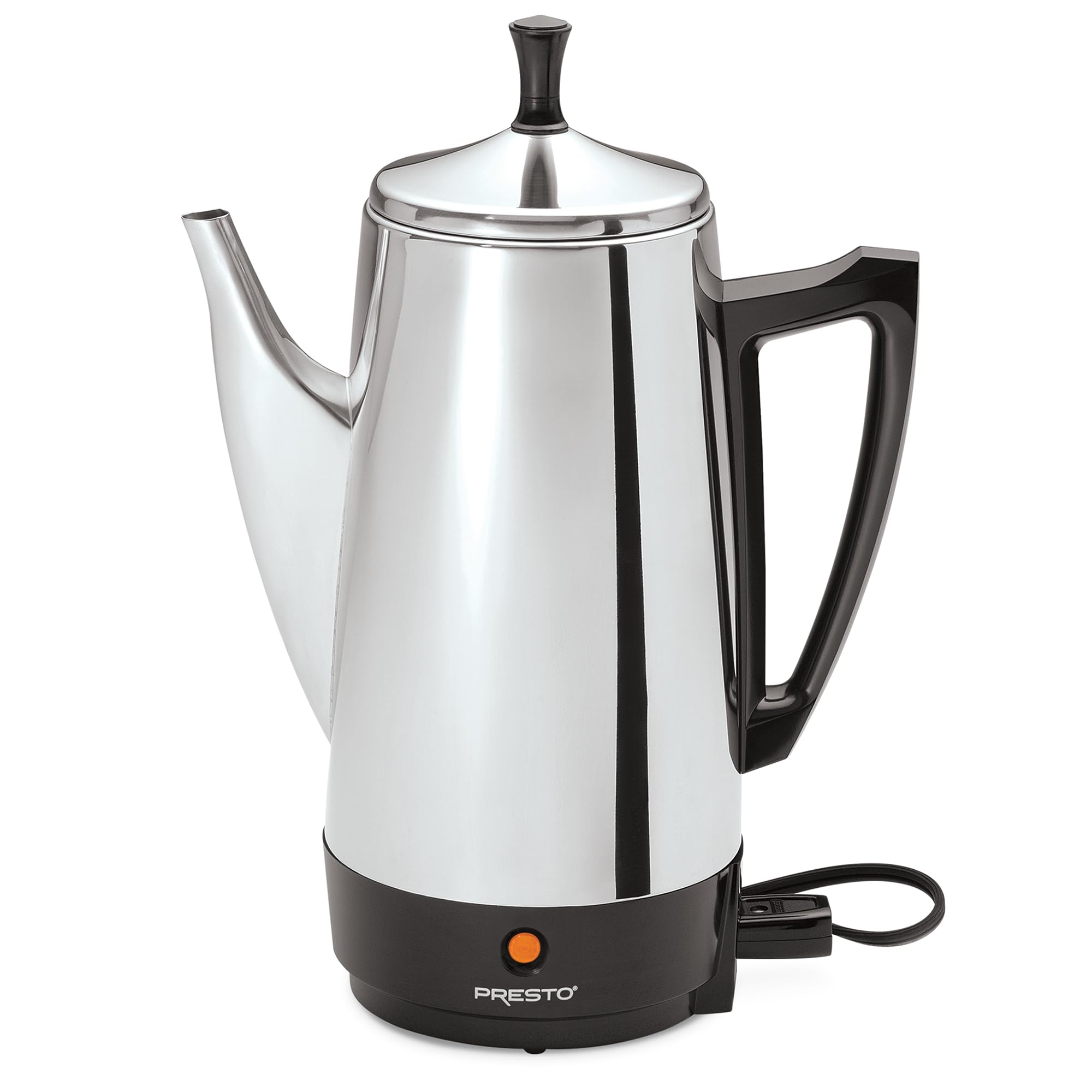
The Presto Percolator brings a traditional all-metal build with a 12-cup capacity and a signal light that indicates when brewing is complete. It delivers piping-hot, robust coffee that fans of old-fashioned percolator flavor will appreciate. However, it lacks an automatic shut-off, requiring you to unplug it manually after use, and the basket cover has sharp edges that can cause cuts during cleaning. These limitations, combined with the distinct percolator taste profile, make it a niche option for those who specifically want this style of brewing.
Pros
- Brews piping-hot, robust coffee in about a minute per cup.
- Stainless steel body wipes clean easily and resists odor buildup.
Cons
- Sharp edges on the basket cover can cause minor cuts during handling.
- Requires manual unplugging after brewing – no automatic shut-off.
Best suited for percolator enthusiasts who want a metal-bodied machine and are willing to stay nearby to unplug it after brewing.
How to Choose
The coffee maker that lasts years and delivers great taste starts with understanding which brew method fits your routine, not just the price tag.
Brew Type
The brew type determines the flavor profile and effort required. Single-serve pod machines offer speed and consistency but lock you into proprietary pods. Drip brewers give you a full pot and more control over grind and water ratio, but they take longer to clean. Manual methods like pour-over or French press produce cleaner, brighter flavors with fewer moving parts to fail. Cold brew makers are simple and durable, but only produce cold concentrate. Espresso machines deliver concentrated shots but demand practice and maintenance.
Your daily routine should dictate the choice: if you drink one cup fast in the morning, single-serve or manual works. If you need to serve a family, a drip machine or percolator is better. If you enjoy the ritual, manual methods reward patience with superior longevity.
Capacity
Capacity is more than just how many cups you can brew at once. Larger reservoirs reduce refill frequency but add counter space and weight. A 12-cup drip carafe may serve a family, but it also means lukewarm coffee if you drink slowly – the warming plate can cook the coffee over time. Single-serve machines with a 40+ oz reservoir are convenient for one or two cups, but you lose the ability to fill a thermos.
The hidden trade-off: bigger capacity often means more plastic or glass surfaces that can crack or leak. Smaller manual brewers like the AeroPress or Chemex are inherently more durable because they have fewer parts. Match capacity to your peak usage, not your ideal – overbuying leads to wasted coffee and faster wear.
Programmability
Programmable features like auto-start, brew strength, and auto-off add convenience but come with extra electronics that can fail. A machine with a simple mechanical switch often outlasts one with a digital timer and membrane buttons. The trade-off: you lose the ability to set a morning brew timer, which many find essential.
If you must have programmability, look for a machine with separate, replaceable components (e.g., a removable water tank and a filter basket that can be cleaned easily). Avoid models where the control panel is integrated with the heating element – that’s a common failure point.
Build Quality
Build quality determines how long the machine lasts. Plastic components – especially in the water tank, lid hinges, and internal tubing – degrade faster under heat and mineral buildup. Stainless steel and glass bodies resist cracking but can be heavy and fragile. The best indicator of durability is the materials used in the brew path and the warranty length.
A machine with a metal heating element and stainless steel water path will survive many descaling cycles. Budget machines often use aluminum or thin plastic that warps. If you plan to keep a coffee maker for more than 2-3 years, prioritize metal construction and a replaceable filter basket. Manual brewers (AeroPress, Chemex, Bialetti) sidestep these issues entirely.
Special Features
Extra features like a built-in frother, iced coffee mode, or hot water dispense can turn a basic brewer into a mini café. But each added feature introduces a new potential failure point – frother motors clog, hot water buttons stick, and iced programs may not cool the coffee enough. The hidden trade-off: you pay more upfront and may lose reliability.
Evaluate whether you will actually use a feature weekly before paying extra. A standalone milk frother ($20-$30) is cheaper to replace than a built-in one that breaks. For most buyers, the core brew quality and durability matter more than gimmicks.
FAQ
Why does my Keurig coffee maker stop working after a few months?
Keurig machines, like many pod brewers, use plastic internal components that degrade under heat and scale buildup. Regular descaling can extend life, but design tolerances mean some units fail early. If long-term durability is a priority, consider manual brewers like the AeroPress or Chemex that have no heating elements to fail.
How long should a coffee maker last before needing replacement?
A typical electric drip or single-serve machine lasts 3–5 years with proper care. Manual brewers (AeroPress, Chemex, Bialetti) can last decades because they have no moving parts. Budget electric machines often fail within 1–2 years. If you average more than 2 cups per day, expect to replace an electric brewer sooner.
Is a pour-over coffee maker better than a drip machine for taste?
Pour-over coffee makers like the Chemex produce a cleaner, brighter flavor because the water flows through a thicker paper filter that removes more oils and fine particles. Drip machines can match this with a high-quality filter and precise grind, but pour-over gives you full control over water temperature and pour rate. For the best flavor, pour-over wins – but it requires attention and time.
Can I use ground coffee in a single-serve pod machine?
Most single-serve pod machines only accept proprietary pods. However, some models like the Hamilton Beach 2-Way include a reusable filter basket for ground coffee. Check the product specs for ‘reusable filter’ compatibility. If you want to switch between pods and grounds, look for a machine explicitly advertised as dual-use.