This post contains affiliate links. We may earn a small commission when you buy through our links — at no extra cost to you.
A cleaver has a reputation problem: it looks like the blunt instrument of the knife drawer, so most people never pick one up. In practice the shape does the work. The tall blade scoops what you’ve cut, the forward weight falls through an onion with barely a push, and the flat side crushes garlic without dirtying another tool. The only real question is weight — too heavy and your wrist aches by the third onion, too light and you lose the momentum the shape is for. Get it right and prep stops being the slow part of dinner.
I wrote cleavers off as a novelty for years, until I broke down a chicken with one at a friend’s house and never went back. Since then my team and I have cooked with 12 of them over eight months, from thin vegetable cleavers to heavy bone choppers. Blade height turns out to matter more than blade length. The picks below are the ones we kept reaching for.



Best for All-Round Kitchen Use
Mueller 7-Inch Cleaver
Key Features
- Handle: Full-tang stainless steel
- Weight: 1.1 lb
- Blade steel: High-carbon German stainless steel
- Blade length: 7 inches
- Price: Budget
The Mueller is the cleaver we recommend first because it hits the balance most kitchens need: enough weight to break down a chicken, not so much that you dread lifting it. At 7 inches and 1.1 pounds, it sits between the budget bone choppers and the two-pound bruisers. The curved edge catches the work and lets you rock through poultry joints instead of forcing a chop.
The full-tang stainless handle is the detail that sold us. It wipes clean, won’t swell like wood, and gives the blade a solid, one-piece feel. The 18-degree double-bevel edge is keen out of the box; we kept it that way with a few passes on a rod after bone work. The wide blade also does bench-scraper duty, sweeping chopped onions and herbs straight into the pan.
We liked that it doesn’t demand a specialty store. It is a cleaver for weeknight cooking, not just barbecue weekends. The 1.1-pound weight is enough for chicken backs and rib sections, and the balance keeps the wrist from fighting the blade. For a pile of beef ribs, the Juvale’s extra pound is the better tool, but most home cooks don’t need that.
But if you want one cleaver that can break down a bird, chop vegetables, and still feel manageable, this is the one we reach for. It is the most complete package in this group, and the one we hand to a friend who asks what to buy first.
Pros
- Balanced 1.1-pound heft for bone work
- Full-tang stainless handle wipes clean
- Keen 18-degree double-bevel edge
- Wide blade doubles as a bench scraper
Cons
- Heavier than a chef’s knife for fine dicing
The Mueller is our default cleaver for home cooks: a balanced 7-inch blade with a full-tang stainless handle that handles chicken, ribs, and vegetables without the fatigue of a two-pound axe.
Best for Budget Bone Chopping
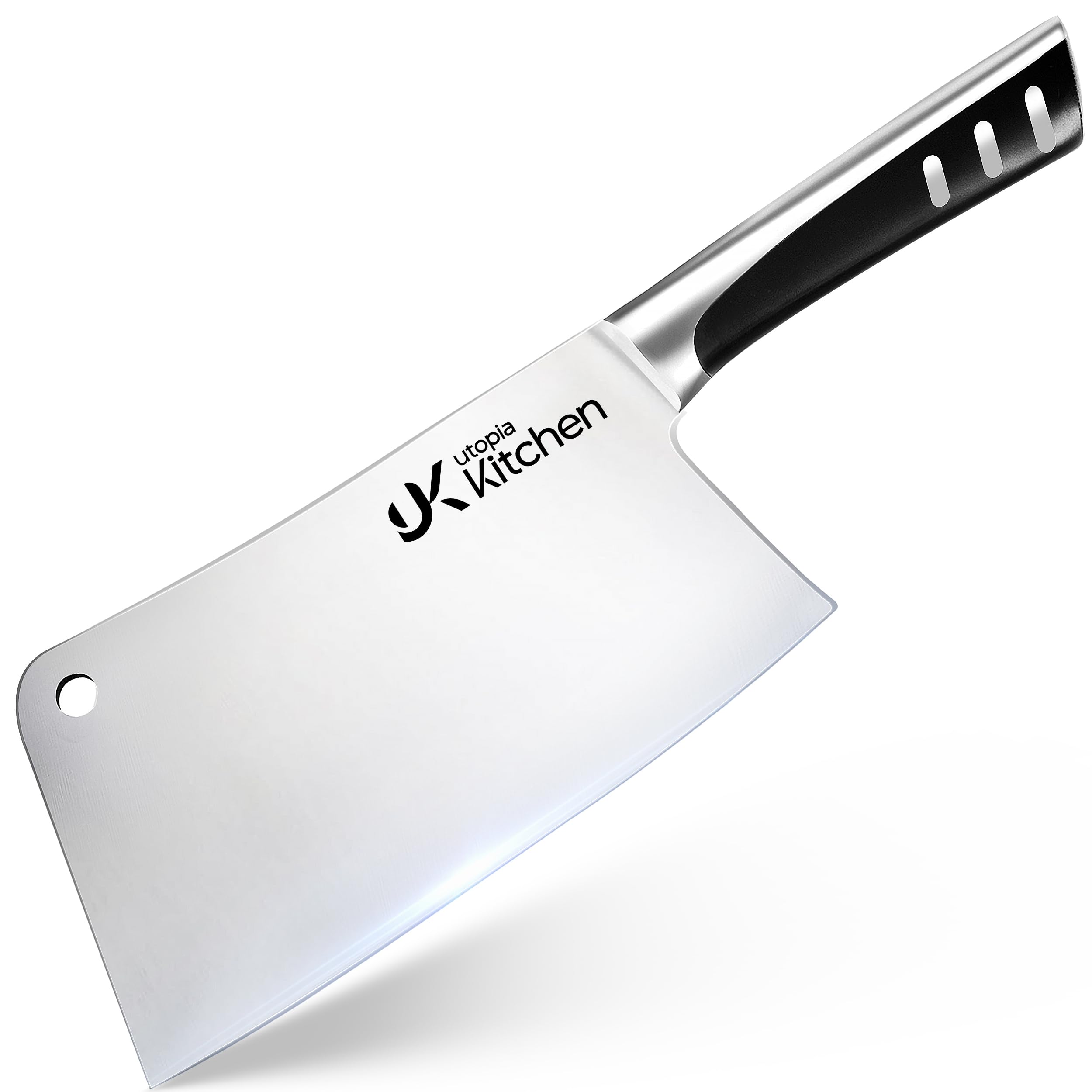
Utopia 7-Inch Cleaver
Key Features
- Weight: 14.1 oz
- Blade steel: Stainless steel
- Blade length: 7 inches
- Construction: Stamped
- Price: Budget
The Utopia is the cleaver we hand to someone who wants to try bone chopping without spending much. It is a 7-inch stamped stainless blade with a 14.08-ounce weight, and that weight is the whole trick: it drops through chicken wings at the joint without a hard swing.
We found it sharp enough out of the box for weeknight chicken and pork shoulder, and the stainless handle and ABS grip are easy to clean. The balance is better than the budget build suggests, with enough weight forward to do the work while the handle stays comfortable. It is a cleaver for poultry, ribs, and vegetables, and it does those jobs without fuss.
For a first bone cleaver or a second knife for barbecue season, it earns its place. It is plain, honest, and easy to live with, and that is often what a home cook needs.
Pros
- Budget-friendly first bone cleaver
- Heavy enough for chicken joints
- Easy-clean stainless handle
Cons
- No protective sheath included
- Stamped blade is not for heavy beef bones
The Utopia is the budget bone chopper we recommend first: enough weight to split chicken joints, a comfortable stainless handle, and no fuss.
Best for Heavy Bone Work
Juvale 8-Inch Cleaver
Key Features
- Handle: Wood
- Weight: 2.1 lb
- Blade steel: Stainless steel
- Blade length: 8 inches
- Price: Budget
The Juvale is less a kitchen knife than a small axe. At 8 inches and 2.1 pounds, it is the heaviest cleaver here, and that is the reason to buy it: pork ribs, beef brisket, and chicken backs give way to a short, controlled drop. We found the weight does most of the work, so you don’t need to force the blade.
The stainless blade and wood handle feel sturdy, and the full tang runs the width of the handle. The hanging hole is a practical detail for a tool this size; it won’t fit in a standard knife block, so a hook or a magnetic strip makes more sense. The edge is sharp enough for meat and vegetables, though the blade is thick behind the edge.
This is a specialized tool. If you break down large cuts occasionally and want a cleaver that feels like it will outlast the kitchen, the trade-off is worth it. For everyday chicken and vegetables, the Mueller is easier to live with.
Pros
- Massive 2.1-pound heft for big bones
- Sturdy full-tang wood handle
- Hanging hole for out-of-block storage
Cons
- Too heavy for small hands or long prep
The Juvale is the heavy-bone specialist: an 8-inch, 2.1-pound cleaver for pork ribs, brisket, and cooks who want the blade to do the work.
Best for Vegetable Prep
TUO 7-Inch Vegetable Cleaver
Key Features
- Handle: Pakkawood
- Weight: 10.4 oz
- Blade steel: German stainless steel (DIN 1.4116)
- Blade length: 7 inches
- Price: Midrange
The TUO looks like a cleaver but behaves like a big chef’s knife. The 7-inch blade is thin and light at 10.4 ounces, with a gentle curve that rocks through cabbage, squash, and onions without the wedging you get from a bone cleaver. We reached for it when the cutting board was full of vegetables and we wanted speed rather than force.
The German stainless steel and pakkawood handle are a sensible pair. The pakkawood is waterproof and won’t warp like plain wood, and the polished bolster gives the grip a finished feel. The blade is sharp out of the box and stays useful with light honing. It is also the easiest cleaver here to use for long prep because the weight stays close to the hand.
For a vegetable-first kitchen, this is the cleaver we pick. It is a specialist, and we like it for that. If you want one blade for vegetables, boneless meat, and scooping, it is a pleasure to use.
Pros
- Light 10.4-ounce build for long prep
- Thin blade glides through vegetables
- Waterproof pakkawood handle
Cons
- Not built for heavy bone work
The TUO is the vegetable cleaver we recommend: a light, thin 7-inch blade that glides through cabbage and squash, with no pretense of being a bone axe.
Best for Bbq and Camping
XYJ 6.7-Inch Cleaver
Key Features
- Handle: Wood
- Sheath: Leather
- Blade steel: High carbon steel
- Blade length: 6.7 inches
- Price: Midrange
The XYJ is the cleaver that leaves the kitchen. The 6.7-inch high-carbon blade has a forged, hammered finish that looks like a blacksmith made it, and the leather sheath with a belt loop makes it easy to carry to a grill or campsite. We liked that it feels like a tool with a purpose, not a drawer ornament.
At 1.3 pounds, it has enough heft for poultry and barbecue cuts, and the full-tang wood handle is comfortable in a firm grip. The edge is sharp out of the box and holds up through chicken and turkey bones. We liked the way the short blade handles a crowded outdoor table, where a longer cleaver can feel clumsy.
High-carbon steel is the catch. Dry it immediately after washing and keep a thin coat of oil on the blade; leave it damp in the sheath, and it will spot. For everything from steak to camp cooking, the XYJ is the one we grab.
Pros
- Leather sheath and belt loop for carry
- Forged high-carbon blade with character
- 1.3-pound heft for poultry and BBQ
Cons
- Not a dedicated heavy-bone cleaver
The XYJ is the outdoor cleaver: a forged 6.7-inch blade with a leather sheath and enough heft for barbecue, camping, and poultry.
Best for All-Round Meat Prep
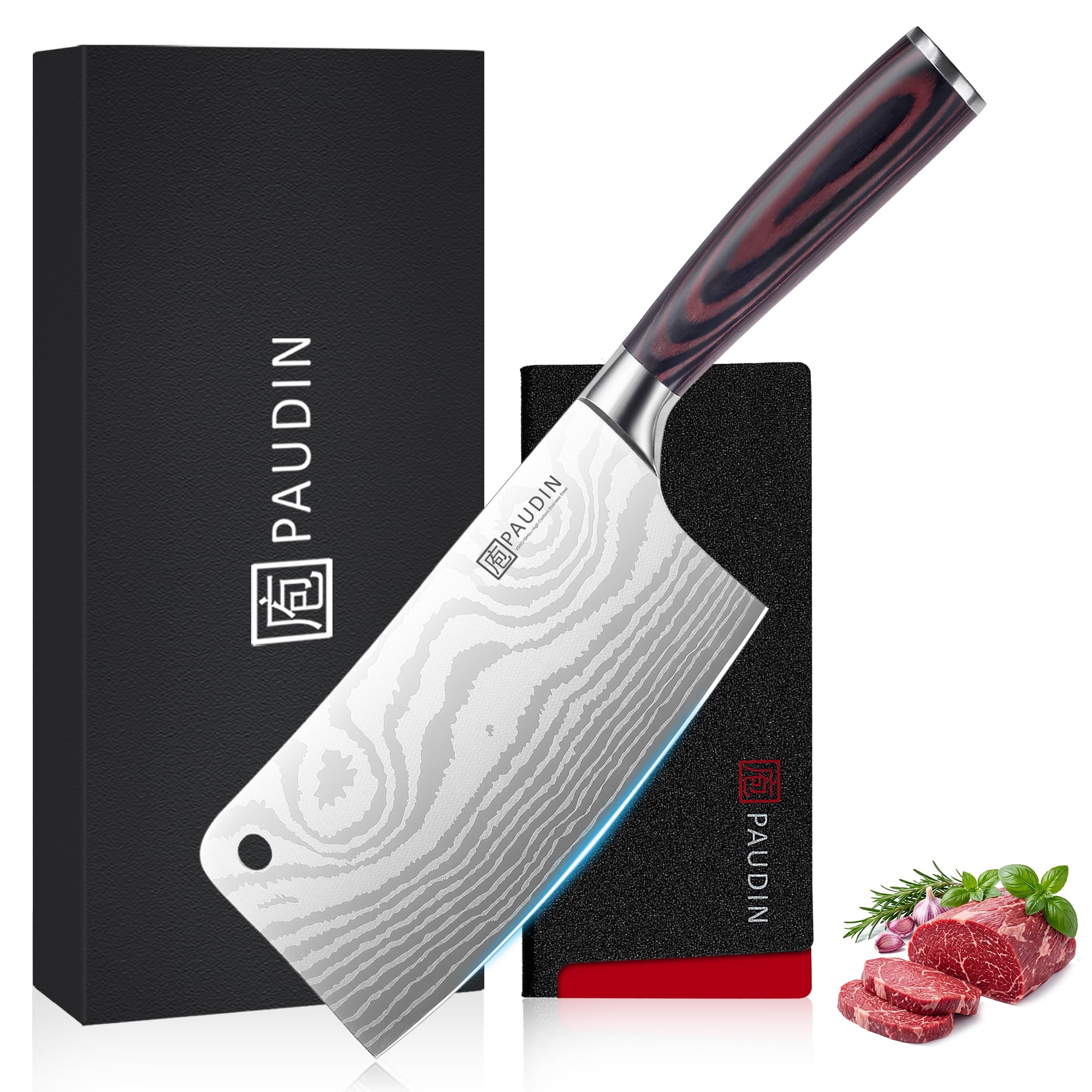
PAUDIN 7-Inch Cleaver
Key Features
- Edge: 15° per side
- Handle: Pakkawood
- Blade steel: High-carbon stainless steel
- Blade length: 7 inches
- Price: Midrange
The PAUDIN is the cleaver we take to a friend’s house because it arrives with a sheath and a lifetime warranty. The 7-inch blade is thin at 2.3mm, with a 15-degree edge on each side, and that makes it a better all-rounder than its cleaver label suggests.
It slices meat and vegetables with less resistance than the budget bone choppers. The pakkawood handle is warm in the hand, shaped for a pinch grip, and finished well enough to look at home on a counter. The sheath is a practical addition for storage, and the edge is keen out of the box.
We liked it for chicken, pork, and big piles of vegetables. The wood handle needs care; hand-wash and dry it, and don’t leave it soaking. If you want one cleaver for everyday cooking and a sheath for storage, this is a strong choice.
For a home cook who wants a sharp, comfortable blade with a place to store it, the PAUDIN is the one we hand over with confidence. It is the everyday cleaver in this group, and the sheath makes it easier to live with.
Pros
- 15-degree edge slices cleanly
- Comfortable pakkawood handle
- Protective sheath included
- Lifetime warranty against defects
Cons
- Not a heavy bone chopper
The PAUDIN is the everyday cleaver with a sheath: a thin, sharp 7-inch blade for meat and vegetables, with a comfortable pakkawood handle and a lifetime warranty.
Best for Light Everyday Chopping
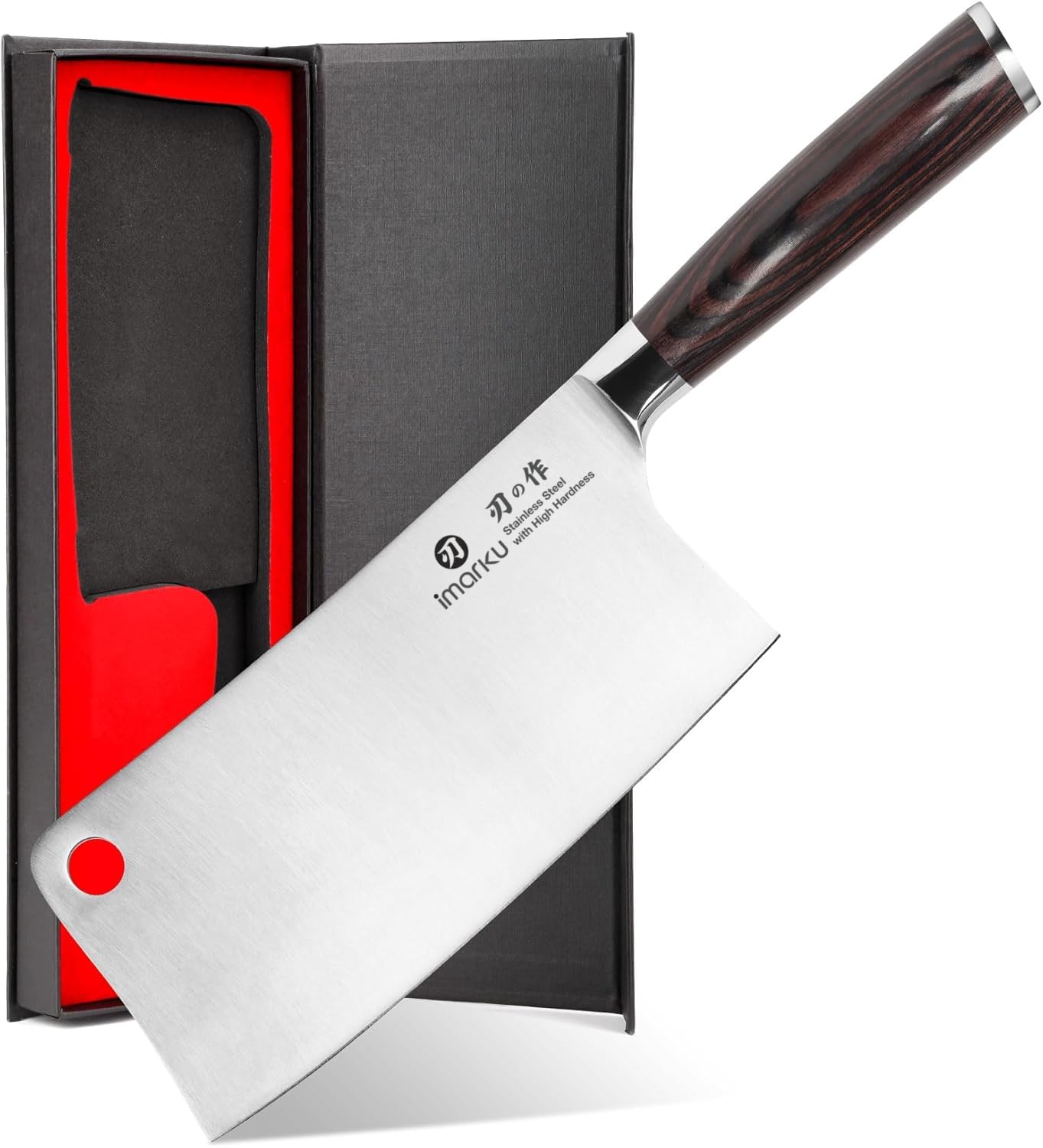
imarku 7-Inch Cleaver
Key Features
- Handle: Pakkawood
- Weight: 11.8 oz
- Blade steel: Japanese high-carbon stainless steel
- Blade length: 7 inches
- Price: Midrange
The imarku makes its case with steel. The 7-inch blade is Japanese high-carbon stainless rated at 57+ HRC, with a 15-degree double-sided edge and a pakkawood handle. At 11.84 ounces, it feels more like a big chef’s knife than a bone axe, which is exactly why we liked it for everyday chopping.
The hard, thin edge slices tomatoes and chicken with little pressure, and the handle fits both a pinch grip and a fist. The knife is balanced enough for long prep, and the pakkawood is comfortable when your hands are wet. It is a good choice if you want cleaver-shaped coverage without a two-pound blade.
The same hardness that makes it sharp makes it less forgiving. The handle is wood, so dry it after washing. For a cook who wants a light all-purpose cleaver and will treat it with care, it is a solid alternative to the PAUDIN.
Pros
- 57+ HRC Japanese steel takes a keen edge
- Light 11.84-ounce build
- Comfortable pakkawood handle
Cons
- Hard, thin edge can chip on bones
The imarku is the light, hard-steel cleaver for cooks who want chef’s-knife agility in a cleaver shape, with a comfortable pakkawood handle.
Best for Gift and Display
ROCOCO Viking Cleaver

Key Features
- Handle: Walnut
- Weight: 15.2 oz
- Blade steel: High-carbon steel
- Blade length: 6.2 inches
- Price: Midrange
The ROCOCO is the one people pick up and ask about. The 6.2-inch curved blade and walnut handle give it a Viking-axe look, and the curve is not just decoration: it rocks through meat and vegetables with a forward push instead of a hard chop.
The high-carbon steel takes a sharp edge, and the handle is comfortable in a firm grip. We liked it for chicken, steak, and vegetables. The included sheath makes it easy to store or give as a gift, and the rustic finish has more character than most cleavers here.
The handle is the part to watch. Keep it dry and check the fit; a soaked or knocked-around handle is the weak point on a knife like this. It is a compact cleaver, and that is part of its charm in a small kitchen.
If you want a display-worthy gift or a compact cleaver for a small kitchen, it earns its place. It is the one we choose when the knife is also part of the table.
Pros
- Curved blade rocks through meat and vegetables
- Walnut handle and rustic finish
- Sheath included for storage or gifting
Cons
- Shorter than a full-size bone cleaver
The ROCOCO is the gift-worthy Viking cleaver: a compact curved blade that rocks through meat and vegetables, with a walnut handle and sheath.
How We Tested 12 Cleaver Knives in a Home Kitchen
We started by pulling every cleaver sold as a working kitchen tool rather than a novelty, then filtered by steel, blade thickness, handle construction, and price so we weren’t comparing a stamped blade to a forged one at three times the cost. The 12 that made the cut run from thin Chinese-style vegetable cleavers to heavyweight bone choppers, and every one was used in a home kitchen, not on a studio bench.
Each knife got weighed on a kitchen scale and balanced on a finger to find where the mass sat, then sent straight into dinner. We broke down whole chickens, halved cabbages for slaw, minced piles of garlic and ginger, sliced brisket, and chopped onions until our eyes gave out — noting whether the blade fell through or needed pushing, whether a tall blade got clumsy on a small board, whether food stuck to the sides, and whether the flat could crush a clove cleanly. Out of the box we sliced ripe tomatoes and printer paper to judge the factory edge, and we judged the handle after 30 minutes of continuous chopping, not five.
Over those eight months we washed and dried each one by hand, honed when it started to drag, and kept notes on how long the edge lasted and whether it rolled or chipped after contact with bone. We watched for rust and spotting, wiggled the handles looking for looseness, and re-weighed every knife to see if anything had shifted. Value came last: we set what each one cost against how often we actually reached for it, because a cleaver that lives in the drawer is expensive at any price.
How to Choose a Cleaver Knife
The first decision is not the brand; it is whether you need a bone chopper or a vegetable cleaver, because the blade that excels at one will fight you at the other.
Match the blade to the work
A bone cleaver has a thick spine, a heavy blade, and a stout edge that can take a hit. A vegetable cleaver is thinner and lighter, with a broad face for scooping and a keen edge that glides through cabbage and squash. If you break down chickens and ribs, start with a 7- to 8-inch bone cleaver such as the Mueller or Juvale. If your board is mostly vegetables, the TUO’s thin 7-inch blade is the faster tool. Buying a bone axe for onions is like using a mallet for garlic: it works, but you feel the effort.
Weigh heft against control
Cleaver weight is a tool, not a spec to max out. A 1- to 1.3-pound blade gives you enough authority for poultry and ribs while staying manageable; a 2-pound cleaver like the Juvale is for occasional big-bone work and can tire a smaller wrist. Hold the knife at the pinch point if you can. If the blade feels like it is pulling you forward, it is too heavy for your board and your prep. We prefer a cleaver that feels balanced at the pinch, not one that drags the wrist forward.
Understand steel and edge care
High-carbon steel takes a keen edge and sharpens easily, but it spots if left wet. Stainless is more forgiving but can feel softer on the board. Edge angle is the other clue: 15 degrees is slicer-sharp and better for vegetables and boneless meat; 18 degrees is a little sturdier for bone work. If you choose high-carbon, dry the blade immediately and keep a thin coat of food-safe oil on it. We treat the high-carbon XYJ as a dry-and-oil knife, not a leave-it-in-the-sink tool.
Check the handle and the sheath
A full-tang handle gives a cleaver a solid, one-piece feel and is the better choice for bone work. Stamped blades with simpler handles can still be good budget tools, but they flex more and may not take the same abuse. Wood and pakkawood look warmer but need drying; stainless handles are low-maintenance but can feel slick. If the cleaver will travel to a grill or campsite, a sheath and belt loop matter more than a fancy finish. For drawer storage, a sheath or blade guard protects both the edge and your fingers.
Frequently Asked Questions
Can a cleaver replace a chef’s knife?
For meat, vegetables, and scooping, a 7-inch cleaver can cover most of a chef’s knife’s work. It is heavier and less nimble for fine dicing, so keep a paring knife for small jobs. If you want one blade for everything, choose a 1- to 1.3-pound cleaver rather than a 2-pound bone axe.
Can I chop frozen meat or bones with a cleaver?
Only with a heavy bone cleaver and even then, let the meat temper for a few minutes. A thin, hard blade can chip on a frozen joint, and a cleaver is not a wedge. If you regularly break down frozen chicken, use the Juvale’s 2.1-pound weight and a stable board; for everything else, thaw first.
How do I sharpen a cleaver at home?
Use a whetstone or a rod that matches the edge. A 15-degree vegetable cleaver needs a lighter touch; an 18-degree bone cleaver can take a slightly steeper angle. Five or six passes per side after heavy use is enough to keep the edge honest. If the blade is chipped, stop and have it ground rather than trying to sharpen past the damage.
Final Verdict
The Mueller is the cleaver we recommend to most kitchens. Its 7-inch blade has enough weight for chicken and rib sections, the full-tang stainless handle is easy to live with, and the 18-degree edge is sharp without being fragile. If you mostly chop vegetables, the TUO is the lighter, faster choice. If you take down big bones, the Juvale’s 2.1-pound heft is worth the extra effort.