This post contains affiliate links. We may earn a small commission when you buy through our links — at no extra cost to you.
A clean fillet starts long before the blade touches the fish — it starts with whether the knife will bend with the backbone or fight it. I’ve watched plenty of decent catches turn into ragged, bone-studded strips because the knife was too stiff, too dull, or too short for the job at hand. What you actually want is a thin, flexible blade that follows the spine instead of gouging through it, paired with a handle that stays grippy once your hands are wet and slick. Get those two things right and you lose less meat, finish faster, and stop dreading the cleaning station.
Over the past four months, my team and I worked through 14 fillet knives — everything from bare-bones budget models to hand-finished blades — on trout, walleye, and a few saltwater fish, at kitchen counters and on a wobbling dock table. Flexibility and edge retention separated the field quickly, and a few knives that looked great in photos turned out to be all looks and no bite. Here’s the thing nobody tells a first-time buyer: the blade steel matters less than the grind and how the handle fits your hand. Below are the ones worth owning, sheaths included.




Best for All-Round Filleting
HOSHANHO 7-Inch Fillet Knife
Key Features
- Steel: 10Cr15CoMoV high-carbon
- Handle: Pakkawood
- Weight: 10.6 oz
- Blade Length: 7 in
- Price: Midrange
The HOSHANHO is the sharpest knife we lifted out of a box for this guide, and it was still biting at the end of a long afternoon of trout and bluegill without a pass on a steel. That is the thing you cannot fix later. A fillet knife that goes dull halfway through the pile is a knife you fight for the rest of the session, and this one never put us in that position. The 7-inch blade is thin enough to follow a rib line by feel and tapered enough at the tip to work around pin bones without tearing the fillet.
Forged 10Cr15CoMoV high-carbon steel is why it feels closer to a kitchen knife than a fishing tool, and it is also why this is the heaviest knife of our picks. The listing puts it at 300 grams, and you notice that in the last third of a long session. What the weight buys is steadiness: the blade tracks where you point it rather than skittering off a bone, and the balance sits back in the hand where you can control it.
The pakkawood handle is the best-looking of the group and, more usefully, it stays secure with wet hands. It is not rubber-secure the way the KastKing’s grip is, and if you fillet on a boat with slime on everything, that difference is real and worth weighing. On a kitchen board, we preferred the HOSHANHO’s handle shape to every other knife here.
Seven inches turns out to be the sweet spot for a mixed bag. It is long enough for walleye, bass, and a decent striper, and short enough that you can still steer the tip around a bluegill’s ribs, which is not true of the 9-inch KastKing. If salmon and saltwater are most of your fishing, buy the longer blade instead; for everything else, this is the length that keeps earning its place.
Pros
- Sharp out of the box and holds its edge
- Thin 7-inch blade follows ribs by feel
- Pakkawood handle stays secure when wet
- Looks and feels pricier than it is
Cons
- Ships without a sheath or blade guard
We recommend it to most people because it arrives sharper than anything else here and holds that edge through a session, with a handle that stays secure in wet hands.
Best for Detail Trimming
Dalstrong Gladiator Elite 7-Inch
Key Features
- Steel: German high-carbon
- Handle: G10
- Sheaths: Two included
- Blade Length: 7 in
- Price: Premium
The Dalstrong is the most expensive manual knife here, and it is the one that feels most like a piece of kitchen equipment rather than something that lives in a tackle box. Full tang, a black G10 handle with three rivets, and a 7-inch blade ground thin behind the edge and polished to 16 to 18 degrees per side: this is a knife built to be looked at as well as used.
The tip is what earns it a place. It is narrow and tapered, which makes this the best knife here for fussy work — running along a bone line, lifting silverskin off a fillet, trimming the dark strip out of a salmon tail. Next to the wider, flatter blades on this list, the extra control is obvious in the hand. Two sheaths come in the box, a leather-look one and a plastic one, so it can live in a drawer and travel in a bag without you buying anything extra.
The trade is price. This is a premium knife in a category where a very good one costs a fraction of it, and the gain over the KastKing is refinement rather than raw cutting speed. If you fillet twice a year, the long KastKing blade does the same coarse work. If you portion fish for the freezer and care how the knife feels while you do it, this is the one to hold first.
Pros
- Narrow tapered tip for detail trimming
- Full-tang G10 handle with three rivets
- Two sheaths included
- Holds an edge and sharpens readily
Cons
- Premium price for a manual knife
Buy this one if you trim and portion as much as you fillet; we think the tapered tip, full tang, and G10 handle justify the premium.
Best for Salmon and Big Fish
KastKing Speed Demon Pro 9-Inch
Key Features
- Steel: G4116 German stainless
- Handle: Non-slip polymer
- Sheath: Included
- Blade Length: 9 in
- Price: Budget
Nine inches is a lot of blade, and that is the entire argument for this knife. On a salmon or a decent striper you can make one long draw from head to tail instead of sawing, and a single clean pass is the difference between a fillet that lies flat and one with a ragged edge. For panfish and trout it is more knife than the job needs, and you feel the extra length on every turn.
The G4116 German stainless takes a working edge and holds it, and the black non-stick coating helps a wet fillet slide instead of drag. The handle is the part we rate highest: a soft molded polymer that fills the hand and stayed put with fish slime on our fingers, which is more than we can say for the smoother handles here. At just under six ounces, it is also light for its size.
At this price it is the value play of the group: a long German-steel blade, a sheath, and a grip that works wet, for a fraction of what the premium knives here cost. We reach for it first when the fish are big, and that is the test that matters.
Pros
- 9-inch blade for single-pass draws
- Non-slip polymer grip works wet
- Sheath included with the knife
- Strong value for a long blade
Cons
- Stiff, straight-backed blade is awkward for skinning
- 9-inch length is too much for panfish and trout
Our choice for salmon and saltwater: nine inches of German steel for one long, clean draw, at the lowest price of any long blade here.
Best for High-Volume Cleaning
BUBBA Li-Ion Cordless Electric
Key Features
- Power: Cordless Li-ion
- Blades: Four Ti-nitride coated
- In the Case: Charger and zippered case
- Blade Length: 7 in
- Price: Premium
If you have ever stood over a cooler of thirty fish at eleven at night, the case for this knife is obvious. The BUBBA is cordless, it runs on a lithium-ion battery with an LED indicator on the handle, and the reciprocating blade does the cutting while you steer. On a big batch it is faster than any manual knife here by a wide margin.
It also arrives with four Ti-nitride coated blades, a charger, and a zippered case that holds the lot, and the blades pop out for cleaning. Where we hesitate is the edge. The blades can arrive needing a touch-up, and a dull reciprocating blade tears a fillet instead of slicing it, so hone a new blade before you commit a fish you care about to it.
Battery life is a genuine strength: the indicator tells you where you stand, and a charge lasts a long session rather than dying mid-fish. Cleaning is the chore. The blades come off easily enough, but the mechanism and the case want a proper rinse and dry, and BUBBA specifies hand washing only.
At the top of the price range here, it is a specialist’s tool rather than a first fillet knife. If you clean a few trout a season, a manual blade is quieter, cheaper to own, and just as quick on five fish. If you process limits, run a charter boat, or have hands that ache after a batch, the electric earns its keep.
Pros
- Much faster than manual knives on big batches
- Cordless with long battery life
- Blades remove for cleaning; case holds everything
- Secure handle with a trigger guard
Cons
- Blades can arrive needing a honing
- The most expensive knife here
We keep this one for volume: four blades and a battery turn a cooler of fish into an hour’s work, provided you hone the blade first.
Best for Budget Tackle Box
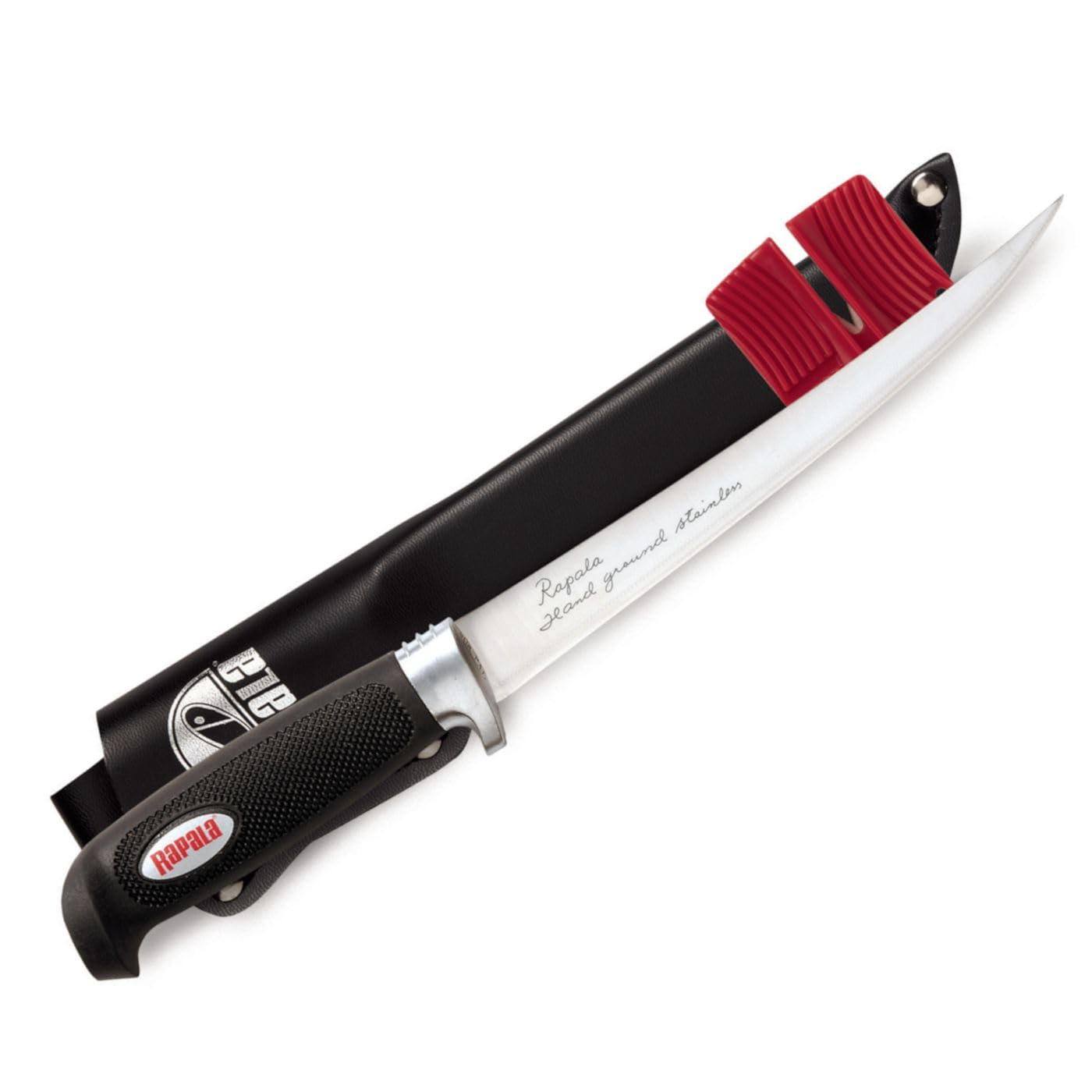
Rapala Soft Grip 6-Inch
Key Features
- Handle: Textured soft grip
- Includes: Sheath and sharpener
- Blade Length: 6 in
- Price: Budget
A knife, a belt sheath, and a sharpener in one package: that is the pitch, and it is why this Rapala is our budget pick. The 6-inch blade is flexible stainless, sharp out of the box, and thin enough to work around the ribs of a trout or a walleye without much thought. Nothing about it feels fancy. Everything about it works.
The soft-grip handle is the part we keep coming back to — a textured rubber that does not turn into a bar of soap once there is slime on your hands, with a shape that fills the palm without any sharp edges. The blade has the classic Rapala give, more flex than any of the kitchen-style knives here, which makes it the easiest of the group to skin with.
Six inches is the limit, though. On panfish, trout, perch, and walleye it is ideal; on a salmon you will be making two or three passes where one would do. The included single-stage sharpener is a touch-up tool rather than a sharpening system — useful on the boat, and worth replacing with a rod or a stone at home. For a first fillet knife, a spare in the tackle box, or a gift for someone who fishes a few times a year, nothing here beats it for the money.
Pros
- Sheath and sharpener included
- Non-slip textured soft grip
- Flexible blade makes skinning easier
- Cheapest complete kit here
Cons
- 6-inch blade is short for salmon
The cheapest complete kit here — a sharp 6-inch blade, a belt sheath, and a sharpener — and that is exactly why it is our budget pick.
Best for Packing and Travel
KastKing Folding Fillet Knife
Key Features
- Handle: TPE rubber and polymer
- Sheath: Included
- Blade Length: 6.5 in
- Folded Length: 7.5 in
- Price: Budget
Thirteen and a half inches open, seven and a half folded: that is the whole idea. This is the fillet knife that lives in a tackle box, a glove compartment, or a daypack without taking the room a fixed blade needs, and unlike most folders it carries a genuine fillet blade — thin, flexible, and finished with a titanium-bonded non-stick coating.
Open it and it locks up solid, with no play at the pivot once it is set. The glass-reinforced polypropylene frame and TPE rubber grip follow the same idea as the fixed KastKing’s handle, and it stays put in a wet hand. At 6.5 inches the blade covers panfish, trout, and modest bass, and the sheath that comes with it is light enough to forget in a pocket.
What you give up is the reassurance of a single piece of steel. No folder feels quite as solid as a full-tang fixed blade when you are bearing down on a big fish, and the blade is short for anything much past a walleye. For the way most people actually fish, though — a few fish, a long walk back to the truck — the knife that is with you beats the better one on the rack at home.
Pros
- Folds to 7.5 inches for a pack or tackle box
- Locks up solid with no pivot play
- Rubberized grip stays put when wet
- Good value for a folding fillet knife
Cons
- Folding joint needs a rinse and dry after every trip
Our pick for the pack: it folds to 7.5 inches, locks up solid, and cuts like a fixed fillet knife once it is open.
Best for Trimming and Portioning
Mercer Culinary M23860 8.5-Inch
Key Features
- Steel: High-carbon Japanese
- Handle: Santoprene
- Weight: 4.6 oz
- Blade Length: 8.5 in
- Price: Budget
Eight and a half inches of narrow, thin blade is a different tool from the 6- and 7-inch knives here. Mercer builds this one for people who portion fish rather than clean a limit: the long narrow profile takes a fillet off in one controlled draw and slides under silverskin and fat with the flat of the blade.
It is stamped from one piece of high-carbon Japanese steel rather than forged, which keeps it light at 4.6 ounces and keeps the price down. The Santoprene handle has textured finger points and a shape built to be gripped hard. It is the least glamorous handle here and possibly the most secure in a wet hand.
The edge is the surprise. It arrives sharp, takes a honing quickly, and holds well enough for a knife in this price band, though it does not have the refined feel of the HOSHANHO or the Dalstrong. This is restaurant-supply equipment: plain, functional, built to be used hard, and backed by a limited lifetime warranty.
What you do not get is a sheath, which matters if the knife rides in a bag rather than a roll — a slide-on guard is a cheap addition. What you do get is the cheapest long blade here, and the one worth adding to a bag that already has a 7-inch knife in it.
Pros
- Long narrow blade for trimming and portioning
- Light and easy to control
- Secure textured handle
- Cheapest long blade here
Cons
- No sheath included
We reach for this one when there is trimming to do: 8.5 inches of narrow steel for silverskin, fat, and long clean draws.
Best for Gift and Light Use
imarku 7-Inch Fillet Knife

Key Features
- Steel: 10Cr15CoMoV high-carbon
- Handle: Pakkawood
- Blade Length: 7 in
- Construction: Forged
- Price: Midrange
On paper the imarku looks like our top pick with a smaller bill: the same 10Cr15CoMoV high-carbon steel, a 7-inch blade, forged construction, and a chestnut pakkawood handle with a mirror-polished spine. That is not a coincidence. This Japanese-style fillet pattern has become the template for the category, and imarku has followed it closely.
The details are where the two diverge. The imarku’s handle is darker and glossier, the blade carries a laser-etched logo, and the mirror finish runs along the spine, the ferrule, and the tip. It is the most gift-ready knife here — if you are buying for someone who will appreciate a pretty blade, this is the easiest of these to hand over wrapped.
The trade for that finish is upkeep. A mirror-polished blade shows every fingerprint and water spot, and high-carbon steel wants a rinse and a towel the moment you are done, not later. It is a knife that rewards a habit rather than forgiving you for skipping one.
Where it fits is as the value alternative to our top pick: same steel family, same 7-inch shape, and a finish that looks more expensive than the price suggests. We still put the HOSHANHO first, because a working fillet knife is judged on the edge and the grip after twenty fish, not on how it looks coming out of the box.
Pros
- Same steel family as our top pick
- Mirror-polished, gift-ready finish
- Costs less than the top pick
Cons
- Polished blade and glossy wood show spots
It is the one we point to when you want the top pick’s steel and shape for less money, and it looks the part too.
How We Tested the Best Fish Fillet Knives
We started by gathering every fillet knife with a meaningful base of real user feedback behind it, then filtered that list by blade steel, flexibility, blade length, handle material, and whether it shipped with a sheath worth carrying. That last filter eliminated more candidates than I expected. We landed on 14 knives and spent four months living with them.
Testing happened where fish actually get cleaned: kitchen counters, a folding table on a dock, and a tailgate in the rain. We broke down trout, walleye, and a handful of saltwater fish, beginning with a paper-slice check out of the box to see how each edge arrived, then counting how many fish a knife got through before it started dragging or tearing instead of slicing. On the frame, we watched whether the blade rode the backbone or cut into the ribs, and how much meat was left behind — the strongest performers left a clean, almost translucent skeleton.
Wet-hand work mattered as much as sharpness. We slicked each handle with fish slime and water, then noted which ones turned slippery, which forced a cramped grip, and which left our hands tired halfway through a batch. After washing, we checked for rust spotting, swelling, and seams that separated. Sheaths got their own pass: whether the knife seated securely, whether the edge could make contact inside, and whether the whole thing would survive a season in a tackle box. Appearance broke a few ties, mostly because certain handles looked battered after a month and others still looked new.
How to Choose a Fish Fillet Knife
The right fillet knife is sized to the fish you actually bring home, not the one you hope to catch, and the handle matters as much as the blade.
Match the blade to the fish, not the trophy
Fillet knives come in 6-, 7-, and 9-inch blades for good reasons. A 6-inch blade like the Rapala’s suits panfish, trout, perch, and walleye: short enough to steer around small bones, light enough to use all afternoon. A 9-inch blade like the KastKing’s earns its length on salmon, striper, and saltwater fish, where one long draw from head to tail gives a cleaner fillet than three short ones.
The trap is buying the long blade first. On a bluegill, nine inches of steel is clumsy and hides the mistakes a shorter blade would show you. Buy for the fish you catch most weeks, then add a second knife when your fishing changes.
Flex is a preference, not a ranking
A thin, flexible blade bends along a rib cage and follows the layer between flesh and skin. A stiffer blade holds a straighter line and gives more control when you cut through bones or portion a fillet. The difference shows up most in skinning: if you skin every fillet, favor flex, as the Rapala and the HOSHANHO do; if you cut salmon steaks and fillet now and then, a stiffer blade is easier to control.
One caveat worth knowing: the word flexible on a listing tells you nothing about how much. A knife that bends into a U and one that gives a few degrees both get the label, so judge by how the blade behaves in use rather than by the word.
Steel, edge holding, and the saltwater tax
The Japanese high-carbon steels on the HOSHANHO and the imarku take a very fine edge and hold it, but they are the most rust-prone knives here if they are put away wet. German stainless such as the KastKing’s G4116 gives up a little sharpness for toughness and corrosion resistance.
None of these belong in a dishwasher. A rinse in fresh water, a dry with a towel, and a few strokes on a honing rod before each session is the whole routine. If the knife lives on a boat, do the rinse at the dock rather than when you get home — salt does its damage in the car.
The handle is what you notice on the twentieth fish
Handles fall into three camps here: textured rubber and Santoprene on the Rapala and the Mercer, molded polymer on the two KastKings, and wood or G10 on the HOSHANHO, the imarku, and the Dalstrong. Rubber is the safest wet-weather choice, G10 is nearly as secure and looks better, and pakkawood is the warmest in the hand and the least grippy once there is slime on it.
Shape matters as much as material: a handle that fills your palm reduces the squeeze you need, and the squeeze is what tires your hand after an hour. Fillet on a boat and put wet grip first; fillet in a kitchen and put comfort first.
Manual or electric
An electric fillet knife does the cutting for you, and if you are cleaning a cooler of fish or your hands ache after a batch, that is worth real money. The trade-offs are the ones the BUBBA lives with: blades that can arrive needing a hone, a battery to manage, and a mechanism that needs cleaning rather than a rinse.
We keep a manual knife in the kit for everything short of a big batch, because a sharp fixed blade is quiet, simple to own, and just as fast on ten fish. Buy electric for volume or for hand strength; buy manual for everything else.
Frequently Asked Questions
Is a fillet knife the same as a boning knife?
No. A boning knife is shorter and stiffer, built to work around joints in meat and poultry; a fillet knife is longer and thinner so it can bend along a fish’s ribs and skin. You can bone a chicken with a 7-inch fillet knife, but a dedicated boning knife does it with less flex and more control. If fish is your main job, buy the fillet knife first.
Can I use a fish fillet knife as an everyday kitchen knife?
For slicing and trimming, yes — a thin flexible blade does lovely work on chicken breasts and silverskin. For chopping, no. There is no height behind the edge to push through an onion, and the fine edge suffers on a cutting board. Keep a chef’s knife for vegetables and board work and let the fillet knife handle fish, poultry, and trimming.
Can I fly with a fillet knife?
Not in carry-on. Knives are prohibited in aircraft cabins, so a fillet knife has to travel in checked luggage, ideally in its sheath inside a hard case. Check your destination’s rules before you pack as well — some countries restrict fixed blades more tightly than the United States does.
Why does my fillet knife cut through the skin?
Usually the blade is tilted too steeply or you are pushing too hard. Lay the blade almost flat against the fillet, a few degrees above the skin, and use light sawing strokes so the edge finds the layer between flesh and skin instead of diving through it. A slightly steeper microbevel helps on a very thin, very sharp blade.
Final Verdict
For most people the HOSHANHO 7-inch is the fillet knife to buy: it arrives sharper than anything else here, holds that edge through a session, and the pakkawood handle stays secure when your hands are wet. If salmon and saltwater fill your calendar, the KastKing’s nine inches give you longer, cleaner draws for far less money.
And if you clean fish by the cooler rather than by the dozen, go electric — just hone the blade before the first fish.